
Speaker Helper



Speaker Helper belongs to a collection of libraries called AI Helpers developed for building Artificial Intelligence.

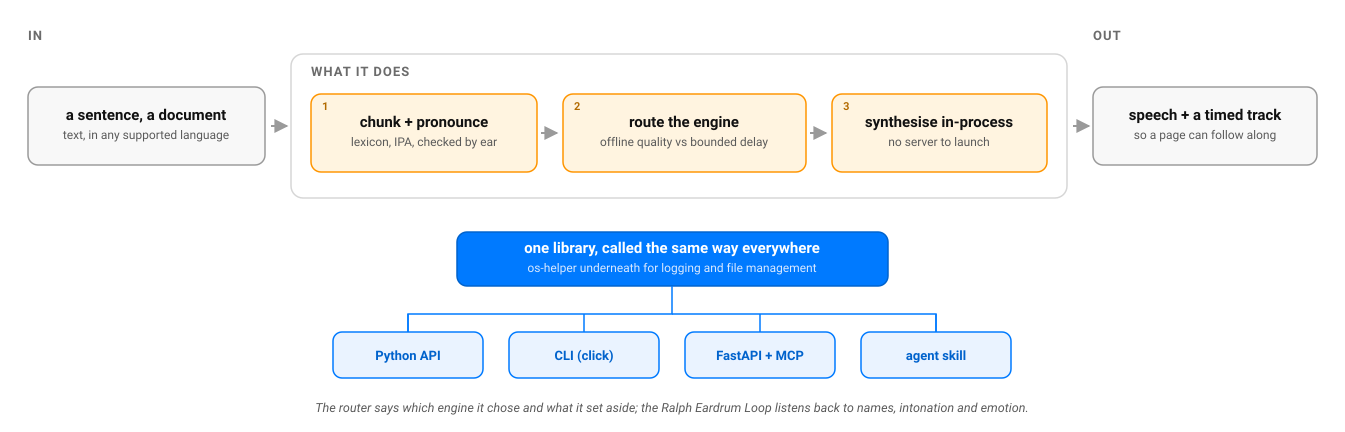
Professional text-to-speech — offline and streaming, with voice cloning and a built-in evaluation gate — synthesised in your own process: no server to start, no port to configure. Kokoro is the default engine, with 54 voices across nine languages.
speaker-helper is the counterpart of
vocal-helper: where vocal-helper turns
speech into text, speaker-helper turns text into speech. It gives you the
same core over four surfaces — a typed Python API, a CLI, a REST API, and a
minimal web GUI — runnable locally (conda + pip) or as a Docker server.
-
Two modes. Offline (whole text → one audio) and streaming (sentence-split, low time-to-first-audio).
-
Automatic engine routing. Tell speaker-helper your condition — online real-time (delay-bounded streaming; speed = real-time factor, must run faster than real time) or offline (batch; quality is the only objective) — and the router picks the best engine + mode from measured quality↔speed evidence, with a number-citing justification. No guessing.
-
The operating matrix decides the engine, not a hard-coded default.
backend: auto(the default) resolves from the mode: offline goes tochatterboxin every language — its Turbo model for English, its 23-language Multilingual model elsewhere — and streaming goes tokokoro, which synthesises faster than real time on CPU (RTF well below 1.0, no GPU). Name a backend explicitly and it is honoured as-is. -
Backend-agnostic, and nothing to launch. The engine is an implementation detail behind a
TTSEngineprotocol, and every local backend runs in this process. Eight ship:kokoro— ONNX Runtime, 54 voices; the streaming default;openvoiceandchatterbox— cloning from a recording. The chatterbox backend auto-picks its Turbo model for English and its 23-language Multilingual model elsewhere;kyutai— native French and English from Kyutai's 1.6B model, voices from a published embedding bank;audio8— Edge0's realism-tuned 0.6B cloner (Apache-2.0, 23 languages) throughmlx-audioon Apple Silicon, always conditioned on a reference recording and its transcript — the bundled female one by default;qwen3tts— Qwen3-TTS 0.6B (Apache-2.0) through the same MLX cloning contract; the closest clone measured here, at the edge of real time;elevenlabs— the paid cloud cells:eleven_v4offline,eleven_v4_turbostreaming, the lexicon sent as inline IPA where v4 reads it. The only backend that sends text off the machine, soautonever picks it; it needsELEVENLABS_API_KEY;mock— deterministic, for tests and CI.
A new backend is one
register_backendcall. -
Voice cloning, everywhere. Point at a recording and speaker-helper clones the voice — in the library, CLI, REST API, and GUI. Missing transcripts are derived automatically with
vocal-helper. -
A pronunciation lexicon, applied by default. State once, in a
lexicon.yaml, how a word is pronounced — exact IPA (spliced verbatim into kokoro's phoneme stream, deterministic) or an orthographic respelling (for engines without phoneme access). An entry with neither gets its respelling derived once by a local LLM (resolved throughbest-engine-ai-helper, served by Ollama) and cached; after that, everything is deterministic and offline. Seelexicon.yaml.example. -
Numbers are said, not guessed. Dates, times, amounts and numbers are spelled out as words before an engine reads them (French and English, deterministic,
speaker_helper.spoken_numbers):14/11becomes a date,9h30a time,3 200 €an amount, while identifiers such as4GorRN7stay as written. A narration's cues keep the page's digits.numbers_to_words: falseinsettings.yamlturns it off. -
Long texts don't degrade. Past ~500 characters,
say()synthesises sentence-group chunks and concatenates them; the local LLM places the cuts at discourse boundaries (it only ever groups locally-split sentences, so the text cannot change), with a deterministic greedy fallback. -
Built-in AI evaluation. A committed dataset, versioned thresholds, and speed/anomaly/fidelity metrics gate quality in CI — no vibe checks. Quality is measured as round-trip intelligibility (text→speech→text WER/chrF).
-
No model download at synthesis time. The default engine's weights are fetched once, ahead of use, by
speaker-helper install-voice— from a pinned release, into a local cache. Nothing is fetched while you are speaking, so an air-gapped box only needs that cache. -
Batteries included. Library, CLI, REST API, web GUI, Docker.
See EXAMPLES.md for a runnable cookbook,
docs/tech-report.en.md for the technical report
(FR),
and LISEZMOI.md for the French
readme.
Documentation
How it fits together
flowchart LR
    text["your text"]:::input
    subgraph SH["speaker-helper — one process, 4 surfaces: API · CLI · REST · GUI"]
        speaker["Speaker<br/>offline · streaming · clone"]:::core
        router["router<br/>condition → engine + mode"]:::core
        eval["evaluation<br/>RTF · anomalies · WER/chrF"]:::eval
        subgraph BE["backends, selected by settings.backend"]
            kokoro["kokoro — streaming default<br/>ONNX Runtime · 54 voices"]:::engine
            clone["openvoice · chatterbox · audio8 · qwen3tts<br/>cloning · chatterbox = offline default"]:::engine
            kyutai["kyutai<br/>native FR+EN · voice bank"]:::engine
            cloud["elevenlabs<br/>cloud · paid · only when named"]:::engine
            mock["mock<br/>deterministic · no model"]:::engine
        end
    end
    weights[("weights cache<br/>~/.cache/speaker-helper")]:::store
    audio["audio<br/>WAV · MP3 · M4A"]:::output

    text --> speaker
    router -.->|picks| speaker
    speaker -- "TTSEngine protocol" --> kokoro
    speaker -- "TTSEngine protocol" --> clone
    speaker -- "TTSEngine protocol" --> kyutai
    speaker -- "TTSEngine protocol" --> cloud
    speaker -- "TTSEngine protocol" --> mock
    weights -.->|loaded once| kokoro
    kokoro --> audio
    clone --> audio
    kyutai --> audio
    cloud --> audio
    mock --> audio
    speaker -.->|measured by| eval
    eval -.->|evidence| router

    classDef input fill:#FFF5CC,stroke:#FFCC00,color:#000000
    classDef core fill:#CCE4FF,stroke:#007AFF,color:#000000
    classDef eval fill:#D4F5D9,stroke:#28CD41,color:#000000
    classDef engine fill:#EFDCF8,stroke:#AF52DE,color:#000000
    classDef store fill:#E8E8ED,stroke:#8E8E93,color:#000000
    classDef output fill:#FFEACC,stroke:#FF9500,color:#000000
speaker-helper talks only to the TTSEngine protocol, so the concrete engine is
swappable: create_engine(settings) looks settings.backend up in a registry
and returns the matching object. All of it runs inside your process — there
is no engine elsewhere, no port, and no connection to fail. The router turns
an operating condition into a concrete engine + mode from measured evidence; the
evaluation layer produces that evidence.
How it works
Installation
Prerequisites — Python 3.10–3.13 and git, libsndfile, ffmpeg, cross-platform. soundfile needs the native libsndfile library, and audio-helper (voice-clone trimming / concatenation) uses ffmpeg:
- 🍎 macOS (Homebrew):
brew install python git libsndfile ffmpeg - 🐧 Ubuntu/Debian:
sudo apt update && sudo apt install -y python3 python3-pip git libsndfile1 ffmpeg - 🪟 Windows (PowerShell):
winget install Python.Python.3.12 Git.Git ffmpeg(libsndfileis bundled with thesoundfilewheel — no separate install).
We recommend using Python environments. Check this link if you're unfamiliar with setting one up: 🥸 Tech tips.
From PyPI
# core
pip install speaker-helper
# with extras (server, and STT for cloning/eval round-trip):
pip install "speaker-helper[server,stt]"
Installing from git still works if you need an unreleased commit:
pip install "git+https://github.com/warith-harchaoui/speaker-helper.git@v0.9.3"
Available extras: server (REST API), stt (vocal-helper), youtube,
podcast, mic (speech-to-speech sources), eval (DeepEval), dev.
Or, for local development (conda + pip):
conda create -n speaker-helper python=3.11 -y
conda activate speaker-helper
pip install -e ".[server]"          # add ",dev" for the test/lint toolchain
pip install -e ".[server,stt]"      # add ",stt" to auto-transcribe clone references
speaker-helper is part of the AI Helpers ecosystem: it installs
os-helper (logging) and
audio-helper (audio
slicing/concatenation) automatically. The optional stt extra adds
vocal-helper for
transcribing voice-clone references and the evaluation round-trip.
The default voice (Kokoro)
There is no engine to start. kokoro runs in the same process as your code, so
the two things it needs are a package and a file:
pip install "speaker-helper[kokoro]"   # ONNX Runtime + the phonemiser
speaker-helper install-voice           # ~340 MB of weights, fetched once
speaker-helper health                  # says whether it could synthesise now
espeak-ngdoes the phonemisation. Prefer the system package —brew install espeak-ngon macOS,sudo apt install espeak-ngon Debian/Ubuntu. The copy bundled in theespeakng-loaderwheel looks for its data in the home directory of the machine that built it and, when it does not find it, callsexit(1)from C: no traceback, no catching it.- The weights (~340 MB: an ONNX graph and a voice bank) are pulled once from
a pinned
kokoro-onnxrelease into~/.cache/speaker-helper/kokoro.install-voicechecks the exact sizes, so a truncated download is repaired instead of being mistaken for an install. - Speed, measured on this machine (Apple M2 Max, warmed, zero anomalies):
mean real-time factor 0.22 in French, 0.24 in English, 0.21 in
Spanish — four to five times faster than real time on the CPU, no GPU
involved. See
BENCHMARKS.md.
The cloning backends are separate installs, because both pull torch and reading
a page aloud should not require a deep-learning stack:
pip install "speaker-helper[chatterbox]" (or [openvoice]).
Self-hosted engines (no Hugging Face)
The default engine never touches Hugging Face. Its two files come from a pinned
GitHub release and then live in a local cache, and nothing is fetched while
synthesis is running — so air-gapping kokoro means having that cache, and
nothing else:
speaker-helper install-voice            # on a machine with a network
# -> ~/.cache/speaker-helper/kokoro/{kokoro-v1.0.onnx,voices-v1.0.bin}
Copy that directory to the closed machine (or mount it) and speaker-helper health reports status: ok with no network at all. A second location,
~/.cache/sprezzature-skill/kokoro, is read as well, so a machine that already
downloaded the same two files for that suite is not asked for 340 MB twice.
The cloning backends are the ones that still reach out: chatterbox fetches
its own checkpoints on first use, and openvoice wants the checkpoints MyShell
publishes. speaker-helper install-voice --engine openvoice says so rather than
pretending it can do it for you.
Quick start
Python
from speaker_helper import Speaker, Settings

spk = Speaker(Settings.from_mapping({"backend": "kokoro", "language": "fr"}))
result = spk.save("Bonjour le monde.", "hello.wav")
print(f"{result.duration_s:.2f}s audio, RTF {result.rtf:.2f}")
# 1.19s audio, RTF 4.42      <- first call: the ONNX session is built here
# 1.19s audio, RTF 0.31      <- every call after it
The first synthesis loads the model, so its real-time factor measures the
load, not the engine. Speaker.warmup() moves that cost to where you want it
— which is why the evaluation gate warms up before it times anything.
CLI
speaker-helper is one click group, and
-h / -V both answer. Global options are declared on the group, so they
precede the sub-command: speaker-helper --backend mock synth …,
speaker-helper --engine kokoro voices.
speaker-helper --engine kokoro voices
speaker-helper synth "Bonjour le monde." -o hello.wav
speaker-helper synth "Une. Deux. Trois." -o out.wav --stream
speaker-helper --language fr route --condition online_realtime    # pick an engine
speaker-helper --backend mock eval               # gate quality (no engine needed)
speaker-helper --clone synth "Bonjour." -o cloned.wav
REST API server
speaker-helper serve --bind-host 0.0.0.0 --bind-port 8080
curl -s -X POST localhost:8080/synth -H 'content-type: application/json' \
     -d '{"text": "Bonjour."}' -o out.wav
# streaming (Server-Sent Events, one JSON chunk per sentence):
curl -N -X POST localhost:8080/synth/stream -H 'content-type: application/json' \
     -d '{"text": "Une. Deux. Trois."}'
The server also:
- serves a minimal web GUI at
/(a dependency-free vanilla-JS + Tailwind page for synth, streaming, voices, cloning, and the router) — just openhttp://localhost:8080/; - exposes
POST /route(the engine router) alongside/synth,/synth/stream,/voices, and/clone.
Or with Docker — the engine runs inside the container, so there is nothing on the host for it to find:
docker compose up --build # speaker-helper API on :8080
Choosing an engine (the router)
The evaluation layer measures quality and speed; the router acts on that evidence. You state an operating condition and it returns a concrete engine
- mode, justified by the numbers — never a guess.
online_realtime— delay-bounded streaming. Speed is the real-time factor (RTF): the engine must synthesise faster than real time (RTF < 1), with a margin for time-to-first-audio and jitter (ceiling0.8). Among the engines that keep up, the router maximises quality on the quality↔RTF Pareto front, and selects streaming with low-TTFA knobs.offline— batch. There is no real-time constraint, so quality is the only objective: the highest-quality engine wins, speed disregarded.
The two conditions rank quality on different criteria, and every decision reports which one it used (quality_source, rtf_source) — provenance, not a derived grade.
online_realtimereads the public arena Elo (public_elo): human pairwise votes. An engine listed on no public arena scores0.0withno_public_elo, rather than inheriting a flattering prior.offlinereads the owner-ratified per-language priors (prior) — or a measurement where one exists: kokoro's UTMOSv2 score (measured_mos), or the round-trip chrF of your own evaluation reports (measured_chrf) when you pass them in.
from speaker_helper import route, RouteRequest, Speaker

decision = route(RouteRequest(condition="online_realtime", language="fr"))
print(decision.engine, decision.mode, decision.quality_source)
print(decision.justification)

# or build a Speaker straight from a routed operating point:
spk = Speaker.from_route("offline", language="fr")
speaker-helper --language fr route --condition online_realtime
speaker-helper route --condition offline --json decision.json
New engines are characterised in the companion study (measured RTF / MOS / speaker-similarity) and folded back here as data — the toolbox routes, the study measures.
Voice cloning
Point at a recording and speaker-helper clones the voice — in the library, CLI,
and REST API. If you do not supply a transcript of the reference, it is derived
automatically with vocal-helper (install
the stt extra). A ready-to-use reference — a French female voice from the
CML-TTS dataset (CC BY 4.0, see assets/ref-fr-female.NOTICE.md) — ships as
assets/ref-fr-female.wav and is the default.
from speaker_helper import Speaker, Settings, VoiceSample

# `backend` is what selects the engine; `engine` is only a label on results.
spk = Speaker(Settings.from_mapping({"backend": "chatterbox"}))
# give only the audio — the transcript is transcribed and aligned for you:
await spk.clone_voice("my-voice", [VoiceSample("my_voice.wav", "")])
result = await spk.say("Maintenant je parle avec la voix clonée.")
speaker-helper clone                       # clone the bundled reference, print id
speaker-helper --clone-audio my_voice.wav synth "Bonjour." -o out.wav
Reference audio longer than the cloning engines' limit (30 s is the common
ceiling, so speaker-helper trims to 28 s) is cut automatically (via
audio-helper) and re-transcribed, so
audio and text stay aligned. kokoro does not clone at all and says so, naming
the two backends that do, rather than raising a bare NotImplementedError.
Speech-to-speech (re-voicing)
Bring audio in from the AI Helpers source packages and re-voice it — transcribed
with vocal-helper and spoken back
(optionally in a cloned voice or another language):
import asyncio
from speaker_helper import Speaker, Settings
from speaker_helper.sources import from_youtube, revoice

async def main() -> None:
    src = from_youtube("https://youtu.be/…")                 # extra: youtube
    async with Speaker(Settings.from_mapping({"language": "fr"})) as spk:
        out = await revoice(src, spk)                        # transcribe + re-speak
    open("revoiced.wav", "wb").write(out.wav_bytes)

asyncio.run(main())
speaker-helper speak-from --source youtube --url https://youtu.be/… -o out.wav
speaker-helper speak-from --source podcast --url https://feed/rss   -o out.wav
speaker-helper --clone speak-from --source mic --seconds 5          -o out.wav
Sources are optional extras: youtube (youtube-helper), podcast
(podcast-helper), mic (capture-helper).
Evaluation (no vibe checks)
Quality is gated, not guessed. speaker-helper eval runs the engine over a
committed dataset and checks versioned thresholds — synthesis faster than real
time, zero audio anomalies (empty / clipped / aberrant duration), and,
with an STT transcriber wired in, a WER/chrF round-trip. It exits non-zero
when the bar is missed, so it gates CI.
speaker-helper --backend mock eval                 # deterministic, no model
# backend=mock engine=auto cases=12
# mean_rtf=0.3 p95_rtf=0.3 anomaly_rate=0.0 quality=1.0 (prior)
# PASS

speaker-helper eval --languages fr,en,es --json report.json    # the real engine
# lang   cases  mean_rtf  p95_rtf  anomaly  quality  verdict
# fr        12     0.223    0.261    0.000    0.750  PASS
# en        10     0.237    0.299    0.000    0.750  PASS
# es        10     0.206    0.230    0.000    0.750  PASS
--languages warms the engine up per language before timing, which is what you
want from a benchmark. A single-language eval does not, so on a cold process
its first case carries the model load and its p95 reports that instead of the
engine.
The evaluation targets the engine-agnostic Speaker, so the same gate grades
the mock backend in CI or a real engine locally — only --backend differs.
For teams standardising on a framework, the eval extra adds a
DeepEval binding
(RealTimeFactorMetric, AudioIntegrityMetric, and RoundTripIdempotenceMetric
— the text→speech→text chrF check) that reports the same measurements as DeepEval
custom metrics — deterministic and offline.
Configuration
Copy settings.yaml.example to settings.yaml (it is
gitignored) or use speaker_config.json.example
as a reference. Seven keys can also be overridden from the environment:
SPEAKER_HELPER_BACKEND, _ENGINE, _VOICE, _VOICE_SAMPLE, _VOICE_ID,
_LANGUAGE and _LEXICON (the MCP server reads SPEAKER_HELPER_MCP_HOST /
_PORT); ${VAR} references inside the YAML are expanded from the environment.
Development
pip install -e ".[dev,server]"
pytest -q -m "not slow"       # fast, deterministic suite (no engine needed)
pytest -q --cov=speaker_helper --cov-report=term-missing   # with coverage
pytest -m slow                # the real-time-factor benchmark; quiet machine only
ruff check speaker_helper tests && ruff format --check speaker_helper tests
speaker-helper --backend mock eval    # run the evaluation gate locally
CI runs ruff (lint + format) and the coverage-gated fast suite (--cov-fail-under=70)
on Python 3.10–3.13; a failing check blocks merges. The fast suite drives the
deterministic mock backend, so it needs no engine.
Author
Acknowledgements
Special thanks to the contributors, reviewers, and users who helped improve
this project — and to the authors of the pieces the default voice is made of:
Kokoro (hexgrad) for the model,
kokoro-onnx for the ONNX
export and the published weights, and
espeak-ng for the phonemisation.
License
BSD-3-Clause © Warith HARCHAOUI.
1 maintainer

Metadata
1 maintainer
Release files for speaker-helper 0.15.4
For a detailed explanation of source distributions (sdists) and built distributions (wheels), please see the package formats documentation.
Source distribution (sdist)
| File | Size | Uploaded | Provenance | Actions |
|---|---|---|---|---|
| speaker_helper-0.15.4.tar.gz | 258.0 kB | Without provenance | Details for speaker_helper-0.15.4.tar.gz |
Built distribution (wheel)
| File | Interpreter | ABI | Platform | Actions Reset |
|---|---|---|---|---|
| speaker_helper-0.15.4-py3-none-any.whl | Python 3 | none | any | Details for speaker_helper-0.15.4-py3-none-any.whl |
Total release size: 469.7 kB
Release files / speaker_helper-0.15.4.tar.gz
| Download URL | speaker_helper-0.15.4.tar.gz |
|---|---|
| Size | 258.0 kB |
| Tags | Source |
|
SHA-256 checksum How to use checksums |
7b770262e909d93a0a10b9e5293289bee6a43275daf484f2eff3ba39a314b6c0
|
|
BLAKE2b-256 checksum How to use checksums |
ae031fe3127031e3841afcbde4c14a7958e6004245e71f6bdb7392ad6c85d17c
|
| Upload date | |
|
Uploaded using Trusted Publishing? What is trusted publishing? |
No |
| Uploaded via |
twine/7.0.0 CPython/3.13.13
|
Release files / speaker_helper-0.15.4-py3-none-any.whl
| Download URL | speaker_helper-0.15.4-py3-none-any.whl |
|---|---|
| Size | 211.7 kB |
| Tags | Python 3 |
|
SHA-256 checksum How to use checksums |
b7acc63505bc205729b7fe6f5487cd75775caf6cee93f18fab8ca612794067ec
|
|
BLAKE2b-256 checksum How to use checksums |
84a06f18e0209976020bb4b85a18b9fa3554aa23a3475009c31da65b277faa6f
|
| Upload date | |
|
Uploaded using Trusted Publishing? What is trusted publishing? |
No |
| Uploaded via |
twine/7.0.0 CPython/3.13.13
|
Security for speaker-helper 0.15.4
Provenance
Provenance describes where a file came from. On PyPI, provenance is shared via attestations, which provide a verifiable record of the build or publishing details. View details, limitations and caveats.
No provenance found
None of the files in this release were uploaded with provenance metadata.
A note on package security
PyPI is a repository for distributing packages, not a service for auditing them. While third-party security researchers and our staff do their best to detect and remove malicious packages, PyPI cannot guarantee the quality, security or suitability of any given package.
To learn more about protecting yourself from malicious actors, visit our package security documentation.














