
specsrbench







Benchmarking deep learning against classical deconvolution for galaxy spectral super-resolution.
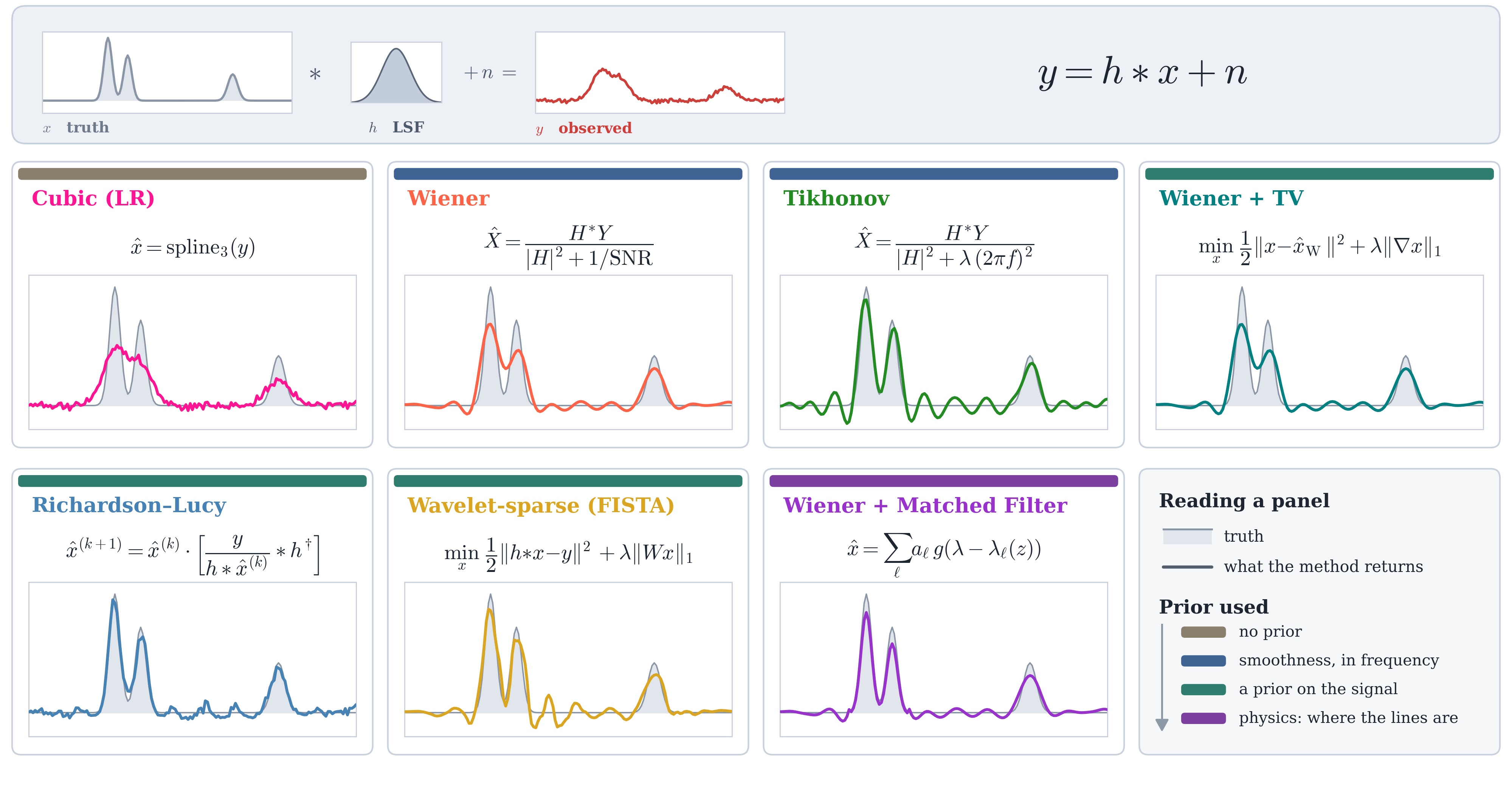
Every method in the benchmark, on a 1-D toy where the truth is known: a close
doublet the instrument blends into one blob, and a weak isolated line. Drawn by
scripts/make_classical_toy_figure.py using the same deconvolvers the
benchmark runs.
Seven classical deconvolution methods — cubic interpolation, Wiener, Tikhonov, Wiener + total variation, Richardson–Lucy, wavelet-sparse FISTA, and a redshift-informed matched filter — scored against the SR2 deep-learning pipeline of Haghjoo et al. 2026 on JWST/NIRSpec prism spectra from JADES.
The deep-learning side is a separate package,
specsr, whose weights live
on the Hub. This package holds
the classical baselines, the metrics, the tuning, and the figures.
Install
pip install specsrbench          # the baselines and the figures
pip install 'specsrbench[all]'   # + the ML arm and the LSF derivation
Or from source, for development:
git clone https://github.com/aryana-haghjoo/specsr-benchmark
cd specsr-benchmark
pip install -e '.[dev]'
[ml] pulls in torch and specsr (needed by build predictions and by
figure 1's toy CNN); [lsf] pulls in astropy (needed only to re-derive the
instrument LSF). Neither is required to draw the other five figures.
What it is for
The short version of the result: on this data, at the pixel level, no method beats cubic interpolation.
SR2 leads the raw mean-absolute-error table by 30%, and does it by producing a spectrum at 0.54 of the reference's amplitude — absolute error against a noisy reference falls when you shrink toward zero, whatever the reconstruction quality. On a scale-free metric all eight methods land within 1.2% of each other and SR2 ranks seventh of eight. What does survive is sharper and more interesting than a leaderboard: SR2 exceeds the reference's own line signal to noise on all four diagnostic lines while recovering only 36–53% of true line amplitudes, at false-detection rates of 0.30 (Hβ) and 0.44 ([O II]) against ≤ 0.09 for any classical method.
Line flux ratios fare no better. Measured from integrated Gaussian fluxes, with Hβ and [O III] fitted jointly, no method improves on the interpolated prism spectrum; SR2's ratios are unbiased in the median but scatter about twice as widely as the reference's.
Getting there took four separate metric traps, each of which had to be closed
before the benchmark meant anything. They are documented in
docs/GUARDS.md, and they are the part of this repository
most likely to be useful to someone benchmarking something else.
Start here: the tutorial
If you want to see what this does before installing survey data, run the notebook. It needs no JADES tree, no GPU and no configuration — 24 held-out spectra download from the Hub on first use and everything after that is numpy and scipy.
pip install specsrbench          # enough: fetching the sample is built in
jupyter lab tutorials_for_user/01_quickstart.ipynb
It runs all six classical deconvolvers at the tuned parameters, scores them
against the grating reference alongside the deep-learning prediction, and then
demonstrates live why the obvious metric reverses the result — see
tutorials_for_user/.
from specsrbench.sample import load_sample

s = load_sample()          # 1.9 MB, cached after the first call
recon = s.reconstruct()    # all six classical methods, a few seconds
Quick start
specsrbench paths           # where it will look for inputs
specsrbench figures all     # rebuild all six paper figures
specsrbench figures 4       # or just one
The figures read a cache of derived arrays. If you do not have one, build it (next section) or point at one you do have:
export SPECSRBENCH_CACHE=/path/to/cache_logR_tuned
| figure | what it shows | command |
|---|---|---|
| 1 | every method on a 1D toy where truth is known | specsrbench figures toy |
| 2 | one held-out galaxy, all methods, [O III] inset | specsrbench figures qualitative |
| 3 | residual maps over all 572 spectra vs redshift | specsrbench figures residuals |
| 4 | global fidelity: MAE, uncertainty-normalised, RMSE | specsrbench figures mae |
| 5 | per-line S/N, detection, false detection, width bias | specsrbench figures per-line-snr |
| 6 | error against redshift, in equal-count bins | specsrbench figures redshift |
Figure 1 trains a small CNN inline and needs specsrbench[ml]; the other five
are pure numpy and matplotlib.
Rebuilding everything from the data
No large files are distributed with this package. The chain runs from the raw JADES DR4 products and the published model weights, in six stages:
specsrbench build predictions   # specsr chain over the held-out split (Hub weights)
specsrbench build sets          # eval / tune / calib sets, galaxy-disjoint
specsrbench build lsf --jades-root <JADES DR4>   # measure the instrument LSF
specsrbench build tune          # search the classical parameters under four guards
specsrbench build classical     # the classical reconstructions
specsrbench build lines         # Gaussian line fits, S/N, line fluxes, the summary table
specsrbench build all runs them in order. --dry-run on any stage prints
what it would read and write without doing it.
What each stage needs:
| stage | needs | why |
|---|---|---|
predictions |
specsr, torch, network |
runs SR1 → ZHead → SR2, weights from the Hub |
sets |
the paired dataset | draws the three galaxy-disjoint sets |
lsf |
raw JADES DR4, astropy |
measures the prism→grating kernel |
tune, classical, lines |
nothing beyond the above | pure numpy/scipy |
The paired dataset (3.5 GB) is built by specsr from the JADES tree and is not
redistributable here:
specsr build --jades-root <JADES DR4 tree> --out paired_DR4_logR.npz
The one thing to get right
Match the checkpoint to the wavelength grid by reading its provenance, never
by its filename. More than one file called best_sr2.pth exists, trained on
different grids. Loading the wrong one does not fail — it produces plausible
spectra that are wrong. specsrbench build predictions pins the Hub revision
and records what it loaded in the output's provenance field.
Why the LSF is measured and not read
The evaluation products carry a sigma_pix array that was widely used as the
deconvolution kernel and does not describe the data: it is roughly constant
in nanometres, where a spectrograph's line-spread function is fixed in detector
pixels. Measured against the paired spectra it is up to 2.3× too broad at
5 µm. With it, Wiener, Tikhonov and TV merge line pairs that their own input
still resolves.
specsrbench build lsf measures the real one from the instrument: the prism
dispersion from the raw x1d products, the effective kernel width from
σ_eff² = σ_LR² − σ_HR² on fits to the four diagnostic lines, and the ratio of
the two. It comes out constant to a few per cent across a factor of three in
wavelength, which is the check that it is an instrumental LSF and not a curve
fitted to noise. The sets this package builds deliberately do not carry a
sigma_pix, so the kernel can only come from measuring it.
Tuning is guarded, in four ways
Mean absolute error is not a safe objective, and no single guard catches what the others do:
| trap | what it rewards | guard |
|---|---|---|
| smoothing | erasing every line incurs no line-shaped residual | median line S/N ≥ 0.9 × no-deconvolution baseline |
| shrinkage | scaling toward zero lowers error against a noisy reference | output std within [0.90, 1.15] of the target's |
| blurring | a unit-gain Wiener filter with snr ≤ 1 can only broaden | median FWHM bias ≤ the baseline's |
| merging | two close lines smeared into one peak look like one good line | resolvable [O III] pairs kept resolved ≥ baseline |
Each is blind to the others: line S/N is amplitude over sideband noise, so a global rescale leaves it unchanged; the amplitude guard is width-invariant; and all three of those are single-line statistics, so a Gaussian fitted to a blended doublet passes them. The fourth is measured on real spectra — a synthetic pair was tried and discarded as far too easy to hold apart.
specsrbench build tune applies all four inside the search, and
tests/test_invariants.py asserts them against whatever cache is present. A
method is allowed to fail guard 4 only if classical_params.json records that
no setting passes it; that is Tikhonov's case, and the paper says so.
Tests
pytest                    # the full suite
pytest -m "not slow"      # skip the end-to-end figure builds
The suite runs without any data — tests that need a cache skip cleanly. With one present it checks the cache's structural invariants, the four guards, and rebuilds a slice of each classical cache from the recorded parameters to confirm it reproduces.
Layout
src/specsrbench/
  paths.py      where inputs and outputs are found
  methods.py    the eight methods and the reference, their names and cache keys
  metrics.py    MAE, scale-free MAE, amplitude ratio, the guards
  classical.py  the seven classical deconvolvers, on the log R=4000 grid
  data.py       the cache loader every figure shares
  figures/      one module per paper figure
  build/        the six pipeline stages
  sample.py     the 24-spectrum tutorial sample, fetched from the Hub
scripts/        talk figures, which are not paper figures
tutorials_for_user/  the tutorial notebook
tests/
figures/        where `specsrbench figures all` writes its PDFs
Documentation
Full documentation, including the API reference, is at https://aryana-haghjoo.github.io/specsr-benchmark/, and the tutorial has its own page.
The tutorial sample is hosted separately, on the Hub: https://huggingface.co/datasets/aryana-haghjoo/specsr-benchmark.
Citing
Paper 2 is in preparation. Until it appears, cite the archived software release and Haghjoo et al. 2026 for the models.
Every release is archived on Zenodo:
- 10.5281/zenodo.22104971 — cite this one unless you need a specific version. It is the concept DOI and always resolves to the latest release.
- 10.5281/zenodo.22105099 — v0.1.1 specifically, for when the exact version matters (a result you are reproducing, say).
CITATION.cff carries the machine-readable metadata; GitHub's "Cite this
repository" button reads it.
License
MIT. See LICENSE.
1 maintainer

Metadata
1 maintainer
Release files for specsrbench 0.2.1
For a detailed explanation of source distributions (sdists) and built distributions (wheels), please see the package formats documentation.
Source distribution (sdist)
| File | Size | Uploaded | Provenance | Actions |
|---|---|---|---|---|
| specsrbench-0.2.1.tar.gz | 841.3 kB | With provenance | Details for specsrbench-0.2.1.tar.gz |
Built distribution (wheel)
| File | Interpreter | ABI | Platform | Actions Reset |
|---|---|---|---|---|
| specsrbench-0.2.1-py3-none-any.whl | Python 3 | none | any | Details for specsrbench-0.2.1-py3-none-any.whl |
Total release size: 926.8 kB
Release files / specsrbench-0.2.1.tar.gz
| Download URL | specsrbench-0.2.1.tar.gz |
|---|---|
| Size | 841.3 kB |
| Tags | Source |
|
SHA-256 checksum How to use checksums |
1955dd0cd85fd1d196250247bf5d6c2b5aaec7359e5f33f36eb3edf470fa5819
|
|
BLAKE2b-256 checksum How to use checksums |
af8ef878b51b0288d9631f4a19288a5f29a96ab4ac06e2ee4c5000c4b80581a3
|
| Upload date | |
|
Uploaded using Trusted Publishing? What is trusted publishing? |
Yes |
| Uploaded via |
twine/7.0.0 CPython/3.13.14
|
Provenance
Provenance describes where a file came from. On PyPI, provenance is shared via attestations, which provide a verifiable record of the build or publishing details. View details, limitations and caveats.


PyPI Publish Attestation
PyPI verified that this artifact, at this checksum, originated from the publisher listed below.
Signed by GitHub Actions, verified by PyPI on Oct 7, 2026.
Transparency logRelease files / specsrbench-0.2.1-py3-none-any.whl
| Download URL | specsrbench-0.2.1-py3-none-any.whl |
|---|---|
| Size | 85.5 kB |
| Tags | Python 3 |
|
SHA-256 checksum How to use checksums |
3f751c69056ef0704bea994b78c2f3cbfa1676414dada27de3313dc4139af8a3
|
|
BLAKE2b-256 checksum How to use checksums |
55f60625f3c7e5bde55d95fcef111096e52cab525e44228ef489af4726777302
|
| Upload date | |
|
Uploaded using Trusted Publishing? What is trusted publishing? |
Yes |
| Uploaded via |
twine/7.0.0 CPython/3.13.14
|
Provenance
Provenance describes where a file came from. On PyPI, provenance is shared via attestations, which provide a verifiable record of the build or publishing details. View details, limitations and caveats.
PyPI Publish Attestation
PyPI verified that this artifact, at this checksum, originated from the publisher listed below.
Signed by GitHub Actions, verified by PyPI on Oct 7, 2026.
Transparency logSecurity for specsrbench 0.2.1
Provenance
Provenance describes where a file came from. On PyPI, provenance is shared via attestations, which provide a verifiable record of the build or publishing details. View details, limitations and caveats.
Full provenance
All 2 files in this release have been uploaded with provenance metadata.
Attestation for specsrbench-0.2.1.tar.gz
PyPI Publish Attestation
PyPI verified that this artifact, at this checksum, originated from the publisher listed below.
Signed by GitHub Actions, verified by PyPI on Oct 7, 2026.
Transparency logA note on package security
PyPI is a repository for distributing packages, not a service for auditing them. While third-party security researchers and our staff do their best to detect and remove malicious packages, PyPI cannot guarantee the quality, security or suitability of any given package.
To learn more about protecting yourself from malicious actors, visit our package security documentation.














