
Spectrometer reading plugin
Records spectrometer readings from the Adafruit AS7341 spectrometer sensor attached to your Pioreactor.
Available wavelengths:
415nm445nm480nm515nm555nm590nm630nm680nm


This plugin also installs a SQL table, as7341_spectrum_readings, that will store the readings.
Charts
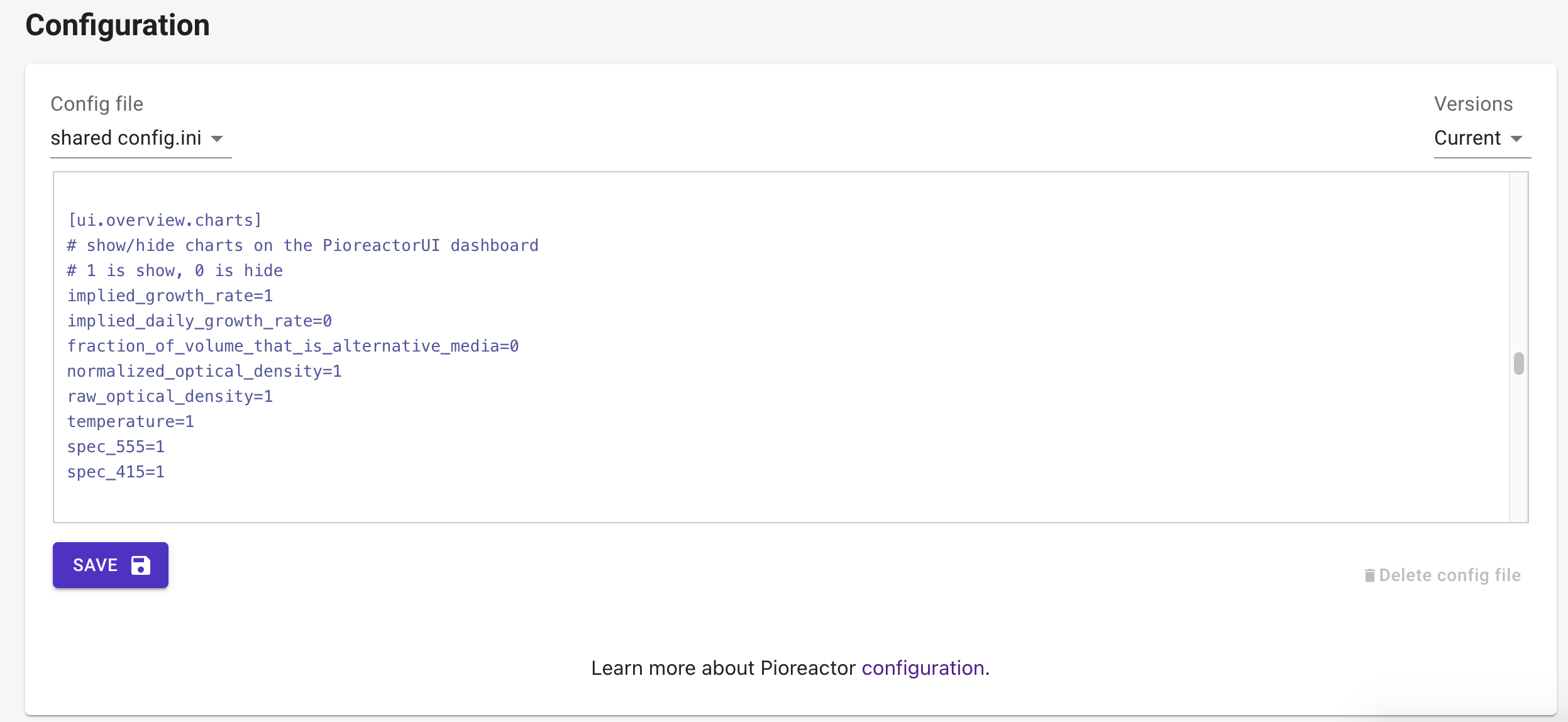
After installation, you can add specific bands as charts. Add spec_415=1, or whatever band(s) you want, to the [ui.overview.charts] section, ex:
Hardware installation
See notes here.
How it works
- In between optical density recordings, the white-light LED on the AS7341 board turns on, and all other LEDs from the Pioreactor's LED channels turn off.
- The light is reflected back towards the board, with some wavelengths being absorbed by the culture.
- All sensors for each wavelength are recorded to MQTT and the SQLite3 database (see below)
- The onboard LED is turned off.
If od_reading is not running, this job samples continuously at the same rate as [od_reading.config].samples_per_second. When od_reading starts, the job switches to dodging mode automatically.
Each wavelength is sent to MQTT under the topics:
pioreactor/<unit>/<experiment>/spectrometer_reading/band_<xxx>
And it is also placed in the SQL table as7341_spectrum_readings.
Using a different LED
You can provide a 5mm LED instead of using the onboard one. We suggest using the following config to accomplish this:
led_current_mA=0
turn_off_leds_during_reading=0
Hardware requirements
- Requires the Adafruit board AS7341 and a StemmaQT 4pin cable.
Vendored dependency
This plugin vendors Adafruit's adafruit_as7341.py module in spectrometer_reading_plugin/_vendor/.
License and provenance are included in:
spectrometer_reading_plugin/_vendor/LICENSE_adafruit_as7341.txtspectrometer_reading_plugin/_vendor/NOTICE_adafruit_as7341.txt
1 maintainer

Metadata
1 maintainer
Release files for spectrometer-reading-plugin 0.4.0
For a detailed explanation of source distributions (sdists) and built distributions (wheels), please see the package formats documentation.
Source distribution (sdist)
| File | Size | Uploaded | Provenance | Actions |
|---|---|---|---|---|
| spectrometer_reading_plugin-0.4.0.tar.gz | 17.7 kB | Without provenance | Details for spectrometer_reading_plugin-0.4.0.tar.gz |
Built distribution (wheel)
| File | Interpreter | ABI | Platform | Actions Reset |
|---|---|---|---|---|
| spectrometer_reading_plugin-0.4.0-py3-none-any.whl | Python 3 | none | any | Details for spectrometer_reading_plugin-0.4.0-py3-none-any.whl |
Total release size: 41.7 kB
Release files / spectrometer_reading_plugin-0.4.0.tar.gz
| Download URL | spectrometer_reading_plugin-0.4.0.tar.gz |
|---|---|
| Size | 17.7 kB |
| Tags | Source |
|
SHA-256 checksum How to use checksums |
53ed38a4a000234923f0b6d1d3aba3d8c13c96850d966975b3c629d470462ccc
|
|
BLAKE2b-256 checksum How to use checksums |
ecd1babb0008521f11beb58dc6262a8b8bee3e1fb1799ba5af3142c3b5480d00
|
| Upload date | |
|
Uploaded using Trusted Publishing? What is trusted publishing? |
No |
| Uploaded via |
twine/7.0.0 CPython/3.14.5
|
Release files / spectrometer_reading_plugin-0.4.0-py3-none-any.whl
| Download URL | spectrometer_reading_plugin-0.4.0-py3-none-any.whl |
|---|---|
| Size | 23.9 kB |
| Tags | Python 3 |
|
SHA-256 checksum How to use checksums |
31e3f0c076fefd2a31fac69ed8b9bff341ab14130968c0a0a7db789b446237f2
|
|
BLAKE2b-256 checksum How to use checksums |
3af1e51320c3bf7b55d81c79f3621da78b8aefba9b09dc7c2240e8cb514de461
|
| Upload date | |
|
Uploaded using Trusted Publishing? What is trusted publishing? |
No |
| Uploaded via |
twine/7.0.0 CPython/3.14.5
|
Security for spectrometer-reading-plugin 0.4.0
Provenance
Provenance describes where a file came from. On PyPI, provenance is shared via attestations, which provide a verifiable record of the build or publishing details. View details, limitations and caveats.
No provenance found
None of the files in this release were uploaded with provenance metadata.
A note on package security
PyPI is a repository for distributing packages, not a service for auditing them. While third-party security researchers and our staff do their best to detect and remove malicious packages, PyPI cannot guarantee the quality, security or suitability of any given package.
To learn more about protecting yourself from malicious actors, visit our package security documentation.














