
Calculation of lunar data using NASA's SPICE toolkit

Project description




spicedmoon
Calculation of lunar data using NASA's SPICE toolkit.
About the project
spicedmoon is a Python toolkit built on top of SPICE (Acton, 1996),
through spiceypy (Annex et Al. 2020) for computing high-precision
lunar observational geometry.
It provides a high-level interface for the retrieval of selenographic coordinates, Sun-Moon-observer geometry,
lunar phase angle and sign, azimuth & zenith, and more, from arbitrary observer locations on Earth or the Moon.
The library offers two complementary computation methodologies:
1. Custom-Body Method (Custom Kernel Based)
This method reproduces the workflow used in classic C/SPICE pipelines:
a temporary SPK and frame kernel is generated for the observer, which becomes a synthetic SPICE "body".
Geometry is then computed using NAIF high-level routines like subpnt (INTERCEPT/ELLIPSOID), subslr, spkezr,
orpxform, and local-level frames.
This method uses fully SPICE-native geometry, but needs to generate temporary kernel files for the custom body, or use pre-existing ones.
2. Direct Geometry Method (No Custom Kernels)
A lightweight alternative that computes geometry via pure vector mathematics:
SPK ephemerides are don via spkpos, and frame transformations via pxform, but ellipsoid intersections
are done analytically and lunar phase is computed from vector angles. This methodology
works without temporary observer kernels.
This method yields results very similar to method 1's ones, and fits better in environments where generating kernel files is undesirable.
Getting started
Prerequisites
- python>=3.7
Kernels
In order to use the package, a directory with all the kernels must be downloaded.
That directory must contain the following kernels:
- https://naif.jpl.nasa.gov/pub/naif/JUNO/kernels/spk/de421.bsp
- https://naif.jpl.nasa.gov/pub/naif/pds/wgc/kernels/pck/earth_070425_370426_predict.bpc
- https://naif.jpl.nasa.gov/pub/naif/generic_kernels/fk/planets/earth_assoc_itrf93.tf
- https://naif.jpl.nasa.gov/pub/naif/generic_kernels/pck/earth_latest_high_prec.bpc
- https://naif.jpl.nasa.gov/pub/naif/generic_kernels/fk/satellites/moon_080317.tf
- https://naif.jpl.nasa.gov/pub/naif/generic_kernels/pck/moon_pa_de421_1900-2050.bpc
- https://naif.jpl.nasa.gov/pub/naif/generic_kernels/lsk/naif0011.tls
- https://naif.jpl.nasa.gov/pub/naif/generic_kernels/pck/pck00010.tpc
Installation
You can install spicedmoon either from the source directory (for development) or directly from PyPI.
From source (editable mode):
pip install -e .
From PyPI (recommended):
pip install spicedmoon
Usage
spicedmoon exposes several high-level functions grouped into two computation
methodologies: the Direct Geometry Method (no custom kernels) and the
Custom-Body Method (kernel-based). Both approaches compute lunar geometry,
but differ in how observer locations are represented.
Below you will find the recommended functions, organized by methodology.
1. Direct Geometry Method (No Custom Kernels)
These functions compute all geometry analytically, without generating observer kernels. They are lightweight, fast, and ideal for simulation or scripting environments.
1.1 get_moon_datas_llhs
Computes lunar geometry from planetographic coordinates (latitude, longitude, height) in degrees and km.
Example
from spicedmoon import get_moon_datas_llhs

llhs = [(40.0, -3.5, 0.7)]        # (lat, lon, height_km)
times = ["2025-01-10 00:00:00"]
kernels_path = "/path/to/kernels"

md = get_moon_datas_llhs(llhs, times, kernels_path)[0]

print(md.lon_obs, md.lat_obs) # Observer's selenographic longitude and latitude in degrees
# 1.4414527418916223 -5.396883424855335
print(md.azimuth, md.zenith) # Azimuth and zenith of the target in degrees. Az is measured from North towards East.
# 265.02364998605594 45.359639487448284
print(md.mpa_deg)  # signed moon phase angle in degrees
# -51.31044215492803
1.2 get_moon_datas_xyzs
Same as above, but receives rectangular coordinates in the chosen source frame.
Useful when your application already works with Earth-fixed or inertial positions.
Example
from spicedmoon import get_moon_datas_xyzs

xyz = [(4510.0, 3480.0, 4060.0)]     # km, in source frame (default: J2000)
times = ["2025-01-10 00:00:00"]
kernels_path = "/path/to/kernels"

md = get_moon_datas_xyzs(xyz, times, kernels_path)[0]
print(md.lon_obs, md.lat_obs) # Observer's selenographic longitude and latitude in degrees
# 2.321034649559275 -5.3589043558009095
print(md.lon_sun_rad, md.lat_sun_rad) # Sun's selenographic longitude and latitude in radians
# 0.9199491298659819 -0.02542042276583308
print(md.mpa_deg)  # signed moon phase angle in degrees
# -50.433894317010626
2. Custom-Body Method (Kernel-Based)
This method creates a temporary SPK + frame kernel for each observer, reproducing
the classic C/SPICE workflow used by NAIF.
Use this method when absolute consistency with SPICE’s own geometry routines is required
(e.g., comparing with legacy C pipelines).
2.1 get_moon_datas
Computes lunar geometry by:
- Creating a custom observer body,
- Generating an SPK for that body,
- Loading it into SPICE,
- Using high-level routines like
subpnt,subslr,spkezr, andpxform.
Example
from spicedmoon import get_moon_datas

lat = 40.0
lon = -3.5
alt_m = 700     # altitude in meters here
times = ["2025-01-10 00:00:00"]
kernels_path="/path/to/kernels"

md = get_moon_datas(lat, lon, alt_m, times, kernels_path)[0]
print(md.lon_obs, md.lat_obs) # Observer's selenographic longitude and latitude in degrees
# 1.4414527418916219 -5.396888519065468
print(md.azimuth, md.zenith) # Azimuth and zenith of the target in degrees. Az is measured from North towards East.
# 265.02364998605594 45.359639487448284
print(md.mpa_deg)  # signed moon phase angle in degrees
# -51.31044215492803
2.2 get_moon_datas_from_extra_kernels
Allows using pre-existing custom-body kernels (e.g., Earth station networks).
Useful when you already have .bsp and .tf files describing station locations.
One must specify the local frame in observer_frame to correctly calculate zenith and azimuth.
This frame must be present in the custom extra kernel files.
from spicedmoon import get_moon_datas_from_extra_kernels

times = ["2025-01-10 00:00:00"],
kernels_path = "/path/to/kernels"

md = get_moon_datas_from_extra_kernels(
    times,
    kernels_path,
    extra_kernels=["stations.bsp", "stations.tf"],
    extra_kernels_path="/path/to/extra/kernels",
    observer_name="DSS-14",
    observer_frame="DSS_LOCAL_LEVEL",
)[0]
2.3 get_moon_datas_from_moon
Custom-body variant for observers located on the Moon.
This function is analogous to get_moon_datas, but assumes the body of reference
for planetographic coordinates is the Moon instead of the Earth.
It generates a custom observer body on the lunar surface and uses SPICE to compute
selenographic geometry from that location.
from spicedmoon import get_moon_datas_from_moon

lat = 10
lon = 45
alt_m = 10000
times = ["2025-01-10 00:00:00"]
kernels_path = "/path/to/kernels"

md = get_moon_datas_from_moon(lat, lon, alt_m, times, kernels_path)[0]
print(md.lon_obs, md.lat_obs) # Observer's selenographic longitude and latitude in degrees
# 44.999999999999986 10.000144376768828
print(md.azimuth, md.zenith) # Azimuth and zenith of the target in degrees. Az is measured from North towards East.
# 180.0 19.97647138243788
print(md.mpa_deg)  # signed moon phase angle in degrees
# -13.767196747269022
3. Lunar + Solar Geometry
3.1 get_sun_moon_datas
This helper computes solar geometry regarding to the moon and returns
a MoonSunData structure.
Useful when you need only Sun position in respect to the moon.
from spicedmoon import get_sun_moon_datas

times = ["2025-01-10 00:00:00"]
kernels_path = "/path/to/kernels"

msd = get_sun_moon_datas(times, kernels_path)[0]
print(msd.lon_sun_rad, msd.lat_sun_rad) # Sun's selenographic longitude and latitude in radians
# 0.9199491298659819 -0.025420447501053357
print(msd.dist_sun_moon_km, msd.dist_sun_moon_au) # Distance between the Sun and the Moon in kilometers and in astronomical units
# 147349561.92390758 0.9849709846767327
4. Data Structures
4.1 MoonData
Returned by all get_moon_datas* functions (both direct and custom-body).
Fields include:
dist_sun_moon_au: Distance between the Sun and the Moon (in astronomical units)dist_sun_moon_km: Distance between the Sun and the Moon (in kilometers)dist_obs_moon: Distance between the Observer and the Moon (in kilometers)lon_sun_rad: Selenographic longitude of the Sun (in radians)lat_obs: Selenographic latitude of the observer (in degrees)lon_obs: Selenographic longitude of the observer (in degrees)mpa_deg: Moon phase angle (in degrees)azimuth: Azimuth angle (in degrees)zenith: Zenith angle (in degrees)
4.2 MoonSunData
Returned by get_sun_moon_datas.
Contains:
lon_sun_rad: Selenographic longitude of the Sun in radianslat_sun_rad: Selenographic latitude of the Sun in radiansdist_sun_moon_km: Distance between the Sun and the Moon in kmdist_sun_moon_au: Distance between the Sun and the Moon in AU
Comparing both methods
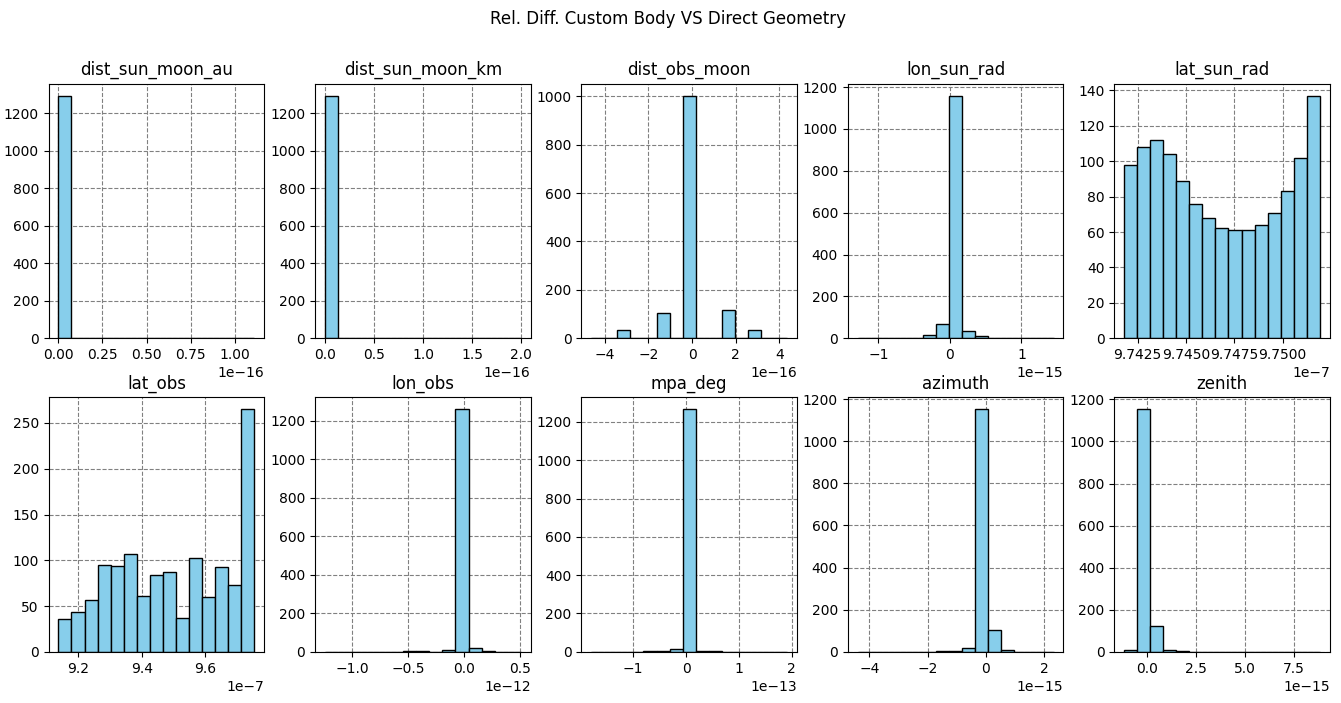
Under tests/ one can see mulitple scripts useful to check result differences between methodologies
and against results from external library (ephem, pylunar, etc.).
Custom-Body and Direct-Geometry should the same results if performed as follows:
from spicedmoon import get_moon_datas, get_moon_datas_llhs
# lat & lon are floats with the geographic coordinates in decimal degrees
# alt is a float with the altitude over sea-level in meters
# dts_str is a str with the date&time in a SPICE-compatible format
# kpath is a str with pointing to the kernels directory path
mds = get_moon_datas(
    lat, lon, alt, dts_str, kpath, earth_as_zenith_observer=False
)
mds = get_moon_datas_llhs(
    [(lat, lon, alt / 1000) for _ in range(len(dts_str))],
    dts_str,
    kpath,
)
In the following figure we can see that the relative differences are extremely low.
Structure
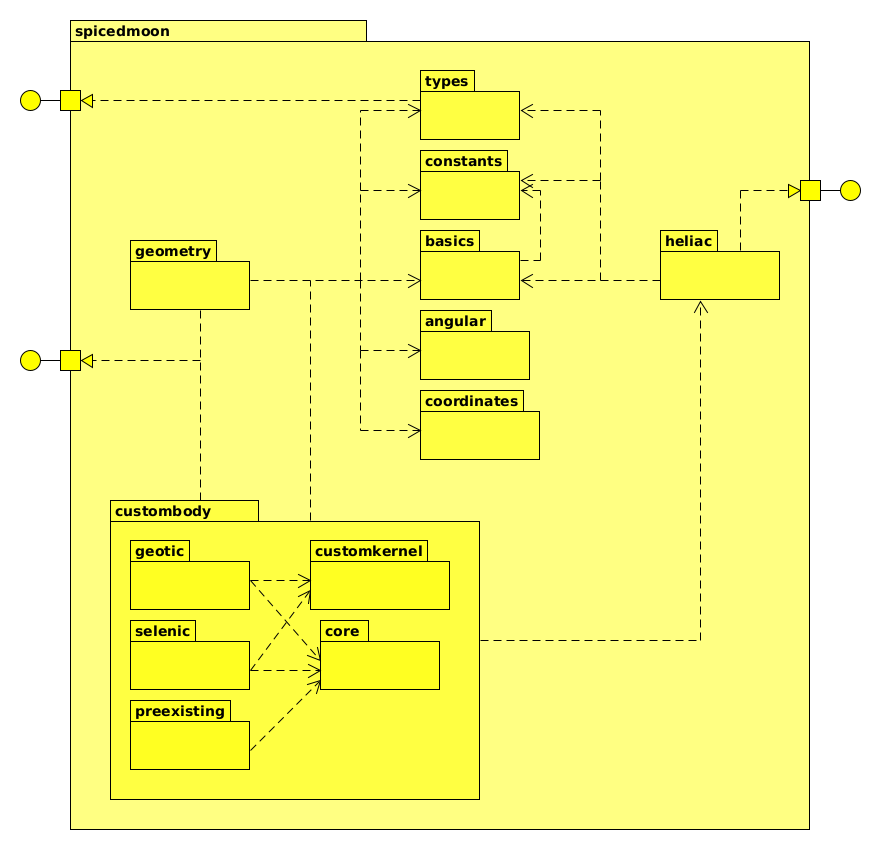
The package is divided in multiple submodules, each dealing with different calculations and functionalities. Its structure can be represented in a UML diagram:
Authors
- Javier Gatón Herguedas - Maintainer - GOA-UVa
- Ramiro González Catón - Contributor - GOA-UVa
- Stefan Adriaensen - Contributor - VITO
- Juan Carlos Antuña Sánchez - Contributor - GRASP-Earth
- Roberto Román Diez - Contributor - GOA-UVa
- Carlos Toledano Olmeda - Contributor - GOA-UVa
License
Distributed under the LGPL-v3 License. See LGPL v3 for more information.
References
- Acton, C. H. (1996). Ancillary data services of NASA's Navigation and Ancillary Information Facility. Planetary and Space Science, 44(1), 65-70, https://doi.org/10.1016/0032-0633(95)00107-7
- Annex, A. M., Pearson, B., Seignovert, B., Carcich, B. T., Eichhorn, H., Mapel, J. A., von Forstner, J. L., Freiherr, McAuliffe, J., Diaz del Rio, J., Berry, K. L., Aye, Klaus-Michael A., Stefko, M. and de Val-Borro, M., Kulumani, S. & Murakami, S. (2020). SpiceyPy: a Pythonic Wrapper for the SPICE Toolkit. Journal of Open Source Software, 5(46), 2050, https://doi.org/10.21105/joss.02050
Release history Release notifications | RSS feed


Download files
Download the file for your platform. If you're not sure which to choose, learn more about installing packages.
Source Distribution
Built Distribution
Filter files by name, interpreter, ABI, and platform.
If you're not sure about the file name format, learn more about wheel file names.
Copy a direct link to the current filters
File details
Details for the file spicedmoon-1.1.0.tar.gz.
File metadata
- Download URL: spicedmoon-1.1.0.tar.gz
- Upload date:
- Size: 157.3 kB
- Tags: Source
- Uploaded using Trusted Publishing? No
- Uploaded via: twine/6.2.0 CPython/3.9.25
File hashes
| Algorithm | Hash digest | |
|---|---|---|
| SHA256 |
f48f38fef5abdcdbf93295b431c0cad6914055aac19ca783569b85c95183ad1c
|
|
| MD5 |
6f2771981d2eb4e54125089cd2067e16
|
|
| BLAKE2b-256 |
8b9d05c59f4a59c3cdce3e05c13ddb8990c6904bb9b26df05f2f26db8364f52b
|
File details
Details for the file spicedmoon-1.1.0-py3-none-any.whl.
File metadata
- Download URL: spicedmoon-1.1.0-py3-none-any.whl
- Upload date:
- Size: 30.1 kB
- Tags: Python 3
- Uploaded using Trusted Publishing? No
- Uploaded via: twine/6.2.0 CPython/3.9.25
File hashes
| Algorithm | Hash digest | |
|---|---|---|
| SHA256 |
8f94675cba89ab40b32940bc581239d8fb1d38cbe520654b06b82109ad91b7f7
|
|
| MD5 |
9ad3895693577827fbdbe3d051f886ce
|
|
| BLAKE2b-256 |
2e456c0d01d40ff800844948dc31948c87799a8dc875d7b03fd6b9e050a482eb
|






