SplatThis
Convert a bitmap into Gaussian splats and deploy them as browser-rendered SVG, scriptless CSS, browser-native Canvas primitives, an accelerated pixel runtime with exact CPU fallbacks, or native editable PowerPoint shapes.
SplatThis is target-aware. It does not pretend that native Canvas, CSS, SVG, PowerPoint, and a generated pixel framebuffer render the same primitives: each output is named and evaluated for what it actually does.
| Output | What you get | Governing evaluation | Best fit |
|---|---|---|---|
| Pixel runtime HTML | WebGL2 evaluates the splat formula; exact Worker/main-thread CPU fallbacks | Selected Chrome canvas pixel buffer | Highest fidelity; accelerated procedural bitmap output |
| Canvas HTML | One Canvas 2D radial-gradient primitive per splat | Native-size Playwright Chromium capture | Fast browser-native splats and optional parallax |
| CSS HTML | Scriptless DOM ellipses with CSS radial gradients | Native-size Playwright Chromium capture | No-script embedding and CSS-only hover parallax |
| SVG | Real gradients, blur primitives, or compact scripted splats | Native-size Playwright Chromium capture | Browser delivery and vector editability |
| PowerPoint | Native DrawingML shapes; no embedded preview PNG | Microsoft PowerPoint slideshow capture | Editable slides |
Chromium is the governing pixel-runtime, native Canvas, SVG, and CSS target. CairoSVG, librsvg, and the internal NumPy renderer cannot approve a browser-native candidate or support a deployed-fidelity claim.
See it
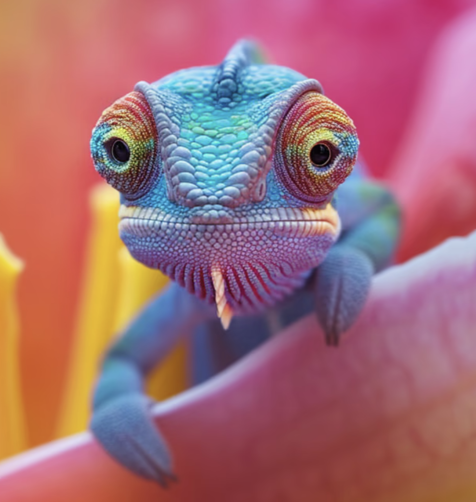
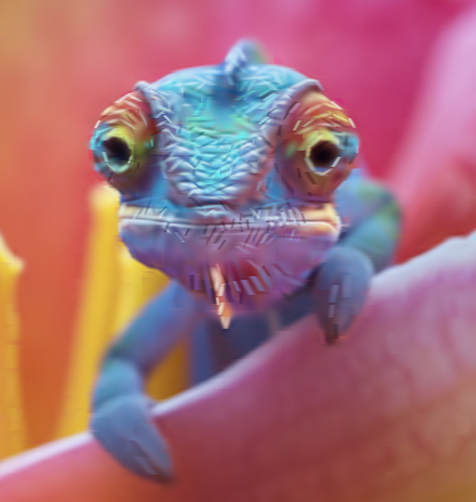
| Source | Pixel runtime in Chrome | Live SVG |
|---|---|---|
 |
 |
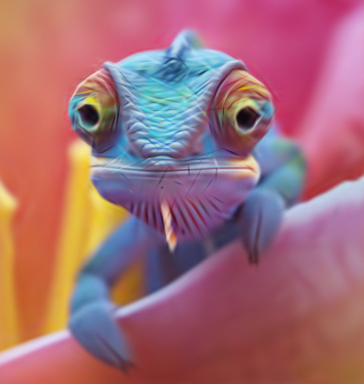 |
Open the example SVG or the historical self-contained pixel-runtime HTML. A larger corpus overview is available in docs/index.html.
Install
SplatThis requires Python 3.13 or newer and an installed Google Chrome for governing pixel-runtime/Canvas/CSS/SVG capture.
git clone https://github.com/BramAlkema/SplatThis.git
cd SplatThis
python3.13 -m venv venv
source venv/bin/activate
python -m pip install --upgrade pip
pip install -e ".[capture]"
The capture extra installs the Playwright client and uses the installed
Chrome. It does not depend on the sibling svg2pptx repository.
On Apple Silicon, add MLX:
pip install -e ".[capture,mlx]"
On CPU or CUDA machines, select Torch explicitly:
splatthis input.png --optimizer-backend torch
If Chrome is unavailable, pixel-runtime, native Canvas, SVG, and CSS exports can still be written, but their acceptance fails closed. Any internal proxy metrics are marked as diagnostics rather than deployed-artifact evidence.
Quick start
Create each supported output from the same image:
# Highest-fidelity runtime; accelerated splat equations with exact CPU fallbacks.
splatthis input.png --format pixel-runtime -o output-pixels.html

# Browser-native Canvas 2D gradient splats.
splatthis input.png --format canvas -o output-canvas.html

# Scriptless DOM/CSS splats; no canvas, SVG, JavaScript, or embedded bitmap.
splatthis input.png --format css -o output-css.html

# Static, editable SVG evaluated in Chromium.
splatthis input.png --format svg -o output.svg

# Native DrawingML splats; gradient is the conservative default.
splatthis input.png --format pptx -o output.pptx
Keep a complete audit trail with --artifacts-dir:
splatthis input.png --format svg -o output.svg \
  --artifacts-dir ./tmp/input-svg-run
The directory contains the run manifest, stage checkpoints, metrics, renderer identity, and acceptance decision.
Choose a quality budget
The default budget is 2,000 splats. More splats only help when initialization and training are allowed to use them.
# Practical larger pixel-runtime run.
splatthis input.png --format pixel-runtime -o output-4k.html \
  --splats 4000 --initial-splat-cap 4000

# Bound resolution and let a preset choose the schedule and detail budget.
splatthis input.png --format pixel-runtime -o output.html \
  --max-edge 384 --time-budget 10m
For an explicit quality target, the default-off pixel-runtime controller can stop before later stages once an observed checkpoint reaches the desired exact CPU-boundary score; the selected final browser backend is graded separately:
splatthis input.png --format pixel-runtime -o output.html \
  --splats 4000 --initial-splat-cap 4000 \
  --adaptive-compute --adaptive-target-ssim-srgb 0.98
This controller does not predict future quality or stop on a plateau. It only acts on already-rendered checkpoints.
Static pixel-runtime HTML selects one runtime in this order: RGBA32F WebGL2,
RGBA16F WebGL2, exact Worker/OffscreenCanvas CPU, then exact main-thread CPU.
The 16F path must also pass a cheap deterministic sample against the exact
formula. The selected path and its compute/end-to-end timings are exposed in
the document metadata, and governing Chromium capture grades that actual
canvas buffer. ?splatthisPixelBackend=rgba32f|rgba16f|worker|main is available
for diagnostics. The current 21-image Chrome gate selected 32F everywhere,
kept its worst source SSIM_sRGB change to -0.0000014, and found exact
Worker/main parity. Cross-browser GPU qualification remains open; unsupported
or rejected GPU paths fall back rather than preventing rendering.
SVG workflows
The standard recipe is the safe static default. Other recipes are explicit:
| Recipe | Characteristics |
|---|---|
standard |
One standards-based radial gradient per splat; static and editable |
palette-quantized |
Shared color gradients; often much smaller, with possible color quantization |
blur |
Native SVG blur primitives; compositor-sensitive |
scripted-matrix |
Compact data expanded by JavaScript at load time; browser use only |
browser-compatible |
Conservative browser-gradient encoding |
splatthis input.png --format svg -o compact.svg \
  --svg-recipe palette-quantized

splatthis input.png --format svg -o polished.svg \
  --fidelity-stage max --artifacts-dir ./tmp/polished-svg-run

# Force the stricter adaptive stop policy without artifact search.
splatthis input.png --format svg -o high.svg \
  --svg-gradient-quality high --no-svg-compositor-gate
SVG elements are emitted back-to-front so their painter's order matches the
front-to-back transmittance renderer. The max-fidelity profile additionally
browser-grades legacy order, corrected standard gradients, and corrected high
gradients, then accepts or reverts the complete artifact. Its decision and
fixed ROIs are stored under svg_compositor_gate in the manifest. See the
SVG compositor gate.
The separate fidelity stage emits every splat-parameter candidate and captures it in Chromium. A proxy
may reject a cheap loser early, but only the browser artifact can promote a
candidate. --svg-optimize can additionally run svgo when it is available on
PATH.
The bounded browser recipe study accepted palette quantization on 7 of 21 corpus images, with 66–71% smaller accepted files and a median accepted LPIPS gain of 0.01014. This does not make it a universal default; see the browser SVG recipe gate.
Scriptless CSS compositor
The CSS target represents every Gaussian as one absolutely positioned ellipse.
Its background is a CSS radial-gradient with adaptive alpha stops matching
the standard SVG Gaussian curve. The browser performs the final alpha-over
composition; SplatThis does not pre-render a pixel buffer.
# Static CSS splats.
splatthis input.png --format css -o splats.html

# Scriptless 10x10 hover-grid parallax from saliency depth layers.
splatthis input.png --format css -o parallax-css.html \
  --layered-saliency --css-parallax-strength 28
The parallax output uses transparent hover cells and CSS sibling selectors to move the midground and foreground planes. It remains interactive with a strict no-script policy. The governing quality capture measures the neutral, non-hovered frame. This target trades runtime code for DOM size: one element per splat is convenient and inspectable, but thousands of DOM nodes can cost more layout and paint work than the single Canvas element.
PowerPoint workflows
PowerPoint output contains native shapes rather than a bitmap masquerading as a slide:
# Recommended general-purpose PowerPoint output.
splatthis input.png --format pptx -o output.pptx \
  --pptx-splat-style gradient

# Explicit corrected painter-order candidate; legacy remains the default.
splatthis input.png --format pptx -o output-corrected.pptx \
  --pptx-painter-order back-to-front

# Deliberately target real PowerPoint's soft-edge compositor.
splatthis input.png --format pptx -o output-softedge.pptx \
  --pptx-splat-style soft-edge \
  --training-export-target pptx-softedge
PowerPoint and LibreOffice do not render every DrawingML effect identically.
The pptx-softedge target is calibrated for Microsoft PowerPoint and may look
washed out elsewhere. In-converter PPTX previews remain proxies; benchmark
claims use real PowerPoint slideshow captures.
A same-population, 21-image PowerPoint corpus test found that corrected
back-to-front shape order improved median SSIM by 0.02662 and median LPIPS by
0.03346, but Hubble regressed. The strict artifact policy selected corrected
order for 14 images and retained legacy for seven. The CLI therefore exposes
both orders while retaining legacy as the default. The resumable external
PowerPoint runner writes the accepted candidate atomically as selected.pptx;
ordinary headless conversion never launches PowerPoint. See the
PowerPoint painter-order MVP.
Layered Canvas parallax
Splat layers can be displaced by mouse position to suggest depth:
splatthis input.png --format canvas -o parallax.html \
  --layered-saliency --canvas-parallax-strength 28
This version draws every Gaussian through the Canvas 2D API before moving the
three resulting Canvas planes. The software-rasterized equivalent is available
explicitly with --format pixel-runtime and
--pixel-runtime-parallax-strength.
This changes presentation, not the underlying 2D reconstruction. PowerPoint hover/grid parallax remains an MVP design rather than a released exporter feature.
What quality to expect
These are seed-0 medians over all 21 stored corpus images at a maximum edge of roughly 384 px. Each score comes from the deployed artifact: the historical Chrome ImageData pixel buffer, Chromium SVG, or Microsoft PowerPoint.
| Artifact | Requested budget | Median final splats | SSIM ↑ | LPIPS ↓ | Median size | Median training |
|---|---|---|---|---|---|---|
| Pixel runtime HTML | 2k | 1,395 | 0.7751 | 0.2443 | 226 KB | 3.6 min |
| Pixel runtime HTML | effective 4k | 2,382 | 0.8406 | 0.1612 | 391 KB | 9.9 min |
| SVG, historical legacy order | 2k | 1,389 | 0.5973 | 0.4023 | 765 KB raw | 4.2 min |
| SVG, compositor-gated | 2k | 1,389 | 0.7111 | 0.2439 | 1.23 MB raw / 93 KB gzip | 4.2 min + gate |
| PowerPoint | 2k | 1,374 | 0.6091 | 0.3843 | 127 KB | 6.6 min |
These historical Canvas-labelled results belong to the ImageData software
renderer now named pixel-runtime. All 21 images improved from 2k to effective
4k in both SSIM and LPIPS. The effective-4k runtime rendered in a median 105 ms
in Chrome. None reached 0.99 SSIM.
An initial same-population Chameleon check makes the distinction concrete. The population contains 1,615 SVG-trained splats. Historical forward DOM order scored 0.7076 SSIM, corrected standard order scored 0.8494, and corrected adaptive high gradients scored 0.8665. Native Canvas scored 0.7072 under its historical order. Replaying the same parameters through the mathematical pixel runtime scored 0.9045, demonstrating the remaining vector-to-pixel-runtime gap. The older internal preview scored 0.8803 but was not an SVG render and must not be compared as one. Native Canvas rendered the gradients in about 11 ms and produced 156 KB of HTML; the CPU pixel runtime took roughly 80-102 ms and produced about 290 KB. These are one-image MVP measurements, not corpus guarantees.
On a separate 1,788-splat, 476 x 502 Chameleon checkpoint, the selected 32F runtime completed in roughly 16-19 ms after warm-up versus roughly 127-140 ms for exact main-thread CPU. It differed on six pixels by one byte and preserved source SSIM_sRGB at 0.90494. The quality-gated 16F path completed in about 20 ms; its source SSIM_sRGB was 0.90486. These remain local Chrome measurements, not a cross-browser guarantee.
SplatThis is also not a replacement for PNG, JPEG, WebP, or AVIF compression. If editability, animation, or the splat representation is unnecessary, a normal bitmap will usually be smaller and more faithful.
See historical pixel-runtime scaling for paired per-image results and SVG/PPTX compositor findings for the format-specific analysis.
How it works
- Content-adaptive initialization places anisotropic splats.
- Torch or MLX optimizes position, scale, rotation, color, and alpha.
- Densification adds detail and pruning removes low-impact splats.
- Target-aware post-fit stages approximate the deployment compositor.
- Monotonic gates keep only measured improvements.
- The final SVG, CSS/Canvas/pixel-runtime HTML, or DrawingML package is written atomically.
The public converter.py module is a small compatibility facade over the
internal numerical engine and isolated prepare, fit, and deployment phases.
Each run starts from an immutable configuration snapshot, produces one
SplatScene, and delegates emission plus governing evaluation to a registered
artifact backend. See Architecture for the module
boundaries and extension rules.
Pixel-runtime and SVG repeat-render noise is currently zero in the calibrated
corpus captures. Native Canvas and CSS still need their own full-corpus noise
calibration. The versioned target floors and PowerPoint capture provenance live
in data/artifact-gates.json.
Main flags
| Flag | Purpose |
|---|---|
--format {svg,pptx,canvas,css,pixel-runtime} |
Select the deployed container and compositor |
--splats N |
Set the maximum splat population |
--time-budget PRESET |
Select a content-aware schedule and detail budget |
--max-edge N |
Bound the input resolution while preserving aspect ratio |
--optimizer-backend {mlx,torch} |
Select the optimizer implementation |
--training-export-target {auto,pixel-runtime,browser-gradient,svg,pptx-softedge} |
Select the training compositor (canvas is a legacy alias for pixel-runtime) |
--svg-recipe RECIPE |
Select the emitted SVG primitive family |
--svg-gradient-quality {standard,high} |
Select compact or stricter adaptive SVG gradients |
--svg-painter-order {back-to-front,legacy} |
Select corrected or historical SVG element order |
--[no-]svg-compositor-gate |
Accept or revert complete browser SVG compositor candidates |
--pptx-splat-style STYLE |
Select DrawingML gradient, soft-edge, or blur splats |
--pptx-painter-order {legacy,back-to-front} |
Emit the historical or corrected DrawingML shape stack |
--fidelity-stage {off,balanced,max} |
Enable accept-or-revert browser SVG polish |
--layered-saliency |
Export base, mass, detail, and edge layers |
--canvas-parallax-strength PX |
Enable native Canvas plane parallax |
--pixel-runtime-parallax-strength PX |
Enable ImageData-runtime plane parallax |
--css-parallax-strength PX |
Enable scriptless CSS hover parallax |
--artifacts-dir DIR |
Retain the manifest and intermediate checkpoints |
Run splatthis --help for the full research and backend surface.
Project status
The supported path includes target-aware training, native Canvas/CSS/SVG, explicit pixel-runtime and PPTX export, browser pixel-runtime/Canvas/SVG/CSS grading, native PowerPoint generation, provenance-complete manifests, and full-corpus reporting. See Reproducibility for what a fixed seed does and does not guarantee per backend.
Top-K teacher/student distillation, mixed native primitives, automatic SVG
recipe selection, adaptive compute, and PowerPoint hover parallax remain
default-off or experimental. Their current evidence is retained under
docs/ rather than presented as release guarantees. The architecture
and acceptance roadmap are in ADR-003.
Development
pip install -e ".[dev,capture]"

isort --check-only src tests tools
black --check src tests tools
flake8 src tests tools
pytest -q
python -m build
python -m twine check dist/*
Reproducibility
A fixed --seed reproduces the reported metrics on both backends, but only
Torch reproduces the emitted artifact byte for byte.
--optimizer-backend |
Reported metrics | Emitted artifact |
|---|---|---|
torch |
identical | byte-identical |
mlx (default) |
identical to nine significant figures | not byte-identical |
MLX orders float32 reductions on the Metal device nondeterministically, so
repeated single-process seeded runs differ by roughly one float32 ULP (~3e-8)
in splat parameters. That is far below any quality threshold — two seeded runs
of the same image agreed on SSIM to nine significant figures — but it is
enough to tip a rounded SVG attribute across a formatting boundary, so
artifact hashes are not stable under MLX. The differences observed so far have
been geometrically inert, such as the rotate() angle of an isotropic splat,
where rotation is a no-op. Select --optimizer-backend torch when you need
bit-identical output or a stable artifact hash.
The corpus medians quoted above are unaffected: they are reported to four decimal places, five orders of magnitude above this noise.
Corpus runs are content-addressed and resumable. Independent conversions can
run concurrently with python tools/corpus_benchmark.py --run --jobs 2 ....
This is restricted to Torch/CPU runs: concurrent seeded MLX processes share one
Metal device and compound the nondeterminism described above. MLX therefore
requires --jobs 1; result-file writes remain serialized for every backend.
CI launches the installed Chrome before running the suite. See CONTRIBUTING.md and CHANGELOG.md.
License
1 maintainer

Download files
Download the file for your platform. If you're not sure which to choose, learn more about installing packages.
Source Distribution
Built Distribution
Filter files by name, interpreter, ABI, and platform.
If you're not sure about the file name format, learn more about wheel file names.
Copy a direct link to the current filters
File details
Details for the file splatthis-0.2.1.tar.gz.
File metadata
- Download URL: splatthis-0.2.1.tar.gz
- Upload date:
- Size: 219.6 kB
- Tags: Source
- Uploaded using Trusted Publishing? Yes
- Uploaded via: twine/7.0.0 CPython/3.13.14
File hashes
| Algorithm | Hash digest | |
|---|---|---|
| SHA256 |
5e827badf9b7bdf9ef99dcead91463551efb391182b2e890b97e13d105c1be16
|
|
| MD5 |
b8a670af9a9b0bd3efb1919d10118b95
|
|
| BLAKE2b-256 |
3308a7b0b7869f60e1629af18f5740ddb5a544071fc8b1b9a2f5a8b4a6307c2a
|
Provenance
The following attestation bundles were made for splatthis-0.2.1.tar.gz:
Publisher:
release.yml on BramAlkema/SplatThis
-
Statement:
-
Statement type:
https://in-toto.io/Statement/v1 -
Predicate type:
https://docs.pypi.org/attestations/publish/v1 -
Subject name:
splatthis-0.2.1.tar.gz -
Subject digest:
5e827badf9b7bdf9ef99dcead91463551efb391182b2e890b97e13d105c1be16 - Sigstore transparency entry: 2311478134
- Sigstore integration time:
-
Permalink:
BramAlkema/SplatThis@18d7f4d250ff3271e5ba9e86e66a3ae8762d7ed2 -
Branch / Tag:
refs/tags/v0.2.1 - Owner: https://github.com/BramAlkema
-
Access:
public
-
Token Issuer:
https://token.actions.githubusercontent.com -
Runner Environment:
github-hosted -
Publication workflow:
release.yml@18d7f4d250ff3271e5ba9e86e66a3ae8762d7ed2 -
Trigger Event:
push
-
Statement type:
File details
Details for the file splatthis-0.2.1-py3-none-any.whl.
File metadata
- Download URL: splatthis-0.2.1-py3-none-any.whl
- Upload date:
- Size: 240.3 kB
- Tags: Python 3
- Uploaded using Trusted Publishing? Yes
- Uploaded via: twine/7.0.0 CPython/3.13.14
File hashes
| Algorithm | Hash digest | |
|---|---|---|
| SHA256 |
d781c936343c0c22f4ed8b49b69589cdefd367806a0a0cfadf0c332ea56283e4
|
|
| MD5 |
31f5f6cb36670106e8a71d77b746cbe0
|
|
| BLAKE2b-256 |
e5b0965a56497b6bda2f7339a55bf2b3ad87144fd1f4a5d1b1a749d21bd977d5
|
Provenance
The following attestation bundles were made for splatthis-0.2.1-py3-none-any.whl:
Publisher:
release.yml on BramAlkema/SplatThis
-
Statement:
-
Statement type:
https://in-toto.io/Statement/v1 -
Predicate type:
https://docs.pypi.org/attestations/publish/v1 -
Subject name:
splatthis-0.2.1-py3-none-any.whl -
Subject digest:
d781c936343c0c22f4ed8b49b69589cdefd367806a0a0cfadf0c332ea56283e4 - Sigstore transparency entry: 2311478143
- Sigstore integration time:
-
Permalink:
BramAlkema/SplatThis@18d7f4d250ff3271e5ba9e86e66a3ae8762d7ed2 -
Branch / Tag:
refs/tags/v0.2.1 - Owner: https://github.com/BramAlkema
-
Access:
public
-
Token Issuer:
https://token.actions.githubusercontent.com -
Runner Environment:
github-hosted -
Publication workflow:
release.yml@18d7f4d250ff3271e5ba9e86e66a3ae8762d7ed2 -
Trigger Event:
push
-
Statement type: