
splicescope
Detect, quantify and characterize alternative & cryptic splicing events from splice junctions — with an honest, reproducible ML layer on top.





📖 Documentation: elmasnuryilmaz.github.io/splicescope · ▶ Try it live: splicescope on Streamlit · 📓 Guided tutorial: examples/tutorial.ipynb (executed, with outputs)
Most of what we want to know about alternative and cryptic splicing is already
present in the splice junctions aligners such as STAR report. splicescope turns those
junctions plus a reference annotation into: a classification of every junction, a
model-free usage metric (Ψ), event-level PSI for cassette exons, mutually exclusive
exons and alternative 5′/3′ splice sites (SE / MXE / A5SS / A3SS), a differential-splicing
test between conditions, and a cross-validated classifier that prioritises genuine cryptic
events over noise.
Everything runs out of the box on a built-in synthetic dataset — no downloads, no private data — which is also what the test suite and CI use.
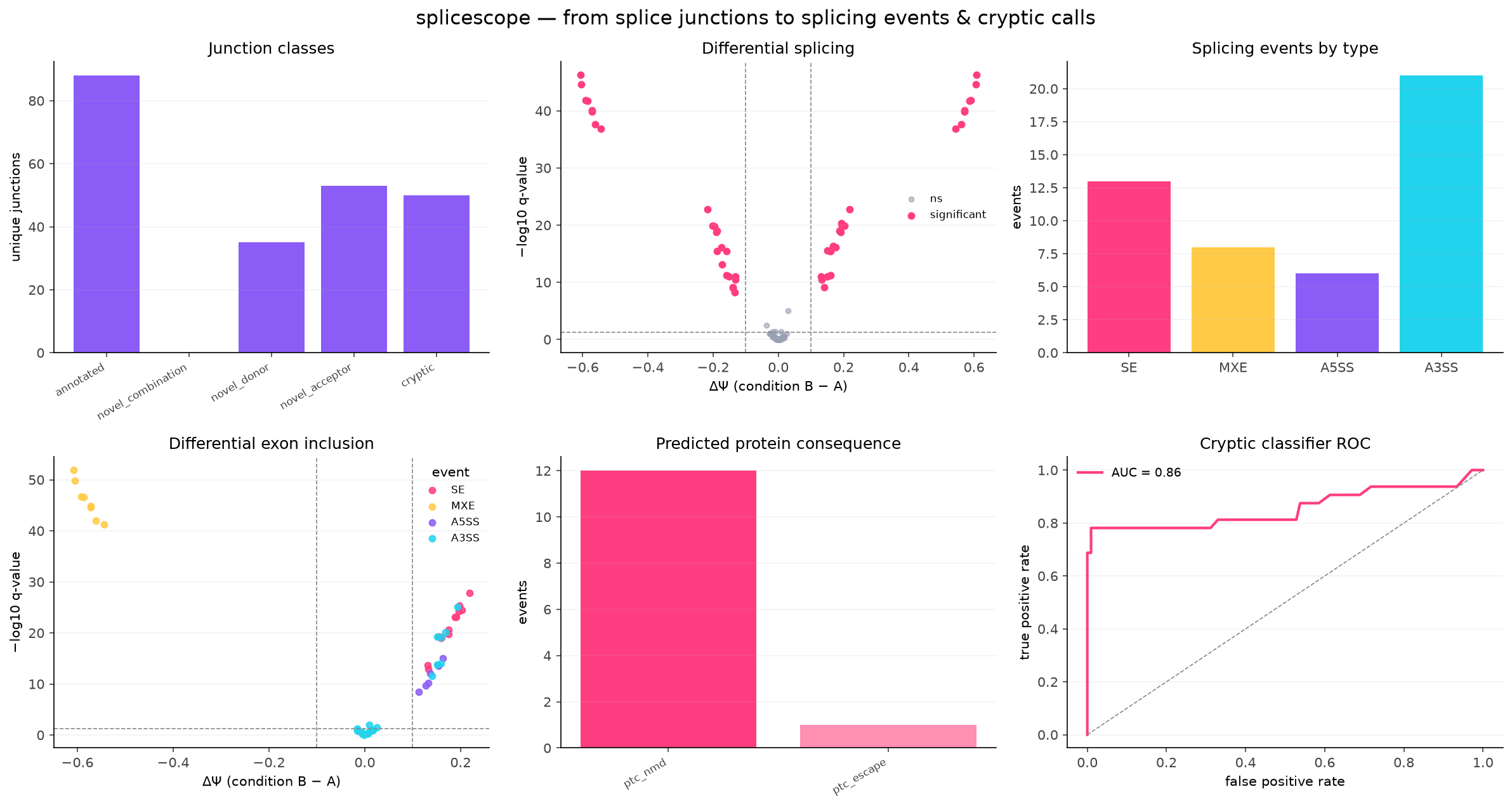
One reproducible command produces every panel above: junction classes, a ΔΨ volcano, splicing events by type (SE / MXE / A5SS / A3SS), differential exon inclusion, what including those exons does to the protein — a premature stop, and whether it is far enough from the last junction to trigger nonsense-mediated decay — and the cryptic classifier's cross-validated ROC.
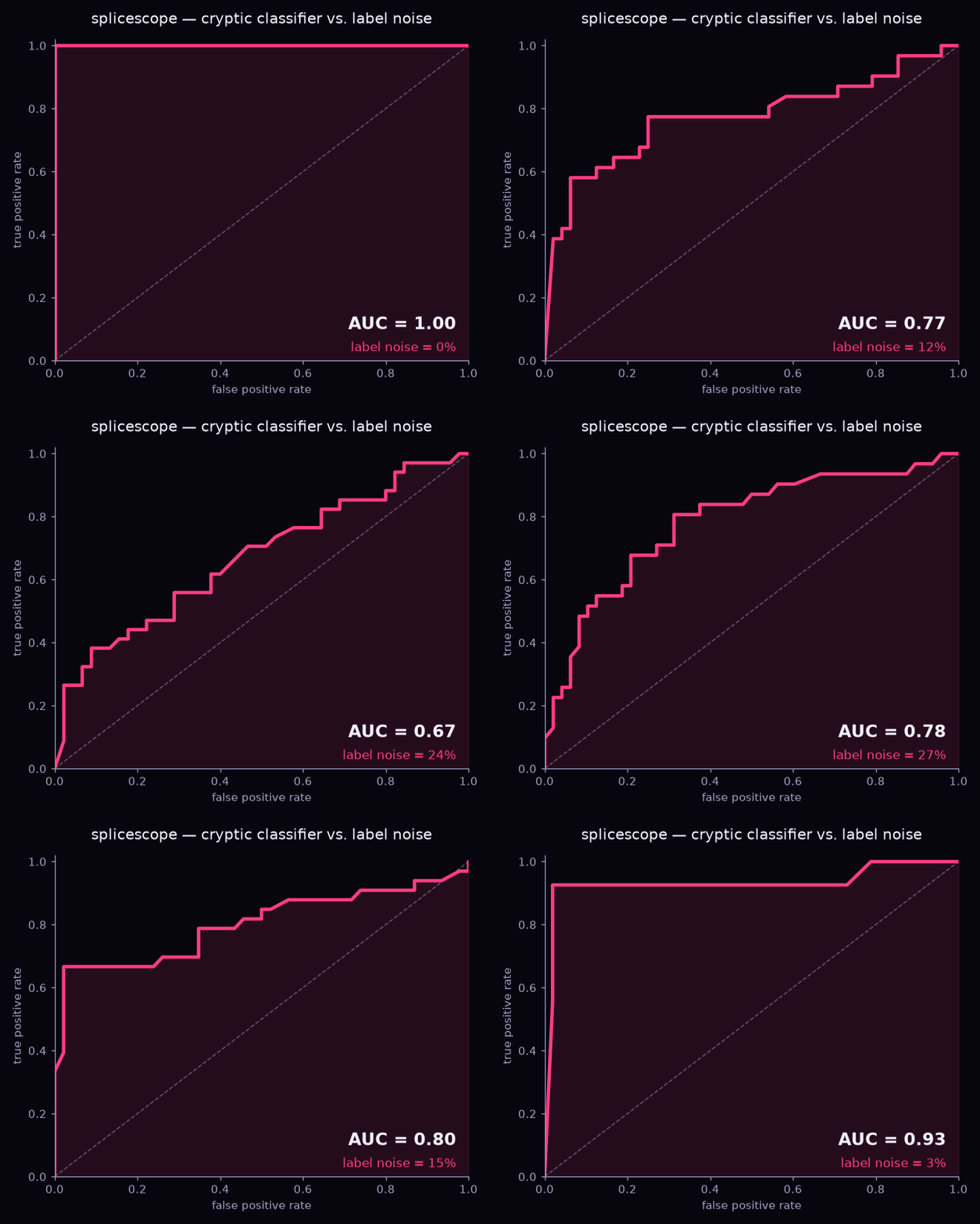
And the classifier degrades gracefully as labelling error grows — an honest robustness check rather than a single lucky number:
Why it exists
Cryptic-exon dysregulation (e.g. loss of TDP-43 in ALS/FTD) has made cryptic splicing a
front-line question in RNA biology. But novel junctions are dominated by technical noise,
and calling the real events usually means ad-hoc thresholds. splicescope replaces those
thresholds with (1) a transparent junction taxonomy, (2) a calibrated statistical test
on the read counts rather than on Ψ, and (3) a prediction of what each event does to the
protein.
A classifier over junction features is also included, evaluated with leakage-free cross-validation and shipped with a model card — but held to the same standard as everything else here. Measured against replication in an independent experiment it is worse than the statistical test at ranking confidently reproducible events, because its features describe whether a junction is plausible, not whether it changes between conditions. Treat it as a noise filter, not as the way to find cryptic events; the numbers are in validation/README.md.
Install
pip install splicescope # add [app] for the Streamlit dashboard
or, to run the tests and work on the code, from a clone:
git clone https://github.com/elmasnuryilmaz/splicescope.git
cd splicescope
python -m venv .venv && source .venv/bin/activate
pip install -e ".[dev,docs]"     # add ",app" for the Streamlit dashboard
#  docs brings the notebook tools: the suite checks that the committed tutorial
#  is the one its builder produces, which means importing the builder
Quickstart
# 1) write a synthetic, ground-truth dataset: STAR SJ.out.tab + GTF (with CDS)
#    + groups.tsv + an indexed genome whose genes carry real open reading frames,
#    plus truth.tsv listing the events injected, so recall can be measured
splicescope simulate --outdir demo_data

# 2) run the whole pipeline: annotate -> quantify -> events -> differential
#    -> protein consequence -> figures
splicescope run \
    --sj-dir demo_data/sj \
    --gtf    demo_data/annotation.gtf \
    --groups demo_data/groups.tsv \
    --genome demo_data/genome.fa \
    --outdir results
Drop --genome and everything except the consequence step still runs. Nothing is
downloaded: the simulated chromosome is built from sense codons and canonical GT/AG
intron ends, so a cryptic exon spliced into it genuinely shifts the frame and genuinely
does, or does not, hit a stop codon.
Or drive it from Python:
from splicescope import annotate, quantify, diff, cryptic
from splicescope.ml import CrypticClassifier
from splicescope.simulate import simulate_dataset

ds = simulate_dataset(n_genes=20, n_per_group=6, label_noise=0.12, seed=11)
ann  = annotate.annotate_junctions(ds.observed, ds.known)   # classify junctions
psi  = quantify.compute_psi(ann)                            # splice-site usage Ψ
dpsi = diff.differential_splicing(psi, ds.groups)           # ΔΨ + beta-binomial LRT + BH

feats = cryptic.extract_features(psi, ds.known)             # per-junction features
clf     = CrypticClassifier()
metrics = clf.evaluate(feats)                               # stratified-CV ROC-AUC / AP
Or the whole of it, protein consequences included, in one call:
from splicescope.demo import run_demo

result = run_demo(n_genes=20, cryptic_fraction=0.6)
result.consequences[["gene_name", "insert_length", "ptc_offset", "consequence_class"]]
How it works
flowchart LR
    A["STAR SJ.out.tab<br/>+ GTF"] --> B["annotate<br/>junction taxonomy"]
    B --> C["quantify<br/>splice-site usage Ψ"]
    B --> D["events<br/>SE · MXE · A5SS · A3SS"]
    C --> E["diff<br/>ΔΨ · beta-binomial LRT · FDR"]
    D --> E
    D --> I["consequence<br/>frame · PTC · NMD"]
    E --> F["enrich<br/>pathway ORA"]
    C --> G["cryptic + ml<br/>cross-validated calls"]
    E --> H["plotting<br/>volcano · ROC · panels"]
| stage | module | what it does |
|---|---|---|
| Ingest | io |
read STAR SJ.out.tab; derive known introns from a GTF |
| Annotate | annotate |
label each junction: annotated, novel_donor, novel_acceptor, novel_combination, cryptic |
| Quantify | quantify |
Ψ = fraction of a splice site's reads flowing through a junction (model-free) |
| Events | events |
reconstruct SE / MXE / A5SS / A3SS events and compute rMATS-style percent-spliced-in |
| Differential | diff |
ΔΨ between two conditions, beta-binomial likelihood-ratio test on read counts, Benjamini–Hochberg FDR (junction- or event-level) |
| Features | cryptic |
intron length, read support, recurrence, motif, distance to known sites … |
| Learn | ml |
RandomForest + StandardScaler, stratified-CV, permutation importance, model card |
| Consequence | consequence |
reading frame, premature stop codon and NMD prediction, for cassette exons and for splice-site shifts |
| Enrich | enrich |
pathway over-representation (ORA) with BH-FDR, corrected by default for how many units each gene was tested on, so a long gene is not enriched for being long; any GMT gene sets, matched by symbol or accession, versioned or not |
| Visualize | plotting |
publication-quality panels (headless-safe) |
The synthetic generator (simulate) is biologically faithful: a cryptic exon produces a
novel_acceptor junction that shares the upstream known donor and a novel_donor
junction that shares the downstream known acceptor, up-regulated in one condition, on a
background of canonical introns and noise. An optional label_noise reflects imperfect
curation so the ML task is realistically hard rather than trivially separable. It also
writes the matching chromosome — coding exons drawn from the 61 sense codons, canonical
GT/AG intron ends, and the 5′UTR staggered per gene so the coding frame at an intron
boundary cycles through 0, 1 and 2 — which is what lets the consequence layer be tested
rather than only asserted.
Formal definitions — the Ψ metric, the differential-splicing statistics, the classifier's leakage-free evaluation protocol and the simulation model are all specified in docs/METHODS.md.
Reproducing any of it — every claim here, the command that checks it, and what the auditing found, in docs/REPRODUCING.md.
Scaling & exploring
nextflow/— a DSL2 pipeline that runs the same steps across many samples on a cluster or in containers.nextflow run nextflow/main.nf -profile testis the self-contained demo; real data goes in as--sj_dir … --gtf … --groups … [--genome …], each staged independently. CI runs all three paths on every push.app/streamlit_app.py— an interactive dashboard that answers one question end to end: a knockdown switches on junctions the annotation does not contain, so which of them are real and what do they do to the protein? It picks a cryptic cassette exon, shows its Ψ in every replicate, and says in words what including it does — "the first premature stop appears 63 nucleotides in, 355 before the last exon-exon junction, more than the 50 the rule allows, so nonsense-mediated decay is predicted" — beside the reason a rank test could not have called it. (pip install -e ".[app]"thenstreamlit run app/streamlit_app.py.) The analysis behind it issplicescope.demo.run_demo, which is also the shortest way to run the whole pipeline on synthetic data from Python; the page itself is presentation only, and CI renders it headlessly on every push.
Testing
pytest            # 366 tests: unit + property-based + end-to-end CLI runs
ruff check .      # lint
pytest --cov=splicescope   # 98 % of statements; CI fails below 90 %
CI runs the suite and the linter on every push against Python 3.10-3.13, plus the
Nextflow pipeline on all three of its input paths and a headless render of the Streamlit
dashboard (see the badge above). A separate job installs the oldest dependency versions
pyproject.toml claims to support — pinned in constraints-oldest.txt — because a matrix
that always resolves to the newest of everything never checks that the declared floor is
real. It is: the suite passes on pandas 1.5.0 with numpy 1.23.5, and on pandas 3.
Twenty of those are property-based (hypothesis): generators produce junction
tables, annotations and DNA, and the invariants have to hold whatever comes out — Ψ
exhausts its splice site, swapping the group labels flips ΔΨ and leaves the p-value
alone, a locus on another chromosome changes nothing, no event names a coordinate that
was never observed. One found a real defect on its first run — an empty result whose
columns it could not index — and sweeping the rest of the package for that same shape
turned up three more of it.
A green suite says the tests pass, not that they would fail if the code broke. So the code is deliberately broken 122 ways and the suite has to notice:
python validation/mutation_survey.py
Each mutation is a mistake someone could plausibly make — an inclusive comparison where it should be strict, a distance measured from the wrong end of a codon, a correction applied to the wrong array — and the script reports any the suite fails to catch. 29 of these passed the suite as it stood when each was first tried: the 50-nucleotide rule this tool's NMD calls rest on, the last-exon exception, whether the reported q-value was Benjamini-Hochberg-adjusted at all, seven of the eight features the cryptic-junction classifier learns from, and three defects reachable only from the minus strand. Three of the 29 are equivalent mutants that provably cannot change any answer, and the script says which and why; the other 26 are now each pinned by a test. It also runs weekly in CI.
The differential test
splicescope tests the read counts Ψ was computed from, not Ψ itself, and that choice
decides whether the tool finds anything on a real dataset.
A two-sided Mann–Whitney U on n replicates per group cannot return a p-value below
2 / C(2n, n) — 0.1 for a 3-vs-3 design, and still 1.1e-5 at 10-vs-10. Clearing
Benjamini–Hochberg across ~10⁵ junctions needs the top hit near 1e-7, so a rank test
reports nothing significant at any realistic replicate count, however large the effect.
Instead, inclusion counts are modelled as beta-binomial and the two groups are compared by a likelihood-ratio test, with a shared dispersion estimated from df-corrected Pearson residuals about each group's own mean. Null p-values are calibrated (nominal 0.05 → observed 0.045–0.053 in simulation) and evidence now grows with coverage rather than only with replicate count.
The rank test is still reachable as test="ranksum" for Ψ tables that carry no counts.
Formal definitions are in docs/METHODS.md §5.
Protein consequence
Finding a cryptic exon says nothing about whether it matters. The same event can be tolerated, shift the reading frame, or introduce a premature termination codon that sends the transcript to nonsense-mediated decay — which is how TDP-43 cryptic exons deplete proteins such as STMN2 and UNC13A.
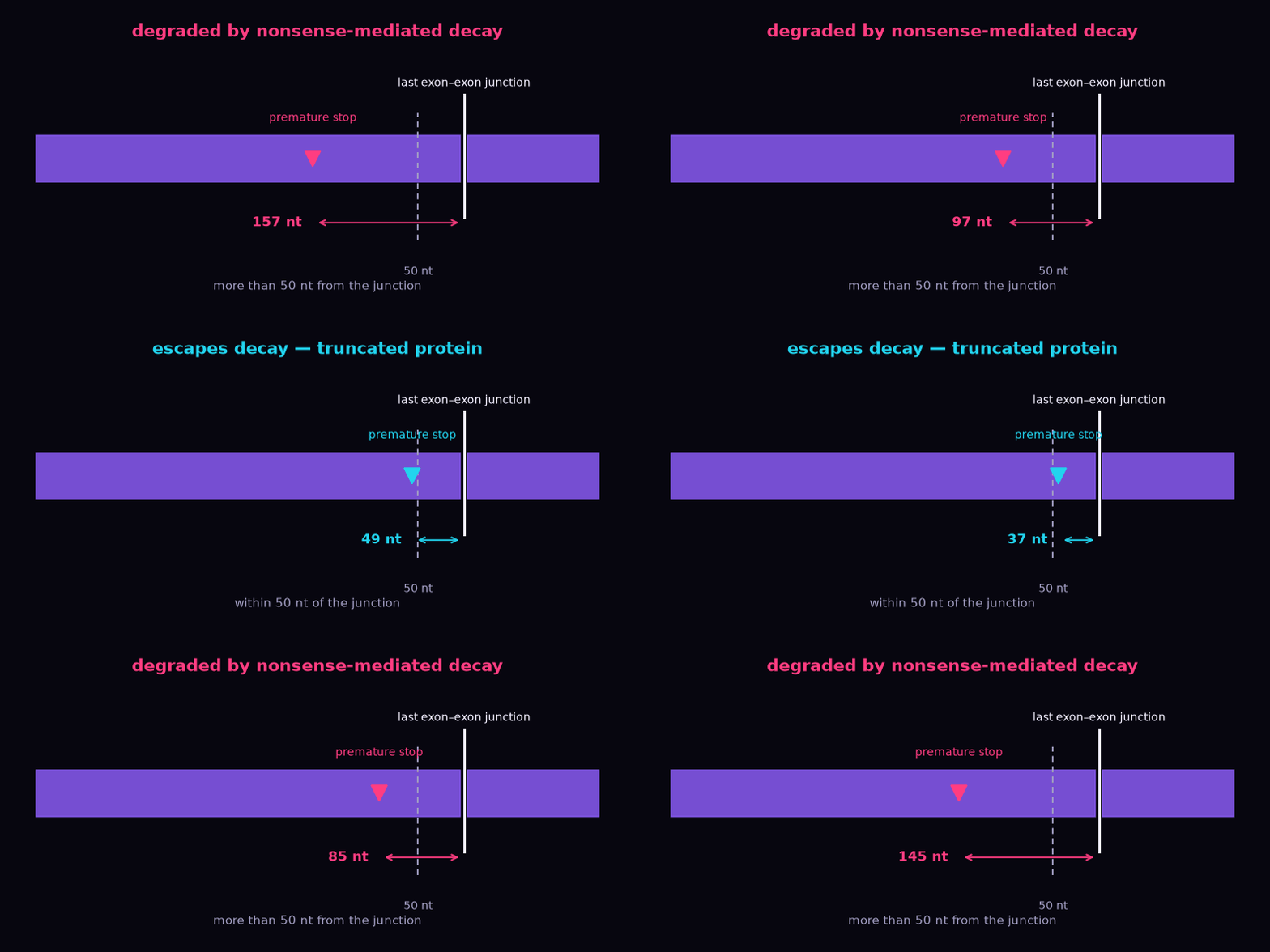
The whole of the prediction is one threshold. Every verdict in that animation comes from
the function the pipeline uses, not from a drawing of the rule — regenerate it with
python docs/make_nmd_rule_gif.py.
Passing --genome to run folds this into the pipeline, writing consequence.tsv for
cassette exons and junction_consequence.tsv for splice-site shifts. Candidates produced
elsewhere — an existing rMATS or LeafCutter run — go through the standalone command:
splicescope consequence \
    --events results/events.tsv \
    --gtf    gencode.v47.annotation.gtf.gz \
    --genome GRCh38.primary_assembly.genome.fa \
    --out    results/consequence.tsv
Cassette exons are given as exon intervals (exon_start/exon_end); novel donors and
acceptors are given as junctions (start/end) and resolved against the annotation into
the sequence they add to, or remove from, the neighbouring exon — which matters because
splice-site shifts outnumber cassettes among reported cryptic events. --mode picks
between the two and defaults to reading it off the columns present. The genome needs its
samtools faidx index next to it; nothing else is required. Each event is classified as
ptc_nmd, ptc_escape, frameshift, exon_truncation, in_frame_insertion,
utr_insertion, non_coding_host or no_host_transcript, alongside the inherited frame,
the PTC offset and its distance to the last exon-exon junction.
A junction already explained by a detected cassette or MXE event is not also reported as a splice-site shift: on its own, a cassette inclusion junction reads as an exon extension running to the end of the intron, which is the wrong interpretation of it. On the built-in demo that exclusion removes 14 of 31 candidate junctions.
Use the full GENCODE annotation, not
basic. The reduced set is missing transcripts and leaves far more events without a host intron — 43 % against 20 % on the same 300 exons, measured once on the GSE245332 run rather than by anything in this repository, so take it as a direction and not a figure.
Notes & limitations
The bundled data is simulated to keep the project self-contained and testable, so the
pipeline has also been run end-to-end on a real experiment — a human TDP-43 knockdown
(GSE245332, 3 vs 3) — where it recovers STMN2, HDGFL2, PFKP, ARHGAP32, KALRN, AGRN, ATG4B
and RAP1GAP among its significant events, and calls 4,699 differentially spliced events
against rMATS's 3,724 on the same BAMs. Those figures were measured with 0.8.1 and three
defects in the differential path have been fixed since, each of which changes which
units are tested or how wide the null is, so they will move when it is re-run — the
weakest of those genes sits at q = 1.5e-02 and may not survive. What does not move is
the argument they were collected for: a rank test cannot clear Benjamini–Hochberg at 3
against 3 and the count model clears it by more than a hundred orders of magnitude.
Numbers, misses, the BAM-to-junction step and the full caveat are in
validation/README.md.
The classifier is a separate matter: its model card is explicit that it should be retrained on curated labels and validated on held-out genes before any real-data use. Ψ here is splice-site usage, a deliberately model-free proxy; event-level PSI is reported alongside it for SE, MXE, A5SS and A3SS. Intron retention is the event class that is genuinely out of reach: it is measured from coverage inside the intron, which splice junctions do not carry.
Contributing and support
Questions, bug reports and pull requests are welcome on the issue tracker. How to set up a development environment and what a pull request needs is in CONTRIBUTING.md; where to get help, what response to expect and how the project is governed is in SUPPORT.md. Everyone taking part is expected to follow the Code of Conduct.
Cite
If you use splicescope in your research, please cite it (see CITATION.cff):
Yılmaz, E. (2026). splicescope: detecting and characterizing cryptic splicing from splice junctions (v0.10.0). Zenodo. https://doi.org/10.5281/zenodo.22287002
The DOI above is the concept DOI: it always resolves to the most recent release, so it stays correct as the software evolves, and it is the one to cite. The only version DOI minted so far belongs to v0.8.1, at 10.5281/zenodo.22287003. Nothing since has been archived on Zenodo, so there is no identifier for this exact version — the line here used to offer v0.8.1's as though there were.
License
MIT © Elmasnur Yılmaz — see LICENSE.
1 maintainer

Metadata
1 maintainer
Release files for splicescope 0.10.0
For a detailed explanation of source distributions (sdists) and built distributions (wheels), please see the package formats documentation.
Source distribution (sdist)
| File | Size | Uploaded | Provenance | Actions |
|---|---|---|---|---|
| splicescope-0.10.0.tar.gz | 185.1 kB | With provenance | Details for splicescope-0.10.0.tar.gz |
Built distribution (wheel)
| File | Interpreter | ABI | Platform | Actions Reset |
|---|---|---|---|---|
| splicescope-0.10.0-py3-none-any.whl | Python 3 | none | any | Details for splicescope-0.10.0-py3-none-any.whl |
Total release size: 271.1 kB
Release files / splicescope-0.10.0.tar.gz
| Download URL | splicescope-0.10.0.tar.gz |
|---|---|
| Size | 185.1 kB |
| Tags | Source |
|
SHA-256 checksum How to use checksums |
672851e0dc5fd0262336be0760f04dd100883c77ae0548e64423498ad27573dc
|
|
BLAKE2b-256 checksum How to use checksums |
2b0f024aa472be219fde60ce132a25d04bb54fa5db8b5cab6f39c443ec709138
|
| Upload date | |
|
Uploaded using Trusted Publishing? What is trusted publishing? |
Yes |
| Uploaded via |
twine/7.0.0 CPython/3.13.16
|
Provenance
Provenance describes where a file came from. On PyPI, provenance is shared via attestations, which provide a verifiable record of the build or publishing details. View details, limitations and caveats.


PyPI Publish Attestation
PyPI verified that this artifact, at this checksum, originated from the publisher listed below.
Signed by GitHub Actions, verified by PyPI on Nov 1, 2026.
Transparency logRelease files / splicescope-0.10.0-py3-none-any.whl
| Download URL | splicescope-0.10.0-py3-none-any.whl |
|---|---|
| Size | 86.0 kB |
| Tags | Python 3 |
|
SHA-256 checksum How to use checksums |
b61502a30c3edce794297b0916f877763ba1953b90b1b4bb9e50cb2773b9d0d9
|
|
BLAKE2b-256 checksum How to use checksums |
985fdaf239ca596dd099771b787fd7d5715f82ac5a10253d82027d1cb593cdb7
|
| Upload date | |
|
Uploaded using Trusted Publishing? What is trusted publishing? |
Yes |
| Uploaded via |
twine/7.0.0 CPython/3.13.16
|
Provenance
Provenance describes where a file came from. On PyPI, provenance is shared via attestations, which provide a verifiable record of the build or publishing details. View details, limitations and caveats.
PyPI Publish Attestation
PyPI verified that this artifact, at this checksum, originated from the publisher listed below.
Signed by GitHub Actions, verified by PyPI on Nov 1, 2026.
Transparency logSecurity for splicescope 0.10.0
Provenance
Provenance describes where a file came from. On PyPI, provenance is shared via attestations, which provide a verifiable record of the build or publishing details. View details, limitations and caveats.
Full provenance
All 2 files in this release have been uploaded with provenance metadata.
Attestation for splicescope-0.10.0.tar.gz
PyPI Publish Attestation
PyPI verified that this artifact, at this checksum, originated from the publisher listed below.
Signed by GitHub Actions, verified by PyPI on Nov 1, 2026.
Transparency logA note on package security
PyPI is a repository for distributing packages, not a service for auditing them. While third-party security researchers and our staff do their best to detect and remove malicious packages, PyPI cannot guarantee the quality, security or suitability of any given package.
To learn more about protecting yourself from malicious actors, visit our package security documentation.













