

SPRĪT

SpRĪT (pronounced "sprite") is the Spectral Ratio Investigation Toolset, a free open-source, python-based package for basic Horizontal Vertical Spectral Ratio (HVSR) processing, using any data format readable by the Obspy python package. SpRIT also supports input from select Tromino sensors (currently, 3G, 3G+, and Blue). SpRIT allows for rapid and accurate processing of HVSR data using simple, user-friendly interfaces to the well-established HVSR algorithms. It has been developed and tested by scientists at the Illinois State Geological Survey, part of the Prairie Research Institute at the University of Illinois, and is intended for use in the classroom, by graduate and undergraduate researchers, and professionals alike. Any issues, questions, or feature requests can be submitted here.
Documentation
- API Documentation: ReadtheDocs or Github Pages
- See Wiki for more tips, tutorials, usage guidelines, troubleshooting, and other information here
- Pypi repository here
Installation
Sprit may be installed from the pypi repository using the pip command:
pip install sprit
The sprit package is in active development. Add the --upgrade argument (pip install sprit --upgrade) to ensure you have the latest version. If there are prerelease versions newer than the latest stable version that you would l
ike to try out, use the --pre flag, i.e., pip install sprit --pre.
This should be done using command line. It is recommended to do this in a virtual environment. For information on creating virtual environments in python, see this page. For the creation of anaconda environments, see here. Note that it is not officially recommended to use pip repositories in anaconda environments, but we have not encountered any issues in our testing with conda environments.
For troubleshooting issues with installation or usage of the sprit package, see the Troubleshooting page of the wiki.
Usage and Examples
Using SpRIT is designed to be simple for students and professionals alike. To carry out HVSR on seismic data, all that is needed is a seismic file readable by ObsPy with the proper seismometer components (usually, a Z, E, and N component).
Example HTML Report (Can also be viewed here)
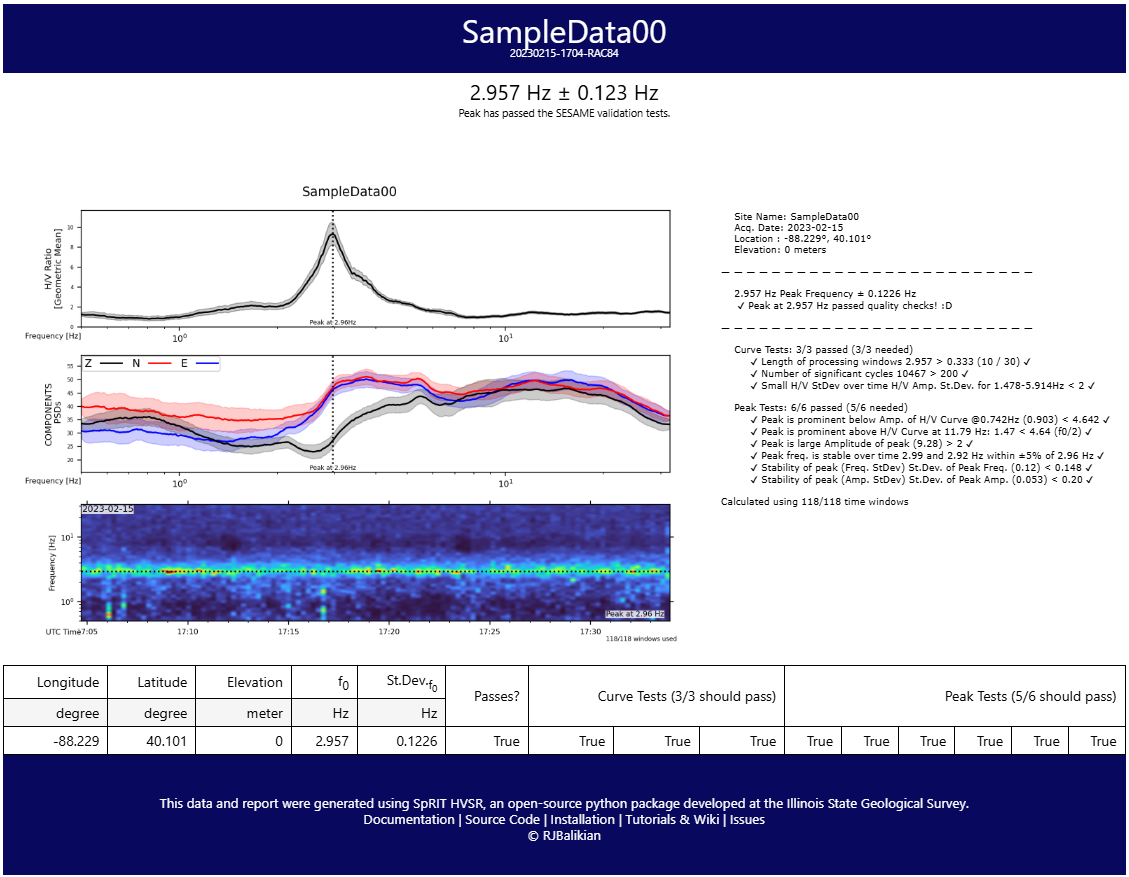
There are three interfaces to the SpRIT HVSR processing code:
- Python interface:
sprit.run(input_data=seisimic_data) - Command line interface:
sprit seismic_data - Graphical User Interfaces (see below)
In the above examples, input_data accepts the following inputs:
- A file readable by ObsPy (supported formats here)
- An ObsPy Stream object
- An input to create a HVSRBatch instance, or
- Use "sample" (or leave
sprit.run()blank) to use a sample dataset.
Additional options and parameters available for the sprit.run() workflow can be viewed using help(sprit.run) in the python interface or sprit -h in command line, or by viewing the documentation (links above).
An example Jupyter notebook is provided in this main repository directory here.
Code examples include:
- Basic processing of sample HVSR data
- Metadata/parameter specification
- Data editing
- Reading Tromino data into SpRIT
- Reports and visualization
- User interfaces
- Export and import
- Batch processing
- Cross Section Plotting
Web App
An experimental, browser based web app is available for use via Streamlit. you can find this at sprithvsr.streamlit.app
HVSR Background
The Horizontal to Vertical Spectral Ratio (HVSR) technique is a method used to analyze ambient seismic noise to calculate the dominant frequency at a site.
This package will allow ambient seismic data to be read in the most common seismic data formats, and will perform Horizontal Vertical Spectral Ratio (HVSR) analysis on the data. H/V analysis was standardized and popularized by the Site EffectS assessment using AMbient Excitations (SESAME) project, with a comprehensive final report issued in 2003.1 This SESAME project and its J-SESAME pacakge were crucial in the developing of the HVSR technique, and the outputs aided in the development of this software package.
This python package is built in large part off the Incorporated Research Institutions in Seismology (IRIS) Horizontal to Vertical Spectral Ratio (HVSR) processing package.2 Specifically, the computeHVSR.py tools that enable the ability to rank HVSR peaks, calculate data quality and peak quality, and the combining of the horizontal components was adapted directly from that package. Because the SpRĪT package is intended to be used to analyze data from rapid field data acquisitions (less than an hour per site), much of the IRIS package was adapted from daily to HV curve calculations to sub-hourly and even sub-minute HV calculations. Because there is limited data, there is no baseline to compare to, so that element is excluded from this package.
That version is intended to read data from the IRIS Data Management Center (DMC) MUSTANG online service,3 which is a toolbox that provides processes for enabling data quality analysis services to data archived in the DMC. For example, a simple service query can extract power spectral density estimates, noise spectrograms, H/V plots, etc.
For guidelines on acquisition, processing, and interpration of H/V data, see: http://sesame.geopsy.org/Papers/HV_User_Guidelines.pdf.
Dependencies
Aside from the modules in the python standard library, the following package dependencies must be installed in your environment for this package to work
- Obspy: Python framework for processing seismological data
- Numpy: "The fundamental package for scientific computing with Python"
- Scipy: "Fundamental algorithms for scientific computing in Python"
- Pandas: "A fast, powerful, flexible and easy to use open source data analysis and manipulation tool"
- pyproj: Module for cartographic projections and coordinate transformations, a python interface to PROJ
- Matplotlib: Comprehensive library for creating static, animated, and interactive visualizations in python
- plotly: Open Source Graphing Library for Python that makes interactive, publication-quality graphs.
Dependencies specifically for GUIs
Jupyter Widget GUI
- ipython
- ipywidgets
- nbformat
Streamlit GUI (browser based)
- streamlit
References
- [1] http://sesame.geopsy.org/Delivrables/SESAME-Finalreport_april05.pdf
- [2] https://github.com/iris-edu/HVSR
- [3] http://service.iris.edu/mustang/
Considerations
Summary from SESAME Project (from https://www.iitk.ac.in/nicee/wcee/article/13_2207.pdf): In very brief, the main learnings may be summarized as follows:
- In situ soil / sensor coupling should be handled with care. Concrete and asphalt provide good results, whereas measuring on soft / irregular soils such as mud, grass, ploughed soil, ice, gravel, not compacted snow, etc. should be avoided. Artificial soil / sensor coupling should be avoided unless it is absolutely necessary, for example, to compensate a strong inclination of the soil. In such a case, either a pile of sand, or a trihedron should be used This soil/sensor coupling issue proves to be particularly important under windy conditions.
- It is recommended not to measure above underground structures. Nearby surface structures should be considered with care, particularly under windy conditions.
- Measurements under wind or strong rain should be avoided. Wind has been found to induce very significant low frequency perturbations.
- The proximity of some specific noise sources should be considered with care (or avoided using an anti-trigger window selection to remove the transients): nearby walking, high speed car or truck traffic, industrial machinery, etc.
- Results tend to be stable with time (if other parameters, such as weather conditions, etc. are kept constant).
- No matter how strongly a parameter influences H/V amplitudes, the value of the frequency peak is usually not or slightly affected, with the noticeable exception of the wind in certain conditions.
Citation
If you use the sprit package in your research, please use the following citation:
Riley Balikian, Hongyu Xaio, Alexandra Sanchez. SPRIT HVSR: An open-source software package for processing, analyzing, and visualizing ambient seismic vibrations. Proceedings of the Geological Society of America, 2023. Pittsburgh, PA.
1 maintainer

Download files
Download the file for your platform. If you're not sure which to choose, learn more about installing packages.
Source Distribution
Built Distribution
Filter files by name, interpreter, ABI, and platform.
If you're not sure about the file name format, learn more about wheel file names.
Copy a direct link to the current filters
File details
Details for the file sprit-3.14.1.tar.gz.
File metadata
- Download URL: sprit-3.14.1.tar.gz
- Upload date:
- Size: 67.9 MB
- Tags: Source
- Uploaded using Trusted Publishing? No
- Uploaded via:
twine/7.0.0 CPython/3.13.14
File hashes
| Algorithm | Hash digest | |
|---|---|---|
| SHA256 |
66ac54ed33a88cb8ebc9e73a923b9cc7dc9bfe2b4ee6cfb75bfbea0ff90f598a
|
|
| MD5 |
92e53d41a30c88007ac260d79769d831
|
|
| BLAKE2b-256 |
3bc1abe5d5ae0a8d4fc1ed285320dc44bfe57ca0608191a44192368d23e20723
|
File details
Details for the file sprit-3.14.1-py3-none-any.whl.
File metadata
- Download URL: sprit-3.14.1-py3-none-any.whl
- Upload date:
- Size: 68.8 MB
- Tags: Python 3
- Uploaded using Trusted Publishing? No
- Uploaded via:
twine/7.0.0 CPython/3.13.14
File hashes
| Algorithm | Hash digest | |
|---|---|---|
| SHA256 |
04600780790f41ee6ecd15e9c3114bbbb7bae75db9a060a81b1260555d81a4dc
|
|
| MD5 |
f51f8d837b23975e1fbf6f6972dacc63
|
|
| BLAKE2b-256 |
80afadf956382e8b60afd3e8cade16135685931bca83a0342f2ed4f5459cb6e3
|














