
sqlparse-turbo





sqlparse's format(),
split() and parse(), rewritten in Rust:
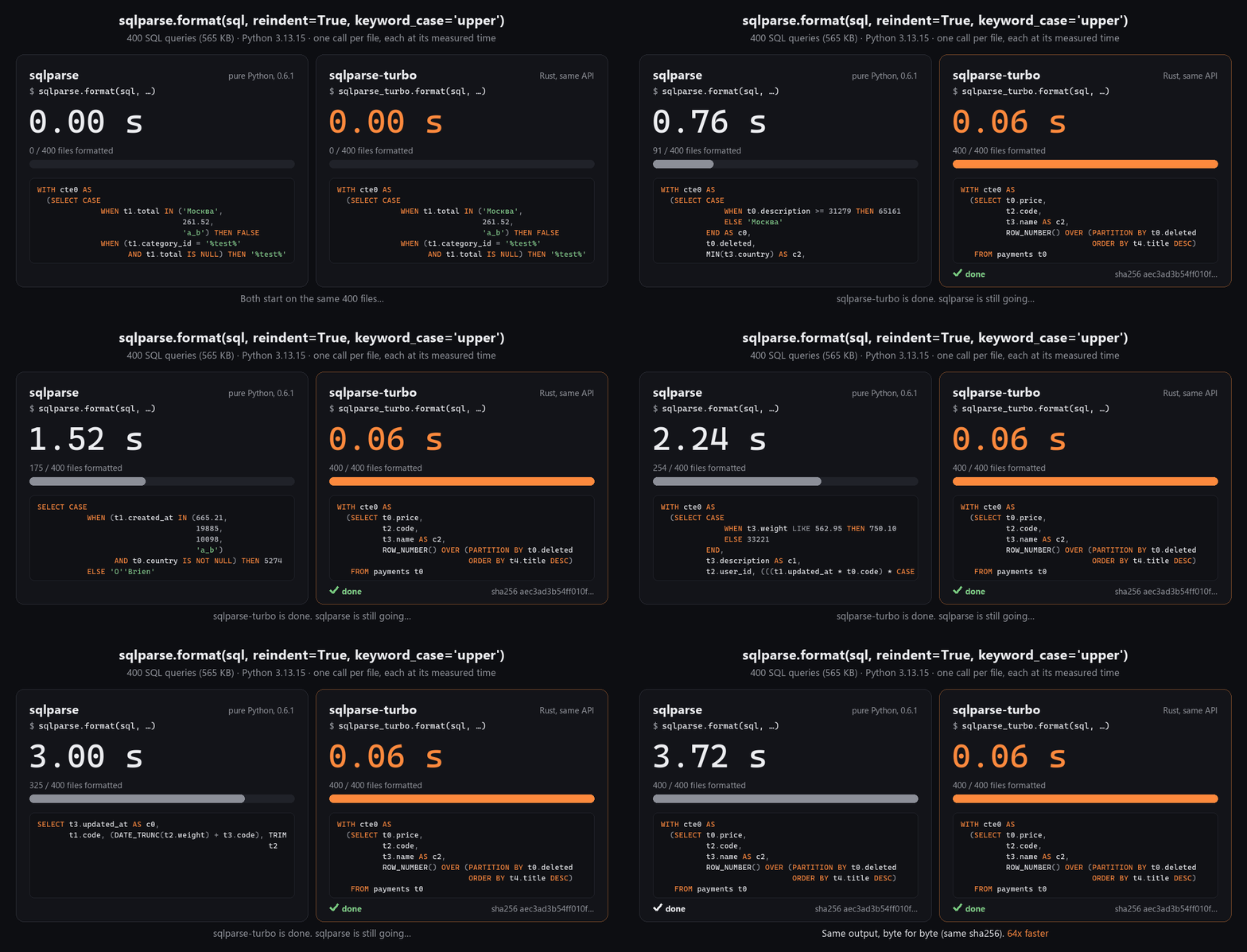
same output, byte for byte, 17-113 times
faster.
pip install sqlparse-turbo "sqlparse==0.6.1"
sqlparse is the pure-Python SQL splitter and formatter that Django depends on (every SQL script a migration
runs goes through sqlparse.split and sqlparse.format, and the test runner formats debug SQL with it), along
with many other tools and scripts. It is also slow: formatting two megabytes of SQL takes over ten seconds. Rust SQL libraries
(sqlparser-rs, sqlformat-rs, sqloxide) are fast, but they format differently, so switching to them changes
your output. This project ports sqlparse itself, quirks included, and proves the port gives the same answer
as the original on every input it has been shown.
import sqlparse_turbo

sqlparse_turbo.format(sql, reindent=True, keyword_case='upper')   # == sqlparse.format(sql, reindent=True, ...)
sqlparse_turbo.split(sql)                                          # == sqlparse.split(sql)
sqlparse_turbo.split_many(sqls)                                    # split() of each, on all CPU threads
sqlparse_turbo.parse(sql)                                          # == sqlparse.parse(sql): sqlparse's own objects

sqlparse_turbo.install()    # from now on sqlparse.format / sqlparse.split are the Rust ones, for every caller,
                            # and sqlparse.parse and sqlparse's lexer too
sqlformat-turbo -r -k upper query.sql # sqlparse's own `sqlformat` command, formatting in Rust
Django
Django and its tools call sqlparse themselves. One line at the top of settings.py gives all of them the Rust,
with nothing else changed:
import sqlparse_turbo
sqlparse_turbo.install()
- django-debug-toolbar formats every query of a
page for its SQL panel with its own sqlparse filter stack. With
install()the statements come grouped from the Rust and only the toolbar's own filters run in Python: the panel formats the 400 corpus queries 4.2x faster (4.92 s → 1.17 s), the HTML identical, and a page making 200 ORM queries loads 2x faster through the toolbar (0.60 s → 0.30 s, the rest being the queries themselves and the templates). Measured withbench/django_toolbar.py, Django 6.1, django-debug-toolbar 8.0, Python 3.13. - Migrations with
RunSQLscripts andsqlmigratego throughsqlparse.splitandsqlparse.format. - Tests: the runner formats debug SQL with
sqlparse.format.
Results
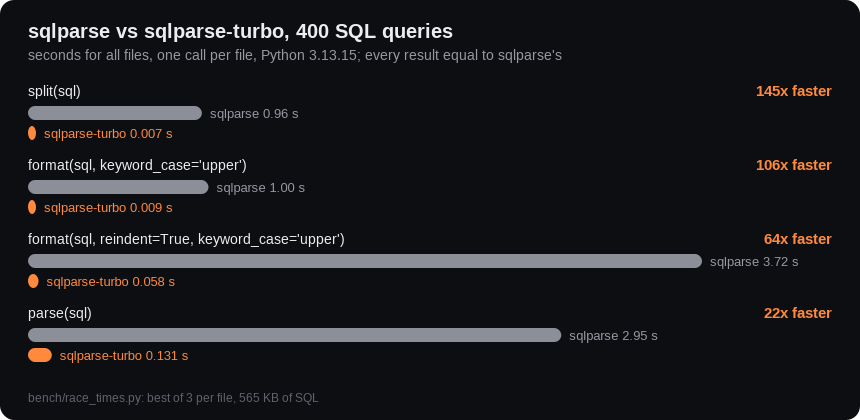
The chart and the animation above come from bench/race_times.py (best of 3 per file,
every result checked equal) and tools/make_visuals.py.
The whole benchmark corpus (440 files, 2.1 MB of SQL: generated queries and scripts), sqlparse 0.6.1 against
sqlparse_turbo through the same public calls, CPython 3.11, Windows 11, best of 3, every result checked equal
(bench/bench_package.py):
| Call | sqlparse | sqlparse_turbo | Speed-up |
|---|---|---|---|
split(sql) |
3.42 s | 0.034 s | 100x |
format(sql, keyword_case='upper') |
3.59 s | 0.078 s | 46x |
format(sql, reindent=True, keyword_case='upper') |
12.12 s | 0.404 s | 30x |
format(sql, strip_comments=True) |
10.58 s | 0.321 s | 33x |
format(sql, reindent_aligned=True) |
12.53 s | 0.395 s | 32x |
format(sql, reindent=True, indent_columns=True, comma_first=True) |
12.86 s | 0.408 s | 32x |
split_many over the 400 query files takes 0.003 s against sqlparse's 1.07 s (12 threads), and with
install() sqlparse's lexer.tokenize is 20x faster.
parse(sql) over the 400 query files: sqlparse 3.1 s, sqlparse_turbo 0.30-0.48 s (6-10x); with Python's
cyclic garbage collector off, 2.8 s against 0.145 s (19x). The statements are grouped in Rust and handed
back as sqlparse's own Statement, Identifier, ... objects, made with object.__new__ and their slots set
from the Rust tree, so a group's value joined when the group was made, normalized taken at creation and
every parent pointer are sqlparse's. A tree is a reference cycle (parent and tokens), so freeing one
waits for the garbage collector, in sqlparse as here: that collection is most of what is left.
Against markocerkez/sqlparse-rs
markocerkez/sqlparse-rs (PyPI sqlparse-rs 0.1.0, imported as
sqlparse_rs) ports sqlparse's lexer and split to Rust and leaves grouping and the filters, so format, in
Python. Both packages on the same 400 query files
(579 KB), same machine, best of 3, every result equal to sqlparse's:
| Call | sqlparse | markocerkez | this one |
|---|---|---|---|
split, each file (CPython 3.13) |
0.99 s | 0.014 s | 0.010 s |
format(keyword_case='upper') (3.13) |
1.05 s | 0.34 s | 0.021 s |
format(strip_comments=True) (3.13) |
3.2 s | 2.5 s | 0.096 s |
format(reindent=True, keyword_case='upper') (3.13) |
3.8 s | 3.1 s | 0.134 s |
split_many, all files (3.13) |
1.31 s | 0.004 s | 0.004 s |
lexer.tokenize, each file (3.13) |
0.72 s | 0.034 s | 0.032 s |
parse, each file (3.13) |
3.1 s | 2.36 s | 0.18 s (0.3-0.6 s as the garbage collector runs) |
split, each file (CPython 3.11) |
1.00 s | 0.77 s | 0.010 s |
format(reindent=True, keyword_case='upper') (3.11) |
3.7 s | 3.4 s | 0.13 s |
Its Rust tables follow the Unicode version of the Python it was generated on (3.13), and on every other Python it hands all non-ASCII text to sqlparse: on 3.11, 243 of the 400 files, and a script that is one of them as a whole. This package keeps the Rust for all text but the few code points that changed between Unicode versions (see Unicode versions below).
| What was checked | Result |
|---|---|
Recorded cases (rust-anything diff): the original run on the corpus, sqlparse's own test files and generated edge cases, through every option |
7,842 / 7,842 identical, errors included |
sqlparse's own test suite, with sqlparse_turbo.install() |
537 passed, same 2 xfail / 1 xpass as plain sqlparse |
Statement trees (tools/check_tree.py): every node's class, value, type and parent, on the corpus, sqlparse's test files, 2,730 cuts of them, 40,000 random scripts and limit inputs |
260,837 calls, 0 differ |
Lexer (tools/check_tokenize.py): recorded texts, cuts of them, random texts |
32,986 texts, 0 differ |
Case filters over every Unicode code point (tools/check_format_flat.py) |
26.7 million texts, 0 differ |
Package against sqlparse (tools/check_package.py): corpus x 13 option sets, split, CLI, bad option types, lexer changes |
6,090 calls in Rust, 0 differ; 18 out-of-range calls all answered by sqlparse |
The Rust lexer under install(): lexer.tokenize and every node of parse() (class, token type object, value) on the corpus, sqlparse's test files and 3,000 random scripts; split_many against split |
3,460 texts, 0 differ, all lexed in Rust; others (another Lexer, a changed one, bytes, streams) left to sqlparse |
Lexer and splitter over every Unicode code point (tools/check_codepoints.py, tools/check_split.py) |
12.2 million and 10.0 million texts, 0 differ |
Patched sqlparse (check_package.py patches): 6 kinds of patch x format, split, parse; recursion error chain |
every patched call answered by sqlparse with the patch, back in Rust once put back; SQLParseError from a RecursionError as in sqlparse |
Callers' own filter stacks through FilterStack.run (check_package.py stacks; check_recursion.py package): grouping only, the indent filters, a filter of the caller's own, serializers |
same trees and output as sqlparse's run, the recursion error from exactly the same size |
Other sqlparse versions (check_other_sqlparse.py, in CI with 0.4.4, 0.5.3, 0.6.0) |
every call answered by that sqlparse, nothing reaches the Rust |
Package over every non-ASCII code point (check_package.py unicode), on each CPython 3.10-3.14 |
the code points that behave as in 3.11 run in Rust, 0 differ; the drifted ones (see Unicode versions) go to sqlparse |
Fresh random cases (rust-anything fuzz --time 600) |
282,550 / 282,556; the 6 pass None where the front door types str/bool (a known difference of the test bindings, see below) |
Python's recursion limit (tools/check_recursion.py): 11 deep-nesting shapes, 3 caller depths, through C calls |
fails at exactly the same size on CPython 3.10, 3.11, 3.12, 3.13, 3.14 |
Platforms, in CI (.github/workflows/ci.yml) from the built wheel |
Linux x86_64 and aarch64 (manylinux2014), Windows x64, macOS arm64 and Intel (universal2) x CPython 3.10, 3.11, 3.12, 3.13, 3.14: all 25 combinations pass sqlparse's suite, the recursion check and the package check (the whole check, front door included, on Linux x86_64) |
Install
pip install sqlparse-turbo "sqlparse==0.6.1" # sqlparse_turbo, the sqlformat-turbo command, and sqlparse 0.6.1
Only sqlparse 0.6.1 gets the Rust. The package does not require that version (requiring it would stop a project pinned to another sqlparse from installing it at all), so pip keeps whatever sqlparse a project already has. On another version everything works as plain sqlparse, no faster, and the import warns:
RuntimeWarning: sqlparse_turbo runs in Rust only with sqlparse 0.6.1; sqlparse 0.5.3 is installed, so every call
goes to sqlparse at its own speed (pip install "sqlparse==0.6.1")
sqlparse_turbo.ACTIVE tells which it is.
Wheels are built for Linux x86_64 and aarch64, Windows x64 and macOS (arm64 and Intel), one abi3 wheel each for every CPython from 3.10 on. Elsewhere pip builds from the source distribution, which needs a Rust toolchain.
From a checkout (builds with maturin): pip install .
or build wheels to copy elsewhere: maturin build --release (an abi3 wheel: one file for every CPython from 3.10 on).
maturin build --release --zig --target x86_64-unknown-linux-gnu --compatibility manylinux2014 -i python3.11
builds the Linux wheel from Windows.
Use
sqlparse_turbo.format(sql, encoding=None, **options) and sqlparse_turbo.split(sql, encoding=None, strip_semicolon=False) take exactly what sqlparse's take and return exactly what they return, errors
included: an invalid option raises sqlparse.exceptions.SQLParseError with sqlparse's message, and a
statement nested past Python's recursion limit raises sqlparse's SQLParseError('Maximum recursion depth exceeded') at the same nesting depth.
sqlparse_turbo.split_many(sqls, strip_semicolon=False) is [sqlparse.split(s) for s in sqls], with the texts
split in Rust on all CPU threads at once and Python's lock released (texts the Rust does not take go to
sqlparse one by one). split releases the lock too, so other Python threads run meanwhile.
sqlparse_turbo.install() replaces sqlparse.format and sqlparse.split on the module, so every caller that
writes sqlparse.format(...) (Django's prepare_sql_script and test runner, the sqlformat CLI) gets the Rust
without changing a line. It also gives sqlparse's default lexer the Rust tokenizer (Lexer.get_tokens), so
sqlparse.parse() and everything else that tokenizes gets faster too: the same (token type, value) pairs, with
sqlparse's own token type objects, and only for the default lexer as sqlparse sets it up and a str the Rust
takes. A name bound before with from sqlparse import format keeps the original. uninstall() puts sqlparse's
functions back. install() refuses (returns False) if the installed sqlparse is not 0.6.1.
install() also replaces FilterStack.run, which callers use to run their own sqlparse filters
(django-debug-toolbar's SQL panel): a stack with grouping on and no token-stream filters gets its statements
grouped in Rust, as parse() makes them, and runs its own statement filters and serializers on them in Python.
Any other stack runs as sqlparse's.
sqlformat-turbo (or python -m sqlparse_turbo) is sqlparse's sqlformat, same arguments, output and exit codes.
When the Rust runs, and when sqlparse does
A call runs in Rust only when it is inside what was proven. Everything else goes to sqlparse itself, unchanged, so the answer is always sqlparse's:
| Runs in Rust | Goes to sqlparse |
|---|---|
| sqlparse 0.6.1 installed | any other sqlparse version |
sql is a str (any encoding: sqlparse only uses it for bytes) |
bytes, a stream, a str subclass, a str with lone surrogates |
| sqlparse's default lexer as sqlparse sets it up | after Lexer.add_keywords, set_SQL_REGEX, clear (Rust again after default_initialization()) |
options of exactly the type the port takes: True/False, int, str, None where allowed |
reindent=1, reindent=None, indent_width=4.0, a str subclass, an int past 64 bits |
indent_width up to 4096 |
a larger indent_width (see Limits) |
| text whose characters this Python's Unicode tables treat as CPython 3.11's do (all ASCII text, nearly all other) | text holding a code point that changed since Unicode 14 on this Python (see below) |
keywords sqlparse never reads (filename, outfile, ... as the CLI passes them) are dropped, as sqlparse ignores them |
|
| sqlparse's code as installed (Rust again once a change is put back) | a replaced, wrapped, added or deleted function, method, class or constant in sqlparse's modules (grouping, filters, sql, tokens, keywords, lexer, ...) |
The rules are in python/sqlparse_turbo/__init__.py.
Patched sqlparse. A program that monkeypatches sqlparse (grouping.group_identifier = ..., a new method
on Identifier, MAX_GROUPING_TOKENS = 5) gets its patch: the package remembers every name in sqlparse's
modules and classes at import and sends calls to sqlparse while one of them differs. On CPython 3.12+ Python
tells the package when one of those dicts changes (a dict watcher), so the comparison runs once after a change
and a call pays well under a microsecond for it; on 3.10 and 3.11 it runs on every call, about 7 µs (a
format("select 1") takes ~10 µs there against ~3 µs on 3.13).
Unicode versions. The Rust's character tables (\w, \d, case mapping, isprintable, line breaks, final
sigma) are taken from CPython 3.11, which has Unicode 14. Other CPythons ship other Unicode versions: 3.10 has
13.0, 3.12 has 15.0, 3.13 has 15.1, 3.14 has 16.0, and on each some code points behave differently (newly
assigned CJK letters become \w and case-insensitive keyword matching changes around them, for example). sqlparse
follows the Python it runs on, so a text holding such a code point goes to sqlparse.
tools/unicode_drift.py compares every code point's behaviour on each CPython with
3.11's and writes the list (_unicode_drift.py: 839 code points for
Unicode 13, 4,489 / 5,116 / 10,304 for 15.0 / 15.1 / 16.0). On a Unicode version not in the list, only ASCII text
runs in Rust. The list goes to the Rust once, as one bit per code point, and a text is checked in one pass.
sqlparse_turbo.parse(sql, encoding=None) returns what sqlparse.parse returns: a tuple of sqlparse's own
Statement objects, node for node, for callers to walk and change; install() puts it in place of
sqlparse.parse (parsestream, a generator, stays sqlparse's). It runs in Rust under the same conditions as
format(), and raises sqlparse's SQLParseError at the same nesting depth.
How it is proven
The port is checked with rust-anything, a tool that records a Python library's behaviour and replays it against a Rust port:
upstream/is sqlparse itself, a git submodule pinned to release 0.6.1. Nothing in it is changed.front/sqlparse_front.pyis the front door:tokenize,split,formatwith every option, andparse_tree(parse()'s tree as plain lists, so the tree is compared node by node).rust-anything recordruns the original on generated edge cases and real SQL (bench/make_inputs.py: the benchmark corpus and sqlparse's own test files, through the option sets people use) and saves what every call returns or raises.rust-anything diffreplays all of it against the Rust (rust/sqlparse-front/);fuzzgenerates fresh inputs and compares the two live;gateruns fmt, clippy, tests, no-unsafe, no-panic and the replay.- The scripts in
tools/go further than the recording: every Unicode code point through the lexer and case filters, hundreds of thousands of trees, the recursion threshold, and the package's public calls against sqlparse's.
How the lexer matches Python's re
Python 3.11 and Rust disagree on \w, \s, \d, \b and case-insensitive letters outside ASCII (Unicode 14
against a newer table, combining marks, numerics like ½, ſ and the Kelvin sign).
tools/gen_lexer.py writes src/lexer_tables.rs from sqlparse itself: every character
class in SQL_REGEX becomes the exact set of code points Python's re matches, asked code point by code
point. Patterns with lookahead run on fancy-regex, so backtracking behaves as in re (123abc lexes as 12
3abcin both); one-character lookbehinds are checked on the character before the match. Each rule gets the set of characters a match can start with, so a position only tries the rules that can match there, and each rule with lookaround gets a lookaround-free prefilter that every match also matches, run first on the regex crate's DFA: where it finds nothing, the slow backtracking engine is skipped.
How the tree matches sqlparse's
src/tree.rs is sql.py on an arena,
src/grouping.rs is grouping.py function by function, and
src/filters.rs the filters that work on the tree. What sqlparse does by
accident is kept, because output depends on it:
- a group's
valueis joined when the group is made and never refreshed: the reindent filter measures identifiers by it, and the Python/PHP output filters print it, after strip_whitespace has changed the leaves (str()is recomputed from the leaves, as in Python); normalized,is_keywordandis_whitespaceare taken at creation (group_operatorlater retypes*);_groupwalks a copy of the list taken at the start, so a token already moved into a group is still looked at, with an index that is off;tidx_offsetand the staleprev_are reproduced;ttype in T.X(subtypes) againstttype in (T.X, T.Y)(equality) andisinstance(x, TokenList)(any group) are told apart everywhere;- tokens put in with
tokens.inserthave no parent, which_current_line_lenandwithin()see; - with an output format, the statement's tokens become a generator the serializer uses up, so the reindent
filter separates the next statement as if the last one were
''; - the limits raise what sqlparse raises: grouping depth 100, 10,000 tokens,
right_marginisNotImplementedError, and Python's own recursion limit, which ~980 nested BEGIN blocks or BETWEEN chains reach. The port counts the frames sqlparse would use from the caller's real stack depth, asks Python for the exact headroom when close to the limit, and knows that CPython 3.12+ no longer counts C calls (such as''.join) against it, so it fails from exactly the same size as sqlparse on every version.
Speed
The Rust alone, no Python (cargo run --release --example bench_format, bench_lexer, bench_split), same
corpus, best of 3, before and after the last optimisation pass:
| Step | first port | regex lexer | now |
|---|---|---|---|
lex (tokenize, 799k tokens) |
0.19 s | 0.087 s | 0.026 s |
split |
0.21 s | 0.10 s | 0.032 s |
parse (lex, split, group) |
0.50 s | 0.36 s | 0.30 s |
format(reindent=True, keyword_case='upper') |
0.62 s | 0.48 s | 0.41 s |
format(strip_comments=True) |
0.49 s | 0.37 s | 0.28 s |
format(reindent_aligned=True) |
0.55 s | 0.41 s | 0.34 s |
The last step was the lexer. 88 % of tokens (spaces, words, punctuation, numbers, strings, comparison
operators) are now recognised by hand-written matchers that decide sqlparse's rules in sqlparse's order:
fast_token in src/lexer.rs. Tests pin which rules each character can
start, and every other case still runs the regexes: a non-ASCII character where \w or \d would matter,
$/# in a word, an unclosed string, a word that can open a multi-word keyword (GROUP BY, LEFT JOIN; then
only that keyword's own rules run). The splitter stopped allocating for keywords and slices statements straight
out of the text.
The package adds little on top (the string crosses into Rust and back once per call, plus a look at the Python stack for the recursion limit).
Where the Rust spends its time now on format(reindent=True), whole corpus: grouping 40 % (spread over 19
passes, the largest, group_matching, 8 %), lexing 20 %, the reindent filter 18 %, building the tree and
copying tokens 8 %. No single hot spot is left; going further would mean merging grouping passes, which
sqlparse runs one after another over the whole tree and whose order the output depends on.
What made it fast besides being Rust: tokens are spans into one string, the tree is an arena of indices,
grouping passes walk the tree instead of rebuilding lists, keyword lookups use a sorted table without
allocating, and the lexer skips most regex work (first-character table, DFA prefilters for lookaround rules:
the last pass made the lexer 2.2x faster with them).
sqlparse spends 58 % of format() in grouping, 27 % lexing and splitting and 9 % in the reindent filter
(docs/profile-format.md); its quadratic spots (_current_line_len re-joining the
whole statement for every line) are walked backwards to the last line break in the port.
Limits and known differences
- Out of memory. sqlparse raises
MemoryError; Rust cannot catch a failed allocation and stops the process. The indent string, the one thing that grows with an option rather than with the input, is allocated as Python does it (OverflowErrorpastsys.maxsize,MemoryErrorwhen it cannot be had), but a later copy of a gigabyte-sized result can still fail. Only a hugeindent_widthmakes a small statement that big, so the package givesindent_widthabove 4096 to sqlparse. - A call the package hands to sqlparse has the package's frame on the stack as well, so sqlparse's own recursion limit comes one nesting level sooner than when called directly.
FilterStack.runwithinstall()decides between the Rust and sqlparse's own run when it is called; sqlparse's reads the stack's filters when the first statement is asked for, so a filter added to the stack afterrun()was called but before iterating is not seen.- The
RecursionErrorbehind the recursionSQLParseErrorsaysmaximum recursion depth exceeded. On CPython 3.10 sqlparse's says where Python hit the limit as well (... in comparison,... in __instancecheck__), which depends on the C call sqlparse was in; theSQLParseErroritself is the same. - The front-door bindings (
rust/sqlparse-front, used for the recording) take typed arguments:Nonefor a bool option is aTypeErrorthere, where sqlparse treats it as False. The package never sends such calls to the Rust. - Exception class needs rust-anything with dotted exception kinds
(erkamyaman/rust-anything#207, not merged yet) to
regenerate the bindings; the bindings in this repository already raise sqlparse's own
SQLParseError. - Not tested: Windows on ARM, musl (Alpine), PyPy, free-threaded CPython; no wheels are built for them.
Layout
| Path | What |
|---|---|
python/sqlparse_turbo/ |
the package: format, split, install, the CLI |
rust/sqlparse-front/src/ |
the port: lexer.rs, split.rs, tree.rs, grouping.rs, filters.rs, format.rs, port.rs (about 3,800 hand-written lines); lexer_tables.rs, pyunicode_tables.rs are generated from Python by tools/gen_lexer.py and tools/gen_unicode.py; lib.rs and the conversions are generated by rust-anything |
front/ |
the front door rust-anything records and replays |
upstream/ |
sqlparse 0.6.1 (git submodule) |
bench/ |
corpus generator (gen_corpus.py, same seed = same bytes), Python workload, recording inputs, bench_package.py |
tools/ |
the checks listed above, generators, run_upstream_package.py |
Development
git submodule update --init
python -m venv .venv && .venv/Scripts/python -m pip install -e ./upstream pytest maturin
.venv/Scripts/python -X utf8 bench/gen_corpus.py          # the corpus (not committed)
.venv/Scripts/python -X utf8 bench/make_inputs.py         # inputs for the recording

# the port, with .venv/Scripts first on PATH so rust-anything's Python sees the pinned sqlparse:
rust-anything record rust/sqlparse-front --inputs rust/sqlparse-front/inputs.jsonl
rust-anything build rust/sqlparse-front
rust-anything diff rust/sqlparse-front
rust-anything gate rust/sqlparse-front
cargo run --release --manifest-path rust/sqlparse-front/Cargo.toml --example bench_format   # Rust alone

# the package:
VIRTUAL_ENV=.venv maturin develop --release
.venv/Scripts/python -X utf8 tools/run_upstream_package.py
.venv/Scripts/python -X utf8 tools/check_package.py
.venv/Scripts/python -X utf8 tools/check_recursion.py package
.venv/Scripts/python -X utf8 bench/bench_package.py
rust-anything gate passes everything except size: it compares the Rust's line count with the 59-line
front door, and most of the Rust is the generated Unicode and lexer tables.
License
BSD-3-Clause, like sqlparse (LICENSE). The port follows sqlparse's code closely, so sqlparse's
copyright notice is kept next to ours.
1 maintainer

Metadata
1 maintainer
Release files for sqlparse-turbo 0.1.1
For a detailed explanation of source distributions (sdists) and built distributions (wheels), please see the package formats documentation.
Source distribution (sdist)
| File | Size | Uploaded | Provenance | Actions |
|---|---|---|---|---|
| sqlparse_turbo-0.1.1.tar.gz | 183.2 kB | With provenance | Details for sqlparse_turbo-0.1.1.tar.gz |
Built distributions (wheels)
| File | Actions Reset | |||
|---|---|---|---|---|
| sqlparse_turbo-0.1.1-cp39-abi3-win_amd64.whl | CPython 3.9 | abi3 | Windows x86-64 | Details for sqlparse_turbo-0.1.1-cp39-abi3-win_amd64.whl |
| sqlparse_turbo-0.1.1-cp39-abi3-manylinux2014_x86_64.manylinux_2_17_x86_64.whl | CPython 3.9 | abi3 | Linux glibc 2.17+ x86-64 | Details for sqlparse_turbo-0.1.1-cp39-abi3-manylinux2014_x86_64.manylinux_2_17_x86_64.whl |
| sqlparse_turbo-0.1.1-cp39-abi3-manylinux2014_aarch64.manylinux_2_17_aarch64.whl | CPython 3.9 | abi3 | Linux glibc 2.17+ ARM64 | Details for sqlparse_turbo-0.1.1-cp39-abi3-manylinux2014_aarch64.manylinux_2_17_aarch64.whl |
| sqlparse_turbo-0.1.1-cp39-abi3-macosx_10_12_universal2.macosx_10_12_x86_64.macosx_11_0_arm64.whl | CPython 3.9 | abi3 | macOS 10.12+ universal2 (ARM64, x86-64), macOS 10.12+ x86-64, macOS 11.0+ ARM64 | Details for sqlparse_turbo-0.1.1-cp39-abi3-macosx_10_12_universal2.macosx_10_12_x86_64.macosx_11_0_arm64.whl |
Total release size: 6.3 MB
Release files / sqlparse_turbo-0.1.1.tar.gz
| Download URL | sqlparse_turbo-0.1.1.tar.gz |
|---|---|
| Size | 183.2 kB |
| Tags | Source |
|
SHA-256 checksum How to use checksums |
947744c4955ff3ed5ba6664136a57c18b7d0aa425c972dc0cbaa10b38caabd80
|
|
BLAKE2b-256 checksum How to use checksums |
f23d125811d098531c994c41684a3ffe151271035f92a7553bc229be8c279a0b
|
| Upload date | |
|
Uploaded using Trusted Publishing? What is trusted publishing? |
Yes |
| Uploaded via |
twine/7.0.0 CPython/3.13.16
|
Provenance
Provenance describes where a file came from. On PyPI, provenance is shared via attestations, which provide a verifiable record of the build or publishing details. View details, limitations and caveats.


PyPI Publish Attestation
PyPI verified that this artifact, at this checksum, originated from the publisher listed below.
Signed by GitHub Actions, verified by PyPI on Nov 23, 2026.
Transparency logRelease files / sqlparse_turbo-0.1.1-cp39-abi3-win_amd64.whl
| Download URL | sqlparse_turbo-0.1.1-cp39-abi3-win_amd64.whl |
|---|---|
| Size | 1.2 MB |
| Tags | CPython 3.9 Windows x86-64 abi3 |
|
SHA-256 checksum How to use checksums |
4ab2e34bf1e2665f46578f9811973052595227c31f76a3ea7bb2c4890f9023be
|
|
BLAKE2b-256 checksum How to use checksums |
b1ef869375df42b85efe9b2e91e7bc273fb4151c2e793fd3ac700f9009f6a35c
|
| Upload date | |
|
Uploaded using Trusted Publishing? What is trusted publishing? |
Yes |
| Uploaded via |
twine/7.0.0 CPython/3.13.16
|
Provenance
Provenance describes where a file came from. On PyPI, provenance is shared via attestations, which provide a verifiable record of the build or publishing details. View details, limitations and caveats.
PyPI Publish Attestation
PyPI verified that this artifact, at this checksum, originated from the publisher listed below.
Signed by GitHub Actions, verified by PyPI on Nov 23, 2026.
Transparency logRelease files / sqlparse_turbo-0.1.1-cp39-abi3-manylinux2014_x86_64.manylinux_2_17_x86_64.whl
| Download URL | sqlparse_turbo-0.1.1-cp39-abi3-manylinux2014_x86_64.manylinux_2_17_x86_64.whl |
|---|---|
| Size | 1.3 MB |
| Tags | CPython 3.9 Linux glibc 2.17+ x86-64 abi3 |
|
SHA-256 checksum How to use checksums |
cd3effaae77a98f09b294bdbe40f03ca6658ba6718dfe90d36a57d90146a10b9
|
|
BLAKE2b-256 checksum How to use checksums |
b241ffe021c4d84623f55dff58d4c76f25503d7f59898fc8958de9ec761a19d7
|
| Upload date | |
|
Uploaded using Trusted Publishing? What is trusted publishing? |
Yes |
| Uploaded via |
twine/7.0.0 CPython/3.13.16
|
Provenance
Provenance describes where a file came from. On PyPI, provenance is shared via attestations, which provide a verifiable record of the build or publishing details. View details, limitations and caveats.
PyPI Publish Attestation
PyPI verified that this artifact, at this checksum, originated from the publisher listed below.
Signed by GitHub Actions, verified by PyPI on Nov 23, 2026.
Transparency logRelease files / sqlparse_turbo-0.1.1-cp39-abi3-manylinux2014_aarch64.manylinux_2_17_aarch64.whl
| Download URL | sqlparse_turbo-0.1.1-cp39-abi3-manylinux2014_aarch64.manylinux_2_17_aarch64.whl |
|---|---|
| Size | 1.3 MB |
| Tags | CPython 3.9 Linux glibc 2.17+ ARM64 abi3 |
|
SHA-256 checksum How to use checksums |
78cb2725fb40884b2bdbeca7c464c3c21293ed3b3c95c99f54de1122c818efca
|
|
BLAKE2b-256 checksum How to use checksums |
da993d83fa78706fa236056130ce3b4c9e3e2a0ac276ac4d24c41567a5313939
|
| Upload date | |
|
Uploaded using Trusted Publishing? What is trusted publishing? |
Yes |
| Uploaded via |
twine/7.0.0 CPython/3.13.16
|
Provenance
Provenance describes where a file came from. On PyPI, provenance is shared via attestations, which provide a verifiable record of the build or publishing details. View details, limitations and caveats.
PyPI Publish Attestation
PyPI verified that this artifact, at this checksum, originated from the publisher listed below.
Signed by GitHub Actions, verified by PyPI on Nov 23, 2026.
Transparency logRelease files / sqlparse_turbo-0.1.1-cp39-abi3-macosx_10_12_universal2.macosx_10_12_x86_64.macosx_11_0_arm64.whl
| Download URL | sqlparse_turbo-0.1.1-cp39-abi3-macosx_10_12_universal2.macosx_10_12_x86_64.macosx_11_0_arm64.whl |
|---|---|
| Size | 2.4 MB |
| Tags | CPython 3.9 abi3 macOS 10.12+ universal2 (ARM64, x86-64) macOS 10.12+ x86-64 macOS 11.0+ ARM64 |
|
SHA-256 checksum How to use checksums |
37d4a882cb3599429732dba91e868b935a1c9aac5b2d92cc61c65f241de4d65b
|
|
BLAKE2b-256 checksum How to use checksums |
b30eb9e4faa65f46b01bebe9893995da80fff25b9c4e31b44d7786c975634b71
|
| Upload date | |
|
Uploaded using Trusted Publishing? What is trusted publishing? |
Yes |
| Uploaded via |
twine/7.0.0 CPython/3.13.16
|
Provenance
Provenance describes where a file came from. On PyPI, provenance is shared via attestations, which provide a verifiable record of the build or publishing details. View details, limitations and caveats.
PyPI Publish Attestation
PyPI verified that this artifact, at this checksum, originated from the publisher listed below.
Signed by GitHub Actions, verified by PyPI on Nov 23, 2026.
Transparency logSecurity for sqlparse-turbo 0.1.1
Provenance
Provenance describes where a file came from. On PyPI, provenance is shared via attestations, which provide a verifiable record of the build or publishing details. View details, limitations and caveats.
Full provenance
All 5 files in this release have been uploaded with provenance metadata.
Attestation for sqlparse_turbo-0.1.1.tar.gz
PyPI Publish Attestation
PyPI verified that this artifact, at this checksum, originated from the publisher listed below.
Signed by GitHub Actions, verified by PyPI on Nov 23, 2026.
Transparency logA note on package security
PyPI is a repository for distributing packages, not a service for auditing them. While third-party security researchers and our staff do their best to detect and remove malicious packages, PyPI cannot guarantee the quality, security or suitability of any given package.
To learn more about protecting yourself from malicious actors, visit our package security documentation.














