

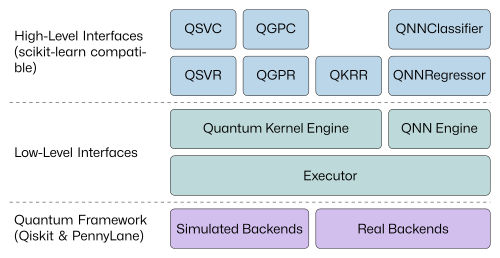
sQUlearn is a user-friendly, NISQ-ready Python library for quantum machine learning (QML), designed for seamless integration with classical machine learning tools like scikit-learn. The library's dual-layer architecture serves both QML researchers and practitioners, enabling efficient prototyping, experimentation, and pipelining. sQUlearn provides a comprehensive tool set that includes both quantum kernel methods and quantum neural networks, along with features like customizable data encoding strategies, automated execution handling, and specialized kernel regularization techniques. By focusing on NISQ-compatibility and end-to-end automation, sQUlearn aims to bridge the gap between current quantum computing capabilities and practical machine learning applications.
sQUlearn offers scikit-learn compatible high-level interfaces for various kernel methods, QNNs and quantum reservoir computing. They build on top of the low-level interfaces of the QNN engine and the quantum kernel engine. The executor is used to run experiments on simulated and real backends of the PennyLane, Qiskit and Qulacs frameworks.
Prerequisites
The package requires at least Python 3.10.
Install sQUlearn
Stable Release
To install the stable release version of sQUlearn, run the following command:
pip install squlearn
Alternatively, you can install sQUlearn directly from GitHub via
pip install git+ssh://git@github.com:sQUlearn/squlearn.git
Examples
There are several more elaborate examples available in the folder ./examples which display the features of this package.
Tutorials for beginners can be found at ./examples/tutorials.
To install the required packages, run
pip install .[examples]
Contribute to sQUlearn
Thanks for considering contributing to sQUlearn! Please read our contribution guidelines before you submit a pull request.
License
sQUlearn is released under the Apache License 2.0
Cite sQUlearn
If you use sQUlearn in your work, please cite our paper:
Kreplin, D. A., Willmann, M., Schnabel, J., Rapp, F., Hagelüken, M., & Roth, M. (2025). sQUlearn: A Python Library for Quantum Machine Learning. IEEE Software, 42(5), 65–72. https://doi.org/10.1109/MS.2025.3527736
Contact
This project is maintained by the quantum computing group at the Fraunhofer Institute for Manufacturing Engineering and Automation IPA.
http://www.ipa.fraunhofer.de/quantum
For general questions regarding sQUlearn, use the GitHub Discussions or feel free to contact sQUlearn@gmail.com.
Acknowledgements
This project was supported by the German Federal Ministry of Economic Affairs and Climate Action through the projects AutoQML (grant no. 01MQ22002A) and AQUAS (grant no. 01MQ22003D), as well as the German Federal Ministry of Education and Research through the project H2Giga Degrad-EL3 (grant no. 03HY110D).
Disclaimer
This software is provided strictly for research and experimental purposes. It represents early-stage exploratory work and has not been validated, verified, or tested for any operational, commercial, or production use.
Technology Readiness Level: TRL 1–3 (Basic principles observed through proof-of-concept)
- No claims are made regarding reliability, accuracy, or fitness for any particular purpose
- The codebase may be incomplete, unstable, or subject to fundamental changes without notice
- Results produced by this software are not guaranteed to be reproducible or correct
- This project exists solely for academic inquiry, algorithmic exploration, and open scientific collaboration
This software is not designed, intended, or suitable for deployment in any real-world system or application. Users assume all responsibility for any use beyond basic research experimentation.
2 maintainers


Metadata
2 maintainers
Release files for squlearn 0.12.0
For a detailed explanation of source distributions (sdists) and built distributions (wheels), please see the package formats documentation.
Source distribution (sdist)
| File | Size | Uploaded | Provenance | Actions |
|---|---|---|---|---|
| squlearn-0.12.0.tar.gz | 198.1 kB | With provenance | Details for squlearn-0.12.0.tar.gz |
Built distribution (wheel)
| File | Interpreter | ABI | Platform | Actions Reset |
|---|---|---|---|---|
| squlearn-0.12.0-py3-none-any.whl | Python 3 | none | any | Details for squlearn-0.12.0-py3-none-any.whl |
Total release size: 464.2 kB
Release files / squlearn-0.12.0.tar.gz
| Download URL | squlearn-0.12.0.tar.gz |
|---|---|
| Size | 198.1 kB |
| Tags | Source |
|
SHA-256 checksum How to use checksums |
d2ac3bfa874cdea50ec8cb19bc6e8be0fb1913d938d778039e3f98689d4fb3d1
|
|
BLAKE2b-256 checksum How to use checksums |
7ad40f824b80890bce3d489d333beed74d4f814eb5e33b3d73f88426b038e8a2
|
| Upload date | |
|
Uploaded using Trusted Publishing? What is trusted publishing? |
Yes |
| Uploaded via |
twine/7.0.0 CPython/3.13.16
|
Provenance
Provenance describes where a file came from. On PyPI, provenance is shared via attestations, which provide a verifiable record of the build or publishing details. View details, limitations and caveats.


PyPI Publish Attestation
PyPI verified that this artifact, at this checksum, originated from the publisher listed below.
Signed by GitHub Actions, verified by PyPI on Oct 26, 2026.
Transparency logRelease files / squlearn-0.12.0-py3-none-any.whl
| Download URL | squlearn-0.12.0-py3-none-any.whl |
|---|---|
| Size | 266.1 kB |
| Tags | Python 3 |
|
SHA-256 checksum How to use checksums |
64b9a59c4793a6e0281647f1d3f70de5924a4fdcf939078b254f9844380a7605
|
|
BLAKE2b-256 checksum How to use checksums |
774c1a18d4d42f843342a98fbecc14e20d1a1fd921b2e5430a6df3fbaa9248af
|
| Upload date | |
|
Uploaded using Trusted Publishing? What is trusted publishing? |
Yes |
| Uploaded via |
twine/7.0.0 CPython/3.13.16
|
Provenance
Provenance describes where a file came from. On PyPI, provenance is shared via attestations, which provide a verifiable record of the build or publishing details. View details, limitations and caveats.
PyPI Publish Attestation
PyPI verified that this artifact, at this checksum, originated from the publisher listed below.
Signed by GitHub Actions, verified by PyPI on Oct 26, 2026.
Transparency logSecurity for squlearn 0.12.0
Provenance
Provenance describes where a file came from. On PyPI, provenance is shared via attestations, which provide a verifiable record of the build or publishing details. View details, limitations and caveats.
Full provenance
All 2 files in this release have been uploaded with provenance metadata.
Attestation for squlearn-0.12.0.tar.gz
PyPI Publish Attestation
PyPI verified that this artifact, at this checksum, originated from the publisher listed below.
Signed by GitHub Actions, verified by PyPI on Oct 26, 2026.
Transparency logA note on package security
PyPI is a repository for distributing packages, not a service for auditing them. While third-party security researchers and our staff do their best to detect and remove malicious packages, PyPI cannot guarantee the quality, security or suitability of any given package.
To learn more about protecting yourself from malicious actors, visit our package security documentation.














