

Symbolic Regression Benchmark Framework
PyPI · Docs · Interactive results
srbf: Symbolic Regression Benchmark Framework
Publications
- Saegert & Köthe 2026, Breaking the Simplification Bottleneck in Amortized Neural Symbolic Regression (ICML 2026) https://arxiv.org/abs/2602.08885
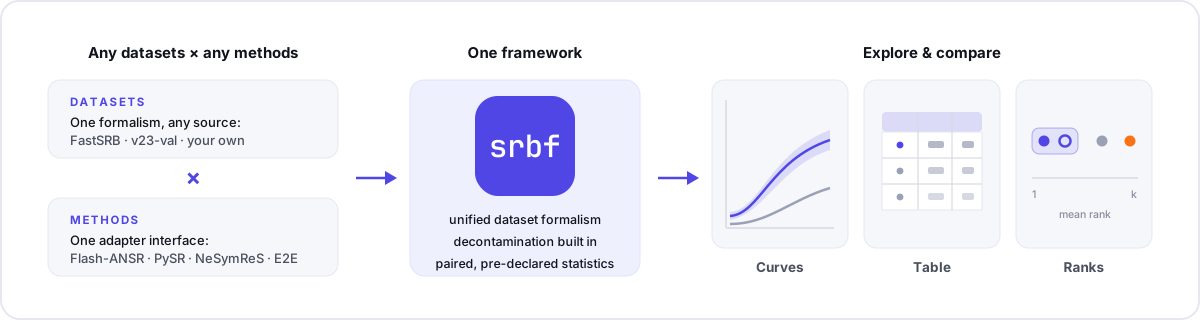
srbf evaluates symbolic-regression models on shared benchmarks with shared metrics. It is the
Symbolic Regression Benchmark Framework carved out of
flash-ansr: the Benchmark driver, model adapters, and
metrics, over symbolic-data catalogs. It depends one-way on flash-ansr (srbf imports
flash-ansr; flash-ansr never imports srbf).
Built for contributions. Developers of SR methods add their model with an adapter that runs
in the method's own environment (any torch, simplipy or Julia version): srbf new mymethod writes the
worker, its suite config, an environment recipe and a test; srbf check runs it on real problems;
srbf run and srbf analyze give the numbers. The pull request carries those files. Methods
compatible with srbf's pins can instead register an in-process adapter class. The built-in adapters
(flash_ansr, pysr, nesymres, e2e, lample_charton, brute_force) are reference examples, not
a closed set. See the adapter contribution guide and CONTRIBUTING.md.
The benchmark seam (srbf.core Protocols + the Benchmark driver) is model-agnostic, the data
source is always a symbolic-data catalog, and adapters are a thin mapper over each model
(flash-ansr via FlashANSR.infer()). Inline !sweep config cross-products and multi-draw
bootstrap reporting (bootstrap_report / draw_distribution) are built in.
Install
pip install srbf                 # benchmark driver + metrics + the flash-ansr adapter (usable out of the box)
pip install "srbf[baselines]"    # + PySR and other pip baseline deps (sympy, pysr, omegaconf)
srbf pulls in flash-ansr, symbolic-data, and simplipy automatically, and requires
Python >= 3.12. The PySR adapter ships in the base wheel but the pysr package (plus a
Julia precompile) comes with the [baselines] extra, so a bare install does not include a
runnable PySR baseline. The unpackaged research baselines (NeSymReS, E2E) are provisioned
out-of-band; see docs/models.md.
Quickstart
# 1. point srbf at a tree holding configs/, data/, and models/ (your srbf checkout works)
export FLASH_ANSR_ROOT=$(pwd)

# 2. get a model to evaluate (flash-ansr's CLI ships with srbf)
flash_ansr install psaegert/flash-ansr-v25.0-T7-3M

# 3. run an evaluation. The config names a symbolic-data catalog (`fastsrb`); it is fetched from
#    Hugging Face on first use and cached, so there is no local data-build step. The config is a
#    sweep over candidate counts; --sweep-filter picks one rung for a smoke test.
srbf run -c configs/evaluation/scaling/flash-ansr-v25.0-T7-3M_fastsrb.yaml --sweep-filter ladder=32 --limit 50 -v
Outputs land under results/evaluation/.../*.pkl, one row per evaluated problem with the raw
prediction columns (derive FVU / recovery / F1 in a separate step; see
docs/running.md). Run programmatically instead:
from srbf import Benchmark

# A config with inline !sweep / experiments expands to several runs; expand and run each one.
for benchmark in Benchmark.runs_from_config("configs/evaluation/scaling/flash-ansr-v25.0-T7-3M_fastsrb.yaml"):
    benchmark.run()  # resume-aware; a no-op if that run's configured target is already reached

# For a single, fully-resolved run (no !sweep / experiments), use from_config directly:
# Benchmark.from_config(config_dict).run()
Documentation
| Guide | What it covers |
|---|---|
| Running evaluations | the srbf run CLI, config anatomy (data_source / model_adapter / runner / experiments / !sweep), outputs, resume, reporting |
| Benchmarks & datasets | the data_source catalog block, the shipped catalog (fastsrb), custom catalogs |
| Models & provisioning | installing/patching the built-in models; the model_adapter block per type |
| Fairness & provenance | one protocol for every method, the upstream-defaults policy, config-provenance labels, blessed configs |
| Adding your model | the adapter protocol + registry, and the PR flow to contribute a new SR method |
Development
pip install -e ".[dev]"
pre-commit run --all-files
pytest tests
License
MIT (see LICENSE). Third-party attributions in THIRD_PARTY_LICENSES.
1 maintainer

Release files for srbf 0.19.0
For a detailed explanation of source distributions (sdists) and built distributions (wheels), please see the package formats documentation.
Source distribution (sdist)
| File | Size | Uploaded | |
|---|---|---|---|
| srbf-0.19.0.tar.gz | 148.2 kB | Details |
Built distribution (wheel)
| File | Interpreter | ABI | Platform | Reset |
|---|---|---|---|---|
| srbf-0.19.0-py3-none-any.whl | Python 3 | none | any | Details |
Total release size: 303.5 kB
Release files / srbf-0.19.0.tar.gz
| Download URL | srbf-0.19.0.tar.gz |
|---|---|
| Size | 148.2 kB |
| Tags | Source |
|
SHA-256 checksum How to use checksums |
da220b37fa2ef4549a28fe15e1b3a2d49987d0963d8296c396e11a3d211377b1
|
|
BLAKE2b-256 checksum How to use checksums |
d5e905a5421bc7e85dbb7dd24011e70b60dd60cd13fedc54b215a44d0df5ba20
|
| Upload date | |
|
Uploaded using Trusted Publishing? What is trusted publishing? |
Yes |
| Uploaded via |
twine/7.0.0 CPython/3.13.14
|
Provenance
Provenance describes where a file came from. On PyPI, provenance is shared via attestations, which provide a verifiable record of the build or publishing details. View details, limitations and caveats.


PyPI Publish Attestation
PyPI verified that this artifact, at this checksum, originated from the publisher listed below.
Signed by GitHub Actions, verified by PyPI on Sep 14, 2026.
Transparency logRelease files / srbf-0.19.0-py3-none-any.whl
| Download URL | srbf-0.19.0-py3-none-any.whl |
|---|---|
| Size | 155.3 kB |
| Tags | Python 3 |
|
SHA-256 checksum How to use checksums |
ba92907d2c394de0dd0613c2278a83d3139de3c421678ffb577cc5cca3041723
|
|
BLAKE2b-256 checksum How to use checksums |
f6de1b2e19113ad172d652eaa29ddf5236cfa830147357a6f7f8486929548487
|
| Upload date | |
|
Uploaded using Trusted Publishing? What is trusted publishing? |
Yes |
| Uploaded via |
twine/7.0.0 CPython/3.13.14
|
Provenance
Provenance describes where a file came from. On PyPI, provenance is shared via attestations, which provide a verifiable record of the build or publishing details. View details, limitations and caveats.
PyPI Publish Attestation
PyPI verified that this artifact, at this checksum, originated from the publisher listed below.
Signed by GitHub Actions, verified by PyPI on Sep 14, 2026.
Transparency log













