




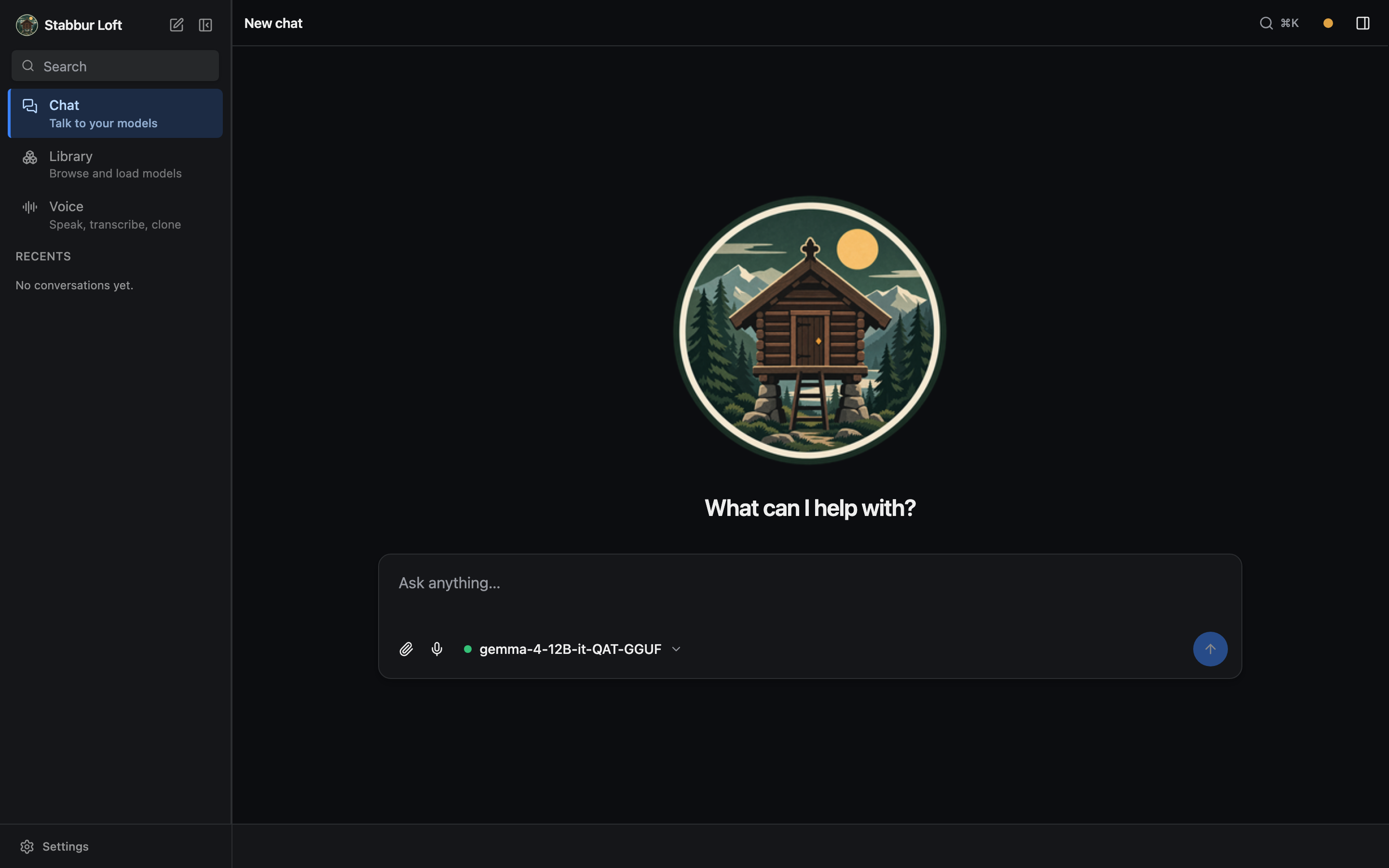
A tool for building and keeping a full local library of LLM models. It discovers models from Hugging Face, Ollama, and LM Studio, pulls them into a single library (browse via a Typer CLI or a browser chat UI), and runs them from there. The library lives under one configurable root you point at an external drive (e.g. a 5TB drive).
Short form. Every command is also available as sb — sb chat, sb serve, sb library ls.
The name. A stabbur is the Norwegian storehouse — raised on pillars, off the ground and out of the damp, where a household kept what it had gathered and wanted to keep. That is what this is: your models, pulled in from wherever they came from and kept somewhere of your own, on your own box, rather than in someone else's cloud.
Proprietary, source-available. stabbur is not open-source. Copyright (c) 2026 Morten Hansen, all rights reserved (see
LICENSE). The source is published for reference and evaluation; running it requires a written license — contact morten@winterop.com. Install is from source withuv(there is nopip install stabbur).
Layout
src/stabbur/
├── config.py          # Pydantic settings (STABBUR_* env vars)
├── models.py          # Catalog / entry / result models
├── catalog.py         # Aggregates listing + pull across sources
├── library.py         # Scans the on-drive library (gguf/ mlx/ voice/ ...)
├── capabilities.py    # Detects per-model tools/vision/audio + context
├── runtime.py         # Serves a model (llama.cpp / mlx_lm / mlx-vlm)
├── voice/             # Voice models: registry, import, TTS/STT runtime
├── cli/              # Typer CLI package, one module per command group (entry: `stabbur` → stabbur.cli:main)
├── app.py             # FastAPI app factory
├── routers/           # health + catalog (browse/pull) + serving (load/chat/audio) endpoints
└── sources/           # huggingface / ollama / lmstudio adapters
Setup
uv sync                       # stabbur itself (needs Python 3.13 + uv)
brew install llama.cpp        # baseline runtime: GGUF chat + OuteTTS speech (build from source on Linux)
make install-mlx              # optional: MLX runtimes (Apple Silicon)
uv sync --extra voice         # optional: mlx-audio runtimes (Dia/Whisper, Apple Silicon)
make frontend                 # optional: build the web UI (needs Bun)
export STABBUR_LIBRARY_ROOT=/path/to/your/library   # required: where your library lives
stabbur doctor                   # verify what's installed
Point stabbur at a library. stabbur won't guess a location — set STABBUR_LIBRARY_ROOT
(a per-machine shell/.env value; an external drive is the intended home). Without
it, library commands fail with a clear message instead of silently using ./data.
Install globally (run stabbur from any directory):
uv tool install --editable ".[mlx,voice,web,benchmark]"   # from a checkout: stabbur on your PATH, code edits live
uv tool install "git+https://github.com/winterop-com/stabbur" # or straight from git (requires repo access; core CLI)
# then put STABBUR_LIBRARY_ROOT in your shell profile (~/.zshrc) so it applies everywhere
Only uv sync + llama.cpp are needed to run GGUF models; the rest are optional.
The benchmark extra adds the stabbur benchmark eval command; drop it if you don't need it.
See getting started for details.
stabbur is installed from source (uv sync / uv tool install -e .), not from PyPI. It builds
as a single self-contained wheel — the bundled first-party MCP servers are vendored into the stabbur
package (src/stabbur/mcp_servers/*) rather than published as separate packages — but stabbur is
proprietary/source-available and is not distributed on PyPI.
CLI
stabbur library ls                     # your library (the models on your drive)
stabbur library sources                # models in app caches (HF/Ollama/LM Studio) you could pull
stabbur library pull lmstudio lmstudio-community/gemma-4-12B-it-QAT-GGUF
stabbur library pull ollama gemma4:31b --move   # copy to the library, then delete the local copy
stabbur doctor                         # pre-flight: runtimes, library, project
stabbur serve --ui                     # browse + chat in the browser (Chat · Voice · Library)
stabbur chat gemma-4-12B-it-QAT-GGUF -p "hi"             # one-shot, scriptable
stabbur chat gemma-4-12B-it-QAT-GGUF -p "?" -i pic.jpg   # image input (vision model)
stabbur voice ls                       # voice models (TTS/STT) in the library
stabbur voice import --all             # import known voice models to the library
stabbur voice speak -v af_heart "hello there"           # text-to-speech (Kokoro)
stabbur voice speak --model dia --seed 10 "hi there"    # Dia (pin a seed for a stable voice)
stabbur project init                   # scaffold a project assistant (model + tools + prompt)
Two model families: Chat (language models you talk to — text in/out; some
also read images/audio or call tools) and Voice (TTS speaks, STT transcribes).
stabbur detects each chat model's capabilities and runs the right runtime — GGUF via
llama.cpp (llama-server, --mmproj for vision/audio), MLX via mlx_lm/mlx-vlm.
The web UI's Library lists both families; the Voice studio does TTS/STT
(Kokoro, Dia with voice cloning, Whisper); in chat you can attach images/audio,
dictate with the mic (Whisper), and read replies aloud (Kokoro by default). See
the voice guide.
Full docs: docs/ (run make docs to serve the site locally) —
getting started, the library, pulling, running & chatting, the web UI, the Chrome side panel,
the DHIS2 assistant, and the architecture.
API
stabbur serve exposes an OpenAI-compatible surface plus browse/voice endpoints:
/api/status, /api/library, /api/voice, /api/chat (tool-aware SSE),
/v1/* (proxied to the loaded model), and /v1/audio/speech +
/v1/audio/transcriptions. See the web UI guide for the
full endpoint table and the single-origin proxy design.
Chrome side panel & the DHIS2 assistant
stabbur ships an MV3 Chrome side panel (extension/, built with WXT) — a thin client for
a local or remote stabbur serve that puts your own model + tools next to any page. It builds
in two flavors from one codebase: the generic stabbur panel and stabbur for DHIS2
(STABBUR_FLAVOR=dhis2).
Pointed at a DHIS2 project (stabbur project new --template dhis2), it becomes the north-star
assistant: chat grounded in the page you are viewing, a target banner (verify + tab
match/mismatch), and "Use my login" — mint a read-only, GET-scoped Personal Access Token
in the DHIS2 tab's own security context and hand it to stabbur once, so the tools act as you
(with a session-cookie fallback). Everything runs against your own local model; nothing
leaves the box.
cd extension && bun install && bun run build          # -> extension/.output/chrome-mv3(-dhis2)
# chrome://extensions -> Load unpacked -> the built dir; then `stabbur serve` and open the panel
See the Chrome side panel guide and the verified prompt catalog.
Configuration
Two separate concepts:
-
The library location — where your models live. Set
STABBUR_LIBRARY_ROOT(a per-machine value; shell profile or.env). stabbur requires it — without one, library/chat/serve commands fail with a clear message rather than silently using a local folder. An external drive is the intended home:export STABBUR_LIBRARY_ROOT=/path/to/your/library # e.g. a mounted external drive
-
A project (
stabbur.toml, viastabbur project init/stabbur project new <dir>) — a purpose-built assistant:[project].model+system_prompt, with tools in a sibling.mcp.json(standardmcpServers). In a project,stabbur serve/stabbur chatbind to that model (like--model, with its tools + prompt); outside a project it's free-play (pick/switch any model). A project uses the machine library by default.
Precedence (high → low): CLI flags, STABBUR_* env vars, stabbur.toml, .env,
~/.config/stabbur/config.toml (machine defaults).
| Key / env var | Purpose |
|---|---|
STABBUR_LIBRARY_ROOT (or library_root) |
the library location (required) |
STABBUR_OLLAMA_MODELS_DIR, STABBUR_LMSTUDIO_MODELS_DIR |
source caches to pull from |
STABBUR_HF_TOKEN |
HF token (uses your HF login if unset) |
STABBUR_DEFAULT_MAX_TOKENS (or default_max_tokens) |
per-turn /api/chat generation cap (default 4096; 0 = unbounded) |
Develop
make lint    # ruff format + check, mypy, pyright (mutates)
make check   # same, read-only (CI gate) + tests
make test    # pytest
make build   # uv build (wheel + sdist)
1 maintainer

Download files
Download the file for your platform. If you're not sure which to choose, learn more about installing packages.
Source Distribution
Built Distribution
Filter files by name, interpreter, ABI, and platform.
If you're not sure about the file name format, learn more about wheel file names.
Copy a direct link to the current filters
File details
Details for the file stabbur-0.6.0.tar.gz.
File metadata
- Download URL: stabbur-0.6.0.tar.gz
- Upload date:
- Size: 330.4 kB
- Tags: Source
- Uploaded using Trusted Publishing? Yes
- Uploaded via:
twine/7.0.0 CPython/3.13.14
File hashes
| Algorithm | Hash digest | |
|---|---|---|
| SHA256 |
e613a069ce18122b4b0268246d9cdcd0bd503de31e91cc37b581582a1665acca
|
|
| MD5 |
1b9bc4cceb0dbf48757c69860929ba9a
|
|
| BLAKE2b-256 |
43454d33bfeb056beb30c18141b82b01b71bd44f28e8d198befab8f4a6037888
|
Provenance
The following attestation bundles were made for stabbur-0.6.0.tar.gz:
Publisher:
pypi-publish.yml on winterop-com/stabbur
-
Statement:
-
Statement type:
https://in-toto.io/Statement/v1 -
Predicate type:
https://docs.pypi.org/attestations/publish/v1 -
Subject name:
stabbur-0.6.0.tar.gz -
Subject digest:
e613a069ce18122b4b0268246d9cdcd0bd503de31e91cc37b581582a1665acca - Sigstore transparency entry: 2606389325
- Sigstore integration time:
-
Permalink:
winterop-com/stabbur@2c0ee17ab29d9f18255198b847ea7951aa3fc8cf -
Branch / Tag:
refs/tags/v0.6.0 - Owner: https://github.com/winterop-com
-
Access:
public
-
Token Issuer:
https://token.actions.githubusercontent.com -
Runner Environment:
github-hosted -
Publication workflow:
pypi-publish.yml@2c0ee17ab29d9f18255198b847ea7951aa3fc8cf -
Trigger Event:
push
-
Statement type:
File details
Details for the file stabbur-0.6.0-py3-none-any.whl.
File metadata
- Download URL: stabbur-0.6.0-py3-none-any.whl
- Upload date:
- Size: 406.9 kB
- Tags: Python 3
- Uploaded using Trusted Publishing? Yes
- Uploaded via:
twine/7.0.0 CPython/3.13.14
File hashes
| Algorithm | Hash digest | |
|---|---|---|
| SHA256 |
c6e9db946c6f5e37b5143791793ec3c1257114a39273a2008c47163a9196dcf5
|
|
| MD5 |
0645c0abe2aa113505c14f2c0d491cad
|
|
| BLAKE2b-256 |
fe17a12ecd268f2177171a784e766698c72241b317f6ee9f514f70b205acfe1c
|
Provenance
The following attestation bundles were made for stabbur-0.6.0-py3-none-any.whl:
Publisher:
pypi-publish.yml on winterop-com/stabbur
-
Statement:
-
Statement type:
https://in-toto.io/Statement/v1 -
Predicate type:
https://docs.pypi.org/attestations/publish/v1 -
Subject name:
stabbur-0.6.0-py3-none-any.whl -
Subject digest:
c6e9db946c6f5e37b5143791793ec3c1257114a39273a2008c47163a9196dcf5 - Sigstore transparency entry: 2606389712
- Sigstore integration time:
-
Permalink:
winterop-com/stabbur@2c0ee17ab29d9f18255198b847ea7951aa3fc8cf -
Branch / Tag:
refs/tags/v0.6.0 - Owner: https://github.com/winterop-com
-
Access:
public
-
Token Issuer:
https://token.actions.githubusercontent.com -
Runner Environment:
github-hosted -
Publication workflow:
pypi-publish.yml@2c0ee17ab29d9f18255198b847ea7951aa3fc8cf -
Trigger Event:
push
-
Statement type:














