
Stabilo Optimize: A Framework for Comprehensive Evaluation and Analysis for the Stabilo Library
Verified details
These details have been verified by PyPIProject links
GitHub Statistics
Maintainers

Project description
Stabilo Optimize












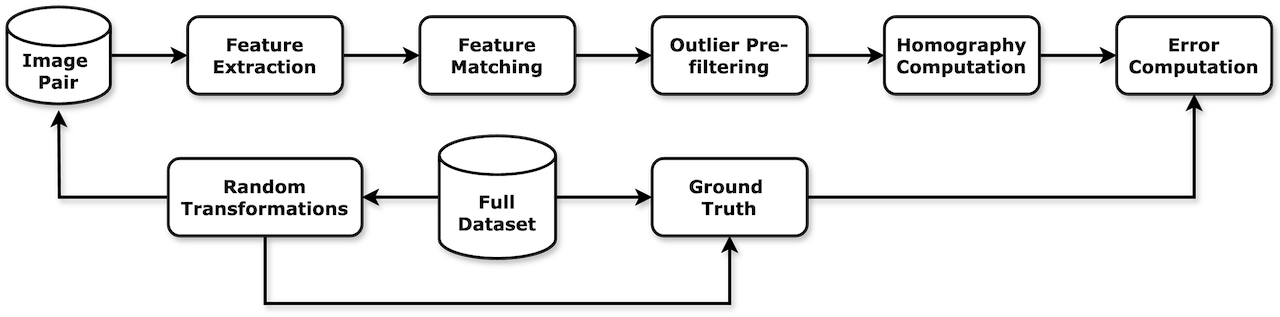
Stabilo-Optimize is a Python benchmarking tool designed specifically to evaluate and tune methods and hyperparameters of the Stabilo 🌀 library for video and track stabilization tasks. It systematically generates performance evaluations through random perturbations, eliminating the need for ground-truth homographies. This tool significantly simplifies the optimization of stabilization techniques, making it ideal for high-precision tasks in fields such as urban monitoring, traffic analysis, and drone imagery processing.
Why Stabilo-Optimize
- Ground Truth-Free Benchmarking: Randomly generates photometric and homographic perturbations (brightness variations, Gaussian blur, saturation adjustments, fog effects, rotations, translations, scales, and perspective shifts).
- Hierarchical Benchmarking Strategy: Encourages users to systematically vary hyperparameters hierarchically for efficient parameter optimization.
- Flexible JSON Configuration: Customize extensive parameter settings using nested dictionaries (see comprehensive_benchmark.json or simple_benchmark.json for examples).
- Result Visualization: Generates comprehensive performance plots and benchmarking process visualizations.
Install
Create and activate a Python virtual environment (Python 3.9–3.13), then install from PyPI:
python3.11 -m venv .venv
source .venv/bin/activate  # On Windows: .venv\Scripts\activate
pip install stabilo-optimize
Also works with uv (uv pip install stabilo-optimize) and conda.
For development, clone the repository and install in editable mode with the dev extra:
git clone https://github.com/rfonod/stabilo-optimize.git
cd stabilo-optimize && pip install -e '.[dev]'
Quick Start
A sample benchmark (simple_benchmark.json) with provided scenes and vehicle bounding box masks is included in the experiments/sample_experiment directory. To reproduce the results, run:
stabilo-optimize benchmark experiments/sample_experiment/simple_benchmark.json -sp -sv -o
-sp: Save performance plots.-sv: Save benchmark visualization video.-o: Overwrite previous results.
Add -l <path>/--log-file <path> (also available on plot) to additionally write console output to a file — parent directories are created automatically, color codes are stripped in the file, the resolved absolute path is printed to the console, and log files are gitignored (*.log) by default.
-v/--verbosity (benchmark only) controls how much detail is printed, including from Stabilo's own internal logging: 0=quiet (top-level status only, Stabilo's own messages fully suppressed), 1=minimal (+ per-run header/summary table, Stabilo errors only), 2=detailed (+ per-scene summary table, Stabilo warnings and up), 3=debug (+ per-trial output, Stabilo info and up).
Use stabilo-optimize benchmark --help to explore additional command-line options, or re-plot existing results without re-running the benchmark:
stabilo-optimize plot experiments/sample_experiment/simple_benchmark.json
Note: This example is limited to three scenes for demonstration purposes. Users should define their own benchmarks with a more representative selection of scenes for meaningful evaluation.
Custom Benchmarking
To set up your own benchmark, create a new experiment directory within experiments containing:
benchmark.json: Configuration specifying methods/hyperparameters and number of random trials (N) per scene. For reliable results, setN > 100.scenes: Directory containing input images (and optional exclusion masks in YOLO format). Ensure selected scenes adequately represent your stabilization tasks. To obtain reliable benchmarking results, include a diverse set of scenes covering different lighting conditions and camera viewpoints.
Example structure:
experiments
└─custom_experiment
  ├─benchmark.json
  └─scenes
    ├ image1.jpg
    ├ image1.txt
    ├ image2.jpg
    ├ image2.txt
    ├ ...
Note: A comprehensive configuration file (comprehensive_benchmark.json) is included for illustration purposes. Due to computational costs, users should avoid directly running such an extensive parameter search. Instead, adopt a hierarchical parameter search approach by fixing some hyperparameters and varying others.
Refer to the Stabilo 🚀 library and the associated article for detailed descriptions of available methods and hyperparameters.
GPU acceleration: setting gpu: true in the config runs (parts of) Stabilo's pipeline on an NVIDIA GPU — see docs/cuda.md in the Stabilo repo for building a CUDA-enabled OpenCV and setting it up. This mainly affects Computation_time, not tuning outcomes: RANSAC-based homography/affine estimation always runs on CPU, so the HEA/MIoU accuracy metrics are essentially unaffected by this setting.
Benchmarking Metrics
Benchmarks use metrics like Homography Estimation Accuracy (HEA) and Mean Intersection over Union (MIoU). MIoU specifically evaluates the accuracy of object-level registration and requires bounding box masks for calculation. Detailed metric definitions and analysis are provided in the manuscript.
Citation
If you use Stabilo-Optimize in your research, software, or product, please cite the following resources appropriately:
-
Preferred Citation: Please cite the associated article for any use of the Stabilo-Optimize, including research, applications, and derivative work:
@article{fonod2025advanced,
  title = {Advanced computer vision for extracting georeferenced vehicle trajectories from drone imagery},
  author = {Fonod, Robert and Cho, Haechan and Yeo, Hwasoo and Geroliminis, Nikolas},
  journal = {Transportation Research Part C: Emerging Technologies},
  volume = {178},
  pages = {105205},
  year = {2025},
  publisher = {Elsevier},
  doi = {10.1016/j.trc.2025.105205},
  url = {https://doi.org/10.1016/j.trc.2025.105205}
}
-
Repository Citation: If you reference, modify, or build upon the Stabilo-Optimize software itself, please also cite the corresponding Zenodo release:
@software{fonod2026stabilo-optimize,
  author = {Fonod, Robert},
  license = {MIT},
  month = jul,
  title = {Stabilo Optimize: A Framework for Comprehensive Evaluation and Analysis for the Stabilo Library},
  url = {https://github.com/rfonod/stabilo-optimize},
  doi = {10.5281/zenodo.13828430},
  version = {1.1.0},
  year = {2026}
}
Contributing
Contributions from the community are welcome! If you encounter any issues or have suggestions for improvements, please open a GitHub Issue or submit a pull request.
License
This project is distributed under the MIT License. See the LICENSE file for more details.
Project details
Verified details
These details have been verified by PyPIProject links
GitHub Statistics
Maintainers
Release history Release notifications | RSS feed

Download files
Download the file for your platform. If you're not sure which to choose, learn more about installing packages.
Source Distribution
Built Distribution
Filter files by name, interpreter, ABI, and platform.
If you're not sure about the file name format, learn more about wheel file names.
Copy a direct link to the current filters
File details
Details for the file stabilo_optimize-1.1.0.tar.gz.
File metadata
- Download URL: stabilo_optimize-1.1.0.tar.gz
- Upload date:
- Size: 31.3 kB
- Tags: Source
- Uploaded using Trusted Publishing? Yes
- Uploaded via: twine/6.1.0 CPython/3.13.12
File hashes
| Algorithm | Hash digest | |
|---|---|---|
| SHA256 |
592b2dad462aee64ec1562bad2225053e5e573bffc6f3a2c276b6386e431d8ea
|
|
| MD5 |
d337755d1cd90c64c46e8588606cfbfa
|
|
| BLAKE2b-256 |
c4d5662e256492c38f4fa8162edd5d62299cb67dcd965e78f46af9ba2bf224a5
|
Provenance
The following attestation bundles were made for stabilo_optimize-1.1.0.tar.gz:
Publisher:
publish.yml on rfonod/stabilo-optimize
-
Statement:
-
Statement type:
https://in-toto.io/Statement/v1 -
Predicate type:
https://docs.pypi.org/attestations/publish/v1 -
Subject name:
stabilo_optimize-1.1.0.tar.gz -
Subject digest:
592b2dad462aee64ec1562bad2225053e5e573bffc6f3a2c276b6386e431d8ea - Sigstore transparency entry: 2119577654
- Sigstore integration time:
-
Permalink:
rfonod/stabilo-optimize@5b00177634ad4b7f1bb188f11692952592628ddc -
Branch / Tag:
refs/tags/v1.1.0 - Owner: https://github.com/rfonod
-
Access:
public
-
Token Issuer:
https://token.actions.githubusercontent.com -
Runner Environment:
github-hosted -
Publication workflow:
publish.yml@5b00177634ad4b7f1bb188f11692952592628ddc -
Trigger Event:
release
-
Statement type:
File details
Details for the file stabilo_optimize-1.1.0-py3-none-any.whl.
File metadata
- Download URL: stabilo_optimize-1.1.0-py3-none-any.whl
- Upload date:
- Size: 27.0 kB
- Tags: Python 3
- Uploaded using Trusted Publishing? Yes
- Uploaded via: twine/6.1.0 CPython/3.13.12
File hashes
| Algorithm | Hash digest | |
|---|---|---|
| SHA256 |
3ce4f4628dd00c4e65866feda9bf36aa0e0c8cc2ff349dd5cb68288706ad3c1d
|
|
| MD5 |
a9947f446c232f66bd1dff2ec3f0a464
|
|
| BLAKE2b-256 |
87b3508ab1214f163a648aa67406f24ad56cfbe19dd450ec589022a59b17c25f
|
Provenance
The following attestation bundles were made for stabilo_optimize-1.1.0-py3-none-any.whl:
Publisher:
publish.yml on rfonod/stabilo-optimize
-
Statement:
-
Statement type:
https://in-toto.io/Statement/v1 -
Predicate type:
https://docs.pypi.org/attestations/publish/v1 -
Subject name:
stabilo_optimize-1.1.0-py3-none-any.whl -
Subject digest:
3ce4f4628dd00c4e65866feda9bf36aa0e0c8cc2ff349dd5cb68288706ad3c1d - Sigstore transparency entry: 2119577704
- Sigstore integration time:
-
Permalink:
rfonod/stabilo-optimize@5b00177634ad4b7f1bb188f11692952592628ddc -
Branch / Tag:
refs/tags/v1.1.0 - Owner: https://github.com/rfonod
-
Access:
public
-
Token Issuer:
https://token.actions.githubusercontent.com -
Runner Environment:
github-hosted -
Publication workflow:
publish.yml@5b00177634ad4b7f1bb188f11692952592628ddc -
Trigger Event:
release
-
Statement type:






