
No project description provided
Verified details
These details have been verified by PyPIProject links
GitHub Statistics
Maintainers

Reason this release was yanked:
Incorrect stable-retro-turbo version scheme; use 1.0.1.post2 instead.
Project description


🚀 Blazing-fast Stable Retro fork with native vectorization and preprocessing 🚀
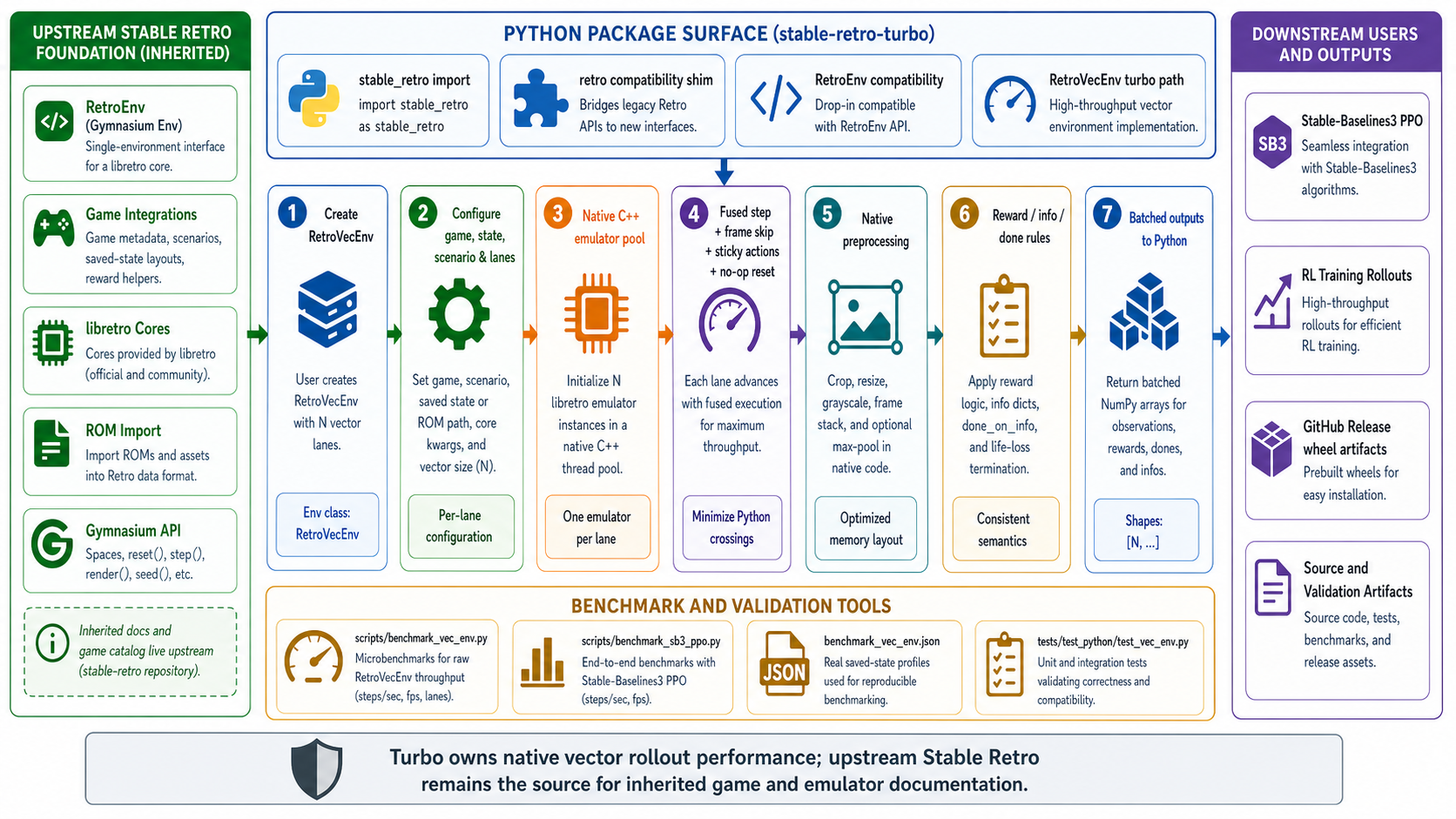
stable-retro-turbo is a performance-focused fork of Stable Retro that accelerates rollouts by moving vectorization and preprocessing into native code. By batching environment stepping and preprocessing natively, it avoids Python overhead, wrapper dispatch, and redundant memory copies, delivering substantially higher rollout throughput, especially with many parallel environments.
Turbo-Only Features
Compared with upstream Stable Retro's single-environment RetroEnv API,
stable-retro-turbo adds a training-oriented fast path:
- ⚡ Native vector environment:
RetroVecEnvprovides an SB3-compatible fast path for many emulator lanes at once. - 🧪 Fused native preprocessing: RL image transforms, frame handling, and reward clipping can run in the native rollout path.
- 📦 Observation ownership modes: Callers can choose copy-safe observations or faster view-based observations for benchmarks.
- 🔎 Native info filtering: Step metadata can be reduced before it crosses the Python boundary.
- 🛤️ Multi-state training support: Lanes can use fixed, sampled, and tracked start states for curricula or task-conditioned agents.
- 🔁 Lane-local autoreset: Finished lanes reset independently while keeping SB3 vector-env episode metadata.
- 🚦 Info-transition terminals: Episodes can end on changes in game info, such as first life loss.
- 🧾 Scenario-defined events: Integrations can declare reusable named
events in
scenario.json, including verbose multi-trigger events such as"op": "decrease"or"op": "change". - 🎛️ Rollout stochasticity controls: Sticky actions and random no-op starts are available in the native path.
- 🧩 Explicit ROM paths: Benchmarks and integrations can run without relying on an imported ROM lookup.
- 🍄 Expanded Mario saved states: Mario Level 1 and Level 2 starts ship with the package.
- 🍄 Super Mario event hooks:
SuperMarioBros-Nes-v0includes built-inlife_lossandlevel_changescenario events for policy evaluation and curriculum terminals.
Install
uv venv --python 3.14
uv pip install stable-retro-turbo
Use
import stable_retro as retro  # Uses the upstream-compatible import name.

# RetroVecEnv is a stable-retro-turbo interface
env = retro.RetroVecEnv(
    # stable-retro params (all stable-retro params can still be used)
    "SuperMarioBros-Nes-v0",      # Stable Retro game integration.
    state="Level1-1",             # Saved game state to load in each lane.

    # stable-retro-turbo specific params
    num_envs=32,                  # Number of emulator lanes stepped together.
    num_threads=16,               # Native worker threads for those lanes.
    render_mode="rgb_array",      # Return frame arrays instead of opening a window.
    obs_crop=(32, 0, 0, 0),       # Crop 32 pixels from the top before resizing.
    obs_resize=(84, 84),          # Resize observations natively for RL input.
    obs_resize_algorithm="area",  # Area resize is a good downsampling default.
    obs_grayscale=True,           # Convert RGB frames to grayscale natively.
    obs_layout="chw",             # Return channel-first tensors for PyTorch/SB3.
    obs_copy="safe_view",         # Avoid extra copies while keeping observations safe.
    frame_skip=4,                 # Repeat each action for 4 emulator frames.
    frame_stack=4,                # Stack the last 4 processed frames.
    maxpool_last_two=True,        # Max-pool recent frames to reduce flicker.
    noop_reset_max=0,             # Disable random no-op starts for this example.
    sticky_action_prob=0.0,       # Disable sticky actions for deterministic stepping.
    info_filter="terminal",       # Only return full info payloads at episode end.
)

obs = env.reset()  # Shape follows the native preprocessing choices above.
obs, rewards, dones, infos = env.step(
    [env.action_space.sample() for _ in range(32)]  # One action per env lane.
)
env.close()  # Release native emulator resources.
RetroVecEnv Parameters
retro.RetroVecEnv(
    game,
    state=retro.State.DEFAULT,
    scenario=None,
    info=None,
    use_restricted_actions=retro.Actions.FILTERED,
    record=False,
    players=1,
    inttype=retro.data.Integrations.STABLE,
    obs_type=retro.Observations.IMAGE,
    render_mode="human",
    *,
    num_envs=1,                  # number of emulator lanes in the vector env
    num_threads=None,            # native worker threads; defaults to num_envs
    rom_path=None,               # explicit ROM path for direct-ROM or external use
    obs_resize=None,             # native resize target as (width, height)
    obs_crop=None,               # native crop before resize
    obs_grayscale=False,         # convert image observations to grayscale
    obs_resize_algorithm="nearest", # "nearest", "bilinear", or "area"
    obs_layout="hwc",            # observation layout: "hwc" or "chw"
    obs_copy="copy",             # "copy", "safe_view", or "unsafe_view"
    frame_skip=1,                # repeat each action for this many frames
    frame_stack=1,               # stack this many processed frames
    maxpool_last_two=False,      # max-pool the last two skipped frames
    noop_reset_max=0,            # random no-op frames after reset
    sticky_action_prob=0.0,      # chance to repeat the previous lane action
    reward_clip=False,           # clip rewards in the native path
    info_filter="all",           # "all", "terminal", "none", or mode/keys mapping
    done_on=None,                # info-variable terminal rules
)
Inherited fields keep their upstream Stable Retro meaning. The native vector
path currently supports players=1, image observations, and no movie
recording. state also accepts turbo-only multi-state forms: a sequence with
one state per env lane, or a {state_name: weight} mapping sampled on reset.
| Turbo parameter | Default | What it controls |
|---|---|---|
num_envs |
1 |
Number of emulator lanes in the vector environment. |
num_threads |
None (num_envs) |
Native worker threads; when omitted, uses one worker per env lane. |
rom_path |
None |
Explicit ROM path for direct-ROM tests or external integrations. |
obs_resize |
None |
Native resize target as (width, height). |
obs_crop |
None |
Native crop before resize, using the same crop contract as RetroEnv. |
obs_grayscale |
False |
Convert image observations to grayscale natively. |
obs_resize_algorithm |
"nearest" |
Resize algorithm: "nearest", "bilinear", or "area". |
obs_layout |
"hwc" |
Observation layout: "hwc" or "chw". |
obs_copy |
"copy" |
Observation ownership mode: "copy", "safe_view", or benchmark-only "unsafe_view". |
frame_skip |
1 |
Repeat each action for this many emulator frames. |
frame_stack |
1 |
Stack this many processed frames in each returned observation. |
maxpool_last_two |
False |
Max-pool the last two skipped frames before preprocessing. |
noop_reset_max |
0 |
Apply up to this many random no-op frames after reset. |
sticky_action_prob |
0.0 |
Probability of repeating the previous lane action instead of the requested action. |
reward_clip |
False |
Clip rewards with the same semantics as the single-env preprocessing path. |
info_filter |
"all" |
Info payload filter: "all", "terminal", "none", or {"mode": ..., "keys": (...)}. |
done_on |
None |
General per-lane terminal rules keyed by info-variable change, increase, or decrease. |
Why SB3 VecEnv?
RetroVecEnv is specific to stable-retro-turbo and requires
stable-baselines3 at runtime because it subclasses SB3's VecEnv interface.
That makes the native vector path usable as a drop-in environment for SB3
algorithms such as PPO while preserving the vector-env contract SB3 expects:
batched observations, async step/wait calls, autoreset behavior, terminal
observations, reset info, and wrapper compatibility.
The advantage is that training code can keep the familiar SB3-facing API while
the expensive rollout work happens underneath it in native code. Upstream Stable
Retro users typically combine many Python RetroEnv instances through
SubprocVecEnv, DummyVecEnv, or Gymnasium vector wrappers, then apply Python
wrappers for frame skip, resize, grayscale, frame stack, and other preprocessing.
stable-retro-turbo keeps those model-facing semantics, but steps many emulator
lanes and applies preprocessing in one native batch, reducing Python dispatch,
process/wrapper overhead, memory copies, and per-frame preprocessing cost.
Commands
uv run python scripts/benchmark_vec_env.py --list-profiles                         # show saved benchmark profiles
uv run python scripts/benchmark_vec_env.py --profile supermario-level1-1 --dry-run # print resolved env benchmark config
uv run python scripts/benchmark_vec_env.py --profile supermario-level1-1           # run native/classic rollout benchmark
uv run python scripts/benchmark_sb3_ppo.py --profile supermario-level1-1 --dry-run # print resolved PPO benchmark config
uv run pytest tests/test_python/test_vec_env.py                                    # run focused RetroVecEnv tests
uv run --with build python -m build                                                # build source and wheel artifacts
Benchmarks
The benchmark profile file is
scripts/benchmark_vec_env.json. The default
user-facing profile is supermario-level1-1, which uses a real
SuperMarioBros-Nes-v0 / Level1-1 saved state with PPO-style preprocessing:
crop (32,0,0,0), resize 84x84, grayscale, frame skip 4, frame stack 4,
two-frame max-pool, 32 envs, and 16 native threads.
Use real saved states for user-facing throughput numbers. State.NONE is
reserved for explicit direct-ROM hot-path diagnostics and requires
--allow-state-none.
Reference Modal Results
All rows were measured on Modal CPU with cpu_request=16.0,
memory_mb=16384, os_cpu_count=32, affinity_cpu_count=32,
machine=x86_64, platform Linux-4.19.0-gvisor-x86_64-with-glibc2.36, and
Python 3.14.6. Each env-throughput row uses SuperMarioBros-Nes-v0 /
Level1-1, a real saved state, crop (32,0,0,0), resize 84x84, grayscale,
frame skip 4, frame stack 4, two-frame max-pool, sampled actions, and
three samples.
The stable-retro-turbo==1.0.0.post22 rows install the published PyPI wheel
and mount only the benchmark harness/profile JSON. Package runtime:
/usr/local/lib/python3.14/site-packages/stable_retro/__init__.py; extension
/usr/local/lib/python3.14/site-packages/stable_retro/_retro.cpython-314-x86_64-linux-gnu.so.
The upstream rows remotely build Farama stable-retro from
ec7a62718a1f99f34bf5e5d5c57255c9a53df507 (main) and use the classic
RetroEnv path with benchmark-side preprocessing.
Modal runs: full env benchmark
ap-sNnRpf48gi4umUyabfrOA9;
16-env env-only fairness benchmark
ap-vQu3BlHG2uEeyykTbjK9pV.
| Source / backend | Shape | Samples steps/s | Mean | Std | Best | Speedup vs subproc / async | Artifact |
|---|---|---|---|---|---|---|---|
post22 native fused RetroVecEnv |
16 envs |
9403.0, 9278.3, 9612.2 |
9431.2 |
168.7 |
9612.2 |
10.13x / 11.68x |
post22 16-env |
upstream Gymnasium AsyncVectorEnv / classic RetroEnv |
16 envs |
807.3, 810.9, 804.2 |
807.5 |
3.4 |
810.9 |
0.87x / 1.00x |
upstream async |
Notes
- The import package is
stable_retro;retroremains as a compatibility shim. RetroVecEnvis the turbo-specific SB3-compatible vector environment.- Source builds and CI cover Python
3.10through3.14; the repo-local deterministic release helper currently targets Python3.14wheels. Building from source also requires CMake, a C/C++ compiler, and platform core build dependencies. - ROMs are not included. Import ROMs and read game/core docs through upstream Stable Retro unless the work is specifically about this turbo layer.
done_onterminates and autoresets only lanes whose configured info-variable rule fires. Supported ops arechange,increase, anddecrease.- Named
done_onevents are resolved from the selected scenario'seventsmap, with legacymetadata.jsoninfo_eventsused only as a fallback. Events may use compact(variables, op)pairs or verbosetriggers; multiple triggers for one event are OR'd together. - Use
done_on=["life_loss"]ordone_on={"life_loss": {"variables": "lives", "op": "decrease"}}for first-life-loss terminal transitions. active_state_indices()returns a read-onlyint32NumPy view for task-conditioned training; copy it when you need a stable snapshot.- Third-party emulator cores carry their own licenses; see
LICENSES.md.
Architecture
License
Project details
Verified details
These details have been verified by PyPIProject links
GitHub Statistics
Maintainers
Release history Release notifications | RSS feed


Download files
Download the file for your platform. If you're not sure which to choose, learn more about installing packages.
Source Distributions
Built Distributions
Filter files by name, interpreter, ABI, and platform.
If you're not sure about the file name format, learn more about wheel file names.
Copy a direct link to the current filters
File details
Details for the file stable_retro_turbo-1.3.0-cp314-cp314-manylinux_2_26_x86_64.manylinux_2_28_x86_64.whl.
File metadata
- Download URL: stable_retro_turbo-1.3.0-cp314-cp314-manylinux_2_26_x86_64.manylinux_2_28_x86_64.whl
- Upload date:
- Size: 84.5 MB
- Tags: CPython 3.14, manylinux: glibc 2.26+ x86-64, manylinux: glibc 2.28+ x86-64
- Uploaded using Trusted Publishing? Yes
- Uploaded via: twine/6.1.0 CPython/3.13.12
File hashes
| Algorithm | Hash digest | |
|---|---|---|
| SHA256 |
b7988ac28035640c0ad38cd3635d28100c4515346e1ccd9994528bfedbd41f77
|
|
| MD5 |
69e9b449753b7f3a5750ba99fc406785
|
|
| BLAKE2b-256 |
42a8ea59cd3830cf0d48698b913201f8a900c1425458905df6acad07afc7abb7
|
Provenance
The following attestation bundles were made for stable_retro_turbo-1.3.0-cp314-cp314-manylinux_2_26_x86_64.manylinux_2_28_x86_64.whl:
Publisher:
release.yml on tsilva/stable-retro-turbo
-
Statement:
-
Statement type:
https://in-toto.io/Statement/v1 -
Predicate type:
https://docs.pypi.org/attestations/publish/v1 -
Subject name:
stable_retro_turbo-1.3.0-cp314-cp314-manylinux_2_26_x86_64.manylinux_2_28_x86_64.whl -
Subject digest:
b7988ac28035640c0ad38cd3635d28100c4515346e1ccd9994528bfedbd41f77 - Sigstore transparency entry: 2061695856
- Sigstore integration time:
-
Permalink:
tsilva/stable-retro-turbo@ec4fcdb5dbf2fe335f1e67024b38098b91dd6673 -
Branch / Tag:
refs/tags/v1.3.0 - Owner: https://github.com/tsilva
-
Access:
public
-
Token Issuer:
https://token.actions.githubusercontent.com -
Runner Environment:
github-hosted -
Publication workflow:
release.yml@ec4fcdb5dbf2fe335f1e67024b38098b91dd6673 -
Trigger Event:
push
-
Statement type:
File details
Details for the file stable_retro_turbo-1.3.0-cp314-cp314-macosx_14_0_arm64.whl.
File metadata
- Download URL: stable_retro_turbo-1.3.0-cp314-cp314-macosx_14_0_arm64.whl
- Upload date:
- Size: 81.5 MB
- Tags: CPython 3.14, macOS 14.0+ ARM64
- Uploaded using Trusted Publishing? Yes
- Uploaded via: twine/6.1.0 CPython/3.13.12
File hashes
| Algorithm | Hash digest | |
|---|---|---|
| SHA256 |
8746c7c292bf58ff96ad7f34bb68569177dc99ec27f9a01bb34b41c481e92de7
|
|
| MD5 |
b26b3cdd5a7eab02d14ce6d0aadea410
|
|
| BLAKE2b-256 |
c859547b8177825cda9b65e69bc6dac2bc61044e05548f160fc8df25caaf546c
|
Provenance
The following attestation bundles were made for stable_retro_turbo-1.3.0-cp314-cp314-macosx_14_0_arm64.whl:
Publisher:
release.yml on tsilva/stable-retro-turbo
-
Statement:
-
Statement type:
https://in-toto.io/Statement/v1 -
Predicate type:
https://docs.pypi.org/attestations/publish/v1 -
Subject name:
stable_retro_turbo-1.3.0-cp314-cp314-macosx_14_0_arm64.whl -
Subject digest:
8746c7c292bf58ff96ad7f34bb68569177dc99ec27f9a01bb34b41c481e92de7 - Sigstore transparency entry: 2061695874
- Sigstore integration time:
-
Permalink:
tsilva/stable-retro-turbo@ec4fcdb5dbf2fe335f1e67024b38098b91dd6673 -
Branch / Tag:
refs/tags/v1.3.0 - Owner: https://github.com/tsilva
-
Access:
public
-
Token Issuer:
https://token.actions.githubusercontent.com -
Runner Environment:
github-hosted -
Publication workflow:
release.yml@ec4fcdb5dbf2fe335f1e67024b38098b91dd6673 -
Trigger Event:
push
-
Statement type:






