
stablemates-workhorse
The Python clients, worker runtimes, and dashboard host for the Workhorse durable task queue for PostgreSQL.
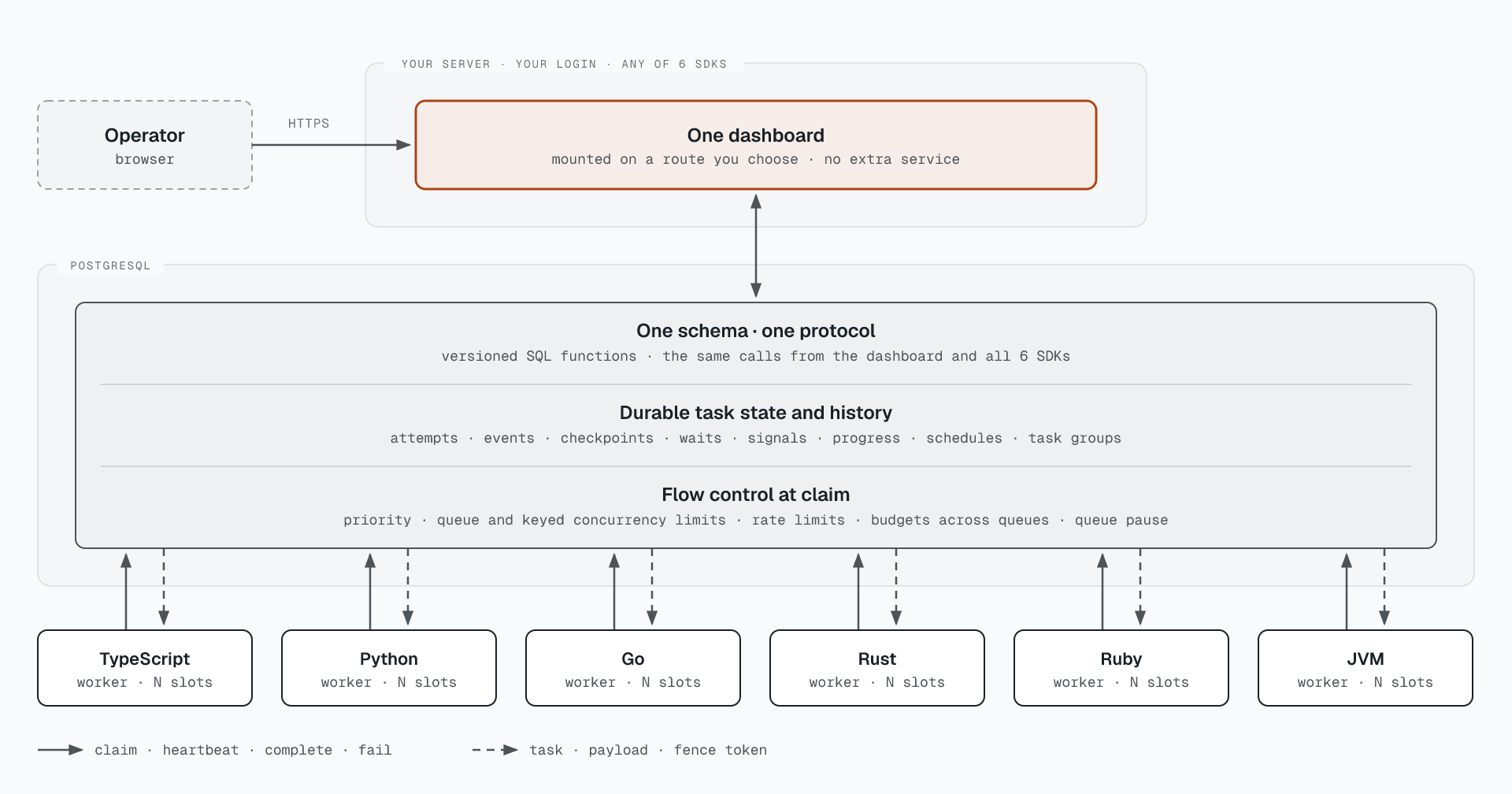
Public beta: Workhorse is usable for evaluation and early production adoption. A 0.x minor release may change behaviour, so read the changelog before you upgrade. It will not ask you to recreate your database: migrations are ordered, and inside a major line a migration only adds, so a running deployment upgrades in place.
An AI agent should read the Workhorse documentation index first.
Install
pip install stablemates-workhorse
Install the schema once, as a deployment step. The application never installs or migrates it.
npx --package @stablemates/workhorse@0.9.0 workhorse schema install
The machine that runs that deployment step needs Node.js 22 or newer. The application itself needs no Node.js.
Pin that version to the stablemates-workhorse version the application depends on. The two are
released together from one commit, so the numbers match. The application refuses a schema below its
schema floor, the oldest schema version it runs against. A schema at or above the floor is
compatible while it still serves the application's protocol. A schema tool from an older release can
leave a schema below that floor.
Runtime processes verify compatibility instead of changing the schema. Call
assert_schema_compatible(connection) at startup. Call assert_schema_compatible_psycopg or
assert_schema_compatible_asyncpg when the application is asynchronous.
Requires Python 3.12 through 3.14 and PostgreSQL 15 through 18.
Run one task
from __future__ import annotations

import os

import psycopg
from psycopg_pool import ConnectionPool

from workhorse import Queue, Worker

database_url = os.environ["DATABASE_URL"]

with psycopg.connect(database_url) as application_connection:
    task_id = Queue(application_connection).enqueue("email.welcome", {"to": "ada@example.com"})
    application_connection.commit()

with ConnectionPool(
    database_url, min_size=3, max_size=3, kwargs={"autocommit": True}
) as worker_pool:
    worker = Worker(worker_pool).handle(
        "email.welcome",
        lambda payload, _context: {"deliveredTo": payload["to"]},
    )
    assert worker.run_once() is True  # Production worker processes call run().

print(task_id)
Handlers receive at-least-once delivery. Use stable provider idempotency keys around external effects; named checkpoints prevent completed application stages from running after a later restart.
An AsyncWorker checkpoint operation follows asyncio cancellation. When a timeout or an
asyncio.TaskGroup cancels the handler's await context.checkpoint(name, operation), the worker
cancels the operation and waits for its cleanup before the cancellation reaches the handler.
Cancellation before the operation returns stops the save, even when the operation catches the
cancellation and returns a value, so a later attempt runs it again. Once the operation returns, its
save may already be under way. The worker waits for that save instead of undoing it, so the handler
sees CancelledError while a later attempt replays the saved value. A cancelled await therefore
never proves that no checkpoint exists, and it does not undo the operation's effects on other
systems.
The operation runs on the event loop in a copy of the handler's context. It sees the handler's context variables and current OpenTelemetry span, so its spans are children of the handler span.
Task groups, checkpoint inputs, and single passes
- A task group tracks many tasks as one unit. After the
group is sealed and every member task is finished, Workhorse enqueues the callback tasks of the
group. The
with queue.task_group(...)block creates a group, adds its tasks, and seals it in one transaction. - A handler can give the input of a
checkpoint. Give it
as
context.checkpoint(name, operation, input=...). If a later run gives a different input, the call raisesCheckpointInputConflictError, the task fails, and the operation does not run again. If the stored checkpoint or the call has no input, Workhorse compares nothing. run_once()returnsTrueonly when a handler ran. It returnsFalseafter a pass that only released the tasks that it claimed. If you call it in a loop, wait afterFalse.
Package boundary
This distribution provides synchronous Psycopg and asynchronous Psycopg or asyncpg clients and
workers. Application clients use caller-owned connections and transactions. Workers take a
caller-owned pool: Worker takes a Psycopg ConnectionPool, AsyncWorker.from_psycopg takes a
Psycopg AsyncConnectionPool, and AsyncWorker.from_asyncpg takes an asyncpg Pool. A worker
borrows a pool connection for each claim and lifecycle statement and returns it afterwards. It also
reserves its own heartbeat and listener connections from that pool, so
size the pool for them. Close the pool
after run returns; the worker never closes it. The package never installs or migrates the shared
PostgreSQL schema.
Next
- Follow the quickstart and deploy worker processes.
- Read the API reference and compatibility policy.
- Use the operations guide for telemetry, health, and maintenance.
- Browse the repository or report a problem in GitHub issues.
License
Apache-2.0. See LICENSE and NOTICE in the package.
1 maintainer

Metadata
1 maintainer
Release files for stablemates-workhorse 0.9.0
For a detailed explanation of source distributions (sdists) and built distributions (wheels), please see the package formats documentation.
Source distribution (sdist)
| File | Size | Uploaded | Provenance | |
|---|---|---|---|---|
| stablemates_workhorse-0.9.0.tar.gz | 952.1 kB | With provenance | Details |
Built distribution (wheel)
| File | Interpreter | ABI | Platform | Reset |
|---|---|---|---|---|
| stablemates_workhorse-0.9.0-py3-none-any.whl | Python 3 | none | any | Details |
Total release size: 1.5 MB
Release files / stablemates_workhorse-0.9.0.tar.gz
| Download URL | stablemates_workhorse-0.9.0.tar.gz |
|---|---|
| Size | 952.1 kB |
| Tags | Source |
|
SHA-256 checksum How to use checksums |
54aec66da7a5ddcaeddc182ccda20ae5f841e9d94f55983821e8b7e0e83e9171
|
|
BLAKE2b-256 checksum How to use checksums |
19a22b1d2b5037fb6817ba07105b1883fcd42a335421136ffd266ada3c9aaf60
|
| Upload date | |
|
Uploaded using Trusted Publishing? What is trusted publishing? |
Yes |
| Uploaded via |
uv/0.12.21 {"installer":{"name":"uv","version":"0.12.21","subcommand":["publish"]},"python":null,"implementation":{"name":null,"version":null},"distro":{"name":"Ubuntu","version":"24.04","id":"noble","libc":null},"system":{"name":null,"release":null},"cpu":null,"openssl_version":null,"setuptools_version":null,"rustc_version":null,"ci":true}
|
Provenance
Provenance describes where a file came from. On PyPI, provenance is shared via attestations, which provide a verifiable record of the build or publishing details. View details, limitations and caveats.


PyPI Publish Attestation
PyPI verified that this artifact, at this checksum, originated from the publisher listed below.
Signed by GitHub Actions, verified by PyPI on Oct 20, 2026.
Transparency logRelease files / stablemates_workhorse-0.9.0-py3-none-any.whl
| Download URL | stablemates_workhorse-0.9.0-py3-none-any.whl |
|---|---|
| Size | 593.4 kB |
| Tags | Python 3 |
|
SHA-256 checksum How to use checksums |
08f405808b433e118a048445989c29e552ed45d95be002c7f2e1cc4eb4fedca6
|
|
BLAKE2b-256 checksum How to use checksums |
5a4cc94913af8828fdbefd55190d76f634452dc07a7a64c261447afc057b7bc8
|
| Upload date | |
|
Uploaded using Trusted Publishing? What is trusted publishing? |
Yes |
| Uploaded via |
uv/0.12.21 {"installer":{"name":"uv","version":"0.12.21","subcommand":["publish"]},"python":null,"implementation":{"name":null,"version":null},"distro":{"name":"Ubuntu","version":"24.04","id":"noble","libc":null},"system":{"name":null,"release":null},"cpu":null,"openssl_version":null,"setuptools_version":null,"rustc_version":null,"ci":true}
|
Provenance
Provenance describes where a file came from. On PyPI, provenance is shared via attestations, which provide a verifiable record of the build or publishing details. View details, limitations and caveats.
PyPI Publish Attestation
PyPI verified that this artifact, at this checksum, originated from the publisher listed below.
Signed by GitHub Actions, verified by PyPI on Oct 20, 2026.
Transparency logSecurity for stablemates-workhorse 0.9.0
Provenance
Provenance describes where a file came from. On PyPI, provenance is shared via attestations, which provide a verifiable record of the build or publishing details. View details, limitations and caveats.
Full provenance
All 2 files in this release have been uploaded with provenance metadata.
Attestation for stablemates_workhorse-0.9.0.tar.gz
PyPI Publish Attestation
PyPI verified that this artifact, at this checksum, originated from the publisher listed below.
Signed by GitHub Actions, verified by PyPI on Oct 20, 2026.
Transparency logA note on package security
PyPI is a repository for distributing packages, not a service for auditing them. While third-party security researchers and our staff do their best to detect and remove malicious packages, PyPI cannot guarantee the quality, security or suitability of any given package.














