

stackgrad: A deep learning framework written from scratch, up to a served Qwen3 with retrieval and a tool-using agent.
Homepage | Documentation | Write-up

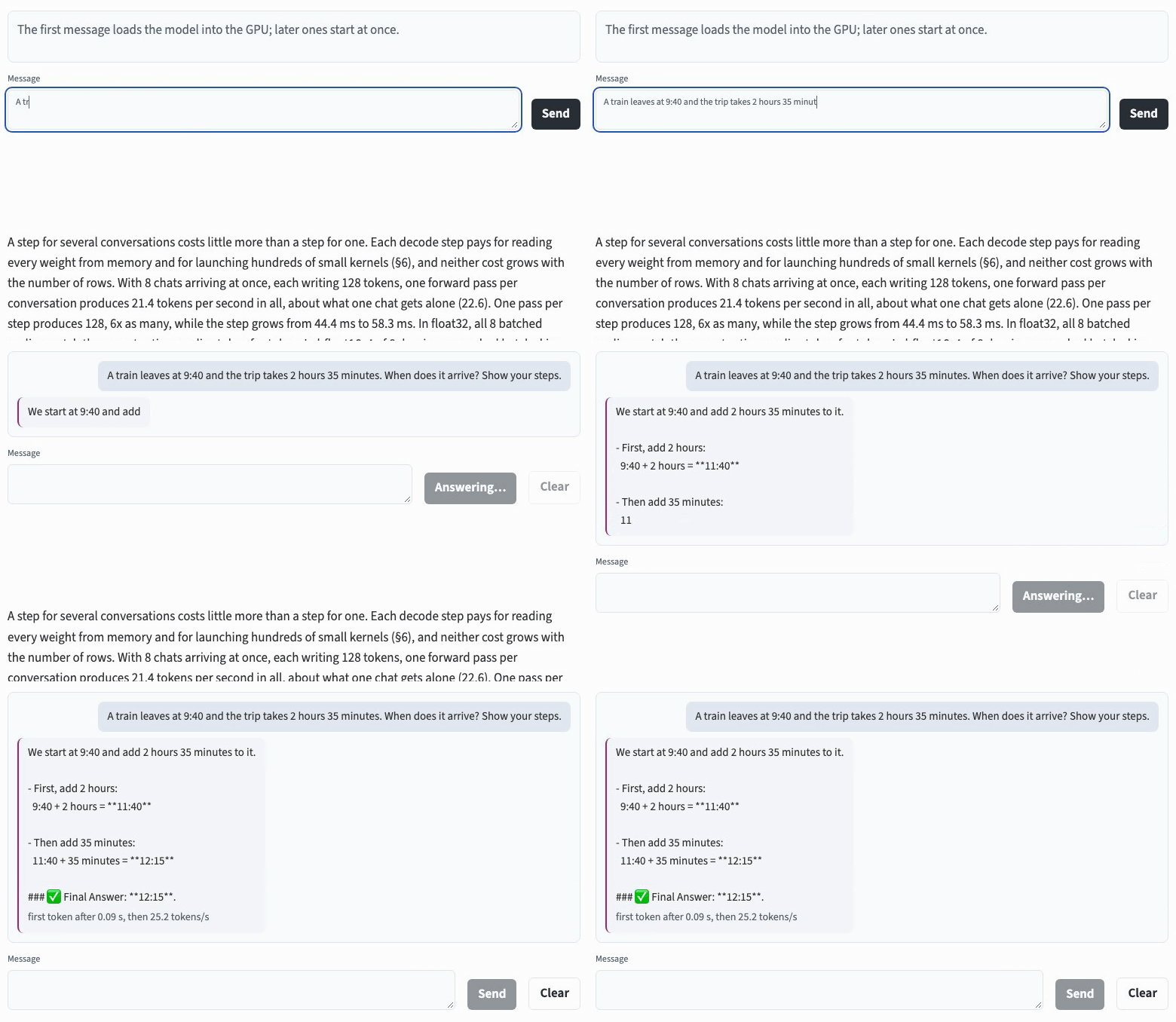
stackgrad is an end-to-end deep learning stack:
- a tensor library with lazy evaluation and autograd, every gradient in one file
- three backends (NumPy, MLX, CuPy) and attention kernels written in Metal and Triton
- layers, optimizers, a BPE tokenizer, and a transformer trained from nothing
- Qwen3-0.6B loaded, served behind an OpenAI-style endpoint, and fine-tuned with LoRA and GRPO
- retrieval and a tool-using agent on that server
The stackgrad/ package is under 3,000 lines, and CI keeps it there.
PyTorch, tiktoken, and transformers appear only in the tests, as the references each piece is checked against.
Laziness
Try a matmul. Nothing runs until you ask for the result.
import numpy as np
from stackgrad import Tensor
from stackgrad.profile import profile

N = 1024
a, b = Tensor(np.random.randn(N, N)), Tensor(np.random.randn(N, N))
with profile() as p:
  c = (a @ b).relu().sum()       # records four ops, runs none
  print(c.shape, dict(p.calls))  # () {}
  c.realize()                    # Matmul, Less, Where, Sum run, once each
print(p.table())
relu shows up as Less and Where: it composes primitives, so it never defines a gradient of its own.
Neural networks
import numpy as np
from stackgrad import Tensor, Module, Linear, Adam, cross_entropy_loss

class LinearNet(Module):
  def __init__(self):
    super().__init__()
    self.l1, self.l2 = Linear(784, 128), Linear(128, 10)

  def forward(self, x):
    return self.l2(self.l1(x.reshape(x.shape[0], -1)).relu())

model = LinearNet()
opt = Adam(model.parameters(), lr=0.001)

x, y = Tensor(np.random.rand(4, 1, 28, 28)), np.array([2, 4, 3, 7])  # replace with real mnist

for i in range(10):
  loss = cross_entropy_loss(model(x), y)
  opt.zero_grad()
  loss.backward()
  opt.step()
  print(i, loss.item())
See train_gpt.py for the full version: a 22.7M-parameter transformer that trains on TinyStories to a validation loss of 1.399 in 71 minutes on one RTX 3090.
Accelerators
- CPU, NumPy
- METAL, MLX, with attention and quantized-matmul kernels in Metal
- CUDA, CuPy, with FlashAttention-2 in Triton
A new backend is one module that exports the 27 names cpu.py exports.
Installation
git clone https://github.com/samitmohan/stackgrad.git
cd stackgrad
uv sync --extra metal --extra serve   # Apple silicon; NVIDIA: uv sync --extra cuda --no-dev
Documentation
The docs website has a quickstart, the API reference, and a showcase of what stackgrad runs, with every measured number and the command that produced it. It builds from the docs/ directory. The write-up, Modern AI: Autograd to Agents, explains each piece from first principles.
Quick example comparing to PyTorch
import numpy as np
from stackgrad import Tensor

x = Tensor(np.eye(3), requires_grad=True)
y = Tensor([[2.0, 0, -2.0]], requires_grad=True)
z = (y @ x).sum()
z.backward()

print(x.grad.tolist())  # dz/dx
print(y.grad.tolist())  # dz/dy
The same thing but in PyTorch:
import torch

x = torch.eye(3, requires_grad=True)
y = torch.tensor([[2.0, 0, -2.0]], requires_grad=True)
z = y.matmul(x).sum()
z.backward()

print(x.grad.tolist())  # dz/dx
print(y.grad.tolist())  # dz/dy
Running tests
uv run python test_grads.py   # every gradient against finite differences
uv run python tests/parity.py # every op and layer against PyTorch
The CI workflow runs the rest.
1 maintainer

Metadata
1 maintainer
Release files for stackgrad 0.2.0
For a detailed explanation of source distributions (sdists) and built distributions (wheels), please see the package formats documentation.
Source distribution (sdist)
| File | Size | Uploaded | Provenance | Actions |
|---|---|---|---|---|
| stackgrad-0.2.0.tar.gz | 46.4 kB | Without provenance | Details for stackgrad-0.2.0.tar.gz |
Built distribution (wheel)
| File | Interpreter | ABI | Platform | Actions Reset |
|---|---|---|---|---|
| stackgrad-0.2.0-py3-none-any.whl | Python 3 | none | any | Details for stackgrad-0.2.0-py3-none-any.whl |
Total release size: 105.0 kB
Release files / stackgrad-0.2.0.tar.gz
| Download URL | stackgrad-0.2.0.tar.gz |
|---|---|
| Size | 46.4 kB |
| Tags | Source |
|
SHA-256 checksum How to use checksums |
1fbe37d05252585de716a878c3c461b266318df4738efb97be674d882513a102
|
|
BLAKE2b-256 checksum How to use checksums |
a075cb1fcf3fb08c407b9914eae478acb9553e062de2cc949acaba4515478b1c
|
| Upload date | |
|
Uploaded using Trusted Publishing? What is trusted publishing? |
No |
| Uploaded via |
uv/0.11.12 {"installer":{"name":"uv","version":"0.11.12","subcommand":["publish"]},"python":null,"implementation":{"name":null,"version":null},"distro":{"name":"macOS","version":null,"id":null,"libc":null},"system":{"name":null,"release":null},"cpu":null,"openssl_version":null,"setuptools_version":null,"rustc_version":null,"ci":null}
|
Release files / stackgrad-0.2.0-py3-none-any.whl
| Download URL | stackgrad-0.2.0-py3-none-any.whl |
|---|---|
| Size | 58.6 kB |
| Tags | Python 3 |
|
SHA-256 checksum How to use checksums |
180c6e616103a8b34aea3459a683dcd64e50218214bd5b89a7ea9bc5381bd26c
|
|
BLAKE2b-256 checksum How to use checksums |
1289e246d3ae67b0a80cb5001fc38a4fb5e8dee844a573ac2d2cd428e40d83f5
|
| Upload date | |
|
Uploaded using Trusted Publishing? What is trusted publishing? |
No |
| Uploaded via |
uv/0.11.12 {"installer":{"name":"uv","version":"0.11.12","subcommand":["publish"]},"python":null,"implementation":{"name":null,"version":null},"distro":{"name":"macOS","version":null,"id":null,"libc":null},"system":{"name":null,"release":null},"cpu":null,"openssl_version":null,"setuptools_version":null,"rustc_version":null,"ci":null}
|
Security for stackgrad 0.2.0
Provenance
Provenance describes where a file came from. On PyPI, provenance is shared via attestations, which provide a verifiable record of the build or publishing details. View details, limitations and caveats.
No provenance found
None of the files in this release were uploaded with provenance metadata.
A note on package security
PyPI is a repository for distributing packages, not a service for auditing them. While third-party security researchers and our staff do their best to detect and remove malicious packages, PyPI cannot guarantee the quality, security or suitability of any given package.
To learn more about protecting yourself from malicious actors, visit our package security documentation.














