

The vital signs of your GitHub repo. Flaky tests, slow reviews, delivery and DORA, risky dependencies and community health, measured in your own GitHub Actions.




A tour on demo data. Watch it with sound.
A free, open-source developer suite for GitHub: CI health and flaky tests, pull request flow, delivery and DORA, dependencies, community health and an org portal. It runs in your own GitHub Actions and keeps its history in your own repo: no StackVitals-hosted backend, account or subscription, and optional integrations use services and keys you choose. GitHub's built-in token covers every module in a repo; an org's private repos in the Portal need a read-only App, and org-wide Copilot usage an org token. Actions minutes on private repos are billed by GitHub as usual (docs/scaling.md). The rules behind its verdicts are checked on public data, with the losses published.
Every run publishes an app on your repo's GitHub Pages (or stackvitals ui owner/repo on your machine): one page per
module, decisions and settings saved straight from the browser, setup for more repos in a few clicks once GitHub is
connected (connecting takes one token, made from a prefilled GitHub page; Pages are turned on for public repos), and a demo at
?demo=1. docs/app.md walks through it.
Install it as the GitHub Action stackvitals/stackvitals@v0 (also on the
GitHub Marketplace), or the CLI and MCP server from PyPI:
pip install stackvitals (or run it without installing: uvx stackvitals).

What you see first
When CI fails on a pull request, one comment sorts each failure, from the repo's own CI history:
StackVitals: about this CI failure
1 of 3 failure(s) look like flakes; the rest need a look.
Verdict What failed Why Likely flaky test t::flaky_oneflaked 6 times in 80 runs in the last 30 days, last 2026-10-20, and the message shows a flake's sign ("TimeoutError"): looks like a flake, check the error, then re-run it New test t::new_oneno earlier flakes: likely from this change (fails with "assert result == 2") Already failing on main test t::broken_onealso failing on the default branch, not caused by this change
The verdict check still blocks until CI is green: a known flake is re-run, never waved through.
Quick start
pip install stackvitals
gh auth login                        # once, so StackVitals can use your GitHub sign-in
stackvitals init your-name/your-repo
init adds one workflow file to your repo, runs it once and turns on your dashboard:
-
Public repo: the dashboard goes live at
https://your-name.github.io/your-repo/. -
Private repo: your data stays in your private repo, and the dashboard opens on your machine:
stackvitals ui your-name/your-repo
Just looking? stackvitals ci report owner/repo reports CI health for any public repo in about 20 seconds, with
nothing added to it. Prefer clicking? The app's Setup page does the same as init. More:
docs/quickstart.md.
How it works
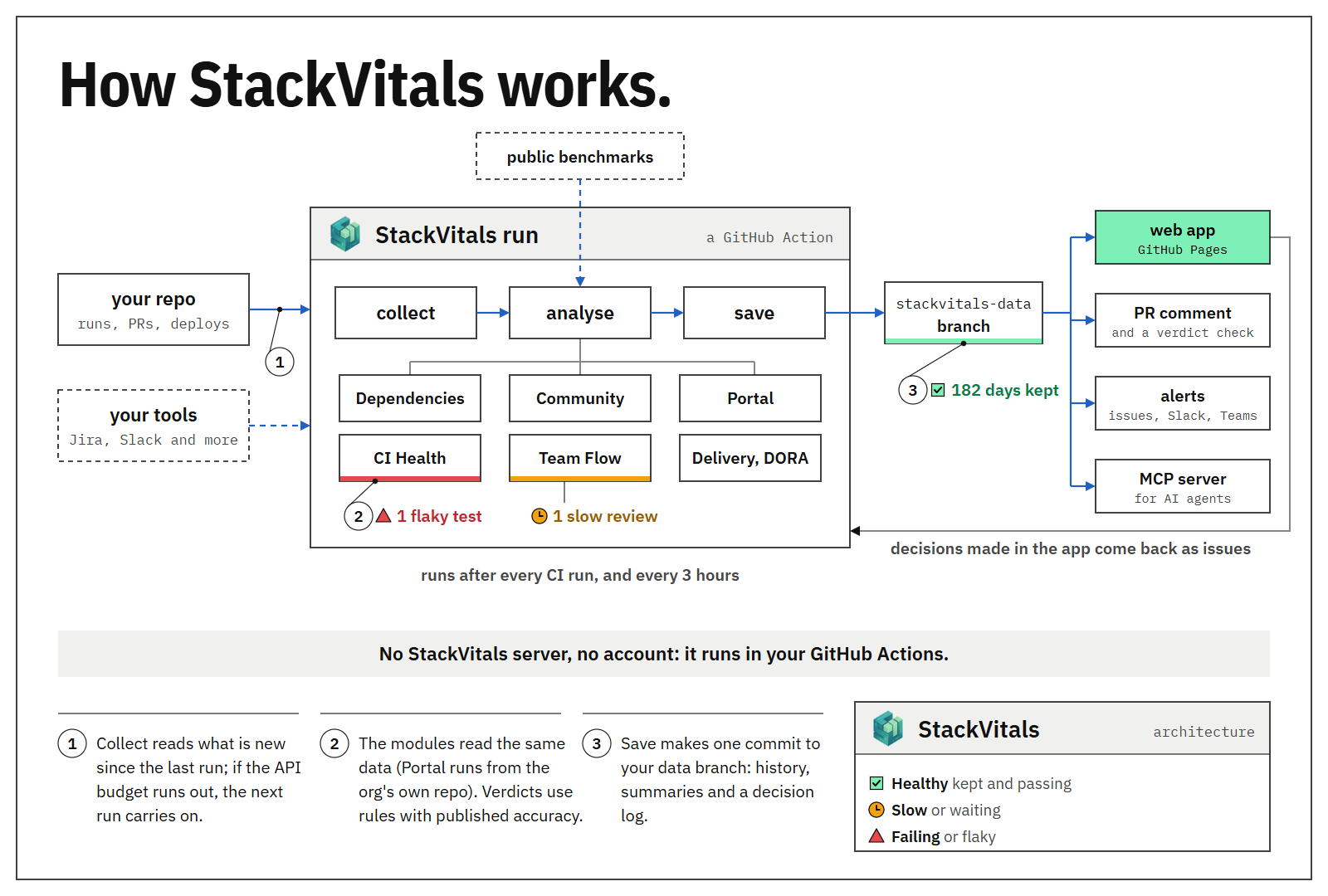
Every step, from what starts a run to what you see: the architecture in detail.
Modules
| Module | What it answers | Status |
|---|---|---|
| CI Health | Which jobs and tests are flaky or slowing down, who owns them, coverage and patch coverage | stable |
| Team Flow | Who has to act next on each pull request, and how long reviews take | stable |
| Delivery | Cycle time split into coding, pickup, review and deploy (LinearB's phases), DORA's five metrics, AI-assisted work compared like with like | stable |
| Insights | What to fix first across modules, ranked by hours lost, with alerts and a weekly digest | stable |
| Dependency Steward | Known vulnerabilities and malware in the lockfiles OSV-Scanner reads (npm, PyPI, Go, Rust, Maven, Ruby, .NET, PHP and more; 65 of 100 sampled repos had one); whether to add, keep or upgrade a package, with upgrade evidence from public repos | preview |
| Community | Where newcomers drop out, how fast they get an answer, who carries the work | stable |
| Portal | A lightweight catalog on GitHub alone: what an org owns, who owns it (checked), scorecards, golden paths and an org-wide view | preview |
| Explore | SQL over your repo's data in the browser, with links to share a query | preview |
| Contribute | Open-source issues an outsider can realistically get merged | stable |
Stable: measured, reviewed and used on the sandbox for every release. Preview: built and tested, but newer or measured on less; its behaviour may still change.
Works with Jira Cloud, Linear, PagerDuty, incident.io, Copilot usage reports, Slack, Teams, Discord, Discourse,
test reports from other CI systems, Backstage, and DevLake's tables (docs/connectors.md). AI
agents get every module through one MCP server (11 core tools by default, all 35 with --tools all).
Connect your tools (optional)
Everything works with GitHub's built-in token. Integrations are optional; pass their keys as repository secrets:
- uses: stackvitals/stackvitals@v0
  with:
    webhook: ${{ secrets.SLACK_WEBHOOK }}            # alerts to Slack, Teams or Discord
    pagerduty-token: ${{ secrets.PAGERDUTY_TOKEN }}  # incidents count in DORA
    jira-email: ${{ secrets.JIRA_EMAIL }}            # Jira, with its site URL under
    jira-token: ${{ secrets.JIRA_TOKEN }}            # [connectors.jira] in .github/stackvitals.toml
Every input: docs/install.md. Every setting: docs/settings.md.
AI agents (MCP)
Your coding agent can ask StackVitals before and while it changes code: is this failure a known flake?, what is blocking PR #123?, who should review this?, is this package safe to add? It answers from your repo's history, with the evidence.
Claude Code:
claude mcp add stackvitals -- uvx stackvitals serve
Claude Desktop, Cursor, VS Code and other MCP clients:
{
  "mcpServers": {
    "stackvitals": { "command": "uvx", "args": ["stackvitals", "serve"] }
  }
}
It uses your gh login or GITHUB_TOKEN. The 11 core tools load by default (ci_failure, is_known_flake,
pr_queue, who_should_review, check_package, insights and more); stackvitals serve --tools all loads all 35.
Listed in the MCP registry as io.github.stackvitals/stackvitals.
Three things it gets right that others get wrong
Measured on public repos beside the rules other tools use (docs/accuracy.md):
- Where you deploy from. With no setup, StackVitals named the right deployment source for 53 of 60 repos (30 of 35 held out). On the same 60, DevLake's default pattern got 9 and a pattern a user would typically write got 22. A wrong source makes every DORA number wrong.
- Who answered an issue. Of the first comments by non-maintainers that the github/issue-metrics action counts as the answer, 46% are drive-bys (40-52%, held-out repos). StackVitals counts the project's answers: maintainers, regular responders and triagers.
- Whether AI help changed anything. Agents' pull requests look 9 points less likely than people's to be merged by someone else. Compared within the same repo, month and size, the gap is +0.5 points (0.0 to +1.1): most of the raw gap comes from which repos agents work in and the size of their changes.
It publishes what failed too. Of the failures an old rule called safe to re-run, 44% (15 of 34) were caused by the change. The tightened rule still got 13 of 81 held-out calls wrong (16%). A stricter one (a flake's sign in the log, no changed file named) got none of 4 fresh calls wrong, too few to show 5%, so nothing is called safe: likely flakes are re-run, never passed by the check. Each sample was labelled by two model families (Claude and Gemini); no person has audited the labels.
Learn more
- Five minutes: docs/quickstart.md. Try CI Health on any public repo first (needs
uv and
gh auth loginor aGITHUB_TOKEN):uvx stackvitals ci report owner/repo --days 14 --html ./ci-report. - By role: engineering managers, maintainers, platform teams.
- Before you rely on it: what each rule does, known limitations, what leaves your repo, threat model, enterprise controls.
- More: FAQ, how it works, roadmap, contributing, governance, security.
1 maintainer

Metadata
1 maintainer
Release files for stackvitals 0.1.2
For a detailed explanation of source distributions (sdists) and built distributions (wheels), please see the package formats documentation.
Source distribution (sdist)
| File | Size | Uploaded | Provenance | Actions |
|---|---|---|---|---|
| stackvitals-0.1.2.tar.gz | 21.4 MB | With provenance | Details for stackvitals-0.1.2.tar.gz |
Built distribution (wheel)
| File | Interpreter | ABI | Platform | Actions Reset |
|---|---|---|---|---|
| stackvitals-0.1.2-py3-none-any.whl | Python 3 | none | any | Details for stackvitals-0.1.2-py3-none-any.whl |
Total release size: 22.9 MB
Release files / stackvitals-0.1.2.tar.gz
| Download URL | stackvitals-0.1.2.tar.gz |
|---|---|
| Size | 21.4 MB |
| Tags | Source |
|
SHA-256 checksum How to use checksums |
5240f4ea47d3484297c49cde9cbde729971998bf5ff21179e063d4058d58e66b
|
|
BLAKE2b-256 checksum How to use checksums |
493caf2c75773ec4ac33b1d453e5c06c6795529943bf847619d6504b8abae87f
|
| Upload date | |
|
Uploaded using Trusted Publishing? What is trusted publishing? |
Yes |
| Uploaded via |
twine/7.0.0 CPython/3.13.16
|
Provenance
Provenance describes where a file came from. On PyPI, provenance is shared via attestations, which provide a verifiable record of the build or publishing details. View details, limitations and caveats.


PyPI Publish Attestation
PyPI verified that this artifact, at this checksum, originated from the publisher listed below.
Signed by GitHub Actions, verified by PyPI on Oct 31, 2026.
Transparency logRelease files / stackvitals-0.1.2-py3-none-any.whl
| Download URL | stackvitals-0.1.2-py3-none-any.whl |
|---|---|
| Size | 1.5 MB |
| Tags | Python 3 |
|
SHA-256 checksum How to use checksums |
020ae06a031a5bf29bf1facb4dbd5102e805c821efb7cb9a611258b422e07b3b
|
|
BLAKE2b-256 checksum How to use checksums |
79bb1b97cebeb31e6ace918ae972ae59a471a4ed51e2df9c997c6ad6420f7ec5
|
| Upload date | |
|
Uploaded using Trusted Publishing? What is trusted publishing? |
Yes |
| Uploaded via |
twine/7.0.0 CPython/3.13.16
|
Provenance
Provenance describes where a file came from. On PyPI, provenance is shared via attestations, which provide a verifiable record of the build or publishing details. View details, limitations and caveats.
PyPI Publish Attestation
PyPI verified that this artifact, at this checksum, originated from the publisher listed below.
Signed by GitHub Actions, verified by PyPI on Oct 31, 2026.
Transparency logSecurity for stackvitals 0.1.2
Provenance
Provenance describes where a file came from. On PyPI, provenance is shared via attestations, which provide a verifiable record of the build or publishing details. View details, limitations and caveats.
Full provenance
All 2 files in this release have been uploaded with provenance metadata.
Attestation for stackvitals-0.1.2.tar.gz
PyPI Publish Attestation
PyPI verified that this artifact, at this checksum, originated from the publisher listed below.
Signed by GitHub Actions, verified by PyPI on Oct 31, 2026.
Transparency logA note on package security
PyPI is a repository for distributing packages, not a service for auditing them. While third-party security researchers and our staff do their best to detect and remove malicious packages, PyPI cannot guarantee the quality, security or suitability of any given package.
To learn more about protecting yourself from malicious actors, visit our package security documentation.














