
Modelling of quantitative state changes as step functions


Project description






The leading use-case for the staircase package is for the creation and analysis of step functions.
Pretty exciting huh.
But don't hit the close button on the browser just yet. Let us convince you that much of the world around you can be modelled as step functions.
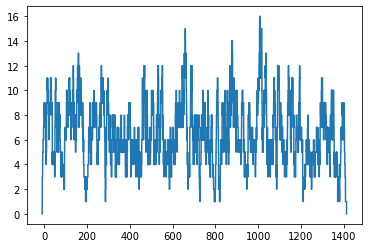
For example, the number of users viewing this page over time can be modelled as a step function. The value of the function increases by 1 every time a user arrives at the page, and decreases by 1 every time a user leaves the page. Let's say we have this data in vector format (i.e. tuple, list, numpy array, pandas series). Specifically, assume arrive and leave are vectors of times, expressed as minutes past midnight, for all page views occuring yesterday. Creating the corresponding step function is simple. To achieve it we use the Stairs class:
import staircase as sc

views = sc.Stairs()
views.layer(arrive,leave)
We can visualise the function with the plot function:
views.plot()
We can find the total time the page was viewed:
views.integrate(0,1440)
We can find the average number of viewers:
views.mean(0,1440)
We can find the average number of viewers for each hour of the day:
[views.mean(60*i, 60*(i+1)) for i in range(24)]
We can find the maximum concurrent views:
views.max(0,1440)
There is plenty more analysis that could be done. The staircase package provides a rich variety of arithmetic operations, relational operations, logical operations, for use with Stairs, in addition to functions for univariate analysis, aggregations and compatibility with pandas.Timestamp.
Installation
Staircase can be installed from PyPI:
pip install staircase
or also with conda:
conda install -c venaturum staircase
Documentation
The complete guide to using staircase can be found at Read the Docs
Contributing
Please stay tuned for how you can contribute...
Versioning
We use SemVer for versioning. For the versions available, see the tags on this repository.
License
This project is licensed under the MIT License - see the LICENSE file for details
Acknowledgments
- This project is heavily reliant on sorted containers. Grant Jenks has done a great job bringing this functionality to Python at lightning fast speeds.
- staircase began development from within the Hunter Valley Coal Chain Coordinator. Thanks for the support!
Release history Release notifications | RSS feed


Download files
Download the file for your platform. If you're not sure which to choose, learn more about installing packages.
Source Distributions
Built Distribution
Filter files by name, interpreter, ABI, and platform.
If you're not sure about the file name format, learn more about wheel file names.
Copy a direct link to the current filters
File details
Details for the file staircase-0.4.4-py3-none-any.whl.
File metadata
- Download URL: staircase-0.4.4-py3-none-any.whl
- Upload date:
- Size: 15.8 kB
- Tags: Python 3
- Uploaded using Trusted Publishing? No
- Uploaded via: twine/3.1.1 pkginfo/1.5.0.1 requests/2.22.0 setuptools/41.2.0 requests-toolbelt/0.8.0 tqdm/4.42.0 CPython/3.7.5
File hashes
| Algorithm | Hash digest | |
|---|---|---|
| SHA256 |
bbf612c19af4a1eb470e04353b21307992753cafaa7aef6510eda7b3f84a2fff
|
|
| MD5 |
76a4b8e5be689785a2606d8dea829344
|
|
| BLAKE2b-256 |
3a551f00e6a7a05042a2fd1f92715c808297b52b7bf4ba4664059a932cc981d9
|






