
Make stalagmites, not stalactites: mechanical enforcement of FDM print physics on STL geometry, with classified violations, prescriptive repairs, and constraint-aware orientation.

Project description
stalagmite
Make stalagmites, not stalactites. Stalagmites grow from the ground and stand; stalactites hang and need support. Stalagmite mechanically enforces that rule on your STL — then tells you how to fix the part, not where to put the scaffolding.
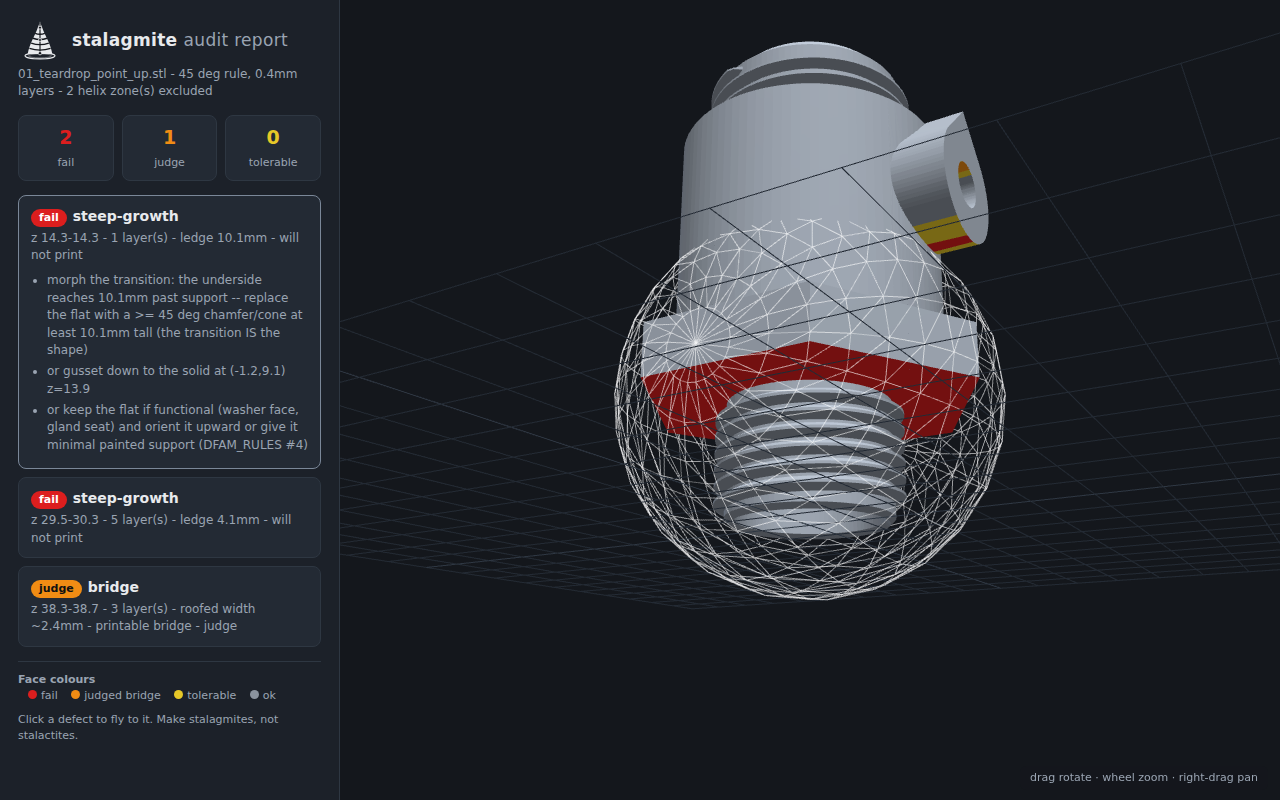
The interactive 3D report (--report): click a defect, the camera
flies underneath it, and the fix is spelled out with coordinates —
"replace the flat with a ≥45° cone at least 10.1mm tall."
Start with HANDOFF.md for the full story; design principles are in
DFAM_RULES.md; the literature behind every threshold is in
LITERATURE.md.
The core rule as one test: every slice must lie within a
dz·tan(max_angle) dilation of the slice below it. This single containment
check subsumes overhang detection, floating features, and unsupported starts.
Slicers paint overhangs red and scaffold around them; this tool exists to
tell you the design is wrong, and (eventually) how to fix it.
Install
pip install .
# or manually:
pip install numpy trimesh shapely networkx scipy
(networkx and scipy are quiet trimesh requirements — slicing fails
without them.)
Quick start
# audit any part -- thread helices are detected automatically
stalagmite part.stl --auto-ex

# the clean reference part, with manual exclusion zones instead
python3 dfam_audit.py fixtures/06_clean_final.stl --ex 0:16.5:11 --ex 54:65:13

# write a copy of the mesh with violating faces painted red
# (open the .ply in any mesh viewer - MeshLab, f3d, Blender, PrusaSlicer)
python3 dfam_audit.py part.stl --ex 0:16.5:11 --export part_violations.ply
Exit code is 0 on PASS, 1 when violations are reported.
Flags: --angle (default 45), --dz layer height (default 0.4mm),
--ex zlo:zhi:rmax cylindrical exclusion zone for thread helices
(repeatable), --export out.ply colored violation mesh, --suggest
parametrized repair suggestions (Tier 3), --warn-angle 30 surface-
quality lint (prints, but degraded downskin — Saunders' yellow band),
--min-wall 0.8 thin-feature lint (Hinchy FFF minimum). Lint warnings
never fail the audit.
Bridge features report the roofed width measured on the merged multi-layer region (the physical span being crossed); a roofed width beyond 10mm escalates the feature to fail severity.
Interactive 3D report (--report)
stalagmite part.stl --auto-ex --report report.html
One self-contained HTML file, openable in any browser, shareable as a file, fully offline (three.js is vendored inline). A rotating 3D view of the part with defect faces coloured by severity, beside a clickable defect list — selecting a defect flies the camera underneath it (defects are undersides) and reveals the Tier-3 repair suggestions. The clean part shows a green PASS.
Helix auto-detection (--auto-ex)
Thread helices legitimately migrate sideways along their flanks and
would otherwise false-positive. --auto-ex recognises them from a
first audit pass by their signature — many consecutive layers of small
constant-area lobes whose centroids lie on a circle and advance by a
consistent per-layer angle (the helix pitch) — then excludes the fitted
cylinders and re-audits. Real defects don't share the signature (flat
ledges are single wide layers; boss undersides are mirror-symmetric
pairs; bridges last a couple of layers), and thread-runout ledges just
above a helix are absorbed into its zone with a bounded growth cap.
On the six-fixture regression suite, auto-detection reproduces the
hand-tuned baseline exactly, and prints each zone in --ex form for
reuse. New users: see GETTING_STARTED.md.
Tier 3: repair suggestions (--suggest)
Each defect feature gets concrete, parametrized fixes rather than "add supports". Fail-severity features are grounded by a reachability search: the highest solid a 45° hull can descend onto, reported with coordinates —
[fail] steep-growth  z 14.3  ledge 8.6mm
    -> morph the transition: replace the flat with a >=45 deg
       chamfer/cone at least 8.6mm tall (the transition IS the shape)
    -> or gusset down to the solid at (-1.3,10.2) z=13.1
Repair taxonomy: ground-it (hull/gusset to nearest solid or bed pillar), morph the transition, teardrop/diamond the opening, flatten/chamfer, accept (judged bridge / functional flat per DFAM_RULES #4 and #7), or reorient (Tier 4). Always re-audit after applying a repair — fixes can create new overhangs (Adam & Zimmer 2014).
Tier 2: violation classification
Every violation is classified by in-plane anchoring and given a severity
(thresholds are literature-sourced, see LITERATURE.md, and boundary-
condition dependent — treat them as defaults, not physics constants):
| class | meaning | severity |
|---|---|---|
| starts-in-air | new body appears with nothing below | fail |
| island | unsupported below AND unattached in-plane | fail |
| steep-growth | cantilever ledge, one-sided anchor | tolerable ≤1.8mm (Adam & Zimmer 2014), else fail |
| bridge | anchored on opposing sides | judge ≤10mm free span (Hinchy 2019), else fail |
Per-slice violations are aggregated into physical defect features
(consecutive layers, overlapping regions), so a six-fixture regression
part reports "1 defect: judged bridge" instead of three slice records.
The colored export encodes severity: red = fail, orange = judged bridge,
gold = tolerable ledge. Bridges are still reported for human judgment
— a deliberate design choice (see DFAM_RULES.md #7 and #10); note the
per-layer free-span figure measures corbelling steps, which understates
the physical hole diameter being roofed.
Tier 4: orientation solver (dfam_orient.py)
Searches build poses minimising support volume subject to what the part is for — the constraints plain auto-orienters don't know:
# thread must stay vertical; helix zones excluded from the proxy
python3 dfam_orient.py part.stl --axis-vertical 0,0,1 \
    --ex 0:16.5:11 --ex 54:65:13 --save oriented.stl

# a seal face must print as the floor
python3 dfam_orient.py part.stl --face 0,0,1:floor
Face modes: floor (normal ends up facing down), up, wall
(vertical), not-down (never support-scarred). Search is Gaussian-
process Bayesian optimisation (Matérn 5/2, LCB), ~35 evaluations, after
Goguelin, Dhokia & Flynn 2021; the objective is their support-ray-length
proxy plus heavily weighted constraint penalties (15° of violation ≈ the
worst-case support cost). Always re-audit the oriented mesh with
dfam_audit.py before printing.
Python API
import trimesh
from dfam_audit import audit_mesh, export_colored

mesh = trimesh.load("part.stl", force="mesh")
bed_area, violations = audit_mesh(mesh, max_angle=45, dz=0.4,
                                  exclude=[(0, 16.5, 11)])
for v in violations:
    print(v.z, v.area, v.kind, v.note)
export_colored(mesh, violations, 0.4, "part_violations.ply")
Tests
pip install pytest
python3 -m pytest test_fixtures.py
The six STLs in fixtures/ are the genuine failure history of one real part
(a threaded pH-probe holder, v2→v7) with known defects — the regression
baseline any refactor must reproduce. See fixtures/FIXTURES.md.
License
MIT
Release history Release notifications | RSS feed


Download files
Download the file for your platform. If you're not sure which to choose, learn more about installing packages.
Source Distribution
Built Distribution
Filter files by name, interpreter, ABI, and platform.
If you're not sure about the file name format, learn more about wheel file names.
Copy a direct link to the current filters
File details
Details for the file stalagmite-0.7.0.tar.gz.
File metadata
- Download URL: stalagmite-0.7.0.tar.gz
- Upload date:
- Size: 180.1 kB
- Tags: Source
- Uploaded using Trusted Publishing? No
- Uploaded via: twine/6.2.0 CPython/3.14.6
File hashes
| Algorithm | Hash digest | |
|---|---|---|
| SHA256 |
88da2413107231491eb220eda64f75202dae5ea5670e9d64ac7abc7055cd602b
|
|
| MD5 |
8fe0166a74b1e6be79bc928b4fde95a7
|
|
| BLAKE2b-256 |
9504e2a4e8ef6f1d3f3dd708e66ae31f1ea3f08d8bdb3f2a16dda694f4e43a9d
|
File details
Details for the file stalagmite-0.7.0-py3-none-any.whl.
File metadata
- Download URL: stalagmite-0.7.0-py3-none-any.whl
- Upload date:
- Size: 177.6 kB
- Tags: Python 3
- Uploaded using Trusted Publishing? No
- Uploaded via: twine/6.2.0 CPython/3.14.6
File hashes
| Algorithm | Hash digest | |
|---|---|---|
| SHA256 |
f83caff6ca732cd3a3fcc4eaad16deac8ae7091cf34be5f9ec50a596094a57a8
|
|
| MD5 |
500fbe0d63a96c10f1af11eb7ffbb450
|
|
| BLAKE2b-256 |
8f5685e3cc8b748fc48aaeef08f7f11cad9f08c4b521e185c5a339700ff4650c
|






