
stamina: Production-grade Retries Made Easy
Transient failures are common in distributed systems. To make your systems resilient, you need to retry failed operations. But bad retries can make things much worse.
stamina is an opinionated wrapper around the great-but-unopinionated Tenacity package. Our goal is to be as ergonomic as possible, while doing the right thing by default, and minimizing the potential for misuse. It is the result of years of copy-pasting the same configuration over and over again:
- Retry only on certain exceptions – or even a subset of them by introspecting them first using a backoff hook.
- Exponential backoff with jitter between retries.
- Limit the number of retries and total time.
- Automatic async support – including Trio.
- Preserve type hints of the decorated callable.
- Flexible instrumentation with Prometheus, structlog, and standard library's
loggingsupport out-of-the-box. - Dedicated support for testing that allows to globally deactivate retries, or to limit the number of retries and to remove backoffs.
For example:
import httpx2

import stamina


@stamina.retry(on=httpx2.HTTPError, attempts=3)
def do_it(code: int) -> httpx2.Response:
    resp = httpx2.get(f"https://httpbin.org/status/{code}")
    resp.raise_for_status()

    return resp
Async callables work use the same API and it's possible to retry arbitrary blocks, too. Check out our tutorial for more examples!
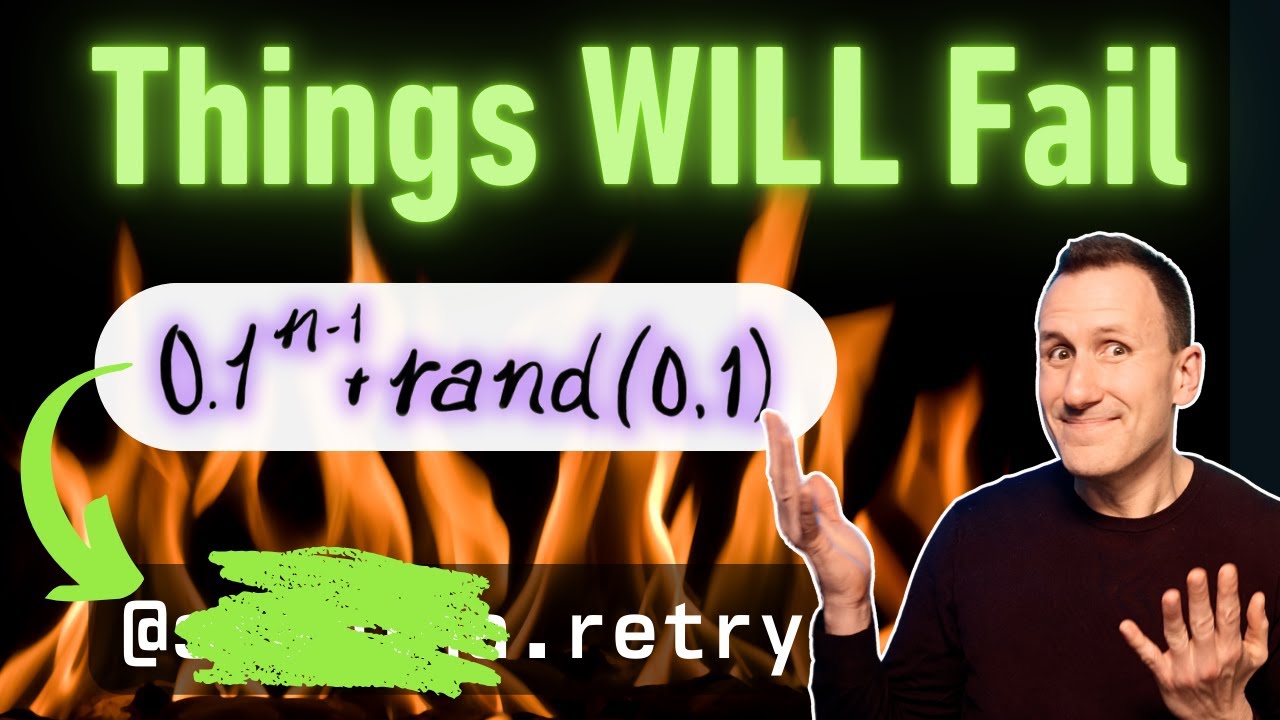
Or, if you prefer video, here's a brief introduction into retries and stamina:
Release Information
Removed
- Support for Python 3.10.
Deprecated
-
Raising
tenacity.TryAgainin code that stamina retries now emits aDeprecationWarning. It only ever worked because stamina uses Tenacity internally. Raisestamina.exceptions.TryAgaininstead.Generally speaking, we do not support "hybrid" usage of Tenacity features via stamina and will break such cases without warning in the future. #158
Added
-
stamina.exceptions.TryAgainthat you can raise to force a retry, whatever on says. If stamina runs out of attempts, it raises the exception that you raisedTryAgainfrom. Without one, your caller gets theTryAgain.Pass after to wait at least a number of seconds, a
datetime.timedelta, or until a timezone-awaredatetime.datetimebefore the next attempt. #158 -
stamina.instrumentation.set_process_details()that lets you change thestamina.instrumentation.RetryDetailsbefore stamina passes them to the retry hooks. For example, you can remove secrets from the arguments before they are logged.stamina.instrumentation.get_process_details()returns the current one. #160 -
stamina.retry_context(),stamina.RetryingCaller(), andstamina.AsyncRetryingCaller()now accept a keyword-only name for retry instrumentation, like Prometheus labels. The default remains<context block>. #165
Changed
-
The type hints of on now accept subclasses of
BaseException, backoff hooks are typed to receive aBaseException, andstamina.instrumentation.RetryDetails.caused_byis typed as aBaseException. This matches what stamina always did at runtime; we've only imposed our opinion via type hints which isn't always useful. If you annotated the argument of a backoff hook withException, your type checker now wantsBaseException. #155 -
If a backoff would end after timeout, stamina now gives up right away. Before, it waited past timeout and attempted once more. This also applies to custom backoffs from backoff hooks. #158
-
On Python 3.15 and later, stamina now uses lazy imports. #159
Fixed
- Context managers returned by
stamina.instrumentation.RetryHooks are now exited only once. #157
Credits
stamina is written by Hynek Schlawack and distributed under the terms of the MIT license.
The development is kindly supported by my employer Variomedia AG and all my amazing GitHub Sponsors.
This project would not be possible without the years of incredible work that went into Tenacity.
stamina for Enterprise
Available as part of the Tidelift Subscription.
The maintainers of stamina and thousands of other packages are working with Tidelift to deliver commercial support and maintenance for the open-source packages you use to build your applications. Save time, reduce risk, and improve code health, while paying the maintainers of the exact packages you use.
1 maintainer

Metadata
1 maintainer
Release files for stamina 26.2.0
For a detailed explanation of source distributions (sdists) and built distributions (wheels), please see the package formats documentation.
Source distribution (sdist)
| File | Size | Uploaded | Provenance | Actions |
|---|---|---|---|---|
| stamina-26.2.0.tar.gz | 670.2 kB | With provenance | Details for stamina-26.2.0.tar.gz |
Built distribution (wheel)
| File | Interpreter | ABI | Platform | Actions Reset |
|---|---|---|---|---|
| stamina-26.2.0-py3-none-any.whl | Python 3 | none | any | Details for stamina-26.2.0-py3-none-any.whl |
Total release size: 693.5 kB
Release files / stamina-26.2.0.tar.gz
| Download URL | stamina-26.2.0.tar.gz |
|---|---|
| Size | 670.2 kB |
| Tags | Source |
|
SHA-256 checksum How to use checksums |
c81efa445d6cd6f898584faa7556df09f6e4d25c16e219914b6422eeb3372985
|
|
BLAKE2b-256 checksum How to use checksums |
4e46e5491b7985761f6870bf11af1c461f57102f564686f2fe7b8637ebcbb0f9
|
| Upload date | |
|
Uploaded using Trusted Publishing? What is trusted publishing? |
Yes |
| Uploaded via |
twine/7.0.0 CPython/3.13.16
|
Provenance
Provenance describes where a file came from. On PyPI, provenance is shared via attestations, which provide a verifiable record of the build or publishing details. View details, limitations and caveats.


PyPI Publish Attestation
PyPI verified that this artifact, at this checksum, originated from the publisher listed below.
Signed by GitHub Actions, verified by PyPI on Nov 15, 2026.
Transparency logRelease files / stamina-26.2.0-py3-none-any.whl
| Download URL | stamina-26.2.0-py3-none-any.whl |
|---|---|
| Size | 23.3 kB |
| Tags | Python 3 |
|
SHA-256 checksum How to use checksums |
4c9688f204d90544cd0c5bdd2a66fd82c6e7cb8248d70687ac69da3e7f5434f6
|
|
BLAKE2b-256 checksum How to use checksums |
fe14ff4255606425fb66f0f4e0f5ac30e98c87a1895df615fe97ce662c551e52
|
| Upload date | |
|
Uploaded using Trusted Publishing? What is trusted publishing? |
Yes |
| Uploaded via |
twine/7.0.0 CPython/3.13.16
|
Provenance
Provenance describes where a file came from. On PyPI, provenance is shared via attestations, which provide a verifiable record of the build or publishing details. View details, limitations and caveats.
PyPI Publish Attestation
PyPI verified that this artifact, at this checksum, originated from the publisher listed below.
Signed by GitHub Actions, verified by PyPI on Nov 15, 2026.
Transparency logSecurity for stamina 26.2.0
Provenance
Provenance describes where a file came from. On PyPI, provenance is shared via attestations, which provide a verifiable record of the build or publishing details. View details, limitations and caveats.
Full provenance
Both files in this release have been uploaded with provenance metadata.
Attestation for stamina-26.2.0.tar.gz
PyPI Publish Attestation
PyPI verified that this artifact, at this checksum, originated from the publisher listed below.
Signed by GitHub Actions, verified by PyPI on Nov 15, 2026.
Transparency logA note on package security
PyPI is a repository for distributing packages, not a service for auditing them. While third-party security researchers and our staff do their best to detect and remove malicious packages, PyPI cannot guarantee the quality, security or suitability of any given package.
To learn more about protecting yourself from malicious actors, visit our package security documentation.














