starlake-airflow
starlake-airflow is the Starlake Python Distribution for Apache Airflow.
It is recommended to use it in combination with starlake dag generation, but can be used directly as is in your DAGs.
For deep architectural details, see ARCHITECTURE.md.
Prerequisites
Before installing starlake-airflow, ensure the following minimum versions are installed on your system:
- starlake: 1.5.7 or higher
- Python: 3.8 or higher
- Apache Airflow: 2.5.0 or higher (3.x supported). Airflow 2.5–2.9 are supported for the full data-aware round-trip, with some advanced features gated to higher versions — see Airflow version compatibility.
Airflow API Configuration
The following environment variables should be defined to enable the Airflow API interaction:
AIRFLOW__API__SECRET_KEYAIRFLOW__API_AUTH__JWT_SECRET
Installation
pip install starlake-orchestration[airflow] --upgrade
or
pip install starlake-airflow --upgrade
StarlakeAirflowJob
ai.starlake.airflow.StarlakeAirflowJob is a factory class that extends the generic factory interface ai.starlake.job.IStarlakeJob[BaseOperator, Dataset], StarlakeAirflowOptions, and AirflowDataset. It is responsible for generating the Airflow tasks that will run the import, load and transform starlake commands.
sl_import
Generates the Airflow task that will run the starlake import command.
def sl_import(
    self,
    task_id: str,
    domain: str,
    tables: set=set(),
    **kwargs) -> BaseOperator:
    #...
| name | type | description |
|---|---|---|
| task_id | str | the optional task id ({domain}_import by default) |
| domain | str | the required domain to import |
| tables | set | the optional tables to import |
sl_load
Generates the Airflow task that will run the starlake load command.
def sl_load(
    self,
    task_id: str,
    domain: str,
    table: str,
    spark_config: StarlakeSparkConfig=None,
    dataset: Optional[Union[StarlakeDataset, str]]=None,
    **kwargs) -> BaseOperator:
    #...
| name | type | description |
|---|---|---|
| task_id | str | the optional task id ({domain}_{table}_load by default) |
| domain | str | the required domain of the table to load |
| table | str | the required table to load |
| spark_config | StarlakeSparkConfig | the optional ai.starlake.job.StarlakeSparkConfig |
| dataset | Optional[Union[StarlakeDataset, str]] | the optional dataset to materialize |
sl_transform
Generates the Airflow task that will run the starlake transform command.
def sl_transform(
    self,
    task_id: str,
    transform_name: str,
    transform_options: str=None,
    spark_config: StarlakeSparkConfig=None,
    dataset: Optional[Union[StarlakeDataset, str]]=None,
    **kwargs) -> BaseOperator:
    #...
| name | type | description |
|---|---|---|
| task_id | str | the optional task id ({transform_name} by default) |
| transform_name | str | the transform to run |
| transform_options | str | the optional transform options |
| spark_config | StarlakeSparkConfig | the optional ai.starlake.job.StarlakeSparkConfig |
| dataset | Optional[Union[StarlakeDataset, str]] | the optional dataset to materialize |
sl_job
Ultimately, all of these methods will call the sl_job method that needs to be implemented in all concrete factory classes.
def sl_job(
    self,
    task_id: str,
    arguments: list,
    spark_config: StarlakeSparkConfig=None,
    dataset: Optional[Union[StarlakeDataset, str]]=None,
    task_type: Optional[TaskType]=None,
    **kwargs) -> BaseOperator:
    #...
| name | type | description |
|---|---|---|
| task_id | str | the required task id |
| arguments | list | the required arguments of the starlake command to run |
| spark_config | StarlakeSparkConfig | the optional ai.starlake.job.StarlakeSparkConfig |
| dataset | Optional[Union[StarlakeDataset, str]] | the optional dataset to materialize |
| task_type | Optional[TaskType] | the optional task type |
Init
To initialize this class, you may specify the optional pre load strategy and options to use.
def __init__(
    self,
    filename: Optional[str] = None,
    module_name: Optional[str] = None,
    pre_load_strategy: Union[StarlakePreLoadStrategy, str, None] = None,
    options: dict = {},
    **kwargs) -> None:
    #...
StarlakePreLoadStrategy
ai.starlake.job.StarlakePreLoadStrategy is an enum that defines the different pre load strategies that can be used to conditionally load tables within a domain.
The pre-load strategy is implemented by the sl_pre_load method that will generate the Airflow group of tasks corresponding to the chosen strategy.
def sl_pre_load(
    self,
    domain: str,
    tables: set=set(),
    pre_load_strategy: Union[StarlakePreLoadStrategy, str, None]=None,
    **kwargs) -> BaseOperator:
    #...
| name | type | description |
|---|---|---|
| domain | str | the domain to load |
| tables | set | the optional tables to pre-load |
| tables | set | the optional tables to pre-load |
| pre_load_strategy | str | the optional pre load strategy (self.pre_load_strategy by default) |
NONE
The load of the domain will not be conditioned and no pre-load tasks will be executed.
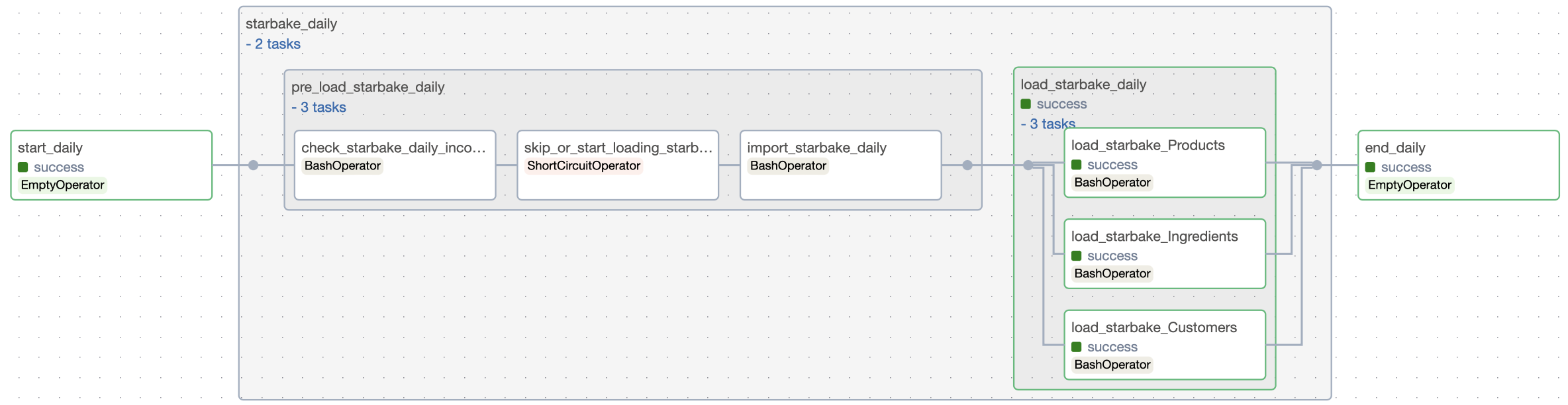
IMPORTED
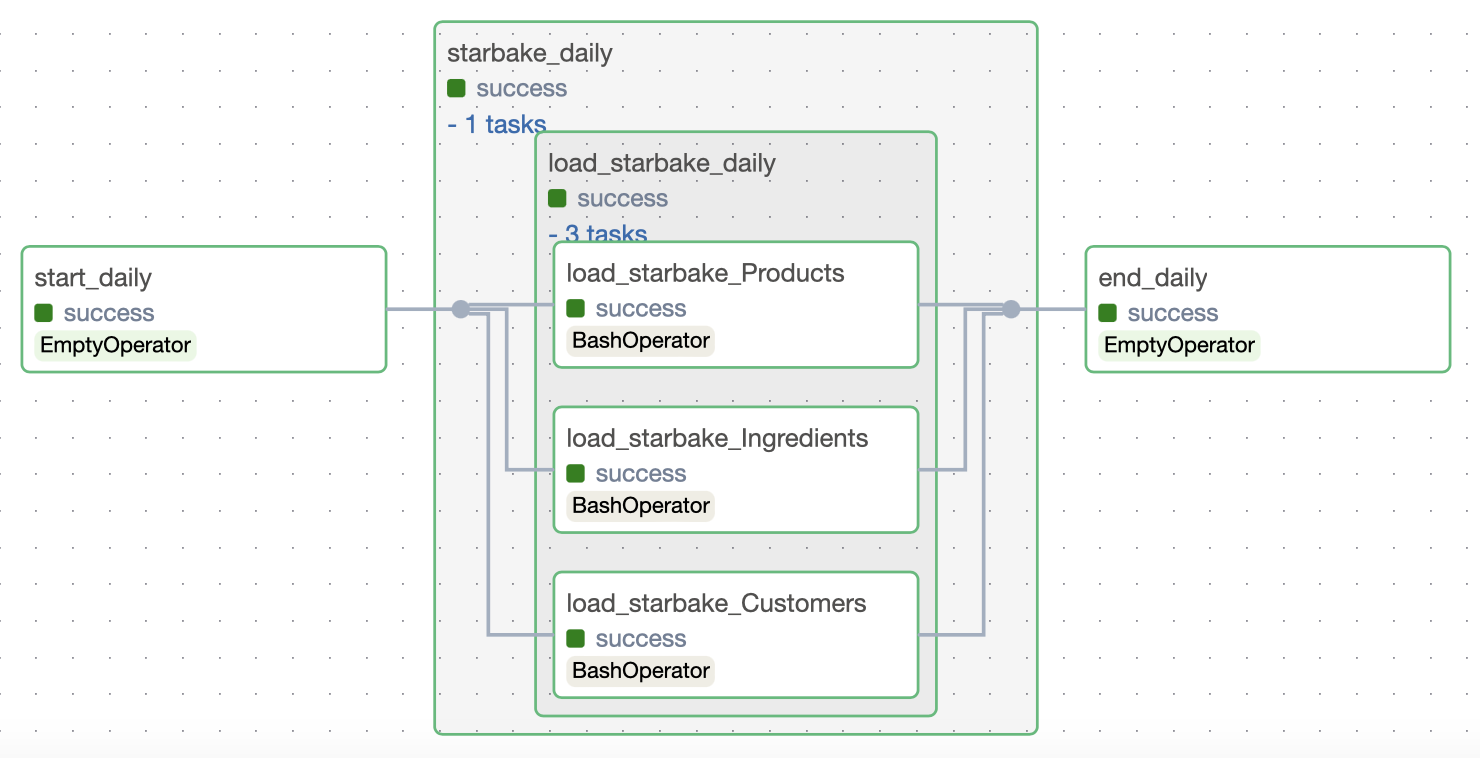
This strategy implies that at least one file is present in the landing area (SL_ROOT/datasets/importing/{domain} by default). If there is one or more files to load, the method sl_import will be called to import the domain before loading it, otherwise the loading of the domain will be skipped.
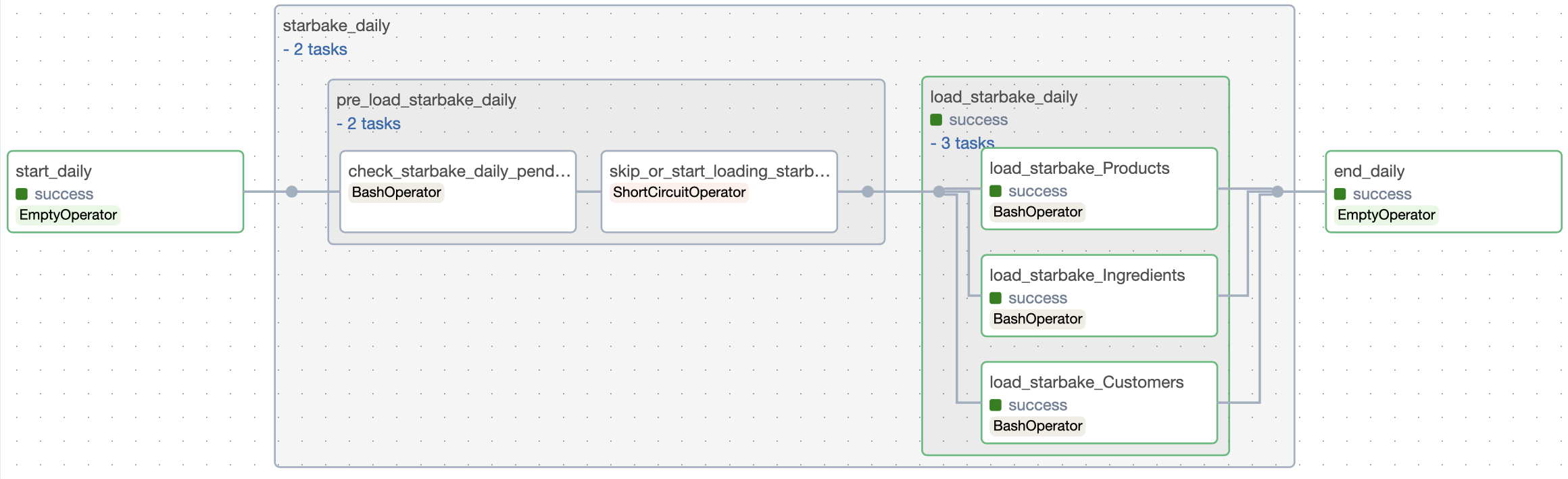
PENDING
This strategy implies that at least one file is present in the pending datasets area of the domain (SL_ROOT/datasets/pending/{domain} by default), otherwise the loading of the domain will be skipped.
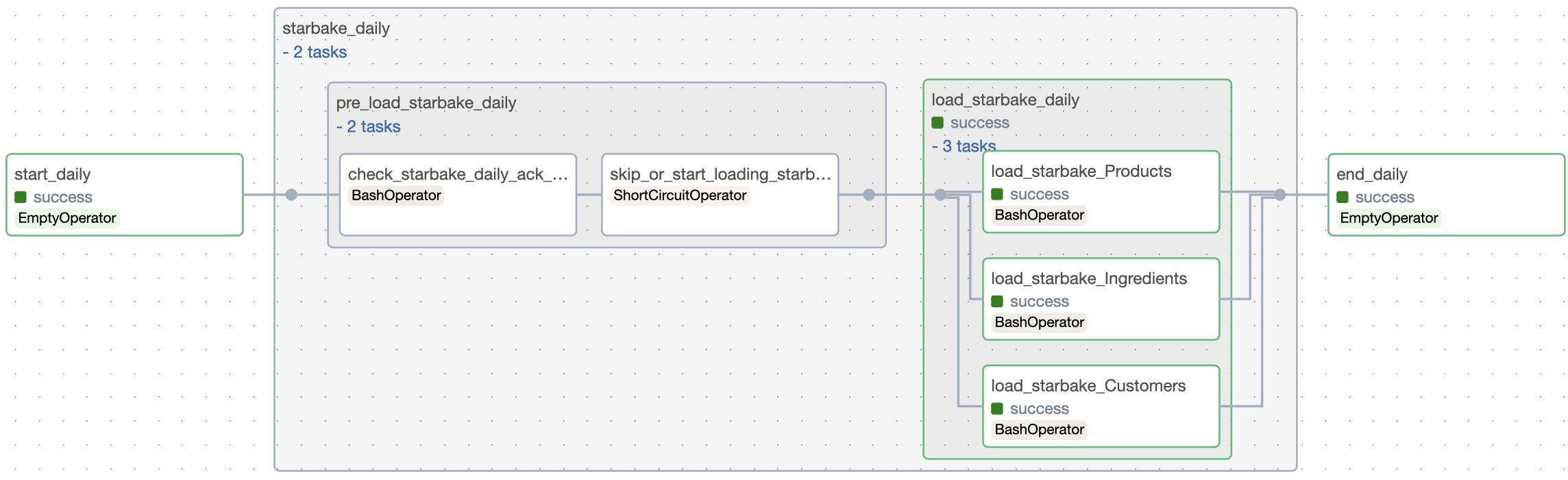
ACK
This strategy implies that an ack file is present at the specified path (option global_ack_file_path), otherwise the loading of the domain will be skipped.
Options
The following options can be specified in all concrete factory classes. Options are resolved with the following priority: options dict, default value, Airflow Variable, environment variable.
| name | type | description |
|---|---|---|
| default_pool | str | pool of slots to use (default_pool by default) |
| tags | str | a list of tags to be applied to the dag |
| start_date | str | optional start date of the dag |
| end_date | str | optional end date of the dag |
| catchup | str | whether to catch up the missed runs or not (False by default) |
| sl_env_var | str | optional starlake environment variables passed as an encoded json string |
| retries | int | optional number of retries to attempt before failing a task (1 by default) |
| retry_delay | int | optional delay between retries in seconds (300 by default) |
| pre_load_strategy | str | one of none (default), imported, pending or ack |
| global_ack_file_path | str | path to the ack file ({SL_DATASETS}/pending/{domain}/{{{{ds}}}}.ack by default) |
| ack_wait_timeout | int | timeout in seconds to wait for the ack file (1 hour by default); ignored in sensor mode |
| pre_load_sensor | bool | true/false (default false) — make the pre-load task WAIT, polling starlake preload until files arrive within pre_load_timeout. On the SHELL environment it is a BashSensor (reschedule mode). Since 0.6.7 (issue #93) it is also supported on the CLOUD environments (cloud_run, dataproc, fargate): the engine builds a deferrable operator when the provider operator supports it (a running triggerer is REQUIRED but cannot be verified at DAG-parse time — force the sensor fallback with pre_load_deferrable=false if none runs) (retries/retry_delay are derived from pre_load_timeout/pre_load_poke_interval, so each empty poke is a recorded task failure), or a reschedule sensor that submits one preload run per poke otherwise (see pre_load_deferrable) |
| pre_load_deferrable | bool | true/false (default true) — CLOUD environments only: when true, prefer a deferrable operator (requires a running triggerer, which cannot be verified at DAG-parse time) if the provider operator supports it; set false to force the reschedule sensor fallback. The cloud_run use_gcloud=true path has no deferrable operator and always uses the sensor |
| pre_load_poke_interval | int | seconds between two pokes while waiting (300 by default) |
| pre_load_timeout | int | wall-clock timeout in seconds for the pre-load wait (3600 by default); on timeout the task fails (or is skipped with pre_load_sensor_soft_fail) and the downstream loads are skipped |
| pre_load_sensor_soft_fail | bool | true/false (default false) — on wait timeout mark the task SKIPPED instead of FAILED (run stays green) |
| pre_load_not_ready_sentinel_path | str | opt-in (absent/blank = off, zero change) — parent prefix for the CLI's --notReadySentinel marker (requires starlake CLI 1.5.15+), resolved to <prefix>/<domain>/<dag_id>__<run_id>.notready (sanitized). Scheme is engine-gated at DAG-parse time: absolute local/file:// on the shell (bash) engine, gs:// on cloud_run/dataproc, s3:// on fargate. See "Pre-load not-ready sentinel" below |
| dataset_triggering_strategy | str | the dataset triggering strategy to use |
| max_active_runs | int | maximum number of active DAG runs (3 by default) |
Pre-load not-ready sentinel
Starlake CLI 1.5.15+ writes a zero-byte marker at --notReadySentinel <uri> on a "not ready" decision and exits 0 — a genuine crash still exits non-zero and never writes the marker. With pre_load_not_ready_sentinel_path set (strictly opt-in), the pre-load verdict becomes deterministic on every engine:
- exit 0 + marker absent → READY → proceed (
skip_or_startproceeds — the bash wrappers echo the int-coded verdict0, the python cloud paths return a truthyreturn_value); - exit 0 + marker present → the marker is consumed (deleted first), then NOT READY is signaled through the existing primitive: falsy XCom →
skip_or_startskips (one-shot),exit 2/poke-again (sensor mode,retry_exit_code=2), the retries-as-poke raise (deferrable waiting), poke-again (cloud sensor waiting); - non-zero exit / engine failure → REAL FAILURE → the task fails NOW. This removes two documented deficiencies (opt-in only): the one-shot wrapper no longer swallows a crashed CLI as "nothing to load", and the waiting paths no longer poke a broken invocation until timeout. Sentinel semantics win over
retry_on_failurefor preload.
The run scope (<dag_id>__<run_id>, whitelist-sanitized — a manual-trigger run_id is user-controlled free text) is substituted at RUN time as data: on the bash paths it travels as the SL_SENTINEL_SCOPE env VALUE (Jinja renders the ids into the templated env field, never into shell code) and is re-sanitized in the flat wrapper via tr; on the python cloud paths it is substituted python-side at execute/poke time into both the submitted payload and the polled path; on the gcloud waiting sensor the sanitized scope is exported python-side around the poke (BashSensor has no append_env).
Per-engine consumption (always inside the task that ran the CLI): bash = [ -f ]/rm -f; cloud_run/dataproc python paths = GCSHook (honoring gcp_conn_id and impersonation_chain); cloud_run gcloud paths = gcloud storage ls/rm with the same impersonation CLI fragment as the other probes; fargate = S3Hook (honoring aws_conn_id). One combination is rejected loudly at DAG-parse time: use_gcloud=true + cloud_run_async=true + retry_on_failure=true + sentinel (that topology's completion sensor cannot carry a consume-then-signal verdict).
Best-effort-write caveat (CLI design): a failed marker write still exits 0 with no marker. For IMPORTED/PENDING this yields a no-op load; for ACK it can trigger a premature load of un-acked data — keep the sentinel prefix on reliable storage with the ACK strategy.
Known residuals (documented, by design):
- with
pre_load_sensor_soft_fail=true, a REAL failure on a waiting sensor surfaces as SKIPPED instead of FAILED (Airflow's sensors convert the fail-fast exception undersoft_fail) — the downstream loads still never run and the failure still never pokes until timeout; soft fail explicitly trades alerting for green runs; - on the python ASYNC one-shot topologies (cloud_run
use_gcloud=false,fargate_async=true), the completion sensor consumes the marker while describing an already-finished execution: manually CLEARING that sensor (or a worker death in the tiny window between the delete and the poke verdict) re-reads the same execution with the marker gone → READY. Preferpre_load_sensor=truewaiting (which re-runs the CLI per attempt) when using the sentinel on those engines; - the gcloud async status task's execution-describe probe keeps its pre-existing shape (an empty describe output reads as success); the sentinel STORAGE probe itself is three-state (present / absent / loud probe failure);
pre_load_not_ready_sentinel_pathis resolved from the options dict only (like the otherpre_load_*options) — it is not read from Airflow Variables or environment variables.
Default DAG Args
The following default DAG arguments are applied when no custom arguments are provided:
| arg | value |
|---|---|
| depends_on_past | False |
| start_date | 2023-01-01 |
| email_on_failure | False |
| email_on_retry | False |
| retries | 1 |
| retry_delay | 5 minutes |
| max_active_runs | 1 |
Data-aware scheduling
StarlakeAirflowJob is also responsible for recording the outlets related to the execution of each starlake command, useful for scheduling DAGs using data-aware scheduling.
The class extends AirflowDataset (which extends AbstractEvent[Dataset]), converting StarlakeDataset instances to Airflow Dataset objects with extras (URI, cron, freshness).
All the outlets that have been recorded are available in the outlets property of the instance of the concrete class.
def __init__(
    self,
    pre_load_strategy: Union[StarlakePreLoadStrategy, str, None],
    options: dict=None,
    **kwargs) -> None:
    #...
    self.outlets: List[Dataset] = kwargs.get('outlets', [])

def sl_import(self, task_id: str, domain: str, tables: set=set(), **kwargs) -> BaseOperator:
    #...
    outlets = self.sl_outlets(domain, **kwargs)
    self.outlets += outlets
    kwargs.update({'outlets': outlets})
    #...

def sl_load(
    self,
    task_id: str,
    domain: str,
    table: str,
    spark_config: StarlakeSparkConfig=None,
    **kwargs) -> BaseOperator:
    #...
    outlets = self.sl_outlets(domain, **kwargs)
    self.outlets += outlets
    kwargs.update({'outlets': outlets})
    #...

def sl_transform(
    self,
    task_id: str,
    transform_name: str,
    transform_options: str=None,
    spark_config: StarlakeSparkConfig=None,
    **kwargs) -> BaseOperator:
    #...
    outlets = self.sl_outlets(domain, **kwargs)
    self.outlets += outlets
    kwargs.update({'outlets': outlets})
    #...
In conjunction with the starlake dag generation, the outlets property can be used to schedule effortless DAGs that will run the transform commands.
Airflow version compatibility
The library supports Apache Airflow 2.5.0 → 3.x from a single codebase. It detects the installed Airflow version at runtime and adapts its behavior, so the full data-aware round-trip (a load DAG emits dataset outlets carrying Starlake's runtime metadata; a transform DAG is triggered by them and reads that metadata) works across the whole range. Some capabilities that depend on newer Airflow APIs are gated by version and degrade gracefully below their floor:
| Capability | Airflow floor | Below the floor |
|---|---|---|
| Datasets (outlets / triggering) | 2.4 (2.5 for triggering_dataset_events) |
n/a — 2.5 is the supported floor |
Outlet extra carried onto the emitted event (supports_inlet_events()) |
2.10 (native outlet_events accessor) |
forwarded by a thin DatasetManager.register_dataset_change wrapper so the runtime extra is not dropped (issue #125) |
Conditional dataset scheduling — DatasetAny/DatasetAll via |/& (supports_dataset_conditions()) |
2.9 | ALL uses a native flat-list schedule; ANY degrades to ALL (flat list) with a logged warning, since OR is not expressible (issue #127) |
retry_exit_code on BashOperator/BashSensor (supports_bash_retry_exit_code()) |
2.10 | the pre-load sentinel drops retry_exit_code so the sensor still constructs; the closed {0,1,2} exit-code contract is a 2.10+ feature (issue #128) |
Assets (replace datasets) (supports_assets()) |
3.0 | datasets are used instead |
Notes:
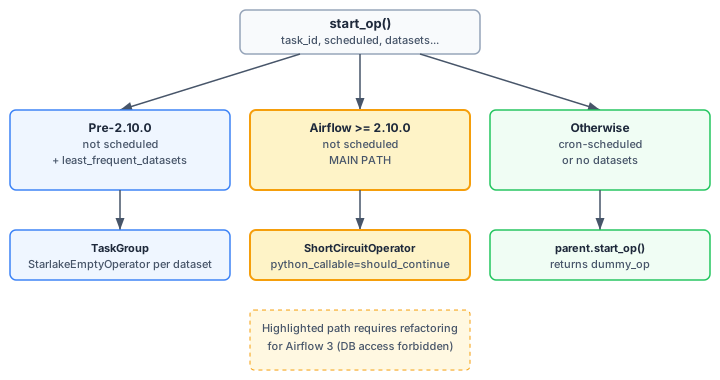
supports_inlet_events()—Truefor Airflow >= 2.10.0. Also enables inlet-event dataset-readiness validation viaShortCircuitOperatorinstart_op().supports_assets()—Truefor Airflow >= 3.0.0, enabling asset-based scheduling (Asset/AssetAny/AssetAll).- The
scheduledDatetemplating (ts_as_datetime/sl_datesmacros) uses Jinja's@pass_contextso it renders correctly during execution on every version, including Airflow 2.5–2.9 (issue #126). - The dataset-triggering strategy is set with the
dataset_triggering_strategyoption (any— default — orall). Below Airflow 2.9,anybehaves asall; use Airflow >= 2.9 for true OR (DatasetAny) triggering.
Advanced opt-in features (deferrable cloud pre-load, the pre-load not-ready sentinel's forced exit-code contract, dataset aliases) remain 2.10+.
StarlakeDatasetMixin
StarlakeDatasetMixin adds dataset outlet management and scheduled date rendering to operators. It is mixed into operators produced by the concrete job classes.
On premise
StarlakeAirflowBashJob
This class is a concrete implementation of StarlakeAirflowJob that generates tasks using airflow.operators.bash.BashOperator. Useful for on premise execution.
An additional SL_STARLAKE_PATH option is required to specify the path to the starlake executable.
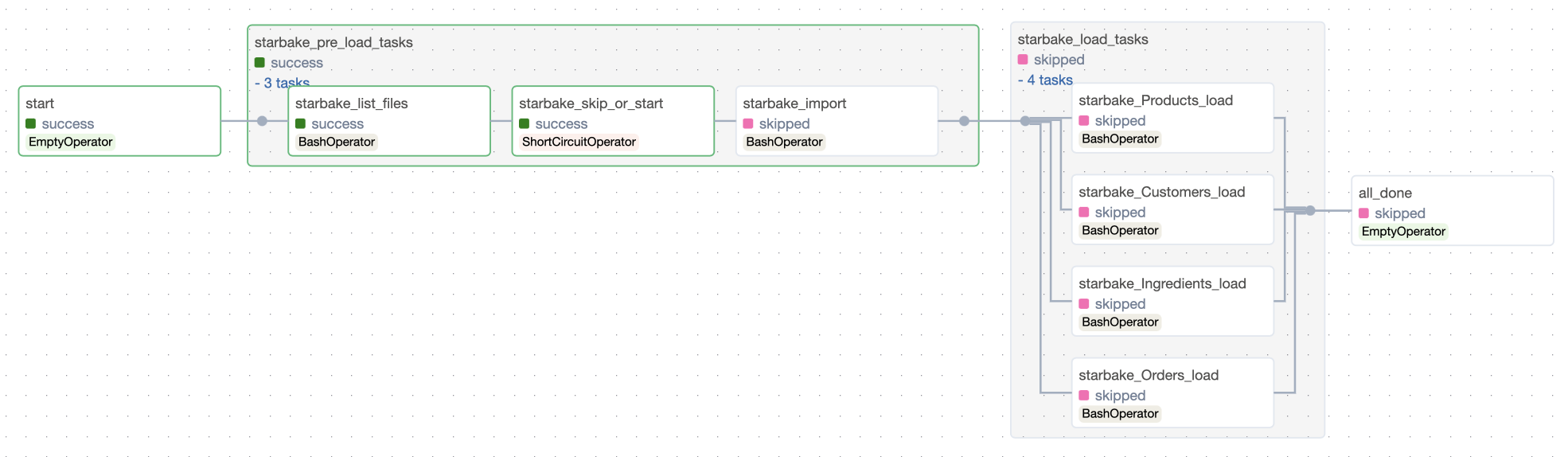
StarlakeAirflowBashJob load Example
The following example shows how to use StarlakeAirflowBashJob to generate dynamically DAGs that load domains using starlake and record corresponding outlets.
description="""example to load domain(s) using airflow starlake bash job"""

options = {
    # General options
    'sl_env_var':'{"SL_ROOT": "/starlake/samples/starbake"}',
    'pre_load_strategy':'imported',
    # Bash options
    'SL_STARLAKE_PATH':'/starlake/starlake.sh',
}

import sys

from ai.starlake.job import StarlakeSparkConfig
from ai.starlake.airflow import StarlakeAirflowOptions

def default_spark_config(*args, **kwargs) -> StarlakeSparkConfig:
    return StarlakeSparkConfig(
        memory=sys.modules[__name__].__dict__.get('spark_executor_memory', None),
        cores=sys.modules[__name__].__dict__.get('spark_executor_cores', None),
        instances=sys.modules[__name__].__dict__.get('spark_executor_instances', None),
        cls_options=StarlakeAirflowOptions(),
        options=options,
        **kwargs
    )
spark_config = getattr(sys.modules[__name__], "get_spark_config", default_spark_config)

from ai.starlake.airflow.bash import StarlakeAirflowBashJob

sl_job = StarlakeAirflowBashJob(options=options)

from ai.starlake.common import sanitize_id

import os

from airflow import DAG

from airflow.datasets import Dataset

from airflow.utils.task_group import TaskGroup

schedules= [{
    'schedule': 'None',
    'cron': None,
    'domains': [{
        'name':'starbake',
        'final_name':'starbake',
        'tables': [
            {
                'name': 'Customers',
                'final_name': 'Customers'
            },
            {
                'name': 'Ingredients',
                'final_name': 'Ingredients'
            },
            {
                'name': 'Orders',
                'final_name': 'Orders'
            },
            {
                'name': 'Products',
                'final_name': 'Products'
            }
        ]
    }]
}]

def generate_dag_name(schedule):
    dag_name = os.path.basename(__file__).replace(".py", "").replace(".pyc", "").lower()
    return (f"{dag_name}-{schedule['schedule']}" if len(schedules) > 1 else dag_name)

# [START instantiate_dag]
for schedule in schedules:
    tags = sl_job.get_context_var(var_name='tags', default_value="", options=options).split()
    for domain in schedule["domains"]:
        tags.append(domain["name"])
    _cron = schedule['cron']
    with DAG(dag_id=generate_dag_name(schedule),
             schedule=_cron,
             default_args=sys.modules[__name__].__dict__.get('default_dag_args', sl_job.default_dag_args()),
             catchup=False,
             tags=list(set([tag.upper() for tag in tags])),
             description=description,
             start_date=sl_job.start_date,
             end_date=sl_job.end_date) as dag:
        start = sl_job.dummy_op(task_id="start")

        post_tasks = sl_job.post_tasks(dag=dag)

        pre_load_tasks = sl_job.sl_pre_load(domain=domain["name"], tables=set([table['name'] for table in domain['tables']]), params={'cron':_cron}, dag=dag)

        def generate_task_group_for_domain(domain):
            with TaskGroup(group_id=sanitize_id(f'{domain["name"]}_load_tasks')) as domain_load_tasks:
                for table in domain["tables"]:
                    load_task_id = sanitize_id(f'{domain["name"]}_{table["name"]}_load')
                    spark_config_name=StarlakeAirflowOptions.get_context_var('spark_config_name', f'{domain["name"]}.{table["name"]}'.lower(), options)
                    sl_job.sl_load(
                        task_id=load_task_id,
                        domain=domain["name"],
                        task_id=load_task_id,
                        domain=domain["name"],
                        table=table["name"],
                        spark_config=spark_config(spark_config_name, **sys.modules[__name__].__dict__.get('spark_properties', {})),
                        params={'cron':_cron},
                        dag=dag
                    )
            return domain_load_tasks

        all_load_tasks = [generate_task_group_for_domain(domain) for domain in schedule["domains"]]

        if pre_load_tasks:
            start >> pre_load_tasks >> all_load_tasks
        else:
            start >> all_load_tasks

        end = sl_job.dummy_op(task_id="end", outlets=[Dataset(sl_job.sl_dataset(dag.dag_id, cron=_cron), {"source": dag.dag_id})])

        all_load_tasks >> end

        if post_tasks:
            all_done = sl_job.dummy_op(task_id="all_done")
            all_load_tasks >> all_done >> post_tasks >> end
StarlakeAirflowBashJob Transform Examples
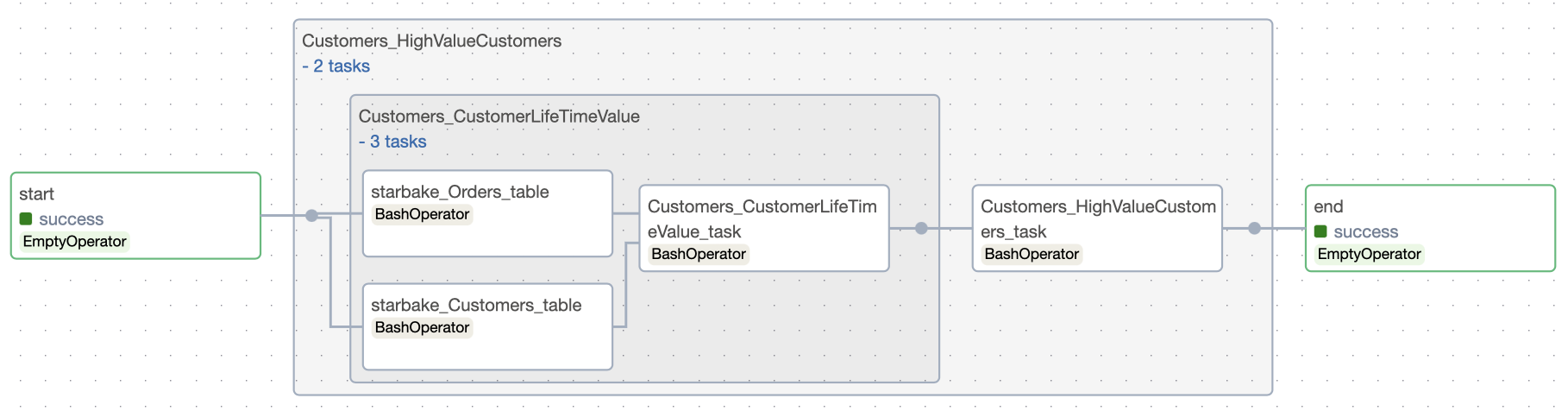
The following example shows how to use StarlakeAirflowBashJob to generate dynamically transform Jobs using starlake and record corresponding outlets.
options = {
    # General options
    'sl_env_var':'{"SL_ROOT": "/starlake/samples/starbake"}',
    'pre_load_strategy':'imported',
    # Bash options
    'SL_STARLAKE_PATH':'/starlake/starlake.sh',
}

import sys

from ai.starlake.job import StarlakeSparkConfig
from ai.starlake.airflow import StarlakeAirflowOptions

def default_spark_config(*args, **kwargs) -> StarlakeSparkConfig:
    return StarlakeSparkConfig(
        memory=sys.modules[__name__].__dict__.get('spark_executor_memory', None),
        cores=sys.modules[__name__].__dict__.get('spark_executor_cores', None),
        instances=sys.modules[__name__].__dict__.get('spark_executor_instances', None),
        cls_options=StarlakeAirflowOptions(),
        options=options,
        **kwargs
    )
spark_config = getattr(sys.modules[__name__], "get_spark_config", default_spark_config)

from ai.starlake.airflow.bash import StarlakeAirflowBashJob

#optional variable jobs as a dict of all options to apply by job
#eg jobs = {"task1 domain.task1 name": {"options": "task1 transform options"}, "task2 domain.task2 name": {"options": "task2 transform options"}}
sl_job = StarlakeAirflowBashJob(options=dict(options, **sys.modules[__name__].__dict__.get('jobs', {})))

from ai.starlake.common import sanitize_id, sort_crons_by_frequency, sl_cron_start_end_dates
from ai.starlake.job import StarlakeSparkConfig

import json
import os
import sys
from typing import Set

from airflow import DAG

from airflow.datasets import Dataset

from airflow.utils.task_group import TaskGroup

cron = "None"

_cron = None if cron == "None" else cron

task_deps=json.loads("""[ {
  "data" : {
    "name" : "Customers.HighValueCustomers",
    "typ" : "task",
    "parent" : "Customers.CustomerLifeTimeValue",
    "parentTyp" : "task",
    "parentRef" : "CustomerLifetimeValue",
    "sink" : "Customers.HighValueCustomers"
  },
  "children" : [ {
    "data" : {
      "name" : "Customers.CustomerLifeTimeValue",
      "typ" : "task",
      "parent" : "starbake.Customers",
      "parentTyp" : "table",
      "parentRef" : "starbake.Customers",
      "sink" : "Customers.CustomerLifeTimeValue"
    },
    "children" : [ {
      "data" : {
        "name" : "starbake.Customers",
        "typ" : "table",
        "parentTyp" : "unknown"
      },
      "task" : false
    }, {
      "data" : {
        "name" : "starbake.Orders",
        "typ" : "table",
        "parentTyp" : "unknown"
      },
      "task" : false
    } ],
    "task" : true
  } ],
  "task" : true
} ]""")

run_dependencies: bool = sl_job.get_context_var(var_name='run_dependencies', default_value='False', options=options).lower() == 'true'

datasets: Set[str] = set()

cronDatasets: dict = dict()

_filtered_datasets: Set[str] = set(sys.modules[__name__].__dict__.get('filtered_datasets', []))

from typing import List

first_level_tasks: set = set()

dependencies: set = set()

def load_task_dependencies(task):
    if 'children' in task:
        for subtask in task['children']:
            dependencies.add(subtask['data']['name'])
            load_task_dependencies(subtask)

for task in task_deps:
    task_id = task['data']['name']
    first_level_tasks.add(task_id)
    _filtered_datasets.add(sanitize_id(task_id).lower())
    load_task_dependencies(task)

def _load_datasets(task: dict):
    if 'children' in task:
        for child in task['children']:
            dataset = sanitize_id(child['data']['name']).lower()
            if dataset not in datasets and dataset not in _filtered_datasets:
                childCron = None if child['data'].get('cron') == 'None' else child['data'].get('cron')
                if childCron :
                    cronDataset = sl_job.sl_dataset(dataset, cron=childCron)
                    datasets.add(cronDataset)
                    cronDatasets[cronDataset] = childCron
                else :
                  datasets.add(dataset)

def _load_schedule():
    if _cron:
        schedule = _cron
    elif not run_dependencies : # the DAG will do not depend on any datasets because all the related dependencies will be executed
        for task in task_deps:
            _load_datasets(task)
        schedule = list(map(lambda dataset: Dataset(dataset), datasets))
    else:
        schedule = None
    return schedule

tags = sl_job.get_context_var(var_name='tags', default_value="", options=options).split()

def ts_as_datetime(ts):
  # Convert ts to a datetime object
  from datetime import datetime
  return datetime.fromisoformat(ts)

_user_defined_macros = sys.modules[__name__].__dict__.get('user_defined_macros', dict())
_user_defined_macros["sl_dates"] = sl_cron_start_end_dates
_user_defined_macros["ts_as_datetime"] = ts_as_datetime

catchup: bool = _cron is not None and sl_job.get_context_var(var_name='catchup', default_value='False', options=options).lower() == 'true'

# [START instantiate_dag]
with DAG(dag_id=os.path.basename(__file__).replace(".py", "").replace(".pyc", "").lower(),
         schedule=_load_schedule(),
         default_args=sys.modules[__name__].__dict__.get('default_dag_args', sl_job.default_dag_args()),
         catchup=catchup,
         user_defined_macros=_user_defined_macros,
         user_defined_filters=sys.modules[__name__].__dict__.get('user_defined_filters', None),
         tags=list(set([tag.upper() for tag in tags])),
         description=description,
         start_date=sl_job.start_date,
         end_date=sl_job.end_date) as dag:

    start = sl_job.dummy_op(task_id="start")

    pre_tasks = sl_job.pre_tasks(dag=dag)

    post_tasks = sl_job.post_tasks(dag=dag)

    if _cron:
        cron_expr = _cron
    elif datasets.__len__() == cronDatasets.__len__() and set(cronDatasets.values()).__len__() > 0:
        sorted_crons = sort_crons_by_frequency(set(cronDatasets.values()), period=sl_job.get_context_var(var_name='cron_period_frequency', default_value='week', options=options))
        cron_expr = sorted_crons[0][0]
    else:
        cron_expr = None

    if cron_expr:
        transform_options = "{{sl_dates(params.cron_expr, ts_as_datetime(data_interval_end | ts))}}"
    else:
        transform_options = None

    def create_task(airflow_task_id: str, task_name: str, task_type: str):
        spark_config_name=StarlakeAirflowOptions.get_context_var('spark_config_name', task_name.lower(), options)
        if (task_type == 'task'):
            return sl_job.sl_transform(
                task_id=airflow_task_id,
                transform_name=task_name,
                transform_options=transform_options,
                spark_config=spark_config(spark_config_name, **sys.modules[__name__].__dict__.get('spark_properties', {})),
                params={'cron':_cron, 'cron_expr':cron_expr},
                dag=dag
            )
        else:
            load_domain_and_table = task_name.split(".",1)
            domain = load_domain_and_table[0]
            table = load_domain_and_table[1]
            return sl_job.sl_load(
                task_id=airflow_task_id,
                domain=domain,
                table=table,
                spark_config=spark_config(spark_config_name, **sys.modules[__name__].__dict__.get('spark_properties', {})),
                params={'cron':_cron},
                dag=dag
            )

    # build taskgroups recursively
    def generate_task_group_for_task(task):
        task_name = task['data']['name']
        airflow_task_group_id = sanitize_id(task_name)
        airflow_task_id = airflow_task_group_id
        task_type = task['data']['typ']
        if (task_type == 'task'):
            airflow_task_id = airflow_task_group_id + "_task"
        else:
            airflow_task_id = airflow_task_group_id + "_table"

        children = []
        if run_dependencies and 'children' in task:
            children = task['children']
        else:
            for child in task.get('children', []):
                if child['data']['name'] in first_level_tasks:
                    children.append(child)

        if children.__len__() > 0:
            with TaskGroup(group_id=airflow_task_group_id) as airflow_task_group:
                for transform_sub_task in children:
                    generate_task_group_for_task(transform_sub_task)
                upstream_tasks = list(airflow_task_group.children.values())
                airflow_task = create_task(airflow_task_id, task_name, task_type)
                airflow_task.set_upstream(upstream_tasks)
            return airflow_task_group
        else:
            airflow_task = create_task(airflow_task_id=airflow_task_id, task_name=task_name, task_type=task_type)
            return airflow_task

    all_transform_tasks = [generate_task_group_for_task(task) for task in task_deps if task['data']['name'] not in dependencies]

    if pre_tasks:
        start >> pre_tasks >> all_transform_tasks
    else:
        start >> all_transform_tasks

    extra: dict = {"source": dag.dag_id}
    outlets: List[Dataset] = [Dataset(sl_job.sl_dataset(dag.dag_id, cron=_cron), extra)]
    if set(cronDatasets.values()).__len__() > 1: # we have at least 2 distinct cron expressions
        # we sort the cron datasets by frequency (most frequent first)
        sorted_crons = sort_crons_by_frequency(set(cronDatasets.values()), period=sl_job.get_context_var(var_name='cron_period_frequency', default_value='week', options=options))
        # we exclude the most frequent cron dataset
        least_frequent_crons = set([expr for expr, _ in sorted_crons[1:sorted_crons.__len__()]])
        for dataset, cron in cronDatasets.items() :
            # we republish the least frequent scheduled datasets
            if cron in least_frequent_crons:
                outlets.append(Dataset(dataset, extra))

    end = sl_job.dummy_op(task_id="end", outlets=outlets)

    all_transform_tasks >> end

    if post_tasks:
        all_done = sl_job.dummy_op(task_id="all_done")
        all_transform_tasks >> all_done >> post_tasks >> end
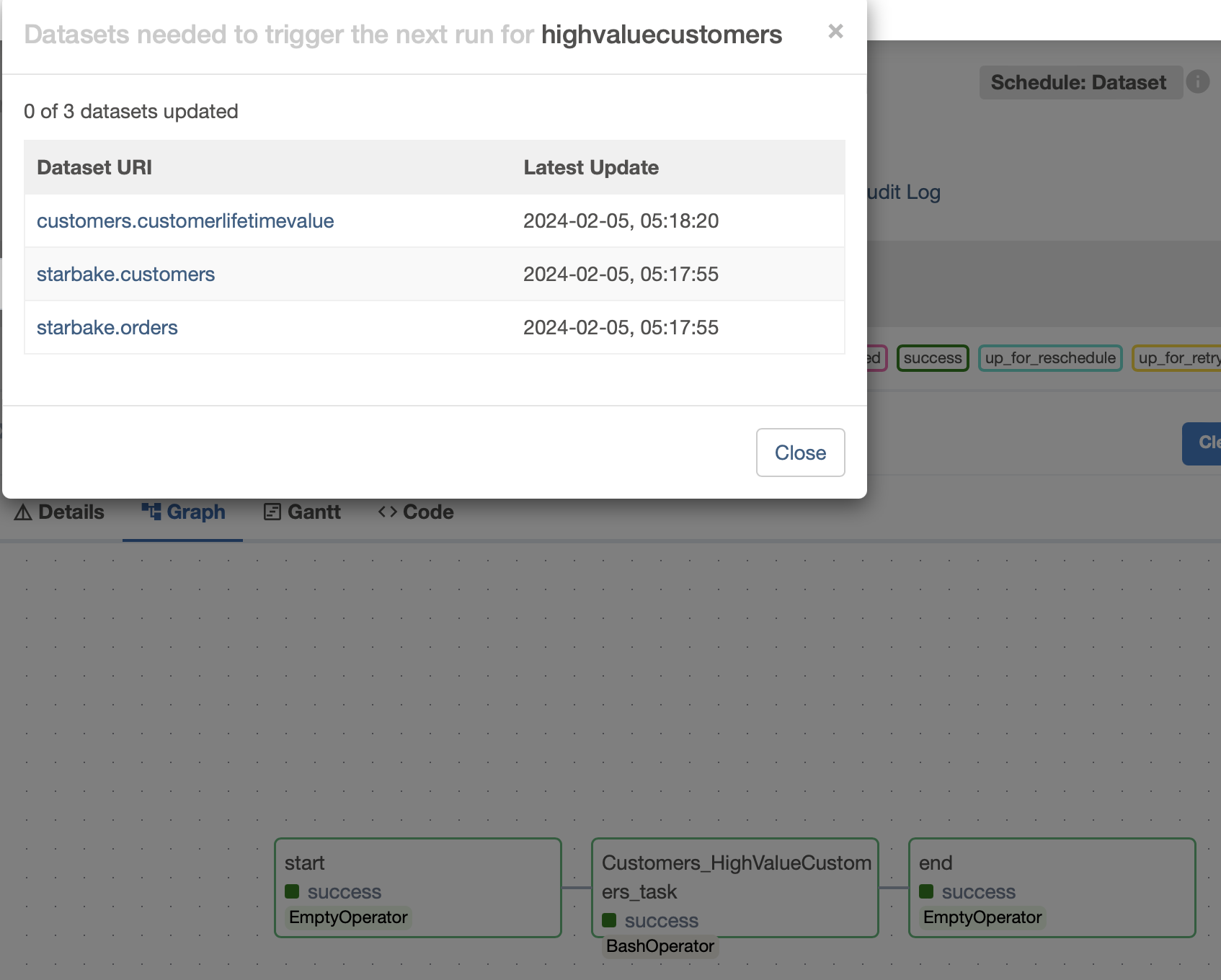
If you want to load the dependencies, you just need to set the run_dependencies option to True:
Google Cloud Platform
StarlakeAirflowDataprocJob
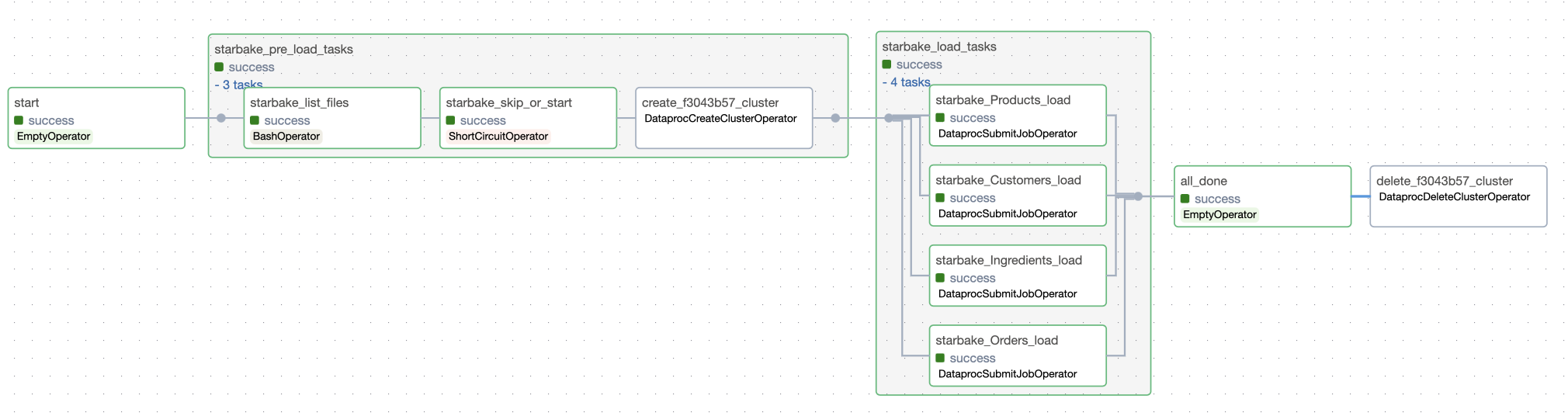
This class is a concrete implementation of StarlakeAirflowJob that overrides the sl_job method to run starlake commands by submitting Dataproc jobs to a configured Dataproc cluster.
It manages the full cluster lifecycle (create, submit, delete) by delegating to an instance of the ai.starlake.airflow.gcp.StarlakeAirflowDataprocCluster class, which is responsible for:
- create the Dataproc cluster by instantiating
airflow.providers.google.cloud.operators.dataproc.DataprocCreateClusterOperator - submit Dataproc job to the latter by instantiating
airflow.providers.google.cloud.operators.dataproc.DataprocSubmitJobOperator - delete the Dataproc cluster by instantiating
airflow.providers.google.cloud.operators.dataproc.DataprocDeleteClusterOperator
This instance is available in the cluster property of the StarlakeAirflowDataprocJob class and can be configured using the ai.starlake.airflow.gcp.StarlakeAirflowDataprocClusterConfig class.
The creation of the Dataproc cluster can be performed by calling the create_cluster method of the cluster property or by calling the pre_tasks method of the StarlakeAirflowDataprocJob (the call to the pre_load method will, behind the scene, call the pre_tasks method and add the optional resulting task to the group of Airflow tasks).
The deletion of the Dataproc cluster can be performed by calling the delete_cluster method of the cluster property or by calling the post_tasks method of the StarlakeAirflowDataprocJob.
Dataproc cluster configuration
Additional options may be specified to configure the Dataproc cluster.
| name | type | description |
|---|---|---|
| cluster_id | str | the optional unique id of the cluster that will participate in the definition of the Dataproc cluster name (if not specified) |
| dataproc_name | str | the optional dataproc name of the cluster that will participate in the definition of the Dataproc cluster name (if not specified) |
| dataproc_project_id | str | the optional dataproc project id (the project id on which the composer has been instantiated by default) |
| dataproc_region | str | the optional region (europe-west1 by default) |
| dataproc_subnet | str | the optional subnet (the default subnet if not specified) |
| dataproc_service_account | str | the optional service account (service-{self.project_id}@dataproc-accounts.iam.gserviceaccount.com by default) |
| dataproc_image_version | str | the image version of the dataproc cluster (2.2-debian1 by default) |
| dataproc_master_machine_type | str | the optional master machine type (n1-standard-4 by default) |
| dataproc_master_disk_type | str | the optional master disk type (pd-standard by default) |
| dataproc_master_disk_size | int | the optional master disk size (1024 by default) |
| dataproc_worker_machine_type | str | the optional worker machine type (n1-standard-4 by default) |
| dataproc_worker_disk_type | str | the optional worker disk type (pd-standard by default) |
| dataproc_worker_disk_size | int | the optional worker disk size (1024 by default) |
| dataproc_num_workers | int | the optional number of workers (4 by default) |
| dataproc_cluster_metadata | str | the metadata to add to the dataproc cluster specified as a map in json format |
All of these options will be used by default if no StarlakeAirflowDataprocClusterConfig was defined when instantiating StarlakeAirflowDataprocCluster or if the latter was not defined when instantiating StarlakeAirflowDataprocJob.
Dataproc Job configuration
Additional options may be specified to configure the Dataproc job.
| name | type | description |
|---|---|---|
| spark_jar_list | str | the required list of spark jars to be used (using , as separator) |
| spark_bucket | str | the required bucket to use for spark and bigquery temporary storage |
| spark_job_main_class | str | the optional main class of the spark job (ai.starlake.job.Main by default) |
| spark_executor_memory | str | the optional amount of memory to use per executor process (11g by default) |
| spark_executor_cores | int | the optional number of cores to use on each executor (4 by default) |
| spark_executor_instances | int | the optional number of executor instances (1 by default) |
spark_executor_memory, spark_executor_cores and spark_executor_instances options will be used by default if no StarlakeSparkConfig was passed to the sl_load and sl_transform methods.
StarlakeAirflowDataprocJob load Example
The following example shows how to use StarlakeAirflowDataprocJob to generate dynamically DAGs that load domains using starlake and record corresponding outlets.
description="""example to load domain(s) using airflow starlake dataproc job"""

options = {
    # General options
    'sl_env_var':'{"SL_ROOT": "gcs://starlake/samples/starbake"}',
    'pre_load_strategy':'pending',
    'sl_env_var':'{"SL_ROOT": "gcs://starlake/samples/starbake"}',
    'pre_load_strategy':'pending',
    # Dataproc cluster configuration
    'dataproc_project_id':'starbake',
    # Dataproc job configuration
    'spark_bucket':'my-bucket',
    'spark_jar_list':'gcs://artifacts/starlake.jar',
    # Dataproc job configuration
    'spark_bucket':'my-bucket',
    'spark_jar_list':'gcs://artifacts/starlake.jar',
}

from ai.starlake.airflow.gcp import StarlakeAirflowDataprocJob

sl_job = StarlakeAirflowDataprocJob(options=options)

# all the code following the instantiation of the starlake job is exactly the same as that defined for StarlakeAirflowBashJob
#...
StarlakeAirflowCloudRunJob
This class is a concrete implementation of StarlakeAirflowJob that overrides the sl_job method to run starlake commands by executing a Cloud Run job.
Cloud Run supports three execution modes via the CloudRunMode enum:
- SYNC -- synchronous execution, the operator waits for the job to complete
- ASYNC -- asynchronous execution with a sensor that polls for completion
- DEFER -- deferrable execution using Airflow's async event loop
Cloud Run job configuration
Additional options may be specified to configure the Cloud Run job.
| name | type | description |
|---|---|---|
| cloud_run_project_id | str | the required cloud run project id (the project id on which the composer has been instantiated by default) |
| cloud_run_job_name | str | the required name of the cloud run job |
| cloud_run_job_region | str | the optional region (defaults to GCP_REGION env var) |
| cloud_run_service_account | str | the optional cloud run service account |
| cloud_run_async | bool | the optional flag to run the cloud run job asynchronously (True by default) |
| cloud_run_async_poke_interval | float | the optional poke interval for async sensor in seconds (30 by default) |
| retry_on_failure | bool | the optional flag governing the pre-load task on failure (False by default): false swallows a failed preload (the skip_or_start XCom gating skips downstream loads), true fails the task so retries re-run it (retries-as-poke); in async gcloud mode it also switches the completion topology (sensor with retry_exit_code instead of the status task). Since 0.6.4 (issue #92) a failed load/transform/stage job always fails the task, whatever this flag |
| retry_delay_in_seconds | float | the optional delay in seconds to wait before retrying the cloud run job (10 by default) |
| use_gcloud | bool | whether to use the gcloud command or the google cloud run python operator (True by default) |
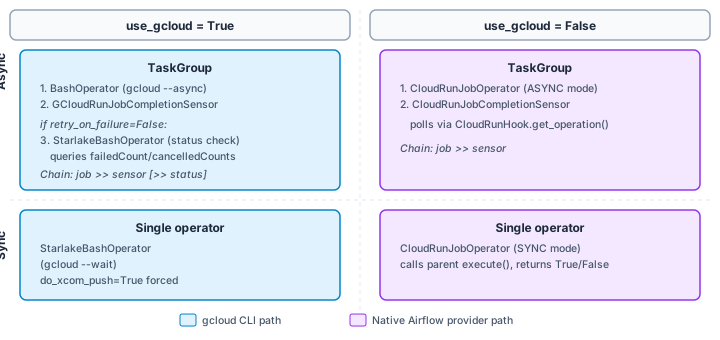
If the execution has been parameterized to be asynchronous, an airflow.sensors.base.BaseSensorOperator will be instantiated to wait for the completion of the Cloud Run job execution.
The following SVG diagrams illustrate key Cloud Run execution flows:
StarlakeAirflowCloudRunJob load Examples
The following examples show how to use StarlakeAirflowCloudRunJob to generate dynamically DAGs that load domains using starlake and record corresponding outlets.
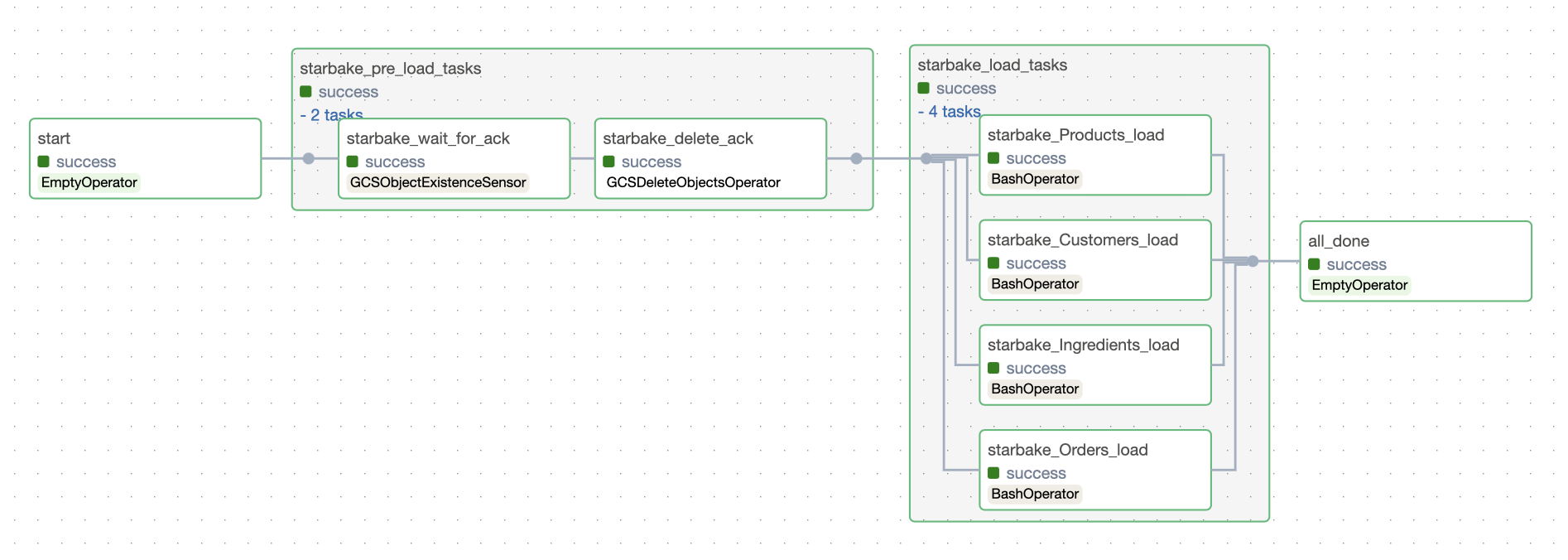
Synchronous execution
description="""example to load domain(s) using airflow starlake cloud run job synchronously"""

options = {
    # General options
    'sl_env_var':'{"SL_ROOT": "gs://my-bucket/starbake"}',
    'pre_load_strategy':'ack',
    'global_ack_file_path':'gs://my-bucket/starbake/pending/HighValueCustomers/2024-22-01.ack',
    'sl_env_var':'{"SL_ROOT": "gs://my-bucket/starbake"}',
    'pre_load_strategy':'ack',
    'global_ack_file_path':'gs://my-bucket/starbake/pending/HighValueCustomers/2024-22-01.ack',
    # Cloud run options
    'cloud_run_job_name':'starlake',
    'cloud_run_project_id':'starbake',
    'cloud_run_async':'False'
}

from ai.starlake.airflow.gcp import StarlakeAirflowCloudRunJob

sl_job = StarlakeAirflowCloudRunJob(options=options)
# all the code following the instantiation of the starlake job is exactly the same as that defined for StarlakeAirflowBashJob
#...
Asynchronous execution
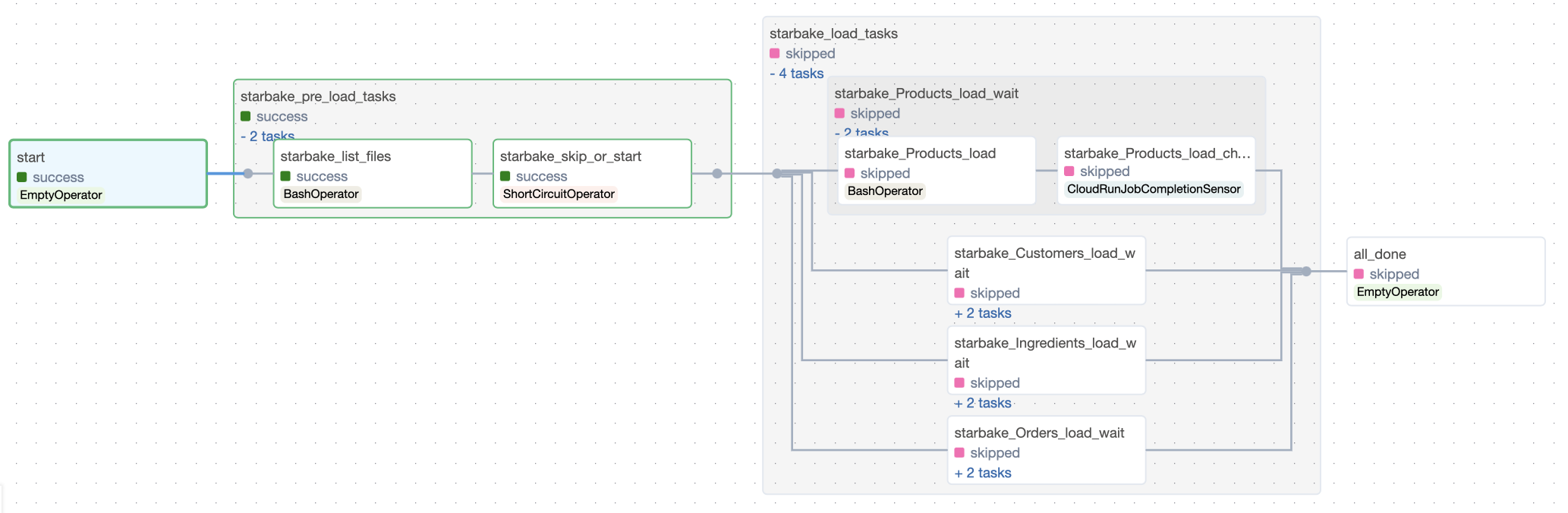
description="""example to load domain(s) using airflow starlake cloud run job asynchronously"""

options = {
    # General options
    'sl_env_var':'{"SL_ROOT": "gs://my-bucket/starbake"}',
    'pre_load_strategy':'pending',
    'sl_env_var':'{"SL_ROOT": "gs://my-bucket/starbake"}',
    'pre_load_strategy':'pending',
    # Cloud run options
    'cloud_run_job_name':'starlake',
    'cloud_run_job_name':'starlake',
    'cloud_run_project_id':'starbake',
    'cloud_run_async':'True',
    'retry_on_failure':'True'
}

# all the code following the options is exactly the same as that defined above
#...
Amazon Web Services
StarlakeAirflowFargateJob
This class is a concrete implementation of StarlakeAirflowJob that overrides the sl_job method to run starlake commands by executing tasks on AWS Fargate using airflow.providers.amazon.aws.operators.ecs.EcsRunTaskOperator.
Fargate supports two execution modes:
- Synchronous -- the operator waits for the ECS task to complete (
fargate_async=False) - Asynchronous -- the task is launched and an
EcsTaskStateSensorpolls for completion (fargate_async=True, default)
Fargate job configuration
Additional options may be specified to configure the Fargate job.
| name | type | description |
|---|---|---|
| aws_conn_id | str | the optional AWS connection id (aws_default by default) |
| aws_profile | str | the optional AWS profile (default by default) |
| aws_region | str | the optional AWS region (eu-west-3 by default) |
| aws_cluster_name | str | the required ECS cluster name |
| aws_task_definition_name | str | the required ECS task definition name |
| aws_task_definition_container_name | str | the required container name within the task definition |
| aws_task_private_subnets | str | the required private subnets for the Fargate task (comma-separated) |
| aws_task_security_groups | str | the required security groups for the Fargate task (comma-separated) |
| cpu | int | the optional container CPU units (1024 by default) |
| memory | int | the optional container memory in MiB (2048 by default) |
| fargate_async | bool | the optional flag to run asynchronously (True by default) |
| fargate_async_poke_interval | float | the optional poke interval for async sensor in seconds (30 by default) |
| retry_on_failure | bool | the optional flag governing the pre-load task on failure (False by default): false swallows a failed preload (its False XCom lets skip_or_start skip downstream loads), true fails the task so retries re-run it (retries-as-poke, sync mode only). Since 0.6.4 (issue #92) a failed load/transform/stage job always fails the task, whatever this flag |
StarlakeAirflowFargateJob load Example
The following example shows how to use StarlakeAirflowFargateJob to generate dynamically DAGs that load domains using starlake on AWS Fargate.
description="""example to load domain(s) using airflow starlake fargate job"""

options = {
    # General options
    'sl_env_var':'{"SL_ROOT": "s3://my-bucket/starbake"}',
    'pre_load_strategy':'imported',
    # Fargate options
    'aws_cluster_name':'my-ecs-cluster',
    'aws_task_definition_name':'starlake-task',
    'aws_task_definition_container_name':'starlake',
    'aws_task_private_subnets':'subnet-abc123,subnet-def456',
    'aws_task_security_groups':'sg-abc123',
    'fargate_async':'True',
}

from ai.starlake.airflow.aws import StarlakeAirflowFargateJob

sl_job = StarlakeAirflowFargateJob(options=options)

# all the code following the instantiation of the starlake job is exactly the same as that defined for StarlakeAirflowBashJob
#...
Additional SVG Diagrams
The following SVG diagrams provide visual reference for key internal flows:
- Start operation branching -- how the
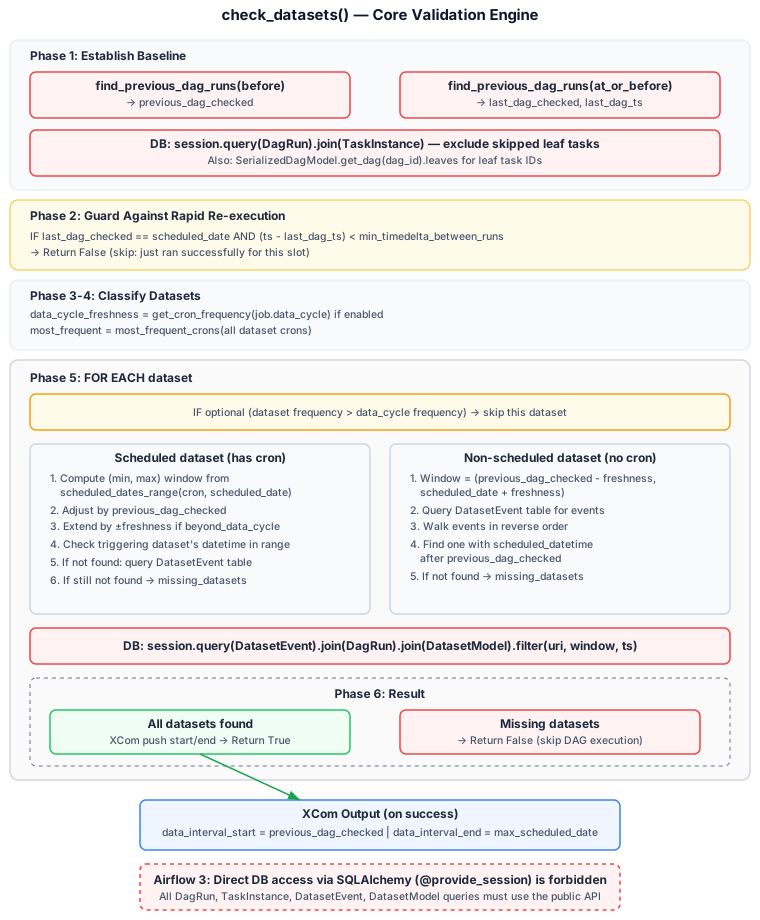
start_op()usesShortCircuitOperatorwith dataset readiness validation - Check datasets flow -- the dataset readiness checking process
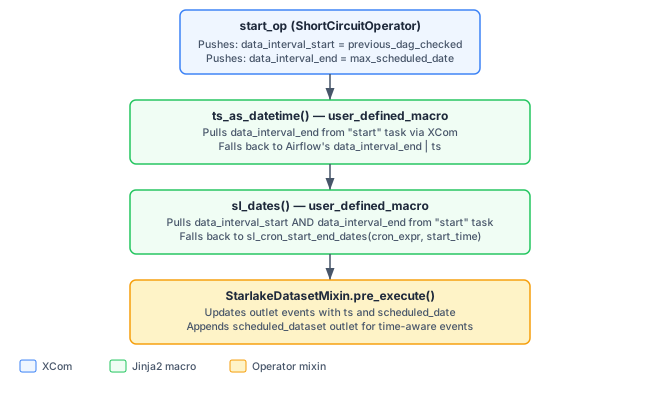
- XCom data flow -- how data flows through XCom between tasks
Azure
Azure support is planned for a future release.
1 maintainer

Download files
Download the file for your platform. If you're not sure which to choose, learn more about installing packages.
Source Distribution
Built Distribution
Filter files by name, interpreter, ABI, and platform.
If you're not sure about the file name format, learn more about wheel file names.
Copy a direct link to the current filters
File details
Details for the file starlake_airflow-0.6.13.tar.gz.
File metadata
- Download URL: starlake_airflow-0.6.13.tar.gz
- Upload date:
- Size: 108.7 kB
- Tags: Source
- Uploaded using Trusted Publishing? No
- Uploaded via:
twine/6.2.0 CPython/3.11.15
File hashes
| Algorithm | Hash digest | |
|---|---|---|
| SHA256 |
2813e08ed6c7e9c8dc7fc1f239b4fbfa9fdd0fed8c747ac66689d2e0b3402f1c
|
|
| MD5 |
3e3ba561bee45b2752b1f4d560b3651e
|
|
| BLAKE2b-256 |
2a9190a6a2e95daf1020596d86ccc88337ad9727f841c3e84174c2d0cd311d6f
|
File details
Details for the file starlake_airflow-0.6.13-py3-none-any.whl.
File metadata
- Download URL: starlake_airflow-0.6.13-py3-none-any.whl
- Upload date:
- Size: 94.8 kB
- Tags: Python 3
- Uploaded using Trusted Publishing? No
- Uploaded via:
twine/6.2.0 CPython/3.11.15
File hashes
| Algorithm | Hash digest | |
|---|---|---|
| SHA256 |
d50c8559f382cb268c3e69e1712688f46b3486fafeae49e2cb7a73dd8b60e45f
|
|
| MD5 |
c891febed1852f6dd6a6b73bf1c7554f
|
|
| BLAKE2b-256 |
063de0709b5d08f01ca06a0df213c6b56f17686aadc0733ca8eaf704298dfe3b
|