
statequant


Recurrent-state quantization for linear-attention and SSM hybrid language models. statequant implements published state-quantization methods (PACE, DAMP, STEPQuant, Q-Mamba DSQ, LRB + BDR, LeapQuant, decay-weighted allocation, ...) behind one interface and runs them on every recurrent-state family with open-weight LLMs: Gated DeltaNet, KDA, Mamba2 / SSD, MiniMax lightning and RWKV-6 / RWKV-7.
- Reference path (transformers / fla): every method on every supported model, for evaluation.
- Packed Triton kernels: int4 / int8 / bf16 state storage with a decode buffer, for Gated DeltaNet, Mamba2 and KDA.
- vLLM plugin: serve Qwen3.5 / Qwen3-Next, OLMo-Hybrid, Nemotron-H-style Mamba2 hybrids and Ling-3.0 with a packed recurrent state.
Installation
pip install statequant              # core (torch)
pip install "statequant[hf]"        # + transformers, for the reference path
pip install "statequant[hf,fla]"    # + flash-linear-attention kernels (GPU)
pip install "statequant[vllm]"      # + vLLM, for the serving plugin
Quickstart
import statequant as sq

q = sq.pace4()                           # or sq.pace48(), sq.damp_int8(), sq.lrb_bdr(), sq.leapquant(8), ...
sq.calibrate(model, q, calib_ids)        # only for methods with a fitted allocation
with sq.apply(model, q):                 # the method's published rounding schedule
    out = model.generate(ids, max_new_tokens=256)
print(sq.report(model, q))               # bits per state value, MiB per sequence
Serving with vLLM:
STATEQUANT_VLLM=pace4 vllm serve Qwen/Qwen3.5-4B --no-enable-prefix-caching
Implemented methods
| method | preset | reference |
|---|---|---|
| PACE-4, PACE-4/8 | pace4(), pace48() |
Haller et al., arXiv 2610.29545 |
| DAMP (paper recipe) | damp_paper_int8(), damp_paper_int4() |
Zhang et al., arXiv 2608.27513 |
| DAMP (PACE evaluation variant) | damp_int8(), damp_int4() |
as configured in PACE |
| STEPQuant | stepquant(4), stepquant(6) |
Yao et al., arXiv 2609.38169; code |
| Q-Mamba DSQ | qmamba_dsq() |
Chen et al., Findings of ACL 2025 |
| LRB + BDR (Low-Rank Bypass, Bounded Directional Rounding) | lrb_bdr(), bdr_int4() |
Li et al., arXiv 2610.15709 |
| LeapQuant | leapquant(8|6|4) |
Pan et al., arXiv 2609.38166 |
| Decay-weighted (Gramian) bit allocation | gramian(bits) |
arXiv 2609.30950 |
| fp16 + stochastic rounding (Nemotron 3) | nemotron() |
NVIDIA, arXiv 2604.12374 |
| Round to nearest (baseline) | rtn(bits, axis, group), int4_g128() |
Formats, schedules and how to compose your own: docs/methods.md. Per-model quality of every method: docs/results.md.
Supported models
| family | models | reference path | packed kernels | vLLM plugin |
|---|---|---|---|---|
| Gated DeltaNet | Qwen3.5, Qwen3-Next, Qwen4-Exp, OLMo-Hybrid | ✓ | ✓ | Qwen3.5 / Qwen3-Next, OLMo-Hybrid |
| KDA | Ling-3.0, Kimi Linear, GLM-5-Next | ✓ | ✓ | Ling-3.0 |
| Mamba2 / SSD | Nemotron-H / Nemotron-3, Falcon-H1, Granite-4.0-H, Bamba, Zamba2, Mamba2 | ✓ | ✓ | MambaMixer2 models |
| lightning | MiniMax | ✓ | ||
| RWKV-7 / RWKV-6 | fla models | ✓ |
Details per family, method coverage and model-specific notes: docs/models.md.
Results
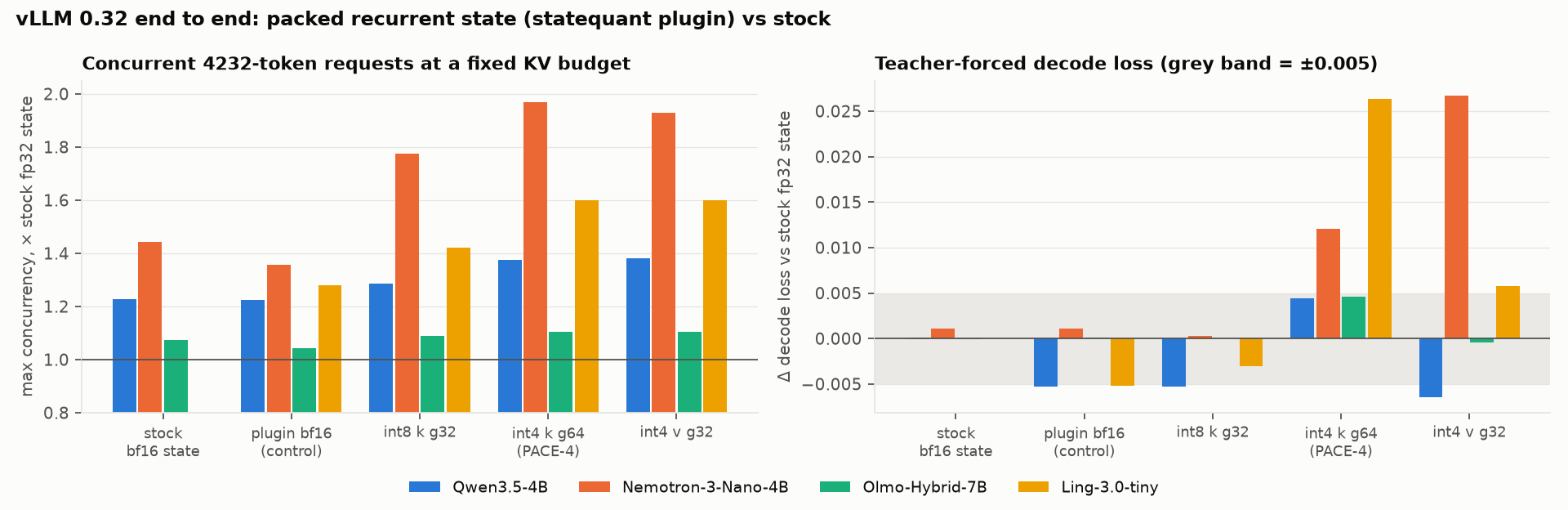
vLLM 0.32 end to end, packed state vs stock:
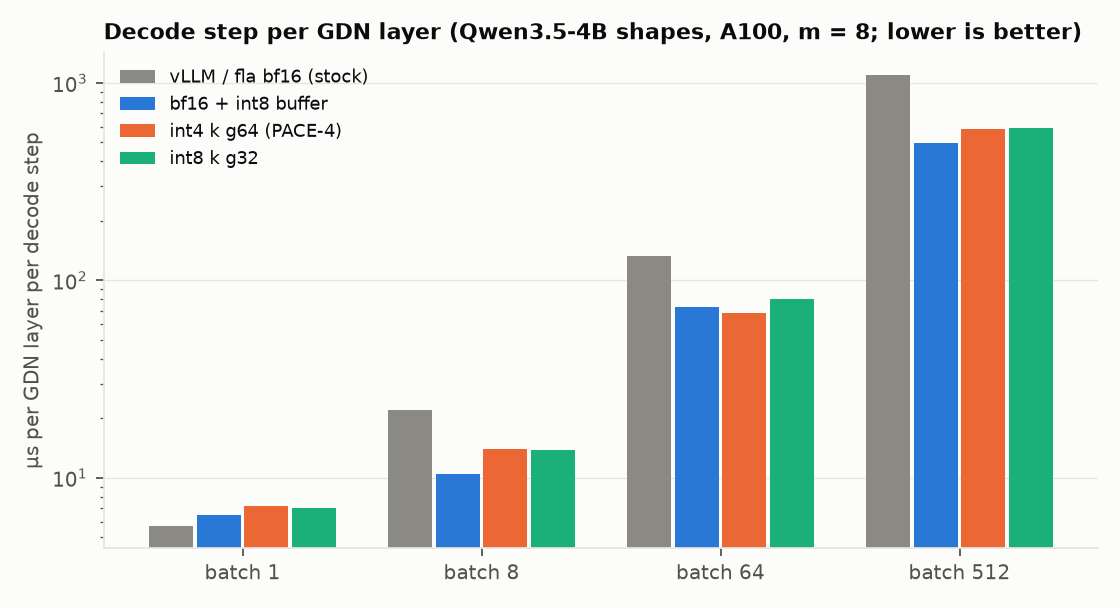
Decode-step latency of the packed kernels:
Full tables and setups: docs/results.md.
Documentation
- Methods: presets, formats, schedules, stateful methods
- Supported models: support matrix, per-family notes
- Packed kernels: storage layout, fused decode step, tests, latency
- vLLM plugin: configuration, restrictions, end-to-end checks
- Results: every preset per model
Citation
If you use statequant, please cite:
@article{haller2026pace,
  title   = {{PACE}: Periodic and Channel-Aligned Encoding of Four-Bit Recurrent States},
  author  = {Haller, Patrick and Laitenberger, Filipe and Akbik, Alan},
  journal = {arXiv preprint arXiv:2610.29545},
  year    = {2026}
}

@software{haller2026statequant,
  title   = {statequant: Recurrent-State Quantization for Hybrid Language Models},
  author  = {Haller, Patrick},
  url     = {https://github.com/HallerPatrick/StateQuant},
  version = {0.1.1},
  year    = {2026}
}
Please also cite the papers of the methods you use (listed in docs/methods.md).
License
Apache-2.0. See LICENSE.
1 maintainer

Metadata
1 maintainer
Release files for statequant 0.1.1
For a detailed explanation of source distributions (sdists) and built distributions (wheels), please see the package formats documentation.
Source distribution (sdist)
| File | Size | Uploaded | Provenance | Actions |
|---|---|---|---|---|
| statequant-0.1.1.tar.gz | 163.1 kB | Without provenance | Details for statequant-0.1.1.tar.gz |
Built distribution (wheel)
| File | Interpreter | ABI | Platform | Actions Reset |
|---|---|---|---|---|
| statequant-0.1.1-py3-none-any.whl | Python 3 | none | any | Details for statequant-0.1.1-py3-none-any.whl |
Total release size: 297.0 kB
Release files / statequant-0.1.1.tar.gz
| Download URL | statequant-0.1.1.tar.gz |
|---|---|
| Size | 163.1 kB |
| Tags | Source |
|
SHA-256 checksum How to use checksums |
e467dab39608e615d5bb6337975477c6b9fe04556164a1bc58b7dc0b48b90bb0
|
|
BLAKE2b-256 checksum How to use checksums |
ee07fc38ae4509b9d1e2ec927552a88768dc481d6b351a1d3a71ee20e8d78b80
|
| Upload date | |
|
Uploaded using Trusted Publishing? What is trusted publishing? |
No |
| Uploaded via |
twine/7.0.0 CPython/3.13.5
|
Release files / statequant-0.1.1-py3-none-any.whl
| Download URL | statequant-0.1.1-py3-none-any.whl |
|---|---|
| Size | 133.9 kB |
| Tags | Python 3 |
|
SHA-256 checksum How to use checksums |
77715288d4903305bf347b22fd3a8088a4ab9dd87c938cde535a8184ecd8a0e7
|
|
BLAKE2b-256 checksum How to use checksums |
ddb56c27cea14ee9c308598c986fa03eceeb361a3935407dc05e43377ef4cc38
|
| Upload date | |
|
Uploaded using Trusted Publishing? What is trusted publishing? |
No |
| Uploaded via |
twine/7.0.0 CPython/3.13.5
|
Security for statequant 0.1.1
Provenance
Provenance describes where a file came from. On PyPI, provenance is shared via attestations, which provide a verifiable record of the build or publishing details. View details, limitations and caveats.
No provenance found
None of the files in this release were uploaded with provenance metadata.
A note on package security
PyPI is a repository for distributing packages, not a service for auditing them. While third-party security researchers and our staff do their best to detect and remove malicious packages, PyPI cannot guarantee the quality, security or suitability of any given package.
To learn more about protecting yourself from malicious actors, visit our package security documentation.














