
This release is a pre-release and may not be stable for production use.

Stepfork
Your agent failed. Make the failure a test.
Local-first behavioral regression testing for AI agents.





Install the alpha: pip install --pre stepfork
Product goal:
Turn a failed AI-agent run into a reproducible pytest regression test, locally, in under five minutes.
The problem
AI agents fail in ways unit tests miss. A flight-search agent books the wrong flight. A refund agent denies an eligible claim. When you diagnose such a failure you usually hand-write a fix and hope the regression is covered.
Stepfork records what an agent actually did during a run: every instrumented tool call, every instrumented LLM request, and the final output. When the agent misbehaves, you replay that recording and export it as an executable pytest regression test that asserts the corrected behavior. The test fails on the buggy code and passes on the fix, using the recorded responses instead of live services.
How Stepfork Works
Stepfork turns a failed AI-agent execution into a reproducible pytest regression test.
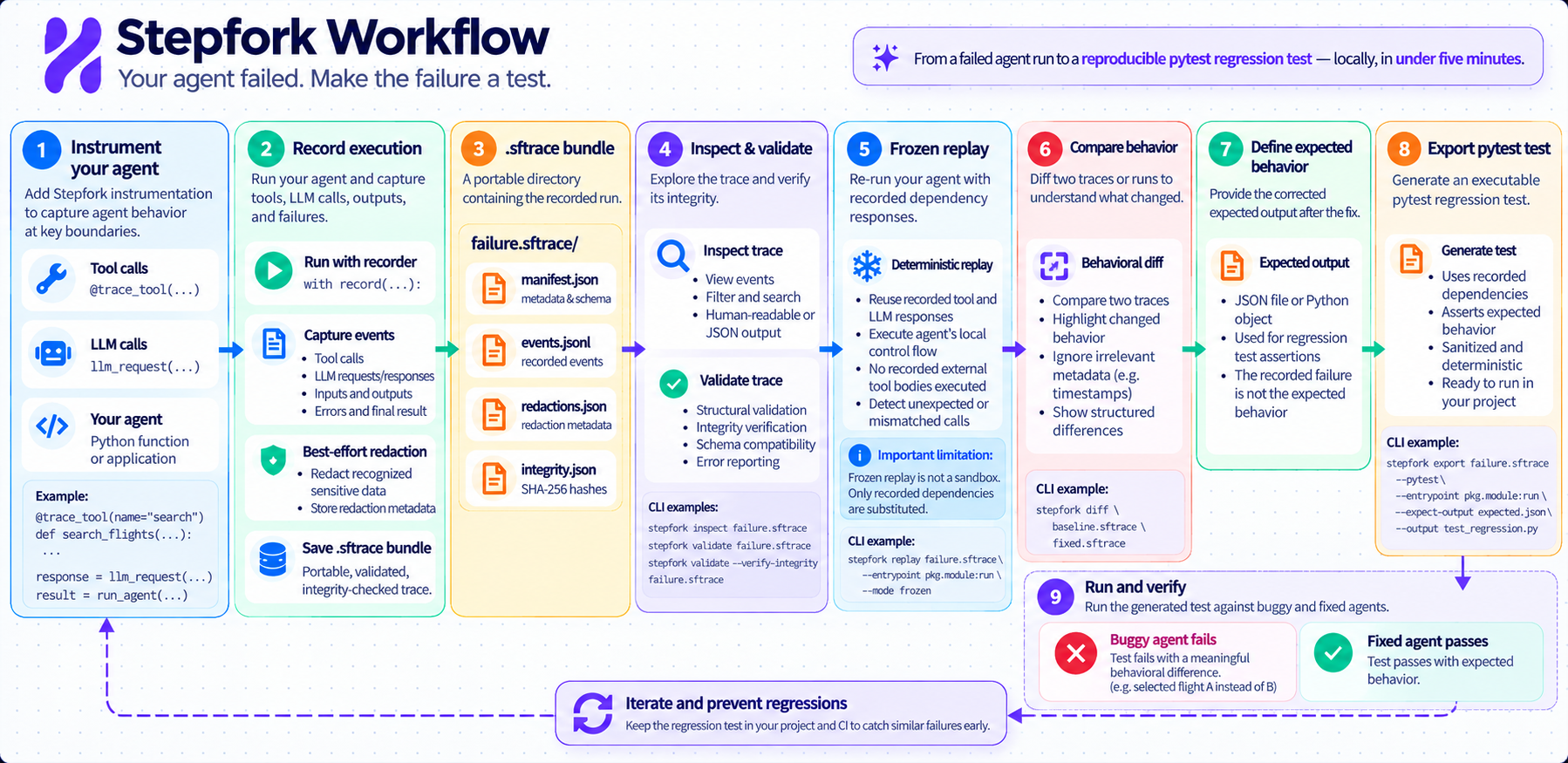
Workflow: Instrument → Record → Inspect → Validate → Frozen Replay → Compare → Define Expected Behavior → Export pytest → Verify Fix
Key Capabilities
- Record a buggy run into a portable
.sftracebundle, including runs that raise. Recording is local-first; nothing leaves your machine. - Frozen replay reruns your entrypoint with responses taken from the
recording, so instrumented tool and LLM bodies never run again. Calls outside
instrumented boundaries are not intercepted; wrap every external dependency
you want frozen with
@trace_toolorllm_request. - Behavioral diff compares a buggy run against a corrected run and reports exactly which behaviors changed.
- pytest export turns a recorded failure into a regression test that asserts the corrected behavior.
- Best-effort redaction of known credential-shaped values at record time.
- Integrity verification via SHA-256 digests that make tampering evident.
- Python 3.11, 3.12, and 3.13 support.
Installation
Stepfork is published on PyPI. Install the current alpha with:
# pip
pip install --pre stepfork

# uv
uv pip install --pre stepfork
The --pre flag is required while Stepfork is a pre-release. You can also
install from the tagged GitHub repository:
pip install "git+https://github.com/utsab345/stepfork.git@v0.1.0a3"
Requires Python 3.11, 3.12, or 3.13. This installs the stepfork CLI and the
Python package. For contributors working from a checkout, use uv sync.
Five-minute quickstart
Fully offline, no API keys, nothing invented. Save the file below as
quickstart.py:
from stepfork import record, trace_tool


@trace_tool(name="order_status")
def order_status(order_id: str) -> dict:
    # Stand-in for your real shipping service. Offline and deterministic.
    return {"order_id": order_id, "status": "shipped", "carrier": "FedEx"}


def run_agent(order_id: str = "ORD-1001") -> dict:
    status = order_status(order_id)
    should_notify = status["status"] == "delivered"  # bug: notifies only on delivery
    return {
        "order_id": order_id,
        "should_notify": should_notify,
        "carrier": status["carrier"],
    }


def run_agent_fixed(order_id: str = "ORD-1001") -> dict:
    status = order_status(order_id)
    should_notify = status["status"] == "shipped"  # fix: notifies when it ships
    return {
        "order_id": order_id,
        "should_notify": should_notify,
        "carrier": status["carrier"],
    }


if __name__ == "__main__":
    with record("notify-agent", output="failure.sftrace") as session:
        result = run_agent()
        session.set_output(result)
    print(result)
The order has shipped, but the buggy agent only notifies on delivery, so it skips the notification. Record that failure:
python quickstart.py
{'order_id': 'ORD-1001', 'should_notify': False, 'carrier': 'FedEx'}
Inspect and validate the trace:
stepfork inspect failure.sftrace
stepfork validate failure.sftrace --verify-integrity
Replay the buggy agent with dependencies frozen. The recorded response is substituted; the real tool body never runs:
stepfork replay failure.sftrace --entrypoint quickstart:run_agent --mode frozen
Stepfork Replay

Trace         failure.sftrace
Agent         notify-agent
Entrypoint    quickstart:run_agent
Mode          frozen

Dependency Calls
  1. tool order_status (substituted)

Status: COMPLETED
Final result: {"carrier":"FedEx","order_id":"ORD-1001","should_notify":false}
Define the corrected behavior and export a regression test for both the buggy and the fixed implementation:
printf '{"order_id": "ORD-1001", "should_notify": true, "carrier": "FedEx"}' > expected.json

stepfork export failure.sftrace --pytest \
  --entrypoint quickstart:run_agent \
  --expect-output expected.json \
  --output test_notify_buggy.py --overwrite

stepfork export failure.sftrace --pytest \
  --entrypoint quickstart:run_agent_fixed \
  --expect-output expected.json \
  --output test_notify_fixed.py --overwrite
Run the tests. The buggy implementation fails; the fix passes. The exported tests use pytest, which is not a runtime dependency of Stepfork, so install it first if your environment does not already have it:
pip install pytest   # only needed to run the exported regression tests
python -m pytest -q test_notify_buggy.py   # 1 failed (behavior mismatch)
python -m pytest -q test_notify_fixed.py   # 1 passed
That regression test reproduces the exact failure you started with, and now pins the corrected behavior.
Real Demonstration
This terminal recording runs the complete failure-to-test flow using the minimal example agent:

Three runnable demo agents ship in this repository (all fully offline, with a fake provider standing in for a real model):
examples/quickstart- a single-tool order-notification agent; the minimal starting point shown above.examples/booking_agent- a fake LLM provider paired with a flight-search tool; books the wrong flight.examples/refund_agent- a fake LLM provider paired with a refund-policy-check tool; denies an eligible refund.
git clone https://github.com/utsab345/stepfork.git
cd stepfork
uv sync
uv run python examples/quickstart/demo.py
uv run python examples/booking_agent/demo.py
uv run python examples/refund_agent/demo.py
Each demo records the buggy run, freeze-replays it without touching the external tool body, diffs it against the corrected run, and exports a regression test that fails on the buggy entrypoint and passes on the fixed one. The demos print real results from real subprocesses; they never fabricate output.
CLI Reference
| Command | Purpose |
|---|---|
stepfork validate [PATH] [--partial] [--verify-integrity] |
Check a .sftrace bundle structurally (and its integrity). |
stepfork inspect [PATH] [--json] [--events] [--errors-only] [--step N] |
Review a bundle locally. |
stepfork replay [PATH] --entrypoint MODULE:FUNCTION [--mode M] |
Rerun the entrypoint with dependencies answered from the trace. |
stepfork diff [BASELINE] [CANDIDATE] [--json] |
Compare the behavior of two runs. |
stepfork export [PATH] --pytest --entrypoint MODULE:FUNCTION [--expect-output JSON] [--output FILE] [--overwrite] |
Generate an executable pytest regression test. |
The full reference (arguments, examples, expected output, and common errors) is in docs/cli.md.
Offline Trace API
from stepfork import ToolCall, Trace

trace = Trace(agent_name="demo-agent")

trace.add(ToolCall(name="search", input={"query": "Kathmandu flights"}))

trace.save("demo.sftrace")
loaded = Trace.load("demo.sftrace")
Validate traces:
stepfork validate demo.sftrace --partial
stepfork validate demo.sftrace
stepfork validate demo.sftrace --verify-integrity
The --partial flag is required here because the example intentionally saves
only a tool_call event. Strict execution validation expects a complete trace
with a run_start event.
Documentation
The full documentation is published at
https://utsab345.github.io/stepfork/;
sources live in docs/.
- Getting started
- How recording works
- Replay
- Behavioral diff
- pytest export
- CLI reference
- Trace format
- Security notes
- Architecture
- Future integrations
- Development
- Release checklist
- PyPI publishing checklist
- Early adopter guide
- v0.1.0a1 release notes
- Changelog
Security and Limitations
Stepfork is experimental. The API, CLI, and .sftrace trace format may change
before v1.0.
- Alpha on PyPI.
pip install --pre stepforkinstalls the current pre-release; the API and trace format may still change. - No automatic failure minimization. The exported regression test uses the recorded steps. Reducing it to the smallest failing subset and fork-at-step are planned work, not automatic behavior.
- No framework integrations yet. LangGraph, OpenAI Agents, and MCP support are planned, not shipped. The proposed design is in docs/integrations.md.
- Replay is not a sandbox. Running an entrypoint under replay executes your own code with your own privileges. Trace data is never executed, but the entrypoint you name is.
- Only instrumented boundaries are frozen. Frozen replay substitutes calls
made through
@trace_toolandllm_request. Any external call your code makes outside those boundaries is not recorded and is not intercepted. - Redaction is best-effort. Pattern-based redaction can miss sensitive information embedded in unusual tool outputs or domain-specific payloads.
- Replay requires determinism. Dependencies that do not honor the recorded responses can make frozen replay diverge from the recording.
Full details, including the integrity model and how to handle untrusted bundles, are in docs/security.md.
Roadmap
v0.1 (released as v0.1.0a1)
- Portable
.sftrace - Trace save/load
- Structural validation
- Best-effort redaction
- Integrity verification
- Validate CLI
- Inspect CLI
- Runtime recording
- Frozen replay
- Behavioral diff
- pytest export
v0.2
- Failure minimization
- Fork-at-step
- Baselines
v0.3
- LangGraph
- OpenAI Agents
- MCP
- GitHub Action
- Local viewer
Contributing
Contributions are welcome. Start with CONTRIBUTING.md and the code of conduct. Local development instructions live in docs/development.md. If you find a security issue, report it privately per SECURITY.md. Please do not include secrets, credentials, or sensitive trace data in issues, tests, examples, or commits.
License
Stepfork is licensed under the Apache License, Version 2.0.
1 maintainer

Metadata
1 maintainer
Release files for stepfork 0.1.0a3
For a detailed explanation of source distributions (sdists) and built distributions (wheels), please see the package formats documentation.
Source distribution (sdist)
| File | Size | Uploaded | |
|---|---|---|---|
| stepfork-0.1.0a3.tar.gz | 3.3 MB | Details |
Built distribution (wheel)
| File | Interpreter | ABI | Platform | Reset |
|---|---|---|---|---|
| stepfork-0.1.0a3-py3-none-any.whl | Python 3 | none | any | Details |
Total release size: 3.4 MB
Release files / stepfork-0.1.0a3.tar.gz
| Download URL | stepfork-0.1.0a3.tar.gz |
|---|---|
| Size | 3.3 MB |
| Tags | Source |
|
SHA-256 checksum How to use checksums |
5355e7272f7c494dbc2e8e9dff635fd7414819b34afad2f668128e303af6f5bf
|
|
BLAKE2b-256 checksum How to use checksums |
dc403f6ca8b46c6824a67575934f5d219422dd5f672a0e476f89a94f296f1e83
|
| Upload date | |
|
Uploaded using Trusted Publishing? What is trusted publishing? |
Yes |
| Uploaded via |
twine/7.0.0 CPython/3.13.14
|
Provenance
Provenance describes where a file came from. On PyPI, provenance is shared via attestations, which provide a verifiable record of the build or publishing details. View details, limitations and caveats.


PyPI Publish Attestation
PyPI verified that this artifact, at this checksum, originated from the publisher listed below.
Signed by GitHub Actions, verified by PyPI on Oct 9, 2026.
Transparency logRelease files / stepfork-0.1.0a3-py3-none-any.whl
| Download URL | stepfork-0.1.0a3-py3-none-any.whl |
|---|---|
| Size | 65.4 kB |
| Tags | Python 3 |
|
SHA-256 checksum How to use checksums |
9c1715185664d38480f034730ac5dbcb199b80825dab66ad14da27cea4619f46
|
|
BLAKE2b-256 checksum How to use checksums |
b752bf4599709d9b6f506c1617cdc43805ca2cf4ceefd8fa19af0b0fdd2dfc21
|
| Upload date | |
|
Uploaded using Trusted Publishing? What is trusted publishing? |
Yes |
| Uploaded via |
twine/7.0.0 CPython/3.13.14
|
Provenance
Provenance describes where a file came from. On PyPI, provenance is shared via attestations, which provide a verifiable record of the build or publishing details. View details, limitations and caveats.
PyPI Publish Attestation
PyPI verified that this artifact, at this checksum, originated from the publisher listed below.
Signed by GitHub Actions, verified by PyPI on Oct 9, 2026.
Transparency log













