
Declarative schema-as-code and ORM for work-management systems. Jira first, dialect protocol for the rest.
Verified details
These details have been verified by PyPIProject links
GitHub Statistics
Maintainers

Project description
stint
Declarative schema-as-code and ORM for work-management systems. Jira first.
stint is two tools in one, the same way SQLAlchemy + Alembic is.
- Schema as code with versioned migrations. Declare projects, issuetypes, custom fields, screens, and schemes as Pydantic classes. Autogenerate a migration from the diff between the declaration and the live Jira instance. Commit the migration. Apply it across environments.
- ORM. Insert and query issues through the same model classes.
session.add(Bug(...)),session.scalars(select(Bug).where(...)).
The problem, in one screen
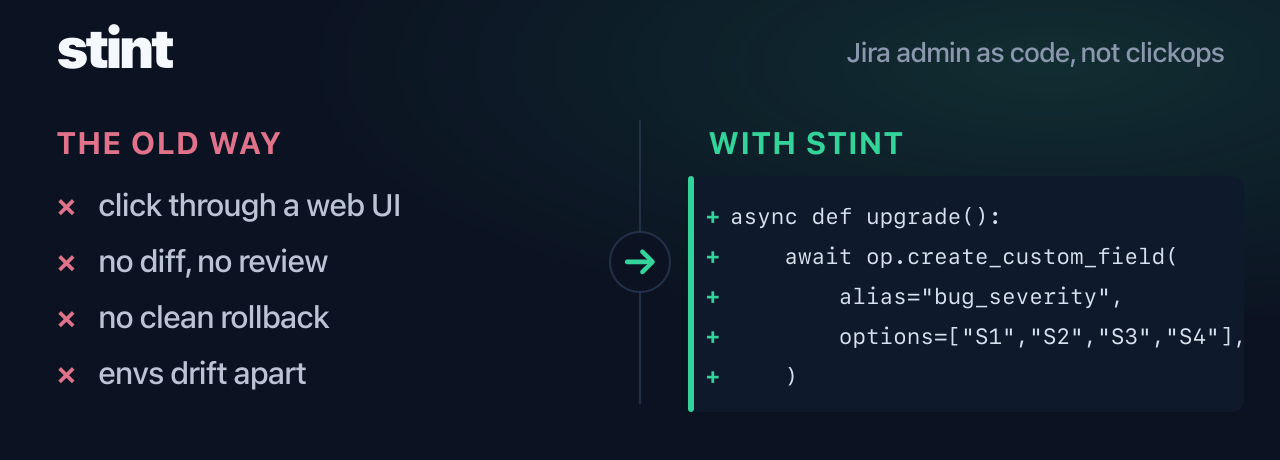
Changing a Jira project today means clicking through the admin web UI. No diff. No review. No record of who changed what or why. Staging and production drift apart and nobody can reconstruct how.
With stint the same change is a commit your teammate can review:
# migrations/2026_06_25_1500_add_bug_severity.py
async def upgrade():
    await op.create_custom_field(
        alias="bug_severity",
        name="Severity",
        type=SelectField,
        options=["S1", "S2", "S3", "S4"],
    )
CI applies that file to staging, then production, from the same source. A bad change rolls back to a known revision. The schema lives in your repo next to the code that depends on it.
Status: 0.2.0. Runs on Python 3.10 through 3.14. Validated against a live
Jira Cloud tenant for 0.1.0. The API may still change within 0.x.
Primary target: Jira Cloud, covering both company-managed and
team-managed projects, validated against a real Cloud tenant for 0.1.0.
Jira Data Center is out of scope, not on the roadmap. An audit against Atlassian's official OpenAPI specs found that ~17 of the admin endpoints stint drives exist only on Cloud; DC keeps those objects web-admin-only and never added REST. A DC dialect would fail on a large part of the op surface, so stint does not target it. Future growth goes to other work-management backends, like Linear, through the dialect protocol.
Install
pip install stint
Python 3.10 or newer. On 3.14+, stint uses PEP 649
deferred annotation evaluation (the default from 3.14) so the schema metaclass
can catch mistakes like a CustomField that shadows its attribute name with a
tailored error. That specific diagnostic degrades to a plain NameError on
3.10–3.13; everything else behaves identically. Runtime deps are pydantic
(2.7+, with the email extra), pydantic-settings, httpx, pyyaml, and
cyclopts (4.0+) for the CLI. cyclopts pulls in rich for terminal output.
Why
Jira admin lives in a web UI. That makes it hard to review changes, hard to mirror across environments, and impossible to roll back cleanly. stint treats Jira as a database where the schema happens to be unusually heavy. The schema is Python you commit. Migrations are Python you commit. Two environments get the same shape by running the same migration chain.
The data plane is a separate concern. Once the schema is under
management, the same model classes are the ORM. Bug.severity == "S1"
compiles to cf[10042] = "S1" (or whatever the per-env id is, resolved
through the state file).
A small example
Define the schema as Pydantic classes:
# schemas/platform.py
from typing import Annotated, Literal

from stint import (
    CustomField, IssueType, Project, Screen, ScreenScheme,
    FieldConfiguration, SelectField, TextField,
)

severity_field = CustomField(
    alias="bug_severity",
    name="Severity",
    type=SelectField,
    options=["S1", "S2", "S3", "S4"],
)

bug_create = Screen(alias="bug_create", name="Bug Create",
                   fields=["Summary", "Reporter", severity_field])
bug_edit = Screen(alias="bug_edit", name="Bug Edit",
                  fields=["Summary", "Reporter", severity_field])
bug_view = Screen(alias="bug_view", name="Bug View",
                  fields=["Summary", "Reporter", severity_field])

bug_screens = ScreenScheme(
    alias="bug_screens", name="Bug Screen Scheme",
    create=bug_create, edit=bug_edit, view=bug_view,
)
bug_fields = FieldConfiguration(
    alias="bug_fields", name="Bug Field Config", required=["Summary"],
)

class Bug(IssueType):
    __alias__ = "bug"
    __screen_scheme__ = bug_screens
    __field_configuration__ = bug_fields

    summary: str
    reporter: str
    severity: Annotated[Literal["S1", "S2", "S3", "S4"], severity_field]

class Platform(Project):
    __key__ = "PLAT"
    __lead__ = "cturner@example.com"
    __style__ = "company-managed"
    __issuetypes__ = [Bug]
Validate it without any network call:
stint validate --schema schemas/platform.py
Generate a migration from the diff between your schema and the live env:
export STINT_USER=you@example.com   # Jira Cloud account email
export STINT_TOKEN=...               # Jira Cloud API token
stint revision --autogenerate \
    --schema schemas.platform \
    --state state/dev.yaml \
    --migrations-dir migrations/ \
    --url jira_cloud+https://you.atlassian.net \
    --auth api-token \
    --env dev \
    -m "add bug severity"
Review the emitted Python file. It looks roughly like:
# migrations/2026_05_25_1430_add_bug_severity.py
from stint import op
from stint.fields import SelectField

revision = "abc123def456"
down_revision = None

async def upgrade():
    await op.create_custom_field(
        alias="bug_severity",
        name="Severity",
        type=SelectField,
        options=["S1", "S2", "S3", "S4"],
    )

async def downgrade():
    op.unsupported("deleting bug_severity destroys severity data on existing issues")
Apply it:
stint upgrade --env dev
Then query and write issues through the same classes:
from stint import Session, StateFile, APITokenAuth, create_engine, select
from schemas.platform import Bug

state = StateFile.load("state/dev.yaml")
engine = create_engine(
    "jira_cloud+https://you.atlassian.net",
    auth=APITokenAuth(email="you@example.com", token=token),
)

with Session(engine, state) as session:
    # READ
    s1s = session.scalars(select(Bug).where(Bug.c.severity == "S1"))

    # WRITE
    bug = Bug(summary="boom", reporter="alice", severity="S2")
    session.add(bug)
    session.commit()
    print(bug.key)              # populated from the response

    # UPDATE
    existing = session.get(Bug, "PLAT-1234")
    existing.severity = "S1"
    session.commit()            # only the changed field is sent
The async version is AsyncSession(engine, state) with the same surface
plus await on the I/O methods.
What ships in 0.1
- Jira Cloud (only target in 0.1): company-managed and team-managed projects, validated against a live Cloud tenant.
- Schema plane: custom fields, screens, screen schemes, issue type screen schemes, field configurations, field configuration schemes, issue types, projects.
- Migrations: autogenerate, multi-head merge, upgrade, downgrade,
brownfield stamp, idempotent ops, advisory lock,
429/503retry. - Data plane: reads and writes, identity map, dirty tracking, ADF wrapping for Cloud descriptions.
- Cloud team-managed projects: project create with style tracking, CMP-only ops fail loud with a Jira UI deep link. Per-issuetype inline screen field lists deferred until Atlassian exposes them through REST.
What does not ship in 0.1
- Workflows and workflow schemes.
- Permission and notification schemes.
- ADF parsing on reads (writes wrap plain text correctly).
- Backends other than Jira. The dialect protocol is the extension point.
CLI
stint reflect    Reflect a Jira instance into a snapshot and print it.
stint revision   Create a migration (empty, --merge, or --autogenerate).
stint stamp      Brownfield: match aliases against existing Jira, populate state.
stint upgrade    Apply pending migrations to head (or --to <rev>).
stint downgrade  Roll back to a specific revision.
stint current    Show the env's current revision.
stint history    List migrations in revision order.
stint validate   Run schema-level checks on a Python schema module.
State files
Each env has a state file (state/<env>.yaml) mapping schema aliases to Jira
object IDs, plus the current migration revision. Commit it. It is the
shared source of truth for a tenant, and it is not sensitive: it holds object
IDs, the tenant URL, and a revision pointer — no credentials, tokens, issue
data, or PII. Secrets stay in environment variables (STINT_TOKEN /
STINT_USER); they never touch the state file. This is unlike Terraform state,
which can embed secrets and warrants an encrypted backend.
- Rebuildable. Lose or corrupt a state file and
stint stampreflects the tenant and reconstructs the ID mapping by name/key. Only the revision pointer is not auto-derived; set it withstamp --revision <rev>. - The lock is local.
stint upgradetakes an advisory<state>.lockon the local filesystem. It serializes applies on one machine, not across teammates or CI on different machines. - Coordinate writers. Two people running
upgradeagainst the same tenant at once can double-apply ops and diverge the state file. The simplest safe pattern is to apply from CI onmain, so applies serialize and the committed state stays canonical. Cross-machine locking is tracked in #12.
Caveats
- No transactions across or within migrations. Jira admin REST does not provide them. A failed migration leaves Jira in a partial state. Re-running picks up where it left off because op functions check the alias-to-id map first.
- Partial commits in the data plane raise
PartialCommitError. Some inserts can succeed and later ones fail; the exception carries the per-instance breakdown so callers can decide what to do. - Drift is not auto-reverted. UI edits land in the live instance and stay there until you reflect, diff, and absorb them into the schema.
- Project lead resolution needs user-search access.
__lead__takes an email, which stint resolves to a backend user id (DC username, Cloud accountId) via the user-search API at apply time. That call requires the "Browse users and groups" global permission. Without it the create/update fails with guidance; set__lead__to an already-resolved username or accountId to skip resolution. - Built-in issue types are adopted, not recreated. Every Jira tenant ships
Bug, Task, Story, Epic, and Subtask. A schema declaring one of those names
(the quickstart's
Bugdoes) adopts the existing type into state onupgraderather than failing on a duplicate-name create. Names are matched exactly, soBugandbugare distinct. - Autogenerate needs a clean migration head.
revision --autogeneratediffs against the state file, which only advances onupgrade/stamp. With unapplied migrations pending it refuses rather than restating them; apply first, or pass--force.
License
MIT. See LICENSE.
Project details
Verified details
These details have been verified by PyPIProject links
GitHub Statistics
Maintainers
Release history Release notifications | RSS feed


Download files
Download the file for your platform. If you're not sure which to choose, learn more about installing packages.
Source Distribution
Built Distribution
Filter files by name, interpreter, ABI, and platform.
If you're not sure about the file name format, learn more about wheel file names.
Copy a direct link to the current filters
File details
Details for the file stint-0.2.0.tar.gz.
File metadata
- Download URL: stint-0.2.0.tar.gz
- Upload date:
- Size: 126.6 kB
- Tags: Source
- Uploaded using Trusted Publishing? Yes
- Uploaded via: uv/0.11.26 {"installer":{"name":"uv","version":"0.11.26","subcommand":["publish"]},"python":null,"implementation":{"name":null,"version":null},"distro":{"name":"Ubuntu","version":"24.04","id":"noble","libc":null},"system":{"name":null,"release":null},"cpu":null,"openssl_version":null,"setuptools_version":null,"rustc_version":null,"ci":true}
File hashes
| Algorithm | Hash digest | |
|---|---|---|
| SHA256 |
0c6a2760d4aa66ac838d552760ba353cd9c29398544373a30577a541d411bef6
|
|
| MD5 |
a6c8dbff4fd9e4fcba3ea77e21fc5683
|
|
| BLAKE2b-256 |
131ed1f9da67360bacb9054691f776f063232434b152e22a7be4dffddb08ce65
|
File details
Details for the file stint-0.2.0-py3-none-any.whl.
File metadata
- Download URL: stint-0.2.0-py3-none-any.whl
- Upload date:
- Size: 100.4 kB
- Tags: Python 3
- Uploaded using Trusted Publishing? Yes
- Uploaded via: uv/0.11.26 {"installer":{"name":"uv","version":"0.11.26","subcommand":["publish"]},"python":null,"implementation":{"name":null,"version":null},"distro":{"name":"Ubuntu","version":"24.04","id":"noble","libc":null},"system":{"name":null,"release":null},"cpu":null,"openssl_version":null,"setuptools_version":null,"rustc_version":null,"ci":true}
File hashes
| Algorithm | Hash digest | |
|---|---|---|
| SHA256 |
5fd01b08f841d4694244eb531c57ea884c84f29bc94d286052408be6a4639942
|
|
| MD5 |
629daf9b93ccaed68cc52f3d32359c41
|
|
| BLAKE2b-256 |
829979dfee8971faf033b3dfa207612c48078db287ce7f70ca0ee090b04ff34d
|






