
stl2bem
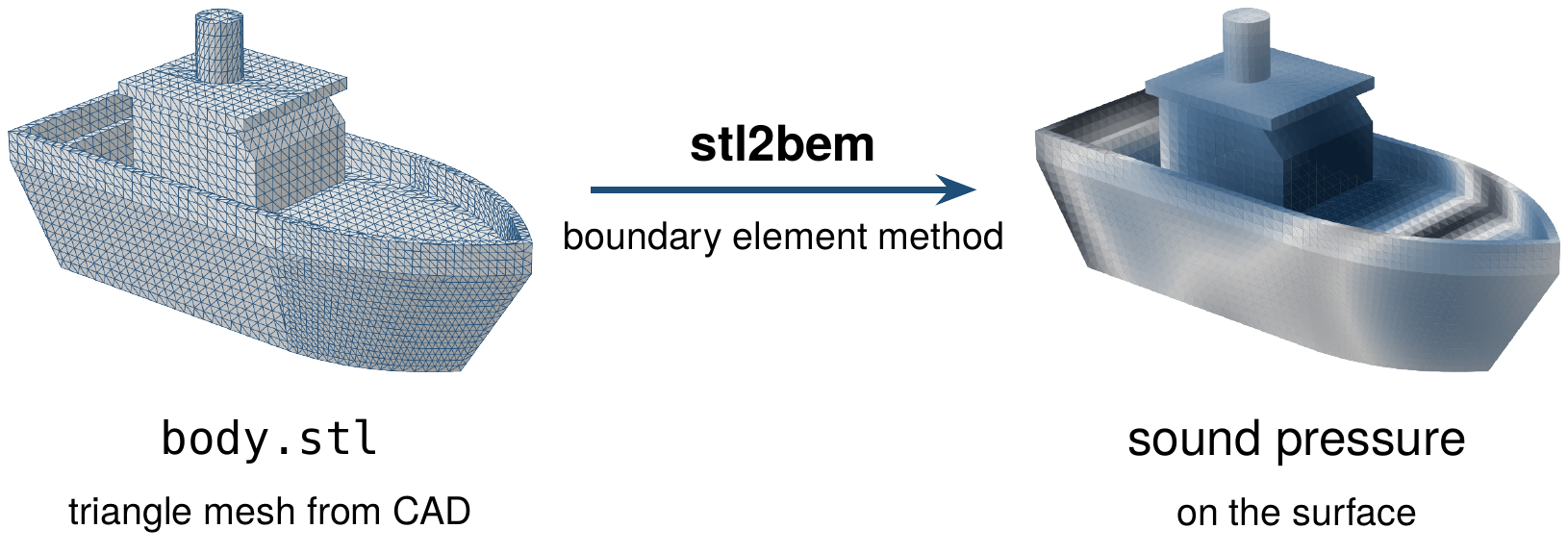
Computes the sound pressure on and around a rigid object from a closed STL mesh, with the boundary element method. It runs on a CPU or an NVIDIA GPU and writes tables over directions and frequencies, for example the response of every microphone on a device, as HDF5 or SOFA files.
 |
 |
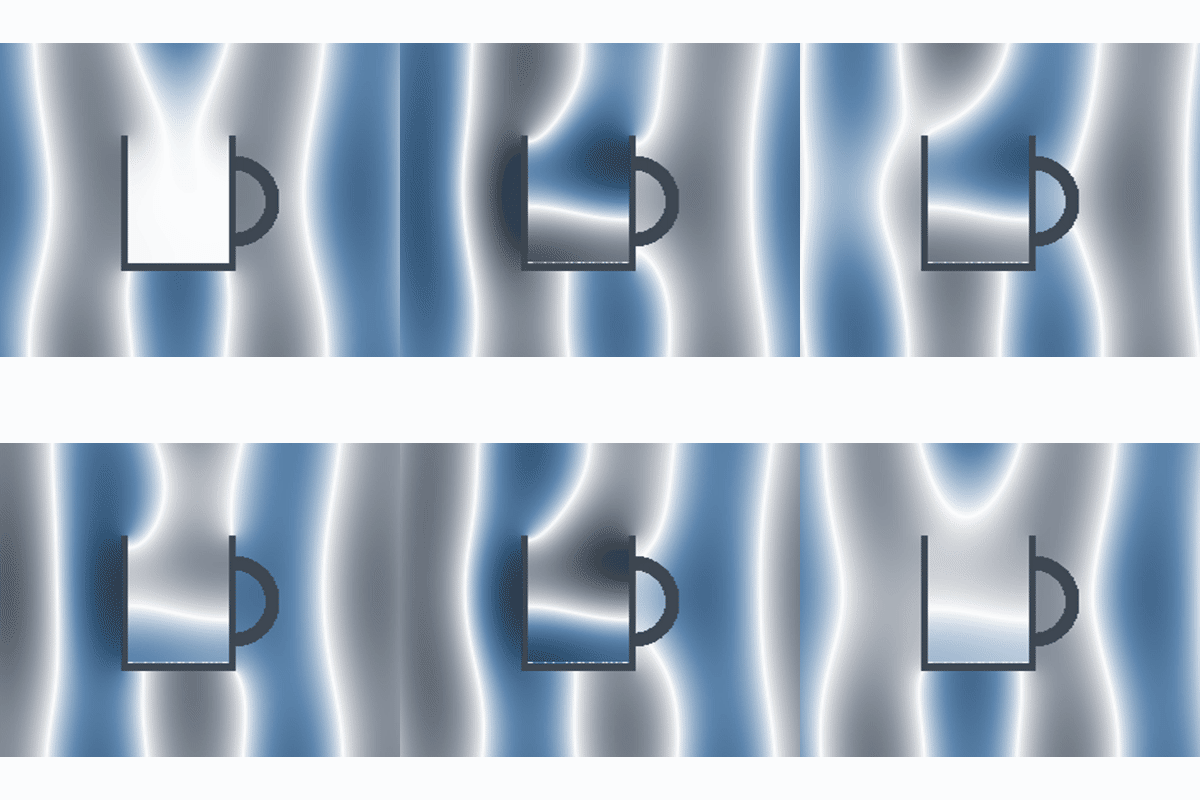 |
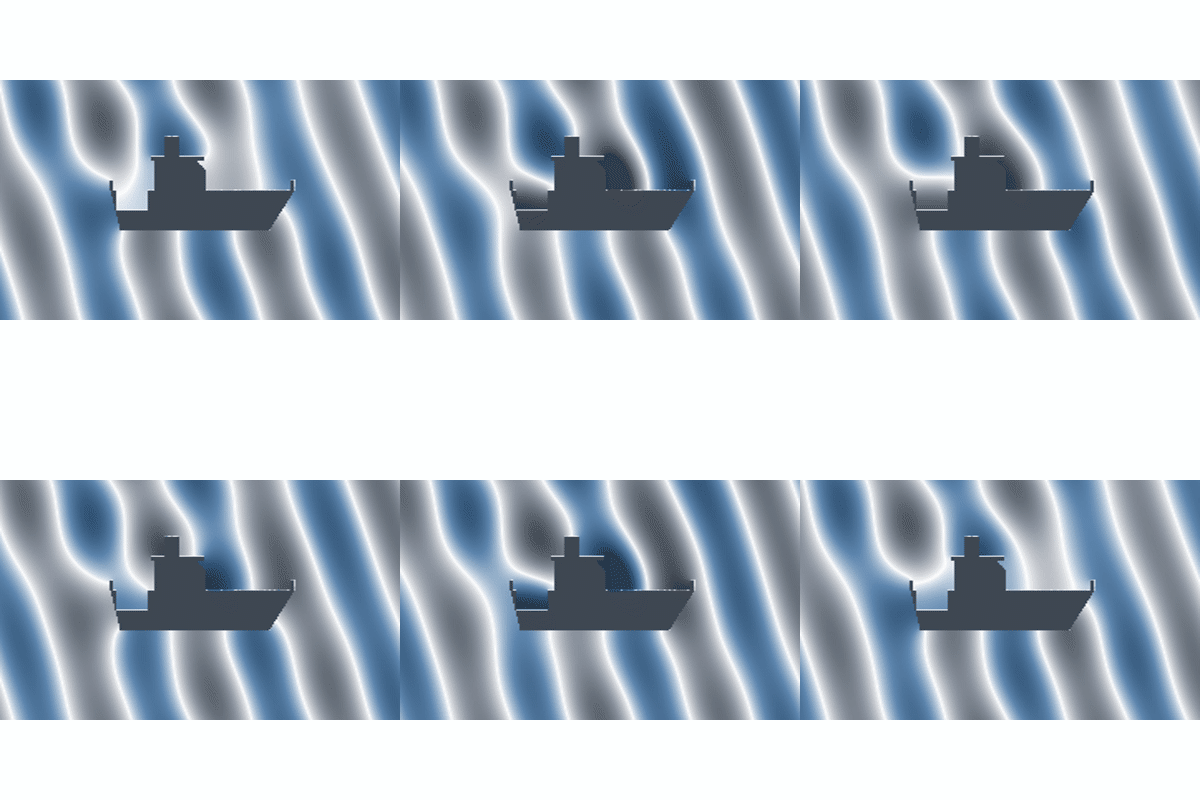
| star, 4 kHz | toy boat, 3 kHz | mug, 2.5 kHz |
 |
 |
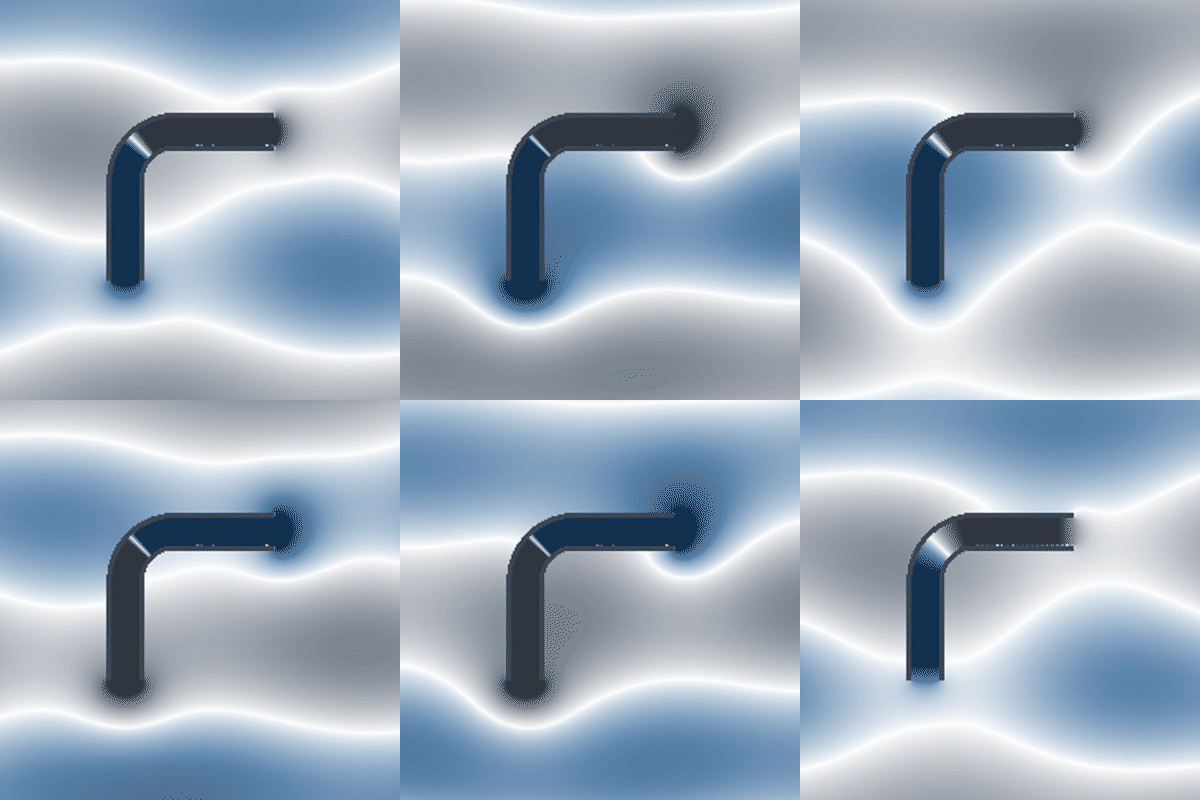 |
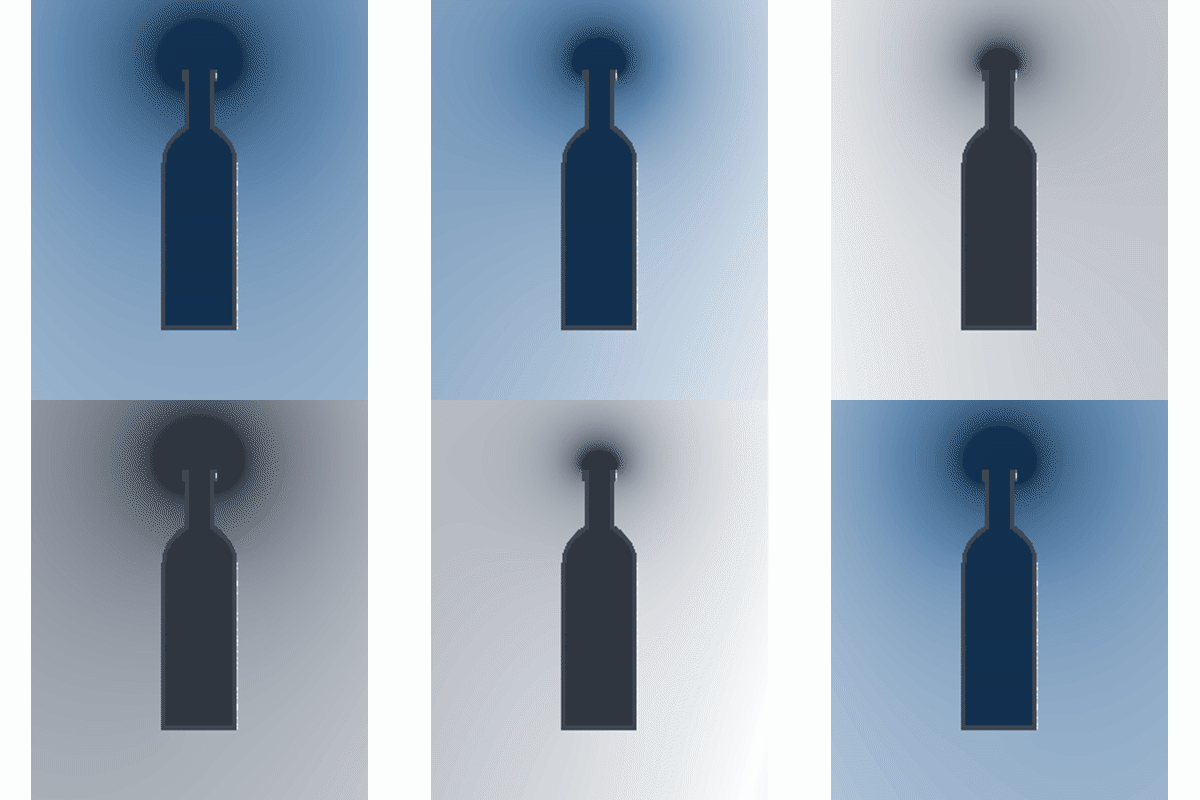
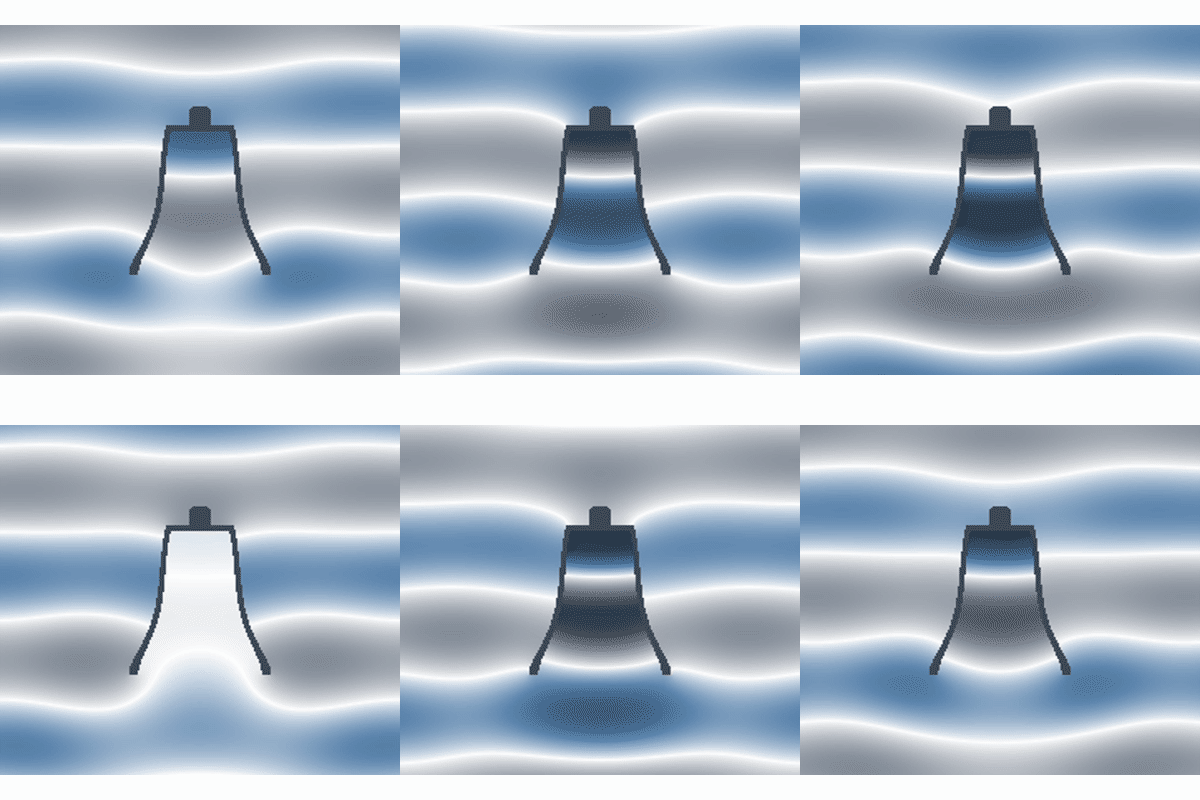
| wine bottle, 144 Hz | bell, 2.5 kHz | elbow pipe, 1.4 kHz |
Plane waves passing six objects modeled in Fusion (3,800 to 12,000 triangles each): real part of the total pressure on a slice through each object, over one period. Surface pressure and cavity resonances of the same objects are in docs/validation.md.
Install
git clone https://github.com/Kwon-Junhyeong/stl2bem
cd stl2bem
pip install .                    # NumPy, SciPy, h5py (CPU)
pip install ".[prep,sofa]"       # optional: merging CAD parts, SOFA export
pip install cupy-cuda12x         # optional GPU backend; pick the CuPy package of your CUDA version
Quick start
stl2bem --stl device.stl --units mm --mics mics.csv --out out/ --dry_run   # check mesh, microphones, resources
stl2bem --stl device.stl --units mm --mics mics.csv --out out/             # 0-8 kHz, 1-degree direction grid
stl2bem --stl device.stl --units mm --mics mics.csv --out out/ --source_distance 0.5   # sources 0.5 m away
mics.csv has one x, y, z row per microphone, in the STL units; each microphone is moved to the closest point of
the surface. Without --source_distance the sources are plane waves (far field). The dry run prints the distance
2D²/λ beyond which that holds for your body; closer sources need --source_distance. It also estimates the
run time: the default grid of 65,160 directions takes minutes on a GPU but hours on a CPU, and --n_el 19
(10 degrees in elevation) makes a CPU run about eight times faster. stl2bem --help lists all options.
From Python:
import numpy as np
from stl2bem import build_mesh, surface_receivers, solve_table, spherical_doa_grid

mesh = build_mesh("device.stl", units="mm", recenter="none")
mics, weights, _ = surface_receivers(np.loadtxt("mics.csv", delimiter=",") / 1000, mesh)
doa, az, el = spherical_doa_grid(360, 19)                 # 1 deg azimuth, 10 deg elevation
freqs = np.linspace(0, 4000, 129)
solve_table(mesh.verts, mesh.tris, mesh.centroids, mesh.normals, mesh.areas, freqs, doa, "table.h5",
            receivers=mics, receiver_elements=weights)
The pressure on a plane through the body, as in the gallery:
from stl2bem.viz import plane_grid, field_on_points
pts, shape = plane_grid(center=(0, 0, 0), u=(1, 0, 0), v=(0, 0, 1), half=(0.2, 0.2), n=(241, 241))
field = field_on_points(mesh, 2000.0, doa=(1, 0, 0), points=pts).reshape(shape)   # NaN inside the body
The localization error that the body causes for a free-field SRP-PHAT:
from stl2bem.analysis import load_table, free_field, doa_error, summarize
body = load_table("table.h5", elevations=[0])
print(summarize(doa_error(body, free_field(body), band=(300, 3000), method="srp-phat", search="azimuth")))
Output
One HDF5 file per body:
| dataset | shape | meaning |
|---|---|---|
p |
(R, D, F) complex64 | total pressure at receiver r for source d at frequency f, relative to the incident pressure at the origin |
doa_grid |
(D, 3) | unit vectors towards the sources; az x el grids are stored az-major (i_az * n_el + i_el) |
source_positions |
(D, 3) | point sources only: their positions (m) |
freqs |
(F,) | Hz |
positions |
(R, 3) | where p is evaluated (m, mesh frame); centroids is an older name for the same array |
chief_points |
(N_c, 3) | only when CHIEF is used: the interior points |
Attributes hold the mesh report, the solver options and the convention. --sofa (or
python -m stl2bem.sofa table.h5) also writes the table as a SOFA file (AES69, GeneralTF).
Convention. e^{+jωt}, incident wave exp(+jk d·r). For a source signal s(t) from direction d, the FFT/STFT bin
(usual e^{-jωt} kernel) at microphone m is S(ω)·p[m, d, ω], so tables and FFT-domain signals combine directly
without conjugation. The phase reference is the center of the bounding box (--recenter bbox); --recenter none
keeps the CAD origin.
Accuracy
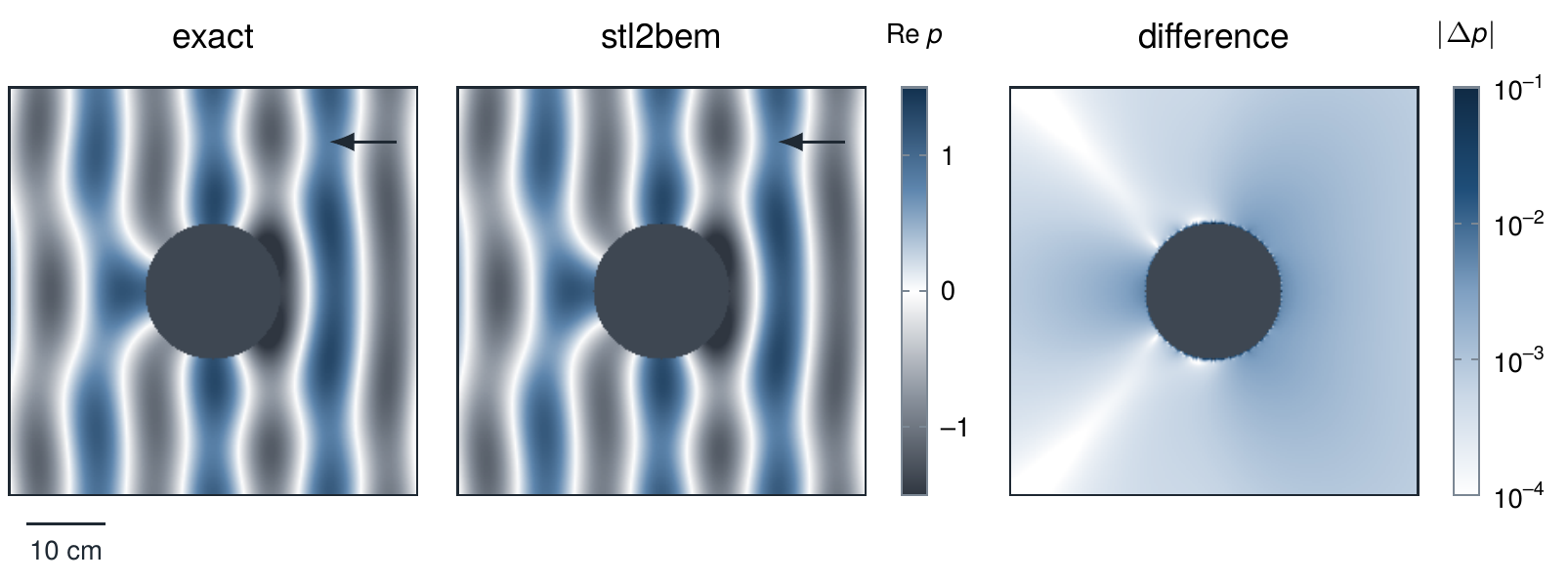
Rigid sphere with 5,120 elements at ka = 3.7 against the exact solution: the median difference is 8.6 × 10⁻⁴ of the incident amplitude. The singular part of the integrals is evaluated exactly, and microphones on the surface are second-order accurate, also on edges and vertices.
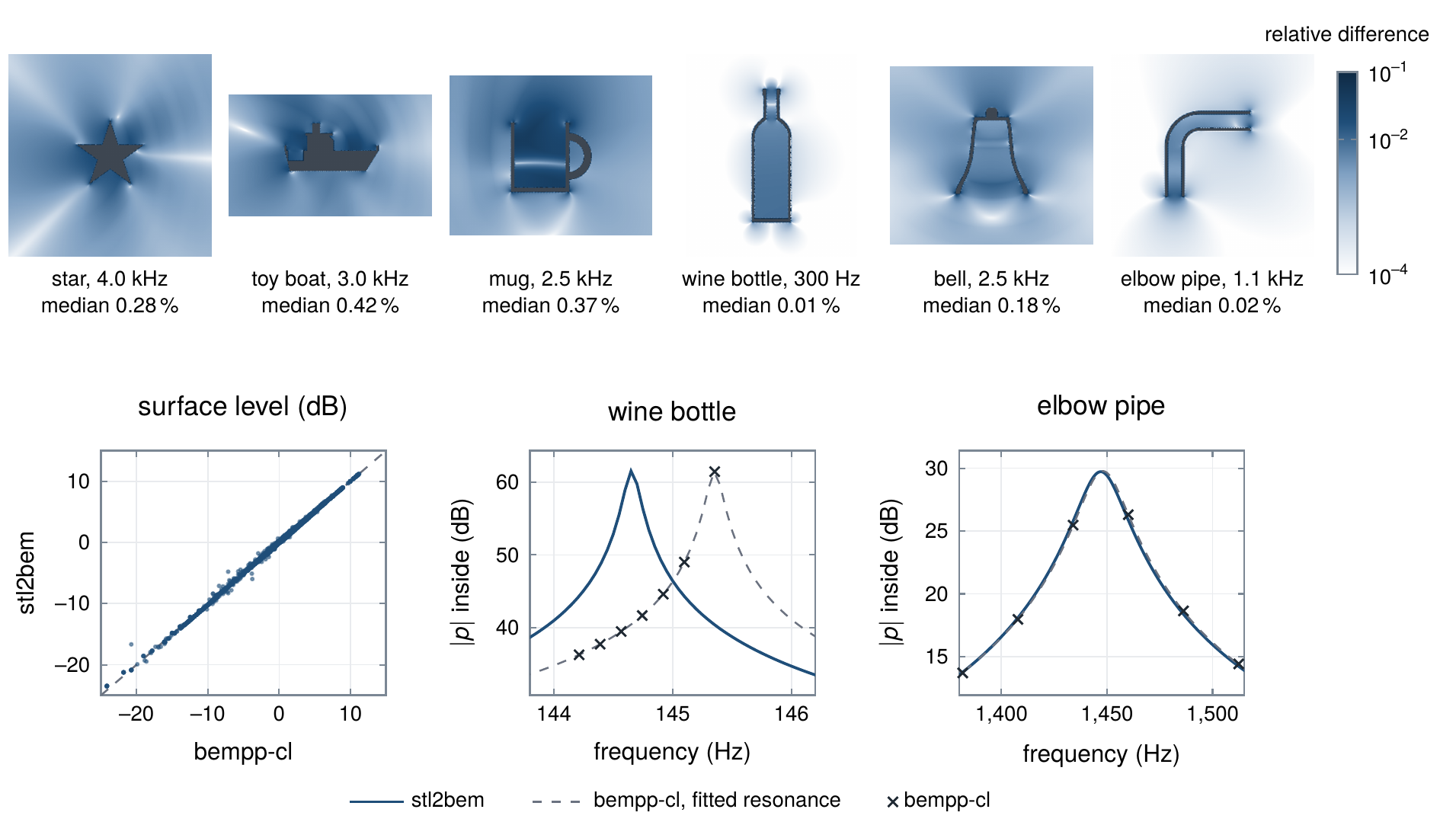
The six gallery meshes solved again with bempp-cl, which uses a different formulation (Burton-Miller, linear elements): the fields differ by 0.01-0.4 % (median) and the resonance frequencies by at most 0.5 %. One frequency with 6,840 directions takes 1 s for 4,800 elements and 11 s for 14,700 on an RTX 4060 Ti (8 GB).
Convergence, the comparison with the original code, resonances and timings: docs/validation.md. Equations and implementation: docs/method.md.
Preparing CAD
The solver needs one closed, consistently oriented surface. A single solid exported from CAD usually is one (all
gallery models are); an assembly usually is not, because its parts overlap. stl2bem-prep merges the parts:
stl2bem-prep chassis.stl board.stl battery.stl --pitch 8 --units mm --out body.stl
It voxelizes the parts (pitch = element size), fills enclosed cavities and extracts a closed surface. Features
smaller than the pitch disappear and thin plates become one pitch thick; --align_z keeps a flat microphone board
flat. In Fusion, set the maximum edge length of the STL export to about λ/6 at the highest frequency; the mesh
report prints the frequency limit from the mean edge length.
Limits
- Rigid bodies in free space: no absorption, no vibrating surfaces, no floor or walls.
- Dense matrices: for N elements the GPU needs about 2.5 GB + 20 bytes × N² (an 8 GB GPU handles about 15,000 elements) and the CPU about 1.5 GB + 55 bytes × N² of RAM; time grows with N³. The dry run prints both.
- CHIEF points need room inside the body. Thin-walled objects (in the gallery, the bottle and the pipe) are solved with the CBIE alone, which is safe there: their irregular frequencies start near c / 2t for wall thickness t, far above the band the mesh resolves.
--formulation burton-milleris experimental: as accurate as the default away from resonances, but it damps sharp cavity resonances. See docs/method.md.
Used in
An earlier version of this solver computed the microphone responses of a robot body in:
- robot-body-sound-localization: direction of a speaker from four microphones on a robot body, by matching recordings to the computed responses.
- calibration-free-sound-localization: the same task without calibrating the microphone channels.
License
MIT (see LICENSE).
1 maintainer

Metadata
1 maintainer
Release files for stl2bem 0.1.0
For a detailed explanation of source distributions (sdists) and built distributions (wheels), please see the package formats documentation.
Source distribution (sdist)
| File | Size | Uploaded | Provenance | Actions |
|---|---|---|---|---|
| stl2bem-0.1.0.tar.gz | 53.2 kB | With provenance | Details for stl2bem-0.1.0.tar.gz |
Built distribution (wheel)
| File | Interpreter | ABI | Platform | Actions Reset |
|---|---|---|---|---|
| stl2bem-0.1.0-py3-none-any.whl | Python 3 | none | any | Details for stl2bem-0.1.0-py3-none-any.whl |
Total release size: 104.6 kB
Release files / stl2bem-0.1.0.tar.gz
| Download URL | stl2bem-0.1.0.tar.gz |
|---|---|
| Size | 53.2 kB |
| Tags | Source |
|
SHA-256 checksum How to use checksums |
5176a726ee2111231fd0830a0c39500c9d8dccc9db50ec5f0a29a80a27ee9aea
|
|
BLAKE2b-256 checksum How to use checksums |
b104b7cf700c57bf4dc4261905ef90fb577628ea04505dcbc08d4afeb2fb36fc
|
| Upload date | |
|
Uploaded using Trusted Publishing? What is trusted publishing? |
Yes |
| Uploaded via |
twine/7.0.0 CPython/3.13.16
|
Provenance
Provenance describes where a file came from. On PyPI, provenance is shared via attestations, which provide a verifiable record of the build or publishing details. View details, limitations and caveats.


PyPI Publish Attestation
PyPI verified that this artifact, at this checksum, originated from the publisher listed below.
Signed by GitHub Actions, verified by PyPI on Nov 19, 2026.
Transparency logRelease files / stl2bem-0.1.0-py3-none-any.whl
| Download URL | stl2bem-0.1.0-py3-none-any.whl |
|---|---|
| Size | 51.4 kB |
| Tags | Python 3 |
|
SHA-256 checksum How to use checksums |
93b2326a579eb6525ff644529c19affd99042aaecfac6e341cc7a0f5ecbec570
|
|
BLAKE2b-256 checksum How to use checksums |
1c87accd54240c08c24371ac2ea69aaebd9571b166927b6ee6ed13091a339643
|
| Upload date | |
|
Uploaded using Trusted Publishing? What is trusted publishing? |
Yes |
| Uploaded via |
twine/7.0.0 CPython/3.13.16
|
Provenance
Provenance describes where a file came from. On PyPI, provenance is shared via attestations, which provide a verifiable record of the build or publishing details. View details, limitations and caveats.
PyPI Publish Attestation
PyPI verified that this artifact, at this checksum, originated from the publisher listed below.
Signed by GitHub Actions, verified by PyPI on Nov 19, 2026.
Transparency logSecurity for stl2bem 0.1.0
Provenance
Provenance describes where a file came from. On PyPI, provenance is shared via attestations, which provide a verifiable record of the build or publishing details. View details, limitations and caveats.
Full provenance
Both files in this release have been uploaded with provenance metadata.
Attestation for stl2bem-0.1.0.tar.gz
PyPI Publish Attestation
PyPI verified that this artifact, at this checksum, originated from the publisher listed below.
Signed by GitHub Actions, verified by PyPI on Nov 19, 2026.
Transparency logA note on package security
PyPI is a repository for distributing packages, not a service for auditing them. While third-party security researchers and our staff do their best to detect and remove malicious packages, PyPI cannot guarantee the quality, security or suitability of any given package.
To learn more about protecting yourself from malicious actors, visit our package security documentation.













