
Stockcast
Turn forecasts into inventory decisions you can simulate, inspect, and evaluate.




Documentation · Quickstart · Philosophy · Examples · API
A forecast is not a decision. Its real value depends on the downstream choices it improves, and ultimately on the operational performance those choices deliver.
Stockcast brings this idea to inventory management: it is the layer between the forecast and the replenishment decision. It maps forecasts from any model into orders, simulates their execution against historical or simulated demand, and evaluates the resulting impact against business metrics such as cost, service, and waste. Happy with a policy? Put it into production with the same objects.
Inspired by PyTorch-style libraries, it is built from Lego-like pieces that snap onto one engine. Each piece is a class you can subclass and adjust.
Stockcast is developed and maintained by Filotas Theodosiou at the Predictive AI and Digital Shift (PADS) research group, VIVES University of Applied Sciences.
Install
pip install stockcast
Stockcast needs Python 3.10+ and only NumPy, pandas, and Matplotlib.
Quickstart
A tea shop sells about six packs a day and orders every morning. Turn its forecast into orders and play out eight weeks:
import numpy as np
import pandas as pd

from stockcast.core import InventoryStateDataFrame, SimulationEngine
from stockcast.evaluation import InventoryEvaluator, avg_on_hand, fill_rate
from stockcast.policies import OrderUpToPolicy

# Eight weeks of daily tea sales.
days = pd.date_range("2026-02-02", periods=56, freq="D")
demand = pd.DataFrame({
    "unique_id": "tea",
    "date": days,
    "y": np.random.default_rng(3).poisson(6, len(days)),
})

# The forecast, from any model: a day's demand is 10 packs or fewer, with
# 95% probability.
forecast = pd.DataFrame({
    "unique_id": ["tea"],
    "date": [days[0]],   # the day it forecasts
    "q95": [10],         # the 95% quantile
})

# The shelf today.
shelf = InventoryStateDataFrame.from_observed(pd.DataFrame({
    "unique_id": ["tea"],
    "date": [pd.Timestamp("2026-02-01")],
    "on_hand": [30],
}))

policy = OrderUpToPolicy(
    lead_time=0,             # delivered before the shop opens
    review_period=1,         # order every morning
    freq="D",                # one period is one day
    service_level=0.95,      # the probability the forecast quantile stands for
    allow_backorders=False,  # a missed sale is lost
)
policy.fit(forecast, target_column="q95")

result = SimulationEngine().run(policy=policy, demand_source=demand, inventory=shelf)
InventoryEvaluator().fit(result).evaluate([fill_rate, avg_on_hand]).round(2)
   fill_rate  avg_on_hand
0       0.99         4.75
result.to_event_frame() holds the full record: one checked row per SKU and
day, with every receipt, order, sale, and shortage. The
Quickstart
builds the forecast from past sales, and
Walkthrough step 3
shows orders that must cover a lead time.
Core principles
Stockcast is built on seven principles. Our Philosophy explains each one, with the research behind it.
- The interface between forecasting and inventory is the target. An order needs the distribution of total demand over the window it covers. Stockcast asks for exactly that, from any model, and adds no hidden safety stock.
- One explicit clock. Every period runs in the same order: receive,
decide, then meet demand. So lead time and the window
H = L + Rmean the same thing in every experiment. - Accounting before optimisation. Only the engine changes the stock, and every row of the event table adds up. A missing input stops the run before the first period.
- Small parts, one base class each. Policies, schedules, constraints, suppliers, callbacks, and physical processes each have one base class. The built-in parts use it, and so can yours.
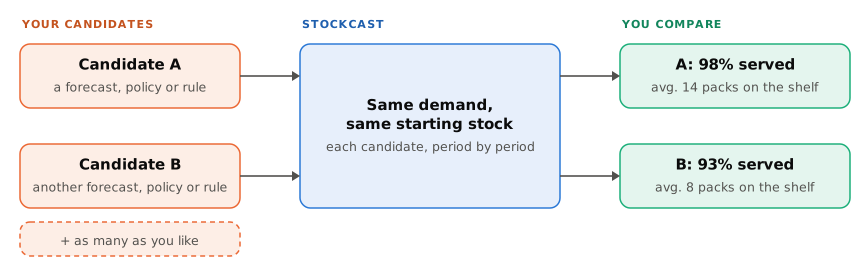
- Easy, scalable evaluation. A comparison is one call: every option runs on the same demand, opening stock, and random draws. Every result carries a manifest, so anyone with the same inputs can rerun it.
- Fast inside, readable outside. DataFrames in and out, NumPy arrays inside. A year of daily order-up-to decisions for 1,000 SKUs takes about 10 to 12 seconds on a laptop.
- From research to production. The parts you backtest are the parts that place real orders, run each period by your scheduler or event stream.
Research and production
Research: backtest and compare. For researchers and analysts who measure forecasts by the decisions they lead to. Compare policies, forecasting models, lead times, suppliers, and shelf-life rules on identical demand. Compare scenarios.
Production: run the chosen policy every period. For engineers who put the chosen policy behind a periodic job: load stock, refresh the forecast, compute orders with the supplier's rules, and save the state. From backtest to production.

Stockcast does not forecast, and it does not search for the best policy for you. It gives you the building blocks to do both: any forecasting model can feed it, and any optimiser can wrap it. Version 0.1 models one stocking point with any number of SKUs and suppliers, in discrete periods.
Learn more
- Walkthrough: nine short steps, from inventory state to a production job.
- Guide: the theory and options of every building block, plus task recipes.
- Examples: 24 runnable notebooks, from a first simulation to multi-supplier, perishable, and production workflows. Good starting points: first simulation, forecast to order, fair comparisons.
- API reference: every public class and function.
- Release notes: what changed in each version.
Citation
If you use Stockcast in your work, please cite the version you used. The
CITATION.cff
file has the details, and GitHub's Cite this repository button formats them:
Theodosiou, F. Stockcast: forecast-driven inventory decisions, simulation, and
evaluation in Python. Version 0.1.0. https://github.com/FilTheo/stockcast
Contributing and support
Questions, bugs, and ideas are welcome on
GitHub Issues. For a bug,
include a small example and the run manifest (result.run_manifest), which
records the versions and settings behind a result. See the
contributing guide for
the development setup.
About
Stockcast is maintained by our team at the Predictive AI and Digital Shift (PADS) research group, VIVES University of Applied Sciences. Read more.
License
1 maintainer

Metadata
1 maintainer
Release files for stockcast 0.1.0
For a detailed explanation of source distributions (sdists) and built distributions (wheels), please see the package formats documentation.
Source distribution (sdist)
| File | Size | Uploaded | |
|---|---|---|---|
| stockcast-0.1.0.tar.gz | 155.1 kB | Details |
Built distribution (wheel)
| File | Interpreter | ABI | Platform | Reset |
|---|---|---|---|---|
| stockcast-0.1.0-py3-none-any.whl | Python 3 | none | any | Details |
Total release size: 327.5 kB
Release files / stockcast-0.1.0.tar.gz
| Download URL | stockcast-0.1.0.tar.gz |
|---|---|
| Size | 155.1 kB |
| Tags | Source |
|
SHA-256 checksum How to use checksums |
fceb2d8e3a1b12c8e937c8dec1350952bc2ef6c42407482cd84017fb604da120
|
|
BLAKE2b-256 checksum How to use checksums |
f22e0c8b22a69af05979bac35e72c13df1bb6ada1c602ba748c7fea8166f1a5a
|
| Upload date | |
|
Uploaded using Trusted Publishing? What is trusted publishing? |
Yes |
| Uploaded via |
twine/7.0.0 CPython/3.13.14
|
Provenance
Provenance describes where a file came from. On PyPI, provenance is shared via attestations, which provide a verifiable record of the build or publishing details. View details, limitations and caveats.


PyPI Publish Attestation
PyPI verified that this artifact, at this checksum, originated from the publisher listed below.
Signed by GitHub Actions, verified by PyPI on Oct 6, 2026.
Transparency logRelease files / stockcast-0.1.0-py3-none-any.whl
| Download URL | stockcast-0.1.0-py3-none-any.whl |
|---|---|
| Size | 172.4 kB |
| Tags | Python 3 |
|
SHA-256 checksum How to use checksums |
30eccb8a040380aaa4bca9e694d113ca35376cb709d5f0a028189628904507ac
|
|
BLAKE2b-256 checksum How to use checksums |
d68f4d6f47bb895d480b2f71e6016f14a18bba9e8faeb517244aaea1cc56cdc5
|
| Upload date | |
|
Uploaded using Trusted Publishing? What is trusted publishing? |
Yes |
| Uploaded via |
twine/7.0.0 CPython/3.13.14
|
Provenance
Provenance describes where a file came from. On PyPI, provenance is shared via attestations, which provide a verifiable record of the build or publishing details. View details, limitations and caveats.
PyPI Publish Attestation
PyPI verified that this artifact, at this checksum, originated from the publisher listed below.
Signed by GitHub Actions, verified by PyPI on Oct 6, 2026.
Transparency log













