
Straightedge
Checked SVG figures and Manim animations for technical explanations.
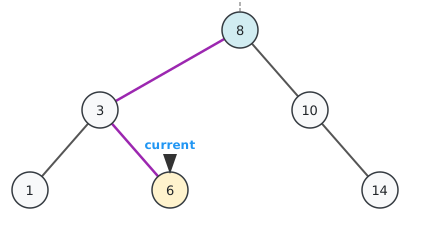
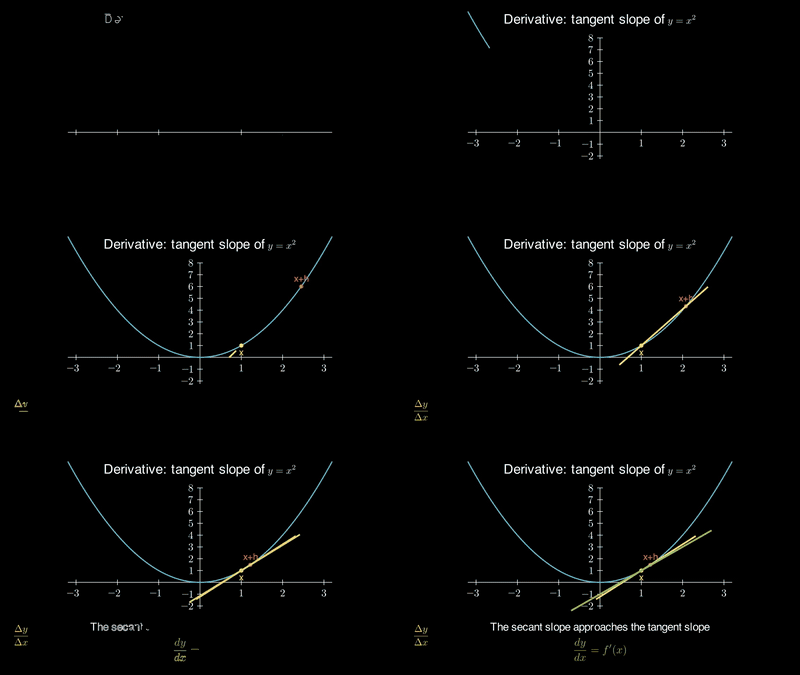

Explore all figures and videos →
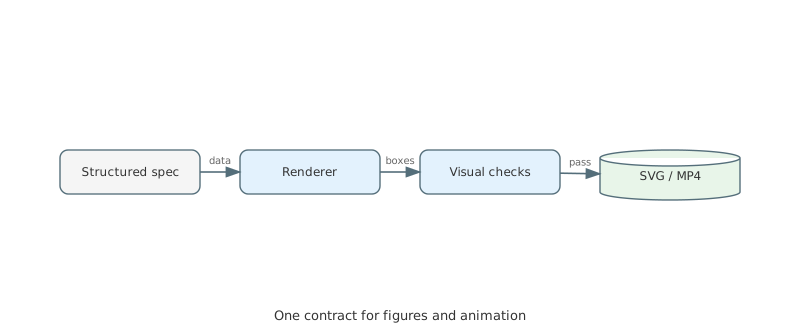
Straightedge turns structured intent into deterministic visuals. It provides two independent output lanes:
| lane | input → output | install |
|---|---|---|
Figures — straightedge.diagrams |
structured dictionary → SVG string | base package; no runtime dependencies |
| Animation — scene builders and agent | plan or prompt → Manim scene → MP4 | straightedge[render] |
Both lanes are designed around the same constraint: a visual can render successfully and still be wrong. Straightedge validates inputs before drawing and exposes geometry and findings that callers can use to reject or repair visible defects.
Install
From a checkout:
python3 -m pip install -e .
SVG figures use only the Python standard library. To build and render animations:
python3 -m pip install -e '.[render]'
Make an SVG figure
from pathlib import Path

from straightedge.diagrams import render_diagram

svg = render_diagram(
    {
        "type": "unit_circle",
        "params": {"angle": 45, "show_triangle": True},
    }
)
Path("unit-circle.svg").write_text(svg, encoding="utf-8")
render_diagram() needs no browser, network, or headless renderer. An unknown
diagram type returns an empty string so a missing optional figure does not abort
an entire document build.
The registry currently contains 35 templates across several domains:
- Math and data: function graphs, coordinate planes, Riemann sums, unit circles, polar graphs, matrices, step functions, heatmaps, and tables.
- Computer science: binary trees, linked lists, stacks, queues, hash tables, call stacks, dynamic-programming tables, architecture diagrams, and state machines.
- Projects and business: Gantt charts, work-breakdown structures, project networks, timelines, flow diagrams, and T-accounts.
Inspect straightedge.diagrams.DIAGRAM_REGISTRY for the exact registered names.
Each renderer accepts a compact, serializable hint and returns a complete SVG
string.
Make an animation
Every shipped animation is reachable by name, in any language, with no LLM — name a template and render it:
straightedge list-templates                                   # what exists
straightedge render --template calculus/derivative_tangent    # the hero animation, in English
straightedge render --template conic/ellipse_foci --qc        # and check the frame
straightedge render --template calculus/riemann_integral \
  --params '{"expression": "x**2 + 1"}'                        # refine with parameters
--template takes any id from list-templates and skips the keyword router
entirely — it is how the animations in the gallery above are drawn.
A formula is another language-neutral path to the deterministic scenes:
straightedge render "y=x^2-4*x+3" --language en
scaffold writes the scene without rendering; render streams Manim's progress
and prints the final media path — the usual low-quality output is
media/videos/scene/480p15/GeneratedScene.mp4.
The formula parser accepts y= and f(x)=, the variable x, arithmetic,
implicit multiplication, powers, common constants, and common elementary
functions. It validates expressions against a strict allowlist before generating
code.
Useful render controls:
# Vertical composition for short-form video
python3 -m straightedge.cli render "y=sin(x)" --aspect 9:16

# Match scene beats to externally produced narration
python3 -m straightedge.cli render "y=sin(x)" --beat-seconds beats.json

# Choose a Manim quality preset and media root
python3 -m straightedge.cli render "y=sin(x)" --quality m --media-dir build/media
--language {en,zh} controls on-screen labels; English is the default.
--aspect {16:9,9:16} changes both the composition frame and pixel resolution.
Beat files map IDs to durations, for example {"b01": 2.4, "b02": 3.1}.
What gets checked
The checks are deliberately usable without Manim. straightedge/qc.py works
against plain geometry values, so callers can apply the same policy to both
figures and scenes.
- Preconditions reject malformed or unsupported structured input.
- Diagram tests reject blank output and verify that meaningful data marks were drawn.
- Scene builders report overlaps, off-screen content, untranslated labels, and other visible risks as structured findings.
- Example simulations assert their mathematical or systems claim before they animate it.
The gallery labels those standalone dataflow examples separately because they are written by hand and do not use Straightedge's prompt pipeline. Their checks are useful demonstrations, not generated-library output.
Narration-driven timing
Hand the renderer the measured length of each narration clip and every step runs for exactly as long as the sentence spoken over it:
straightedge render "riemann sum of x squared" --beat-seconds beats.json
{ "b01": 3.4, "b02": 5.1, "b03": 2.8 }
Straightedge does not synthesise speech — durations arrive as data, so the same
scene renders identically from a cloud TTS clip, a local model, or a human
recording, offline and without an API key. A step with no measurement keeps the
timing it was written with. See
docs/narration-timing.md for the walkthrough, the
two pacing helpers, and the silent failure worth knowing about.
Prompt-driven scenes
For concepts outside the deterministic templates, straightedge/agent/ provides
a writer, reviewer, executor, and bounded repair loop against an OpenAI-compatible
API. See docs/agent-design.md for the design.
⚠️ This lane runs model-written Python. The generated scene is syntax-checked, scanned for disallowed imports and interpreter escapes, reviewed, and executed with a timeout — but that is defence in depth, not a sandbox. An allowlist over an AST is not a security boundary. Run the agent lane in a container or VM whenever the prompt or the model is untrusted. The deterministic template lane (
render,--template) and the figure lane do not execute model output and carry no such caveat.
export OPENAI_API_KEY="..."

# Run it isolated when the input or model is not fully trusted:
docker run --rm --network=none -v "$PWD/out:/out" straightedge-render \
  agent-render "Show why the focal-distance sum of an ellipse is constant" \
  --language en --output-dir /out

# …or directly, only when you trust the prompt and the model:
python3 -m straightedge.cli agent-render \
  "Show why the focal-distance sum of an ellipse is constant" --language en
Language and voice adapters
The figure renderer, geometry checks, scene builders, and English output do not depend on Chinese input. The first natural-language teaching adapter was built for Chinese-speaking teachers, so its keyword planner and optional local Whisper transcription remain useful value-adds in the repository. They are one input adapter, not Straightedge's product boundary.
python3 -m straightedge.cli scaffold \
  "用单位圆展示正弦函数" \
  --language en
Audio transcription is local-only and opt-in:
python3 -m straightedge.cli plan --audio lesson.wav
Development
python3 -m pip install -e '.[dev]'
python3 -m pytest -q
The gallery is a static GitHub Pages site under
site/, published at
https://scimigo.github.io/straightedge/. It intentionally
keeps the library-generated visuals separate from the hand-written, assertion-
backed examples.
Related open-source work
ManimCommunity/manimprovides the animation engine.makefinks/manim-generatorinspired the writer/reviewer/retry shape; Straightedge's agent implementation is written from scratch.ManimCommunity/manim-voiceoveris a natural future integration point for narration synchronization.
License
1 maintainer

Download files
Download the file for your platform. If you're not sure which to choose, learn more about installing packages.
Source Distribution
Built Distribution
Filter files by name, interpreter, ABI, and platform.
If you're not sure about the file name format, learn more about wheel file names.
Copy a direct link to the current filters
File details
Details for the file straightedge-0.1.0.tar.gz.
File metadata
- Download URL: straightedge-0.1.0.tar.gz
- Upload date:
- Size: 300.9 kB
- Tags: Source
- Uploaded using Trusted Publishing? Yes
- Uploaded via:
twine/7.0.0 CPython/3.13.14
File hashes
| Algorithm | Hash digest | |
|---|---|---|
| SHA256 |
652aa8923bb938fc3d019bcd8b07e23d9dbcd6d82382d7f2b0f7e29c1904a39e
|
|
| MD5 |
acaa5c93be2fddd578a216c6fb303204
|
|
| BLAKE2b-256 |
80549cd74dbb3c0aa7780b5301e0e65308ec2736af539192f8351653d2fdb0b2
|
Provenance
The following attestation bundles were made for straightedge-0.1.0.tar.gz:
Publisher:
publish.yml on SciMigo/straightedge
-
Statement:
-
Statement type:
https://in-toto.io/Statement/v1 -
Predicate type:
https://docs.pypi.org/attestations/publish/v1 -
Subject name:
straightedge-0.1.0.tar.gz -
Subject digest:
652aa8923bb938fc3d019bcd8b07e23d9dbcd6d82382d7f2b0f7e29c1904a39e - Sigstore transparency entry: 2498195646
- Sigstore integration time:
-
Permalink:
SciMigo/straightedge@99837efba5338578e58d06ecb6d639e4abd48b35 -
Branch / Tag:
refs/tags/v0.1.0 - Owner: https://github.com/SciMigo
-
Access:
public
-
Token Issuer:
https://token.actions.githubusercontent.com -
Runner Environment:
github-hosted -
Publication workflow:
publish.yml@99837efba5338578e58d06ecb6d639e4abd48b35 -
Trigger Event:
push
-
Statement type:
File details
Details for the file straightedge-0.1.0-py3-none-any.whl.
File metadata
- Download URL: straightedge-0.1.0-py3-none-any.whl
- Upload date:
- Size: 247.9 kB
- Tags: Python 3
- Uploaded using Trusted Publishing? Yes
- Uploaded via:
twine/7.0.0 CPython/3.13.14
File hashes
| Algorithm | Hash digest | |
|---|---|---|
| SHA256 |
e71e7f1960185a6383ff9d56fae962d1821551e84646194d74060b81b7e38332
|
|
| MD5 |
a6712bf3c9e7f6e558dce76c7f4e256e
|
|
| BLAKE2b-256 |
8378dfd1bc663dd81303ef98f3e69d76a577c2525c9b1b0fb52362ad1597e81c
|
Provenance
The following attestation bundles were made for straightedge-0.1.0-py3-none-any.whl:
Publisher:
publish.yml on SciMigo/straightedge
-
Statement:
-
Statement type:
https://in-toto.io/Statement/v1 -
Predicate type:
https://docs.pypi.org/attestations/publish/v1 -
Subject name:
straightedge-0.1.0-py3-none-any.whl -
Subject digest:
e71e7f1960185a6383ff9d56fae962d1821551e84646194d74060b81b7e38332 - Sigstore transparency entry: 2498195833
- Sigstore integration time:
-
Permalink:
SciMigo/straightedge@99837efba5338578e58d06ecb6d639e4abd48b35 -
Branch / Tag:
refs/tags/v0.1.0 - Owner: https://github.com/SciMigo
-
Access:
public
-
Token Issuer:
https://token.actions.githubusercontent.com -
Runner Environment:
github-hosted -
Publication workflow:
publish.yml@99837efba5338578e58d06ecb6d639e4abd48b35 -
Trigger Event:
push
-
Statement type:







