

Strands Compose Chat
A ready-to-run web chat application for agents built with strands-compose.



Explore the live demo
Overview
Strands Compose lets you describe an agent system in a single YAML file, and Strands Compose Agentcore runs that system on AWS Bedrock AgentCore Runtime.
Strands Compose Chat is the front door: a complete web application where people sign in, open a conversation, and chat with the agents you have built. It handles everything around them - user accounts, conversations, history, access control, and usage tracking.
Focus on building agents, and this app makes them accessible to your users.
Where it fits in the ecosystem:
| Layer | Package | Who uses it |
|---|---|---|
| Define the agents | strands-compose | Developers |
| Run / deploy the agents | strands-compose-agentcore | Developers, operations |
| Put the agents in front of people | strands-compose-chat | End users |
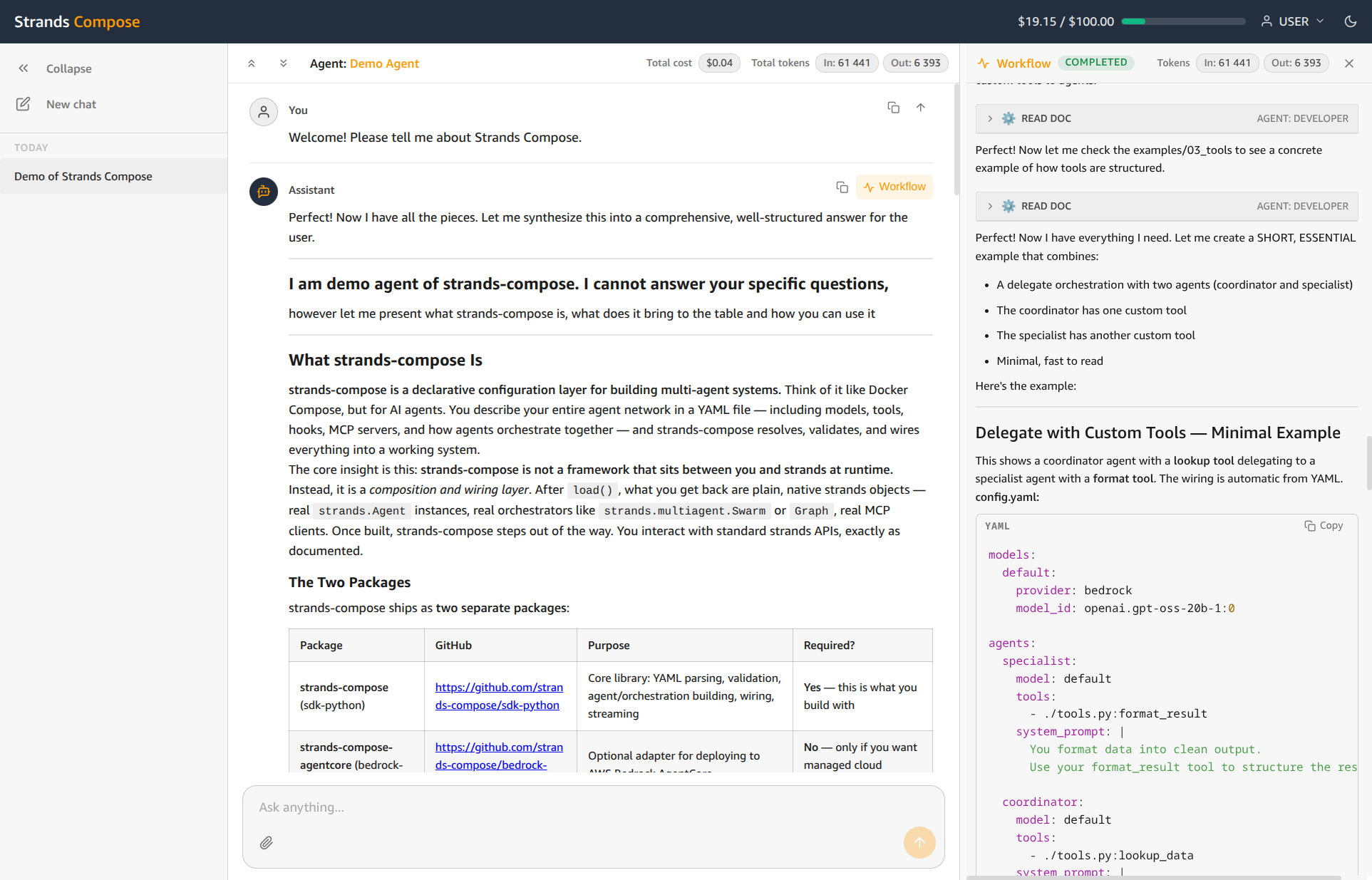
Chat UI for any strands-compose agent
Admin Panel - manage access, users and resources
https://github.com/user-attachments/assets/4ecafdce-16e9-488b-b389-71be92d23aa3
What's included
The application comes complete — there is nothing to assemble:
| Feature | What it gives you |
|---|---|
| Chat interface | Live, streaming replies with multi-agent systems showing their work as it happens. Conversations are saved so people can return to earlier threads. |
| File attachments | Users can send images and documents alongside their messages, within configurable size limits. |
| User accounts and sign-in | Built-in username/password accounts, plus optional single sign-on (SSO) through your existing identity provider — Microsoft Entra, Okta, Google, or any standards-based OAuth provider. |
| Access control | Agents are organised by group, so each person only sees the agents they are entitled to use. Access is closed by default. |
| Admin panel | A web console where an administrator registers agents, manages users and groups, and reviews activity. |
| Usage and cost tracking | Every interaction records token usage, with per-model pricing, per-user budgets, and a dashboard for both administrators and individual users. |
Who it's for
- Freelancers and small teams who have built an agent and need to put it in front of clients or colleagues quickly, with a polished interface and proper sign-in.
- Organisations that want an internal AI assistant or department-specific agents, gated behind company SSO, with usage and cost visibility for budgeting.
- Anyone delivering an agent as a product or internal service who would rather configure a chat app than build and maintain one.
Getting started
The application is published on PyPI as strands-compose-chat and includes the
web interface bundled in. Installing it gives you a command-line tool available
as strands-compose-chat or its short alias scc.
pip install strands-compose-chat
A minimal local run:
scc migrate     # create the database
scc serve       # start the web server on http://127.0.0.1:8000
Two worked setups are in the examples directory:
01-local-dev— run on your own machine with a local database. The fastest way to try the app.02-docker— a production-like stack (the app plus a PostgreSQL database) with Docker Compose. Recommended for production, and the basis for deploying to orchestrators such as ECS or Kubernetes.
Each example has step-by-step instructions and a configuration template.
Technical overview
The intent here is a brief map, not a deep reference — detailed documentation lives in separate documents.
Architecture.
A single deployable application made of two parts: a Python backend and a web frontend that ships bundled inside it. The backend exposes the API and serves the interface; the frontend is what users see in the browser. The backend talks to your agents only through the strands-compose SDK, so anything agent-related stays consistent with the rest of the ecosystem.
Tech stack.
Built on a modern, high-performance stack selected for streaming and multi-tenant workloads. The async backend handles concurrent SSE streams without blocking, the database layer uses async SQLAlchemy 2.0 with eager-loaded relationships and parameterised queries throughout, and the frontend delivers a responsive interface with real-time updates via an event-driven store.
| Layer | Technology |
|---|---|
| Backend | FastAPI, async SQLAlchemy, Pydantic, Alembic, sqladmin, uvicorn |
| Frontend | React, TypeScript, Vite |
| Database | SQLite (local development), PostgreSQL (production) |
Security.
Authentication, authorisation, and transport security are implemented to production standards with no shortcuts. Every endpoint is gated, every credential is hashed or redacted, and production mode enforces a strict baseline at startup — refusing misconfiguration rather than running with it silently.
| Area | Implementation |
|---|---|
| Authentication | Session-cookie and Bearer API key. Constant-time, enumeration-safe. |
| Password storage | Argon2id hashes only; raw credentials are never persisted or logged. |
| Authorisation | Role-based FastAPI dependencies on every endpoint. Agent visibility requires explicit group membership. |
| OIDC / SSO | Standards-based OAuth 2.0 / OpenID Connect; redirect targets validated against open-redirect. |
| Security headers | Strict-Transport-Security, X-Content-Type-Options, Content-Security-Policy, X-XSS-Protection, Referrer-Policy on every response. |
| Framing | frame-ancestors 'self' / X-Frame-Options: SAMEORIGIN by default, so a same-origin page can embed the app; FRAME_ANCESTORS=[] denies framing outright. Cross-origin embedding is not offered — it would require a SameSite=None session cookie. |
| Transport | TrustedHostMiddleware, configurable CORS_ALLOWED_ORIGINS. |
| Production hardening | APP_ENV=prod enforces HTTPS-only cookies, rejects SQLite and wildcard CORS/host settings at startup. |
| Secrets handling | All credentials via environment variables; sensitive fields redacted in logs, diagnostics, and config repr. |
1 maintainer

Metadata
1 maintainer
Release files for strands-compose-chat 0.4.0
For a detailed explanation of source distributions (sdists) and built distributions (wheels), please see the package formats documentation.
Source distribution (sdist)
| File | Size | Uploaded | |
|---|---|---|---|
| strands_compose_chat-0.4.0.tar.gz | 353.8 kB | Details |
Built distribution (wheel)
| File | Interpreter | ABI | Platform | Reset |
|---|---|---|---|---|
| strands_compose_chat-0.4.0-py3-none-any.whl | Python 3 | none | any | Details |
Total release size: 962.7 kB
Release files / strands_compose_chat-0.4.0.tar.gz
| Download URL | strands_compose_chat-0.4.0.tar.gz |
|---|---|
| Size | 353.8 kB |
| Tags | Source |
|
SHA-256 checksum How to use checksums |
4a7b62c1e2070606bffce801bfb1685594f74718ce0e1c62fbd20d48b8fbd616
|
|
BLAKE2b-256 checksum How to use checksums |
680bbb543208f5653f70bb44a9644cacecd9a218c00c331f3909bcf17e76a5e7
|
| Upload date | |
|
Uploaded using Trusted Publishing? What is trusted publishing? |
Yes |
| Uploaded via |
twine/7.0.0 CPython/3.13.14
|
Provenance
Provenance describes where a file came from. On PyPI, provenance is shared via attestations, which provide a verifiable record of the build or publishing details. View details, limitations and caveats.


PyPI Publish Attestation
PyPI verified that this artifact, at this checksum, originated from the publisher listed below.
Signed by GitHub Actions, verified by PyPI on Sep 23, 2026.
Transparency logRelease files / strands_compose_chat-0.4.0-py3-none-any.whl
| Download URL | strands_compose_chat-0.4.0-py3-none-any.whl |
|---|---|
| Size | 609.0 kB |
| Tags | Python 3 |
|
SHA-256 checksum How to use checksums |
9e4fcd5478855bc975a8f3f2c01df672da78f3f57986e4ca6bd10de9ee41dfd4
|
|
BLAKE2b-256 checksum How to use checksums |
477a4aa64308c0bcd56fa15678364ddff5e32c65078c659e214bed0bba6f91bd
|
| Upload date | |
|
Uploaded using Trusted Publishing? What is trusted publishing? |
Yes |
| Uploaded via |
twine/7.0.0 CPython/3.13.14
|
Provenance
Provenance describes where a file came from. On PyPI, provenance is shared via attestations, which provide a verifiable record of the build or publishing details. View details, limitations and caveats.
PyPI Publish Attestation
PyPI verified that this artifact, at this checksum, originated from the publisher listed below.
Signed by GitHub Actions, verified by PyPI on Sep 23, 2026.
Transparency log













