

Run any HuggingFace transformers model from a Strands agent. A tool for every task, or the agent's own multimodal brain. Local. No API keys.







📖 Docs · ⚡ 60-second hello · 👁️ See it work · 🧩 Two ways · 🧪 Examples
🤔 The idea
HuggingFace transformers already runs every model on earth. The missing piece
is a clean, dynamic bridge into an agent loop - without writing per-model glue
every time. This library is that bridge, two ways:
| What it is | You get | |
|---|---|---|
🛠️ use_transformers |
one tool exposing every transformers task | discover · run a pipeline · call any class/method |
🧠 TransformerModel |
a local model as your Agent(model=…) brain |
it sees, hears & speaks via content blocks |
Zero hardcoding.
core/registry.pyreads transformers' ownSUPPORTED_TASKStaxonomy at runtime - the day a task or model lands upstream, it works here. No code change. No version bump.
📦 Install
uv pip install strands-transformers          # from PyPI
PYTHONPATH=. python examples/smoke.py         # verify → "18/18 checks passed"
From source · optional extras (audio · vision · training)
uv pip install -e .                # editable from source
uv pip install -e ".[audio]"       # soundfile, librosa  (mp3/flac/ogg decode)
uv pip install -e ".[vision]"      # torchvision (needed by VLMs!), opencv, av
uv pip install -e ".[training]"    # trl, peft, accelerate
uv pip install -e ".[all]"         # everything
WAV audio works with no extras. Vision models (SmolVLM, Qwen-VL, …) need
[vision]. device="auto" picks cuda → mps → cpu (bf16 on GPU).
⚡ 60-second hello
A 256M-param vision model, seeing pixels in the standard Strands loop - no key, no server:
import io
from PIL import Image
from strands import Agent
from strands_transformers import TransformerModel

buf = io.BytesIO(); Image.new("RGB", (64, 64), (20, 200, 40)).save(buf, "PNG")  # a green square

model = TransformerModel(model_path="HuggingFaceTB/SmolVLM-256M-Instruct")
agent = Agent(model=model, system_prompt="You are concise.")

print(agent([
    {"image": {"format": "png", "source": {"bytes": buf.getvalue()}}},
    {"text": "Color? One word."},
]))
# → Green.
Swap model_path for any HF VLM and the code is identical.
👁️ See it work
Every result below is a real model output (CUDA · transformers 5.12 · torch 2.10):
| You give it | It returns | Example |
|---|---|---|
| 🖼️ a green image + "Color?" | "Green." |
multimodal_agent.py |
| 🎬 brightening video frames | "BRIGHTER." |
multimodal_advanced.py |
🧰 a blue tool screenshot (in toolResult) |
"Blue." |
multimodal_advanced.py |
| 📄 a text document | recovers BANANA-42 |
document_and_audio.py |
| 🔊 a 440 Hz tone (Omni) | "It's a pure tone." |
omni_audio.py |
| 💬 "say: …can speak" (Omni) | 🔊 real 24 kHz speech | omni_audio.py |
| 🦾 camera + "pick the cube" | actions [1, 30, 6] |
molmoact_vla.py |
📋 Copy-paste & run - the snippet behind each row
# 🖼️ image → "Green."   (local VLM brain, content blocks)
import io
from PIL import Image
from strands import Agent
from strands_transformers import TransformerModel

png = io.BytesIO(); Image.new("RGB", (224, 224), (20, 200, 40)).save(png, "PNG")
agent = Agent(model=TransformerModel(model_path="HuggingFaceTB/SmolVLM-256M-Instruct"))
print(agent([
    {"image": {"format": "png", "source": {"bytes": png.getvalue()}}},
    {"text": "What color is this image? One word."},
]))  # → Green.
# 🎬 video → "BRIGHTER."   (a video content block of brightening frames)
import asyncio, numpy as np
from PIL import Image
from strands_transformers import TransformerModel

model = TransformerModel(model_path="HuggingFaceTB/SmolVLM2-500M-Video-Instruct",
                         params={"max_tokens": 48, "do_sample": False})
frames = [Image.fromarray(np.full((224, 224, 3), v, np.uint8)) for v in (10,40,80,120,160,200,230,250)]
msgs = [{"role": "user", "content": [
    {"video": {"format": "mp4", "fps": 2.0, "source": {"bytes": frames}}},
    {"text": "Does this video get brighter or darker? Answer brighter or darker."},
]}]
async def go():
    return "".join([e.get("contentBlockDelta",{}).get("delta",{}).get("text","")
                    async for e in model.stream(msgs)])
print(asyncio.run(go()))  # → ...brighter...
# 🧰 tool screenshot → "Blue."   (an image returned inside a toolResult)
import asyncio, io
from PIL import Image
from strands_transformers import TransformerModel

blue = io.BytesIO(); Image.new("RGB", (224, 224), (25, 25, 210)).save(blue, "PNG")
model = TransformerModel(model_path="HuggingFaceTB/SmolVLM-256M-Instruct",
                         params={"max_tokens": 32, "do_sample": False})
msgs = [
    {"role": "user", "content": [{"text": "Capture the screen, then name its color."}]},
    {"role": "assistant", "content": [{"toolUse": {"name": "capture", "toolUseId": "t1", "input": {}}}]},
    {"role": "user", "content": [{"toolResult": {"toolUseId": "t1", "status": "success", "content": [
        {"text": "Here is the captured screen:"},
        {"image": {"format": "png", "source": {"bytes": blue.getvalue()}}}]}}]},
    {"role": "user", "content": [{"text": "Dominant color of the captured screen? One word."}]},
]
async def go():
    return "".join([e.get("contentBlockDelta",{}).get("delta",{}).get("text","")
                    async for e in model.stream(msgs)])
print(asyncio.run(go()))  # → Blue.
# 📄 document → recovers "BANANA-42"   (a document content block → text LM prompt)
import asyncio
from strands_transformers import TransformerModel

model = TransformerModel(model_path="Qwen/Qwen3-0.6B", enable_thinking=False,
                         params={"max_tokens": 64, "do_sample": False})
body = b"The secret passphrase for the vault is BANANA-42. Keep it safe."
msgs = [{"role": "user", "content": [
    {"document": {"name": "secret", "format": "txt", "source": {"bytes": body}}},
    {"text": "What is the secret passphrase? Answer with just the passphrase."},
]}]
async def go():
    return "".join([e.get("contentBlockDelta",{}).get("delta",{}).get("text","")
                    async for e in model.stream(msgs)])
print(asyncio.run(go()))  # → BANANA-42
# 🔊 text → speech → text   (TTS then ASR, the tool path; the library narrating itself)
from strands_transformers import use_transformers

tts = use_transformers(action="run", task="text-to-audio",
                       model="facebook/mms-tts-eng",
                       inputs="the quick brown fox jumps over the lazy dog")
wav = tts["artifacts"][0]
asr = use_transformers(action="run", task="automatic-speech-recognition",
                       model="openai/whisper-tiny", inputs=wav)
print(asr["content"][0]["text"])  # → "...quick brown fox..."
# 🦾 camera + instruction → robot actions [1, 30, 6]   (VLA via the `call` path)
import numpy as np
from PIL import Image
from huggingface_hub import hf_hub_download
from strands_transformers import use_transformers

REPO = "allenai/MolmoAct2-SO100_101"
top  = Image.open(hf_hub_download(REPO, "assets/sample_realsense_top_rgb.png")).convert("RGB")
side = Image.open(hf_hub_download(REPO, "assets/sample_realsense_side_rgb.png")).convert("RGB")
state = [-0.527, 189.14, 181.41, 60.64, -3.60, 1.097]

use_transformers(action="call", target="AutoProcessor.from_pretrained",
    parameters={"pretrained_model_name_or_path": REPO, "trust_remote_code": True}, cache_key="proc")
use_transformers(action="call", target="AutoModelForImageTextToText.from_pretrained",
    parameters={"pretrained_model_name_or_path": REPO, "trust_remote_code": True, "dtype": "float32"}, cache_key="vla")
print(use_transformers(action="call", target="cached:vla.predict_action",
    parameters={"processor": "cached:proc", "images": [top, side],
                "task": "Pick up the lemon and drop it in the red bowl.",
                "state": state, "norm_tag": "so100_so101_molmoact2",
                "inference_action_mode": "continuous", "num_steps": 10})["content"][0]["text"][:200])
# → MolmoAct2ActionOutput ... actions [1, 30, 6]
Omni audio-in + speech-out needs one bigger model - see
examples/omni_audio.py.
Vision tasks on one COCO photo - detection · depth · panoptic segmentation:


text-to-audio then re-transcribed by whisper (the library narrating itself)▶️ Hear it speak & play every example on the docs site →
🧩 Two ways to use it
🛠️ As a tool - use_transformers
from strands import Agent
from strands_transformers import use_transformers

agent = Agent(tools=[use_transformers])
agent("Transcribe recording.wav")                  # automatic-speech-recognition
agent("What's in scene.jpg?")                       # image-text-to-text
agent("Say 'hello from strands' as audio")          # text-to-audio
agent("Detect objects in https://.../street.jpg")   # object-detection
Discover everything at runtime (action="tasks" | "modalities" | "inspect" | …),
run high-level pipelines, or call any class / fn / method for custom models.
→ The tool guide
🧠 As the agent's brain - TransformerModel
Pass image / video / audio / document blocks (and media inside a
toolResult) - the provider auto-detects the model's processor and routes them.
| Content block | Verified output | Example |
|---|---|---|
image |
"Green." |
multimodal_agent.py |
video (with fps) |
"BRIGHTER." |
multimodal_advanced.py |
image in toolResult |
"Blue." |
multimodal_advanced.py |
document |
recovers BANANA-42 |
document_and_audio.py |
audio (our schema extension) |
audio → text | audio_content_block.py |
audio in and speech out |
hears + speaks | omni_audio.py |
→ Agent brain · Content blocks · Audio
🦾 Robotics / VLA - camera + instruction → actions
Two transformers-native layers, both GPU-verified:
- 🧠 reason — Cosmos-Reason2-2B
(a physical-AI VLM) plans over a scene via
run: "the red cube is bottom-left, move the arm there first." - ⚙️ act — VLA models expose
predict_actionviacall: MolmoAct2 →[1,30,6]; OpenVLA-7b → 7-DoF (auto 4.x→5.x shims).
🔗 Full agentic loop (robot_reason_act_agent.py):
Cosmos plans over real RealSense frames → MolmoAct acts — perception → plan →
action through one tool. (Lerobot policies like SmolVLA / π0 / GR00T run their own
runtimes — pair with use_lerobot.)
→ Robotics guide
🌟 Featured models
Examples use tiny models so they run in seconds. Point the same code at any current
library_name: transformers model - swap the id, the plumbing is identical:
| Modality | Strong open model | How |
|---|---|---|
| Vision-language | Qwen/Qwen3-VL-8B-Instruct · google/gemma-3-4b-it |
brain or run (image-text-to-text) |
| Speech → text | openai/whisper-large-v3-turbo |
run (automatic-speech-recognition) |
| Audio in + speech out | Qwen/Qwen2.5-Omni-3B |
brain (speak=True) |
| Multimodal (audio+vision+text) | microsoft/Phi-4-multimodal-instruct |
brain |
| Robot actions (VLA) | allenai/MolmoAct2 · openvla/openvla-7b |
call → predict_action |
| Embodied reasoning | nvidia/Cosmos-Reason2-2B |
run (image-text-to-text) |
# swap the tiny demo model for a SOTA one - same code:
model = TransformerModel(model_path="Qwen/Qwen3-VL-8B-Instruct")
🏗️ How it works
strands_transformers/
├── tools/use_transformers.py            # the one @tool: discover · run · call
├── models/transformers.py               # TransformerModel - local multimodal brain
├── types/audio.py                       # audio content-block extension
└── core/{registry,engine,io,compat}.py  # taxonomy · load/cache · I/O · legacy shims
Nothing is hardcoded per task - registry.py reads transformers' SUPPORTED_TASKS
at runtime, so coverage tracks upstream automatically.
→ Architecture ·
API reference
🧪 Examples
Runnable, GPU-verified examples in examples/ - image, video, audio,
document, Omni speech, VLA, and pipelines. Run any:
PYTHONPATH=. python examples/<name>.py
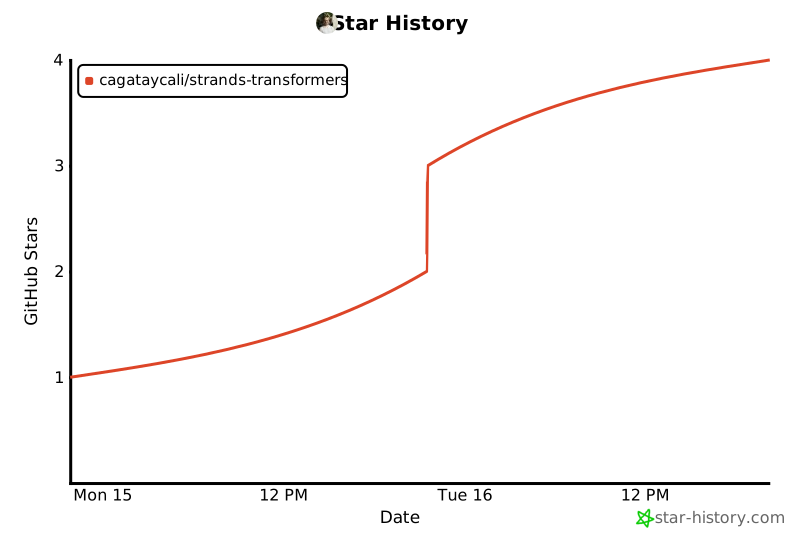
⭐ Star history
License
MIT - built with the Strands Agents SDK and HuggingFace Transformers.
MCP Server (Claude Code / Claude Desktop / Cursor / any MCP client)
No install needed — just uvx:
uvx strands-transformers                    # stdio (Claude Code / Desktop)
uvx strands-transformers --http --port 8021 # HTTP multi-client
Claude Code: claude mcp add transformers -- uvx strands-transformers
Claude Desktop:
{"mcpServers": {"transformers": {"command": "uvx", "args": ["strands-transformers"]}}}
Prefer pip?
pip install "strands-transformers[mcp]"
strands-transformers-mcp
1 maintainer

Download files
Download the file for your platform. If you're not sure which to choose, learn more about installing packages.
Source Distribution
Built Distribution
Filter files by name, interpreter, ABI, and platform.
If you're not sure about the file name format, learn more about wheel file names.
Copy a direct link to the current filters
File details
Details for the file strands_transformers-0.4.2.tar.gz.
File metadata
- Download URL: strands_transformers-0.4.2.tar.gz
- Upload date:
- Size: 2.2 MB
- Tags: Source
- Uploaded using Trusted Publishing? No
- Uploaded via: twine/6.1.0 CPython/3.13.14
File hashes
| Algorithm | Hash digest | |
|---|---|---|
| SHA256 |
f49f1838ae20dd10fa20499a74a997518c8078beebdd16bb590d08287c5591d7
|
|
| MD5 |
1fc119d381ad3d7a1496acafd53daf80
|
|
| BLAKE2b-256 |
590d601db0fed65f5daaccc87c7157ce8dd825db9726d15a56eea644372c840a
|
File details
Details for the file strands_transformers-0.4.2-py3-none-any.whl.
File metadata
- Download URL: strands_transformers-0.4.2-py3-none-any.whl
- Upload date:
- Size: 50.2 kB
- Tags: Python 3
- Uploaded using Trusted Publishing? No
- Uploaded via: twine/6.1.0 CPython/3.13.14
File hashes
| Algorithm | Hash digest | |
|---|---|---|
| SHA256 |
d41c9ab672831de4f822b3a4b40e1d1f7776e0e719cddaa1329d91301d64d8d9
|
|
| MD5 |
eb08b836de38587b74081d899d9b0be8
|
|
| BLAKE2b-256 |
f558edfbe18115e37b520294f021c757223fdc2b7e780a2074ed489318994ffe
|







