
Strata — Agentic BI Toolkit for Looker and BigQuery





If you're a BI engineer or analyst running Looker on BigQuery, your existing tools validate syntax and catch broken SQL. They usually do not answer the governance questions that decide whether a semantic-layer change is safe:
- Which explores had zero queries in the last 30 days?
- Which PDTs are rebuilding nightly at ~$45,000/month in estimated BQ compute to serve nobody?
- Which BigQuery column drops will silently break LookML before users find out at query time?
The tool is called Strata. On PyPI it's distributed as
strata-lookml—strataandstrata-mcpwere already taken by unrelated projects. The CLI (strata), MCP server (strata-mcp), and chart renderer (strata-chart) command names are unaffected. One consequence: if anotherstrata-named tool is already installed viapipx(the unrelatedstrata-mcpPyPI package installs astratacommand too),pipxwill refuse the shared binary name — use theuvxform below, which is collision-safe.
What Strata Is
Strata is a local MCP server and CLI toolkit. Point it at your LookML repo. Your AI client gets 18 analysis tools — 17 read-only, 1 sandboxed chart renderer, and 15 domain skills with structured investigation procedures, and a pre-built graph of your resolved LookML dependency structure — enriched with BigQuery usage and schema facts. Offline-first: connecting to your Looker instance is preferred but optional; no credentials are required to start.
Installation
# Run without installing (recommended) — the console scripts are strata,
# strata-mcp, and strata-chart, not strata-lookml, so pass --from:
uvx --from strata-lookml strata --help

# Or install the CLI + MCP server persistently
pipx install strata-lookml
strata --help
Wire it into an MCP client — the server entry point is strata-mcp, resolved from the
strata-lookml distribution via uvx --from strata-lookml strata-mcp:
{
  "mcpServers": {
    "strata": {
      "command": "uvx",
      "args": ["--from", "strata-lookml", "strata-mcp"],
      "env": { "STRATA_REPO_PATH": "/path/to/your/lookml" }
    }
  }
}


Both badges embed the same uvx --from strata-lookml strata-mcp config above; edit
STRATA_REPO_PATH to your repo after installing. A prebuilt .mcpb bundle for one-click
install in Claude Desktop is attached to each GitHub Release.
Quick Start
# Install
pip install -e ".[dev]"

# Bootstrap your repo — creates conductor/, .mcp.json, and config
strata bootstrap --repo /path/to/your/lookml

# Wire your AI client (Claude Code, Cursor, Gemini)
# .mcp.json is written by bootstrap, or add manually:
{
  "mcpServers": {
    "strata": {
      "command": "strata-mcp",
      "env": { "STRATA_REPO_PATH": "/path/to/your/lookml" }
    }
  }
}
Verify everything is wired before opening your AI client:
STRATA_REPO_PATH=/path/to/your/lookml strata mcp validate
Live Looker enrichment is opt-in — start with offline fixtures, add strata auth login when ready.
See Looker OAuth and Token Management.
Try it now with bundled playgrounds
Three LookML repos and matching fixture JSON ship in the repo. Run the full analysis stack offline in under a minute:
git clone https://github.com/G-Schumacher44/strata-oss.git
cd strata-oss
pip install -e ".[dev]"
export STRATA_REPO_PATH=tests/lookml/enterprise_mono
export STRATA_USAGE_FIXTURE=tests/fixtures/enterprise_usage_facts.json
export STRATA_SCHEMA_FIXTURE=tests/fixtures/enterprise_schema_facts.json
$ strata check
Strata scenario gates passed.

$ strata query status
{
  "node_counts": {"explore": 34, "view": 20, "field": 196, "pdt": 5},
  "edge_count": 378
}

$ strata outputs --out /tmp/strata-demo
{
  "catalog": "/tmp/strata-demo/catalog.json",
  "dead_code_register": "/tmp/strata-demo/dead_code_register.json",
  "pdt_ledger": "/tmp/strata-demo/pdt_ledger.json",
  "schema_drift": "/tmp/strata-demo/schema_drift.json",
  "usage_summary": "/tmp/strata-demo/usage_summary.json",
  "cleanup_roadmap": "/tmp/strata-demo/cleanup_roadmap.json",
  "migration_impact": "/tmp/strata-demo/migration_impact.json",
  "validation_scope": "/tmp/strata-demo/validation_scope.json"
}

$ strata mcp validate
  repo:       .../tests/lookml/enterprise_mono  (from STRATA_REPO_PATH env)
  ✓ repo path exists
  ✓ IR cache found (age: 2235s)
  ✓ skills: 15 found
  ✓ chart templates: 4 found
  ~ BQ project: not set (gcloud default will be used; set bq_project in ~/.strata/config.json for 2-part table names)
  ✗ Looker token missing — run `strata auth login`

  MCP server is ready.
All three included playgrounds (enterprise_mono, gcs_analytics, thelook) have matching
usage and schema fixture JSON in tests/fixtures/ — swap --repo and --*-fixture to run
against any of them.
Developer workflow
Strata utilizes Ruff for linting/formatting and Mypy for type checking.
Linting and type checking:
# Run both ruff and mypy
strata lint

# Fix safe violations automatically
strata lint --fix --format
Install pre-commit hooks to run checks automatically on every commit:
pre-commit install
Every PR is gated by:
ruff check src/ tests/ruff format --check src/ tests/mypy src/strata --ignore-missing-importspython -m pytest
See .github/workflows/strata-ci.yml for details.
LookML Governance
The flagship analysis. Runs fully offline from your LookML files and fixture JSON — no Looker instance, no BQ credentials, no flaky API calls.
Dead Code Campaigns
Strata builds a resolved dependency graph covering explores, views, joins, extends chains,
fields, PDTs, and physical tables. Cross-reference against 30 days of Looker System Activity
and content usage data, and you get exact dead code with dual evidence: the explore exists in
the resolved IR and has zero queries with no dashboard references. Dual evidence is designed to
eliminate false positives before you deprecate — see
docs/testing-findings.md for the false-positive classes caught
and fixed during testing (CTE names misread as physical tables, zombie views invisible to the
orphan-only check).
From the enterprise_mono playground:
- 6 dead explores across 3 legacy connection clusters
- 5 zombie views — referenced only by those dead explores
- ~$765,000/year in compute serving no users
PDT Cost Visibility
Surface which PDTs are building on schedule but backing dead explores. Cross-reference build cost against query volume to identify zombie compute. Get the annualized number before you walk into the conversation with the team.
pdt_attribution_full_funnel  →  ~$45,000/30d  →  dead_finance_v2 (0 queries)
pdt_customer_value_score     →  ~$18,750/30d  →  dead_orders_v2  (0 queries)
──────────────────────────────────────────────────────────────────
Zombie PDT cost:  ~$63,750/30d  (~$765,000/year)  [estimated]
Costs are estimated from BigQuery scan volume (
bytes_processedfrom Looker System Activity) at the standard on-demand rate ($5/TB). This is disk I/O — the data BQ reads from storage to build the PDT — not memory or output size. Flat-rate and committed-use customers will see different actual billing.
The demo dollar figures above are hand-authored values baked into the
enterprise_monofixture (tests/fixtures/enterprise_usage_facts.json) for illustration — they are not computed by applying the $5/TB formula to that fixture. The formula itself is real and runs against live BigQuery scan bytes (src/strata/l1/looker.py) wheneverstrata auth loginis used against a real Looker/BQ instance.
Schema Drift Detection
LookML that references a column the warehouse dropped compiles fine in Looker — it fails silently at query time. Strata catches these before your users do, with column-level traceability from field definition back to the physical BQ table.
14 drift hits found across 3 tables in enterprise_mono — 9 from a real int_inventory_risk
schema migration that LookML was never updated to reflect.
Safe Migrations and Blast Radius
Before dropping a BQ column or renaming a table, run impact analysis across the full LookML graph. Every view, explore, and field that depends on it — with content reference counts.
CI Gate
strata check --repo . --usage-fixture usage_facts.json
Exits 0 if all gates pass. No Looker instance, no credentials, no flaky API calls. Every PR gets deterministic coverage: extends chains resolved, dead code counted, drift checked, validation scope computed.
How does Strata fit with existing tools?
| Tool | What it does | Where it stops |
|---|---|---|
| LookML IDE / Extension | Syntax validation, autocomplete, inline errors | Doesn't know query history, cost, or which explores are actually used |
| Looker MCP Server | Gives Client(Claude, Gemini, Codex, Cursor) live API access to Looker objects and system activity | A bridge for agents — surfaces data, doesn't analyze it |
| Spectacles / content validation | Runs explores in Looker to catch SQL compile errors | Reactive — tests what exists, doesn't surface what should be removed |
| Looker native alerting | Flags broken dashboards and scheduled query failures | Catches failures after they happen, not structural risk before it does |
Strata consumes what the Looker MCP Server surfaces (usage facts, system activity) and produces what a Looker Extension could display (cost ledger, cleanup roadmap, drift report). The three tools are complementary layers, not competitors.
Dashboard
strata dashboard builds all 8 output artifacts and serves a self-contained HTML observability
panel at localhost:8765. No JavaScript framework, no CDN — all JS is bundled locally so it
works in air-gapped or corp-network environments.
The dashboard has four panels:
- Overview — KPI tiles (active explores, dead artifacts, total PDT cost, schema drift hits) + the full dependency graph
- Dead Code Register — every flagged explore and view with dual-evidence badges (structural + usage). Click any node to see what backs it.
- PDT Ledger — cost per PDT per period, zombie vs. active status, which explores reference each PDT
- Schema Drift — missing columns/tables per view, mapped back to physical table and connection
strata dashboard \
  --repo tests/lookml/enterprise_mono \
  --usage-fixture tests/fixtures/enterprise_usage_facts.json \
  --schema-fixture tests/fixtures/enterprise_schema_facts.json
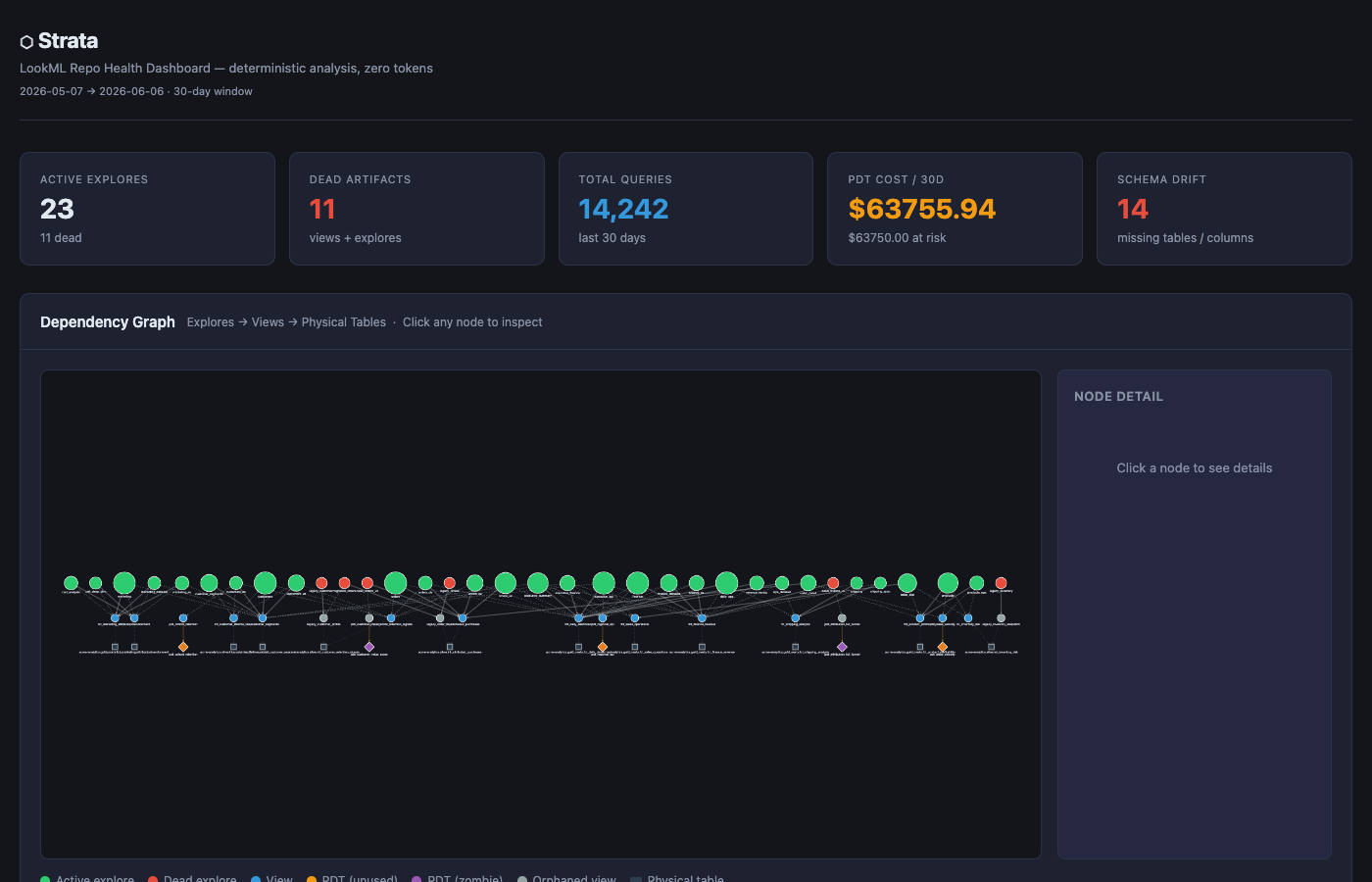
enterprise_mono — 34 explores, 19 models, 30-day window. Green = active explore, red = dead explore, blue = view, orange = unused PDT, purple = zombie PDT, gray = physical table.
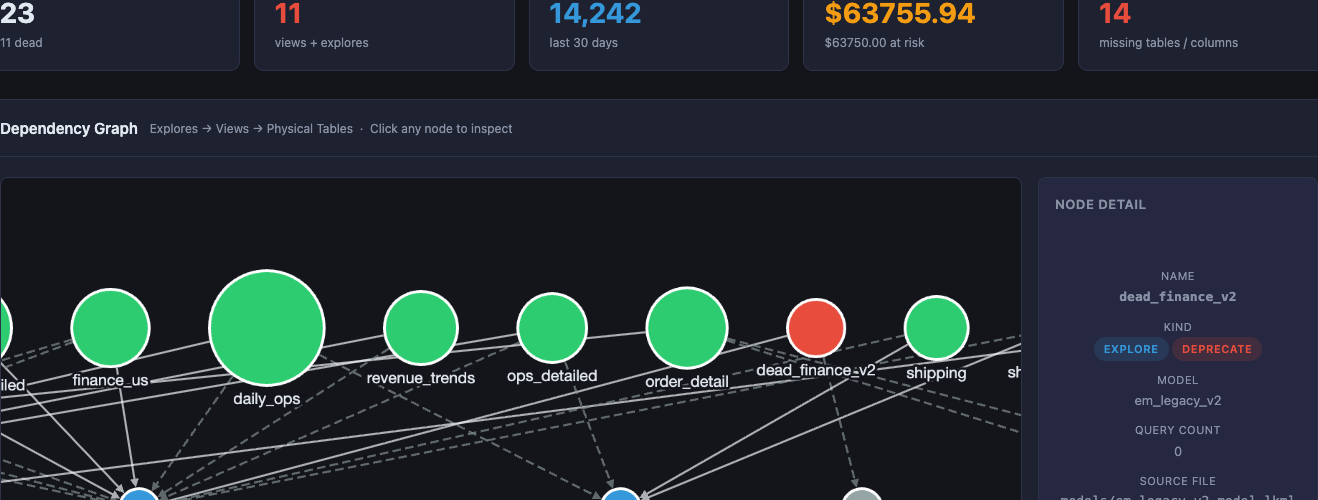
dead_finance_v2 selected — rendered dead-red with a deprecate verdict and QUERY COUNT: 0 in the node detail. Its backing PDT, pdt_attribution_full_funnel, is the purple zombie diamond in the full graph above, rebuilding at ~$45,000/month (estimated fixture data) to serve it.
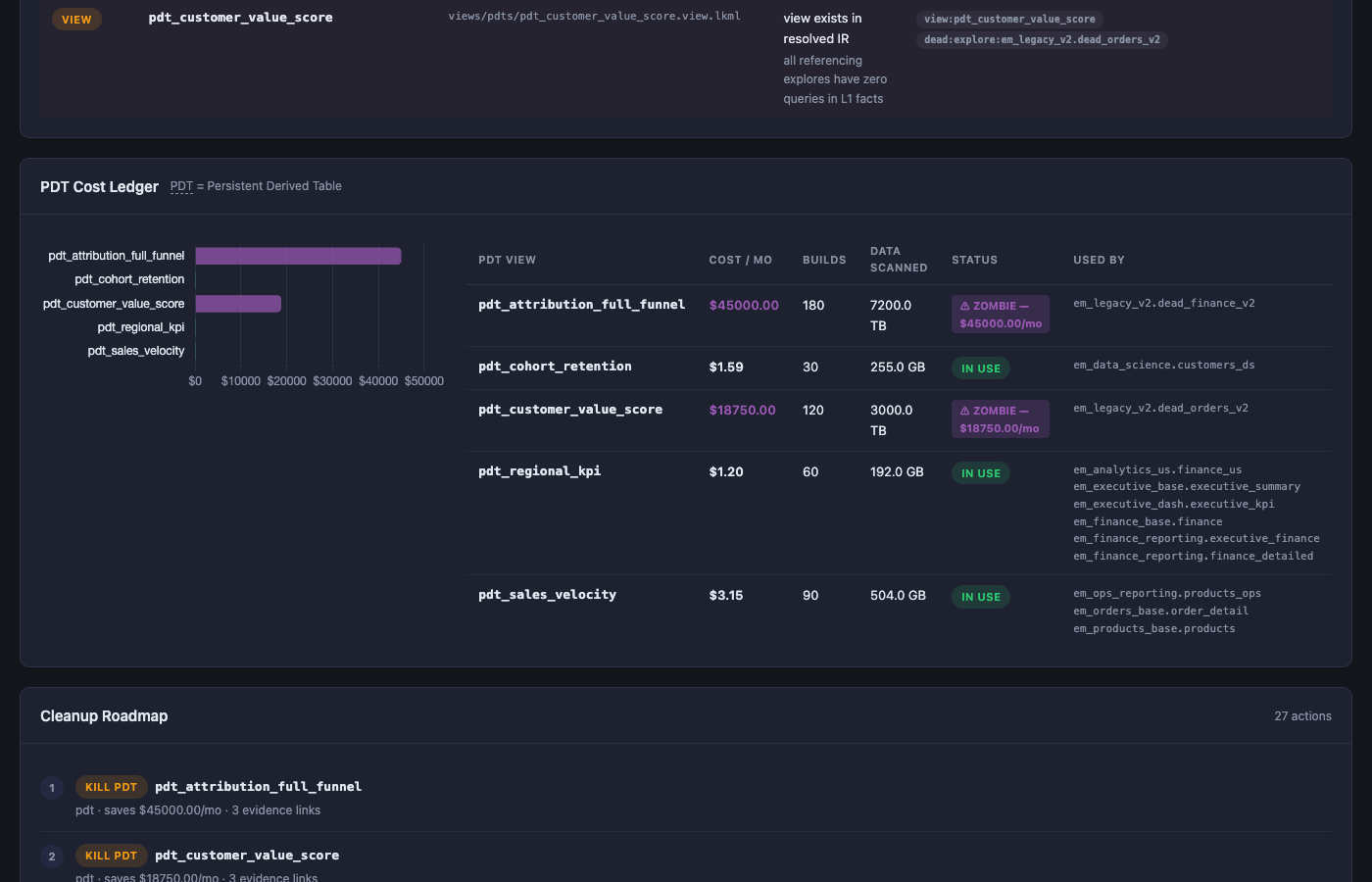
PDT Cost Ledger — both zombie PDTs flagged ⚠ with their monthly cost and the dead explores that consume them, above the Cleanup Roadmap's KILL actions. Every verdict carries evidence links; the Dead Code Register panel (visible at top) applies the same dual-evidence rule — structural and usage tags both required before anything is flagged.
How it works — L0 → L1 → L2 pipeline
LookML repo (read-only clone)
        │
        ▼
   L0 — IR Builder
        Parse all .lkml files → canonical node/edge graph
        Resolve extends chains, refinements, cross-model dependencies
        No LLM. No network. Pure deterministic Python.
        │
        ▼
   L1 — Enrichment
        Join IR against usage facts (explore queries, PDT builds)
        Join IR against schema facts (warehouse column inventory)
        Produces: dead code evidence, PDT cost ledger, schema drift records
        Offline: fixture JSON  |  Live: Looker OAuth → System Activity API
        │
        ▼
   L2 — Synthesis
        One explore = one verdict with evidence
        Lightweight model, clean structured context
        Outputs: cleanup roadmap, migration impact, validation scope
        │
        ├── JSON artifacts   catalog / dead code / PDT ledger / drift / impact
        ├── HTML dashboard   strata dashboard
        ├── MCP server       18 tools (17 read-only + 1 sandboxed render), stdio, any MCP client
        └── CLI              strata check / outputs / build / validate
L0 never calls any LLM or external API — pure offline deterministic Python. L1 enrichment
is offline by default (fixture JSON); live Looker System Activity API access is opt-in via
strata auth login. The MCP server transport is stdio-only — no HTTP server, no cloud
dependency. All analysis runs against a read-only clone.
Philosophy — why deterministic first?
Parsing LookML, resolving extends chains, detecting dead code, computing PDT cost — these are deterministic problems. They cost zero tokens. The structure doesn't need an LLM to understand it; it needs to be mapped.
Strata maps it first. Then a lightweight model reasons over a clean, structured context. This gets more capable as models improve and more efficient over time. The deterministic layer never changes.
LookML's declarative model — explicit explore:, join:, view:, extends: — makes this
possible. Every dependency is named and resolvable without executing a query. Most BI tools
don't have this. A dbt project has a DAG but no semantic layer. A Tableau workbook has implicit
dependencies that are hard to traverse programmatically. LookML's structure is what makes
"what breaks if I change this?" answerable with certainty, not heuristics.
MCP, Skills, and Agent Workflow
The MCP Layer
18 tools over stdio — 17 read-only, plus strata_render_chart, which writes only to
~/.strata/output or /tmp (sandboxed, never your LookML repo). Works with any MCP client.
All tools run against the local IR cache — no live Looker connection required. For live usage
enrichment, see Looker OAuth below.
Agent calls: strata_dead_code_register
  → 6 dead explores, 2 zombie PDTs, ~$63,750/mo estimated in unused compute

Agent calls: strata_explore_deps("dead_finance_v2", "em_legacy_v2")
  → full join graph: 4 views, 1 zombie PDT backing this explore

Agent calls: strata_schema_drift
  → 14 drift hits across 3 tables — column drops not reflected in LookML

Agent calls: strata_validation_scope(["views/orders.view.lkml"])
  → 3 explores affected — minimum revalidation set for this PR
All 18 tools
| Tool | Returns |
|---|---|
strata_ir_status |
Graph summary: node counts, model list, resolution errors |
strata_dead_code_register |
Dead explores + zombie views with dual evidence |
strata_pdt_costs |
PDT ledger: cost/mo, build count, bytes, status |
strata_schema_drift |
Column-level drift: field exists in LookML, missing in warehouse |
strata_explore_deps |
Full join graph for an explore |
strata_query_field |
Field definition: type, SQL, tags, usage |
strata_list_orphans |
Orphaned views, explores, and fields by kind |
strata_usage_summary |
Query counts, top explores, usage gaps |
strata_validation_scope |
Impact set for a set of changed .lkml files |
strata_impact |
Views, explores, and fields affected by a physical table change |
strata_find_field |
Search fields by name, SQL, label, description, or tag |
strata_view_sources |
All views with backing BQ table, field count, orphan flag |
strata_navigate |
One-call ticket brief: views/explores/fields for an anchor, cited as file:line |
strata_list_skills |
Compact metadata for all bundled skills |
strata_skill |
Full skill content — loaded only when requested |
strata_render_chart |
Vega-Lite spec + data → self-contained HTML |
strata_chart_templates |
Available chart types |
strata_conductor_status |
Active workflow slice and next steps |
LLM Cost Controls
L0 and L1 analysis costs zero tokens — pure deterministic Python, no model calls. Tool responses
return structured JSON, not prose, so each MCP call adds ~200–500 tokens to context rather than
paragraphs of explanation. Skills are lazy-loaded: strata_skill("name") pulls one skill on
demand; the rest cost nothing. L2 synthesis does use tokens, but against clean structured
context. Composite tools keep round-trips low: strata_navigate returns a full ticket brief
(views, explores, fields, file:line citations) in one call instead of an agent hand-
orchestrating several separate lookup primitives — a single structured payload in place of
stitching those calls together, and far fewer context-carrying round-trips.
For long-running investigations, Conductor's slice-based handoffs let an agent resume from a single targeted file load (index + handoff-log) rather than re-deriving state from scratch — keeping per-session context lean without measuring token counts explicitly.
Looker OAuth and Token Management
All 18 tools (17 read-only, 1 sandboxed chart renderer) work fully offline against the local IR cache. Live Looker enrichment is opt-in:
strata auth login --looker-url https://your-instance.looker.com
strata auth status
Token stored at ~/.strata/tokens.json (0600 permissions, 0700 parent directory). HTTPS enforced —
http:// rejected except for localhost OAuth callback. Token permissions checked on every read;
loose permissions surface a warning before any tool call.
For enterprise: ADC, OIDC for GitHub Actions, and Google Workspace IAM path in
docs/enterprise-deployment.md.
Skills — Structured Investigation Procedures
15 domain skills bundled with the package. Zero tokens until an agent calls strata_skill("name").
Each skill defines trigger conditions, allowed tools, a step-by-step procedure, stop conditions,
output format, and escalation scripts. lookml_ticket_navigator is the day-to-day ticket entry
point: give it a BQ table, field, view, explore, or .lkml file and it returns the source-cited
brief an agent needs before editing.
Designed to run with smaller, task-appropriate models — [JUDGMENT] marks the few steps that require reasoning;
everything else is mechanical. A typical BigQuery investigation chains skills like this:
Agent reads skill: bq_schema_probe
  → procedure: which BQ datasets to check, how to validate grain, stop conditions
  → agent queries information_schema to map physical tables to LookML views

Agent reads skill: grain_validator
  → detects fan-out risk in joins, missing relationship: declarations

Agent reads skill: sql_builder
  → structured SQL construction for BQ with cost guardrails applied first

Agent reads skill: sql_optimizer
  → optimization rules flagged against the built query

Agent reads skill: bq_query_guardrail
  → final cost and safety gate before any query executes
All 15 skills
| Domain | Skills | Use when |
|---|---|---|
| BigQuery | bq_schema_probe, grain_validator, sql_builder, sql_optimizer, bq_query_guardrail |
Inspect warehouse schema, draft SQL, validate grain, and keep queries cost-safe |
| LookML | lookml_ticket_navigator, lookml_view_reviewer, lookml_explore_join_reviewer |
Find what to touch, review fields/views, and verify explore joins |
| Looker | semantic_layer_audit |
Audit semantic-layer health across usage, drift, and dependency evidence |
| Delivery | jira_to_bi_spec, bi_incident_responder, release_notes_generator |
Turn tickets/incidents/merged changes into scoped BI artifacts |
| Visualization | chart_composer, dashboard_composer |
Compose charts and dashboards from governed fields and evidence |
| Governance | conductor_manager |
Manage Conductor slices, phases, and handoffs |
Conductor — Agent Workflow Management
Conductor is the session continuity system for agent work. It tracks active slices (bounded work units), acceptance criteria, and handoff state across sessions — so an agent picking up where another left off has full context without re-deriving it.
Deploy Conductor into your repo:
strata bootstrap --repo /path/to/your/lookml
# Creates: conductor/index.md, conductor/handoff-log.md, .mcp.json
During an investigation:
strata conductor new-slice "Audit dead explores in gcs_analytics"
strata conductor status
strata conductor log-handoff --completed "dead code register" --next "PDT cost review"
The handoff log records commit hash, what was completed, and exact next steps. strata validate
checks the log format and verifies the referenced commit exists in git — catching hallucinated
handoffs before they compound.
For the full investigation workflow — gate verification, findings format, stop conditions, live enrichment options — see the Governance Runbook.
Vega-Lite Charts — Built In
strata chart bar data.json --title "Revenue by Region" --open
strata chart line trend.json --open
strata chart scatter correlation.csv --open
strata chart heatmap activity.json --open
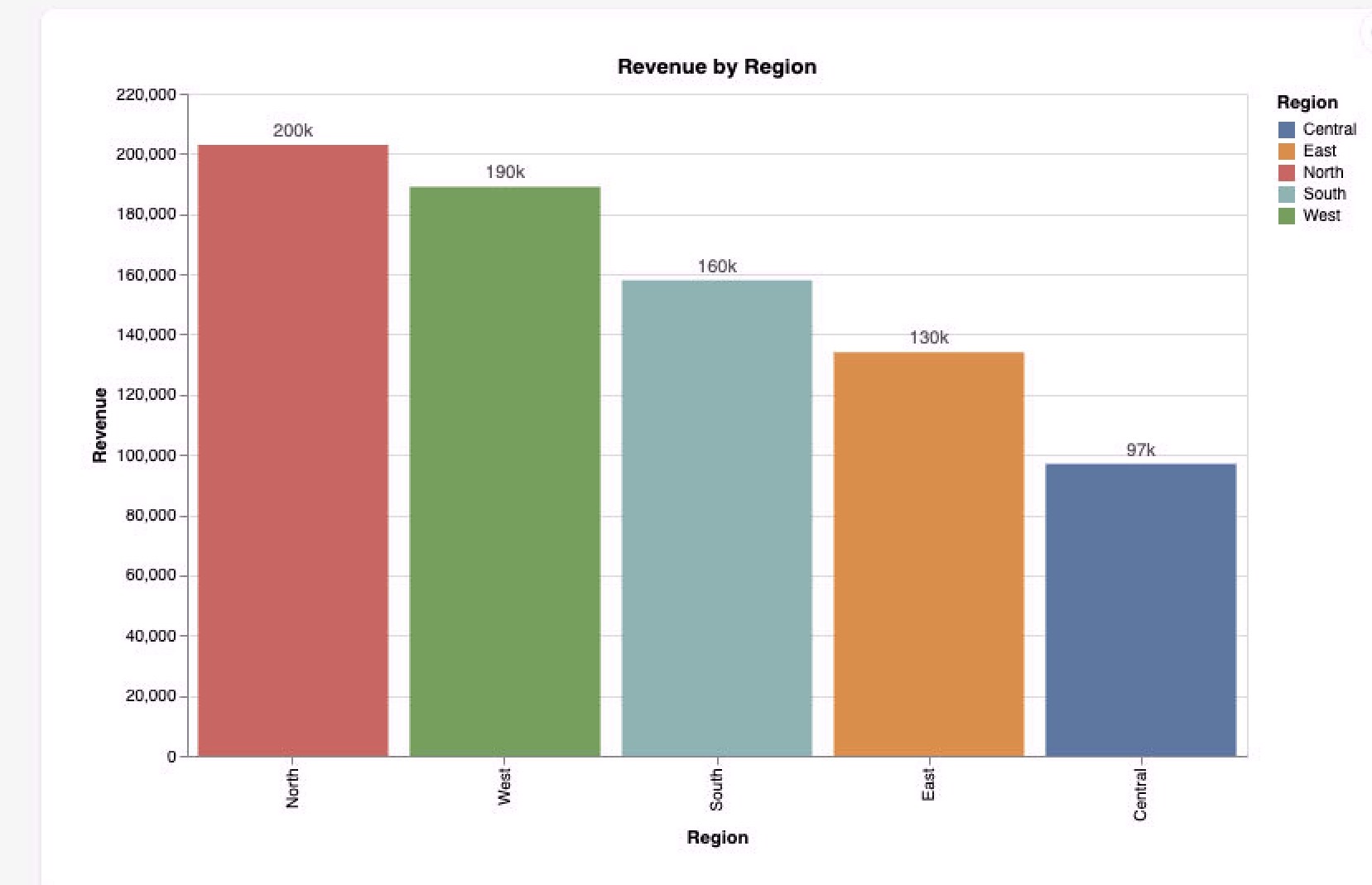 bar — categorical comparison |
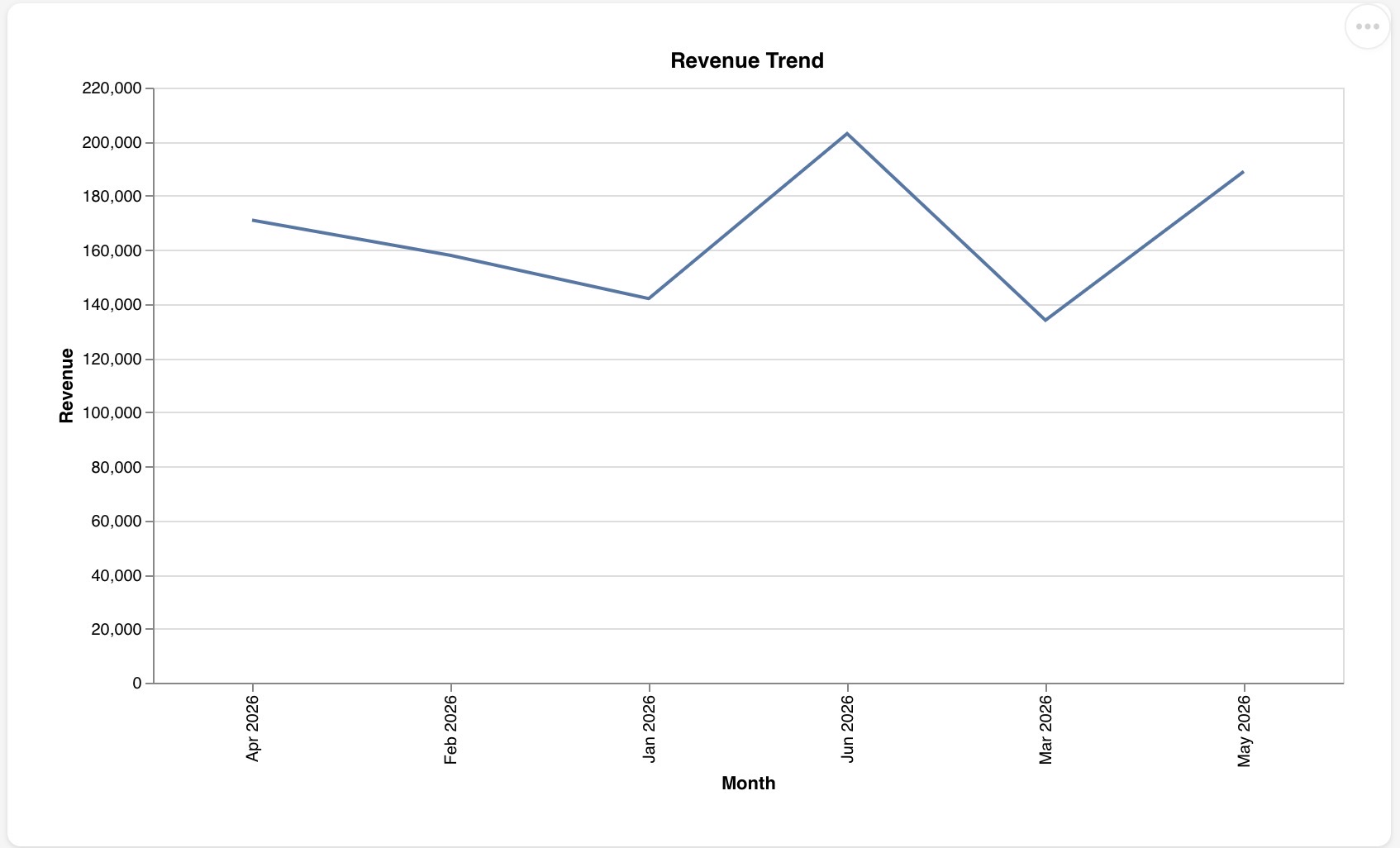 line — trend over time |
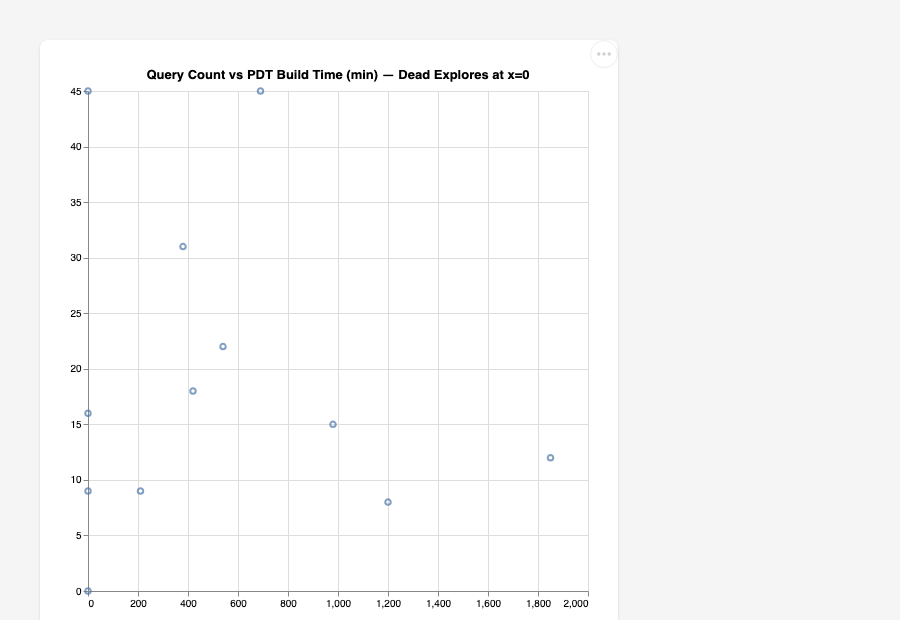 scatter — correlation |
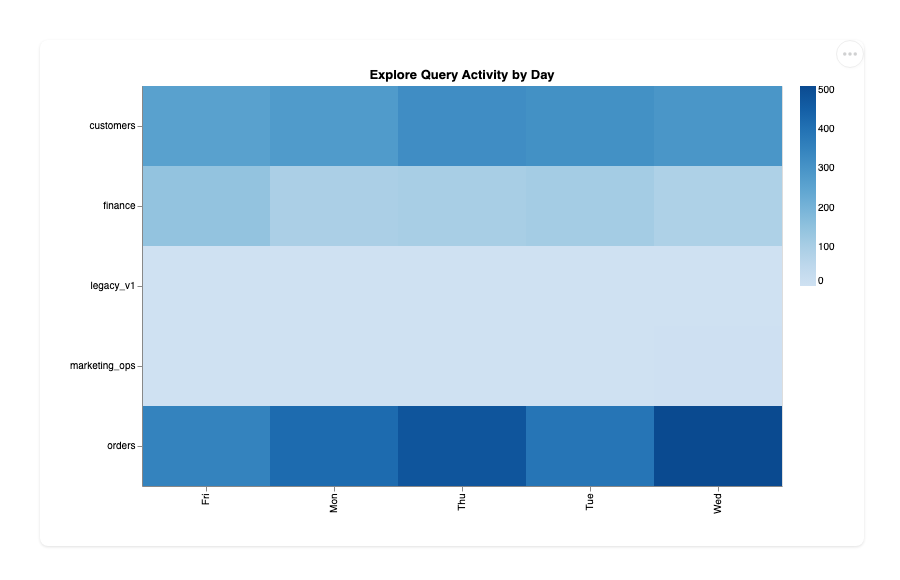 heatmap — two-dimensional breakdown |
4 chart types. JS bundled locally — charts are self-contained HTML files that render offline. Built on Vega-Lite by the UW Interactive Data Lab (@uwdata).
CLI
15 commands. Full reference: docs/cli-guide.md.
| Command | What it does |
|---|---|
strata auth |
Authenticate with Looker and manage local OAuth tokens |
strata bootstrap |
Scaffold Strata into a repo — conductor/, .mcp.json, config |
strata build |
Parse LookML and write the IR cache (strata_ir.db) |
strata chart |
Render charts to self-contained HTML |
strata check |
Offline governance gates — dead code, drift, PDT, verdict validation |
strata clean |
Remove output/, strata_ir.db, __pycache__ |
strata conductor |
Manage slice-based agent workflow and handoffs |
strata dashboard |
Build artifacts and serve the local HTML dashboard |
strata generate-schema |
Pull BigQuery INFORMATION_SCHEMA facts for drift checks |
strata lint |
Run ruff and mypy checks |
strata mcp |
Run, validate, and inspect MCP server configuration |
strata outputs |
Write 8 JSON artifacts to an output directory |
strata query |
Inspect the IR from the terminal |
strata skill |
List bundled skills or print a skill procedure |
strata validate |
Conductor spine check — handoff format, active slice, replay facts |
CI and Bot Deployment
Strata ships two decoupled CI workflows: a hard gate that blocks the build on test failures, and a soft gate that posts advisory PR review without breaking it.
1. PR Comment Bot (soft gate)
strata-pr.yml runs on every PR and posts a single, self-updating comment with
impact analysis — which explores break, validation scope, blast radius — plus the
Conductor spine check (strata validate). The comment is upserted in place on each
push (no duplicate comments), and a failing strata validate is surfaced in the
comment without failing the build, so quick human fixes aren't blocked.
# .github/workflows/strata-pr.yml  (included in repo)
on:
  pull_request:
See .github/workflows/strata-pr.yml and
scripts/pr_comment.py for the full workflow.
2. CI Test Pipeline (hard gate)
strata-ci.yml runs lint (ruff), types (mypy), the test suite (pytest), and
offline strata check / strata outputs across the bundled playgrounds — verifying
dead code, schema drift, and PDT findings deterministically.
# .github/workflows/strata-ci.yml
- name: Strata offline analysis
  run: |
    strata check \
      --repo . \
      --usage-fixture usage_facts.json \
      --schema-fixture schema_facts.json
Exits 0 if all gates pass. No Looker instance, no credentials, no flaky API calls.
Output Artifacts
strata outputs writes 8 JSON files per run: catalog, usage_summary, dead_code_register,
pdt_ledger, schema_drift, migration_impact, cleanup_roadmap, validation_scope. All
deterministic — same fixtures produce identical output. Feed them to downstream reporting or
consume them in your AI client via the MCP layer.
How We Validated
Three offline playgrounds, all findings sourced from actual output artifacts.
Full breakdown: docs/testing.md.
Playground findings — enterprise_mono · gcs_analytics · thelook
enterprise_mono — 19 models, 34 explores, cross-model extends, 3 legacy connection clusters:
- 6 dead explores (0 queries over 30 days) — all flagged with dual evidence
- 5 zombie views — referenced only by dead explores
- 2 zombie PDTs rebuilding at ~$63,750/month estimated — backed exclusively by dead explores
- ~$765,000/year in compute serving no users
- 14 schema drift hits across 3 tables (9 from a real
int_inventory_riskmigration)
gcs_analytics — gold/silver BQ layer, mixed active and legacy:
- 6 dead items (2 orphan views, 2 zombie views, 2 dead explores)
- 1 unused PDT (~$156/month estimated, no explore backer)
- 1 schema drift hit
thelook — Looker's public demo repo, structural baseline:
- 6 dead items (1 orphan view, 1 zombie view, 4 dead explores)
- 1 schema drift hit
Each playground ships with matching fixture JSON files (tests/fixtures/) that simulate
Looker System Activity API responses — so the full analysis runs offline with no credentials.
Docs
Full index: docs/README.md
Quick links
docs/runbook.md |
Governance investigation playbook — gate, workflow patterns, findings format |
docs/cli-guide.md |
Full CLI reference — all commands, env vars, output artifacts |
docs/testing.md |
Playgrounds, scenarios, how to run them |
docs/testing-findings.md |
Full findings — real numbers, drift breakdowns, agentic benchmarks |
docs/security-hardening.md |
Read-only enforcement, credential handling, MCP security model |
docs/enterprise-deployment.md |
IAM, ADC, OIDC for GH Actions, Google Workspace path |
docs/CONTRIBUTING.md |
Contribution guide |
License
Apache 2.0 — © 2026 Garrett Schumacher
mcp-name: io.github.g-schumacher44/strata
1 maintainer

Download files
Download the file for your platform. If you're not sure which to choose, learn more about installing packages.
Source Distribution
Built Distribution
Filter files by name, interpreter, ABI, and platform.
If you're not sure about the file name format, learn more about wheel file names.
Copy a direct link to the current filters
File details
Details for the file strata_lookml-0.1.7.tar.gz.
File metadata
- Download URL: strata_lookml-0.1.7.tar.gz
- Upload date:
- Size: 672.4 kB
- Tags: Source
- Uploaded using Trusted Publishing? Yes
- Uploaded via:
twine/7.0.0 CPython/3.13.14
File hashes
| Algorithm | Hash digest | |
|---|---|---|
| SHA256 |
64e483385332e1d3ca2efe8ef4976607d048fd7a84d0630b3394aed9fd6660cc
|
|
| MD5 |
457107de57810344989f36db0759f98f
|
|
| BLAKE2b-256 |
52b20ccab8386461b6aa37a6a71fb3f9992255d21e7cc986c3319b44cad6fcd4
|
Provenance
The following attestation bundles were made for strata_lookml-0.1.7.tar.gz:
Publisher:
release.yml on G-Schumacher44/strata-oss
-
Statement:
-
Statement type:
https://in-toto.io/Statement/v1 -
Predicate type:
https://docs.pypi.org/attestations/publish/v1 -
Subject name:
strata_lookml-0.1.7.tar.gz -
Subject digest:
64e483385332e1d3ca2efe8ef4976607d048fd7a84d0630b3394aed9fd6660cc - Sigstore transparency entry: 2500102124
- Sigstore integration time:
-
Permalink:
G-Schumacher44/strata-oss@124a396dc566b8e8c9432cdb717ebdd304b0958f -
Branch / Tag:
refs/tags/v0.1.7 - Owner: https://github.com/G-Schumacher44
-
Access:
public
-
Token Issuer:
https://token.actions.githubusercontent.com -
Runner Environment:
github-hosted -
Publication workflow:
release.yml@124a396dc566b8e8c9432cdb717ebdd304b0958f -
Trigger Event:
push
-
Statement type:
File details
Details for the file strata_lookml-0.1.7-py3-none-any.whl.
File metadata
- Download URL: strata_lookml-0.1.7-py3-none-any.whl
- Upload date:
- Size: 728.0 kB
- Tags: Python 3
- Uploaded using Trusted Publishing? Yes
- Uploaded via:
twine/7.0.0 CPython/3.13.14
File hashes
| Algorithm | Hash digest | |
|---|---|---|
| SHA256 |
ebc730ff7f58cb0f3baefea53c11db973635d520eae057b827f84112f714f2ee
|
|
| MD5 |
b45aeba8cbc54d0b459682fc0f36688e
|
|
| BLAKE2b-256 |
22a7f8f327de80c769ec5b74b8139427fb03f5f137b6f9442f9e5473d867d82f
|
Provenance
The following attestation bundles were made for strata_lookml-0.1.7-py3-none-any.whl:
Publisher:
release.yml on G-Schumacher44/strata-oss
-
Statement:
-
Statement type:
https://in-toto.io/Statement/v1 -
Predicate type:
https://docs.pypi.org/attestations/publish/v1 -
Subject name:
strata_lookml-0.1.7-py3-none-any.whl -
Subject digest:
ebc730ff7f58cb0f3baefea53c11db973635d520eae057b827f84112f714f2ee - Sigstore transparency entry: 2500102167
- Sigstore integration time:
-
Permalink:
G-Schumacher44/strata-oss@124a396dc566b8e8c9432cdb717ebdd304b0958f -
Branch / Tag:
refs/tags/v0.1.7 - Owner: https://github.com/G-Schumacher44
-
Access:
public
-
Token Issuer:
https://token.actions.githubusercontent.com -
Runner Environment:
github-hosted -
Publication workflow:
release.yml@124a396dc566b8e8c9432cdb717ebdd304b0958f -
Trigger Event:
push
-
Statement type:














