
Stratified molecular dataset splitting for QSAR model development

Project description
stratosampler

Stratified molecular dataset splitting for QSAR model development.


The problem with naive splits
When you build a QSAR model, the way you split your dataset determines how honestly you evaluate it.
A standard random train_test_split gives you a test set that happens to look like the training set — because it was drawn from the same distribution. This inflates your metrics. You think your model generalises to diverse chemical space. It doesn't.
Full dataset     →  logP range: -2 to 7,  MW range: 150–700
Random test set  →  logP range: -1.8 to 6.9,  MW range: 160–690  ← almost identical
The test set is not a real challenge. It's a mirror.
stratosampler fixes this by stratifying across multiple molecular properties simultaneously, so train and test sets each represent the full property distribution of your dataset — not a random slice of it.
Stratified test set  →  logP range: -1.9 to 6.8,  MW range: 155–685  ← intentionally representative
KS statistic (logP): 0.04 vs 0.18 for random split
Install
pip install stratosampler
# with RDKit (required for computing properties from SMILES):
pip install "stratosampler[rdkit]"
Quick start
from stratosampler import PropertyStratifiedSplitter

splitter = PropertyStratifiedSplitter(
    properties=["MolLogP", "MolWt", "TPSA"],
    n_bins=5,
    test_size=0.2,
    random_state=42,
)

# From SMILES (computes properties automatically)
train_idx, test_idx = splitter.split(df, smiles_col="SMILES")

# From pre-computed property columns
train_idx, test_idx = splitter.split(df, property_cols=["logP", "MW", "TPSA"])

# Three-way split
train_idx, val_idx, test_idx = splitter.split(
    df, smiles_col="SMILES"
)  # set val_size > 0 in constructor

# Get DataFrames directly
train_df, test_df = splitter.get_split_dataframes(df, smiles_col="SMILES")
Scaffold-aware mode
Prevents analogue leakage by keeping molecules sharing a Murcko scaffold together in the same split, while still preserving property distributions at the scaffold-cluster level.
splitter = PropertyStratifiedSplitter(
    properties=["MolLogP", "MolWt", "TPSA"],
    test_size=0.2,
    scaffold_aware=True,
    random_state=42,
)
train_idx, test_idx = splitter.split(df, smiles_col="SMILES")
Evaluate your split
from stratosampler import split_summary, plot_property_distributions

summary = split_summary(df, train_idx, test_idx, property_cols=["logP", "MW", "TPSA"])

print(f"Mean KS statistic:    {summary['mean_ks_stat']:.3f}")   # lower = better
print(f"Mean JS divergence:   {summary['mean_js_div']:.3f}")    # lower = better
print(f"Stratum coverage:     {summary['coverage_score']:.3f}") # 1.0 = all strata in both splits

# Visualise distributions
fig = plot_property_distributions(df, train_idx, test_idx, ["logP", "MW", "TPSA"])
fig.savefig("split_distributions.png", dpi=150, bbox_inches="tight")
Compare strategies
from stratosampler import PropertyStratifiedSplitter, split_summary, plot_split_comparison
import numpy as np

props = ["MolLogP", "MolWt", "TPSA"]

# Random split
rng = np.random.default_rng(42)
idx = np.arange(len(df)); rng.shuffle(idx)
n_test = int(0.2 * len(df))
random_results = split_summary(df, idx[n_test:], idx[:n_test], props)

# Stratified split
strat = PropertyStratifiedSplitter(test_size=0.2, random_state=42)
train, test = strat.split(df, smiles_col="SMILES")
strat_results = split_summary(df, train, test, props)

# Scaffold-aware split
sc_strat = PropertyStratifiedSplitter(test_size=0.2, scaffold_aware=True, random_state=42)
sc_train, sc_test = sc_strat.split(df, smiles_col="SMILES")
sc_results = split_summary(df, sc_train, sc_test, props)

fig = plot_split_comparison(
    {"random": random_results, "stratified": strat_results, "scaffold+strat": sc_results},
    props,
    metric="ks_stat",
)
fig.savefig("strategy_comparison.png", dpi=150, bbox_inches="tight")
Built-in properties
When passing properties to the splitter, these names are computed automatically from SMILES:
| Name | Description |
|---|---|
MolLogP |
Wildman-Crippen LogP |
MolWt |
Molecular weight |
TPSA |
Topological polar surface area |
NumHDonors |
H-bond donors |
NumHAcceptors |
H-bond acceptors |
NumRotBonds |
Rotatable bonds |
NumRings |
Total ring count |
NumAromaticRings |
Aromatic ring count |
FractionCSP3 |
Fraction of sp3 carbons |
NumHeavyAtoms |
Heavy atom count |
Any valid rdkit.Chem.Descriptors attribute name also works.
Why this matters for QSAR
A well-stratified split catches real model failures:
- A model trained on a random split of a logP-skewed dataset will look good on paper but fail on low-logP compounds in deployment.
- A model evaluated on a scaffold-split-only test set may miss property distribution shift — your test compounds are structurally novel but chemically similar.
- Coverage score tells you whether your test set actually challenges the model across the full property space.
The goal is not to make your model look worse — it's to catch problems before they reach the project team.
Real-world example: ChEMBL EGFR kinase inhibitors
The examples/chembl_egfr_stratified_sampling.py script fetches 362 EGFR IC50
records from ChEMBL, clusters them into chemical series via Murcko scaffold
analysis, then draws a stratified sample across every (series × pIC50 range)
stratum — guaranteeing at least 5 representatives per series.
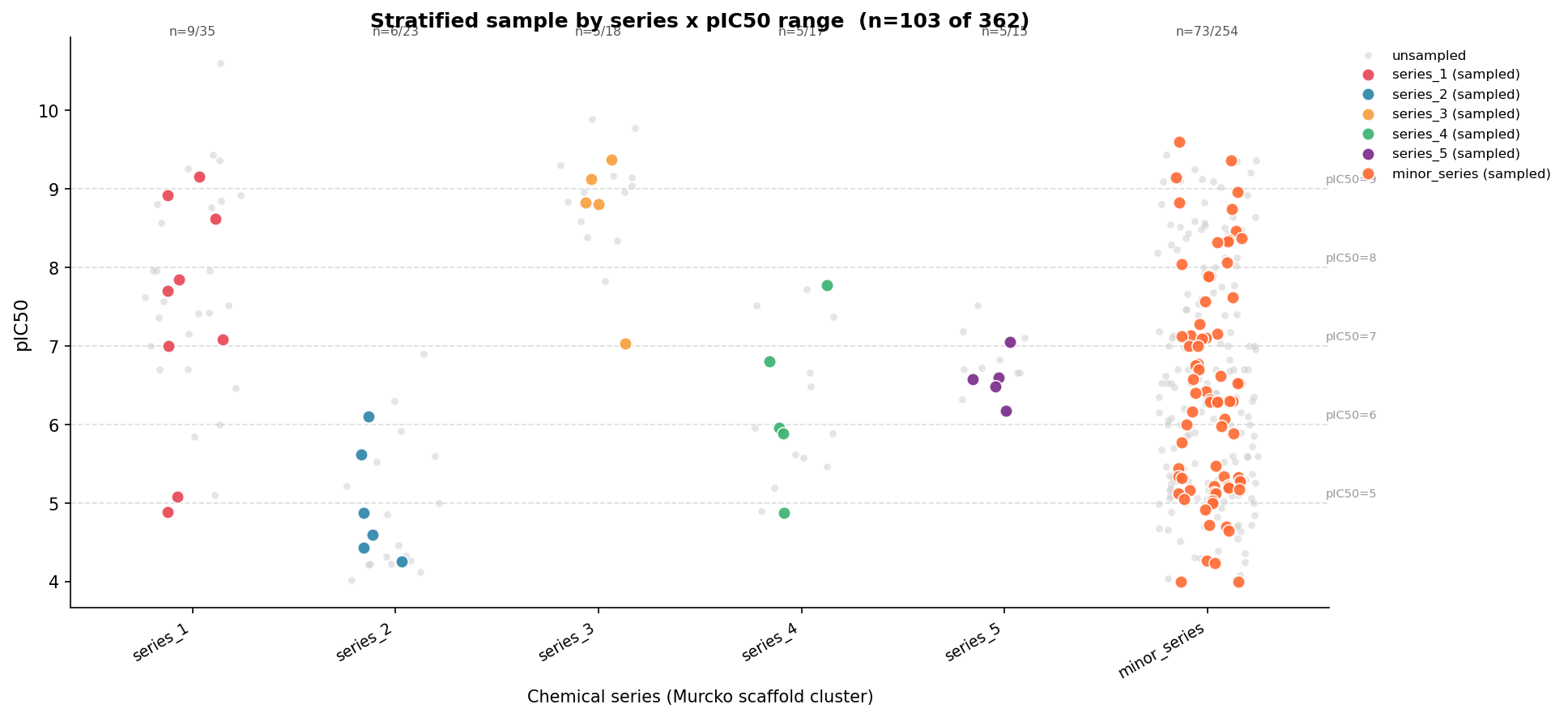
Grey dots are the full population; coloured circles are the 103 sampled compounds (28.5%), one colour per scaffold series. Dashed lines mark pIC50 activity-range boundaries. The sample achieves KS = 0.064 on the pIC50 distribution — close to what a pure property-stratified split would give, while also guaranteeing chemical-series coverage.
Contributing
Issues and PRs welcome. Run the test suite with:
pip install -e ".[dev]"
pytest tests/ -v
License
MIT. See LICENSE.
Citation
If stratosampler is useful in your research:
Fino, R. (2026). stratosampler: Stratified molecular dataset splitting for QSAR.
GitHub: https://github.com/rubbs14/stratosampler
Release history Release notifications | RSS feed


Download files
Download the file for your platform. If you're not sure which to choose, learn more about installing packages.
Source Distribution
Built Distribution
Filter files by name, interpreter, ABI, and platform.
If you're not sure about the file name format, learn more about wheel file names.
Copy a direct link to the current filters
File details
Details for the file stratosampler-0.1.1.tar.gz.
File metadata
- Download URL: stratosampler-0.1.1.tar.gz
- Upload date:
- Size: 23.5 kB
- Tags: Source
- Uploaded using Trusted Publishing? No
- Uploaded via: twine/6.2.0 CPython/3.12.12
File hashes
| Algorithm | Hash digest | |
|---|---|---|
| SHA256 |
c093ca5396874342edbf0646b12c9fb866aacae858b2a2c7f6f3bdd221225f36
|
|
| MD5 |
88e1c952b8ae64a5250858bdd9f5f3a1
|
|
| BLAKE2b-256 |
e3c6dcc1f57490e7969bea6a3fd1a38ac0ea3e1af466f24681024ea2116393d0
|
File details
Details for the file stratosampler-0.1.1-py3-none-any.whl.
File metadata
- Download URL: stratosampler-0.1.1-py3-none-any.whl
- Upload date:
- Size: 19.9 kB
- Tags: Python 3
- Uploaded using Trusted Publishing? No
- Uploaded via: twine/6.2.0 CPython/3.12.12
File hashes
| Algorithm | Hash digest | |
|---|---|---|
| SHA256 |
468b42b391f94484ca307511944ac05da960b7bafab5d9e2f214ff87b9951a50
|
|
| MD5 |
5c17e502effd745603bbe3d2f4c56ed9
|
|
| BLAKE2b-256 |
5a89a711c21f9253b2edcc9ca4eab693e84600302942db4b6a5211b0db3e65fd
|






