
Streaming JSON Parser
Decode complete JSON documents or parse JSON as chunks arrive. streaming-json-parser provides a strict incremental parser with partial values and explicit parse states, alongside complete-document decoding, NDJSON, and selective extraction for Python.




python -m pip install streaming-json-parser
Quickstart: parse while the stream is still arriving
from streaming_json_parser import ParseStatus, StreamingJsonParser

parser = StreamingJsonParser()

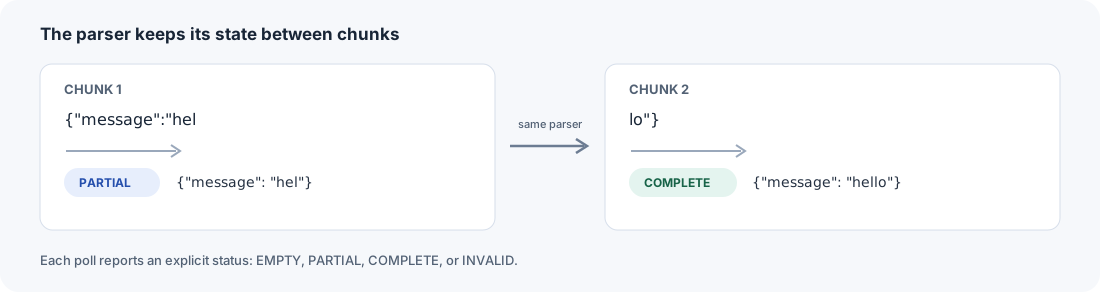
partial = parser.feed(b'{"message":"hel')
assert partial.status is ParseStatus.PARTIAL
assert partial.value == {"message": "hel"}

complete = parser.feed(b'lo"}')
assert complete.status is ParseStatus.COMPLETE
assert complete.value == {"message": "hello"}
The parser resumes from its previous state on each chunk. It distinguishes EMPTY, PARTIAL, COMPLETE, and INVALID results; partial strings are available before the closing quote arrives. By default, .value refers to parser-owned state and may change after later chunks; pass copy_value=True to feed() when you need a retained snapshot.
What it supports
- Strict incremental parsing across arbitrary input chunks, with partial values and explicit statuses.
- Complete JSON decoding, including reusable and workload-tuned decoders.
- NDJSON decoding and streaming records.
- Selective path extraction from complete JSON documents and NDJSON without always building every Python object.
- Structural partial snapshots for callers that do not need unfinished string values. This is a separate finishing mode, not the strict incremental state machine.
- Optional Rust acceleration through
streaming-json-parser-native.
The Python implementation works without optional packages. The project is currently in beta while its public API settles.
Performance
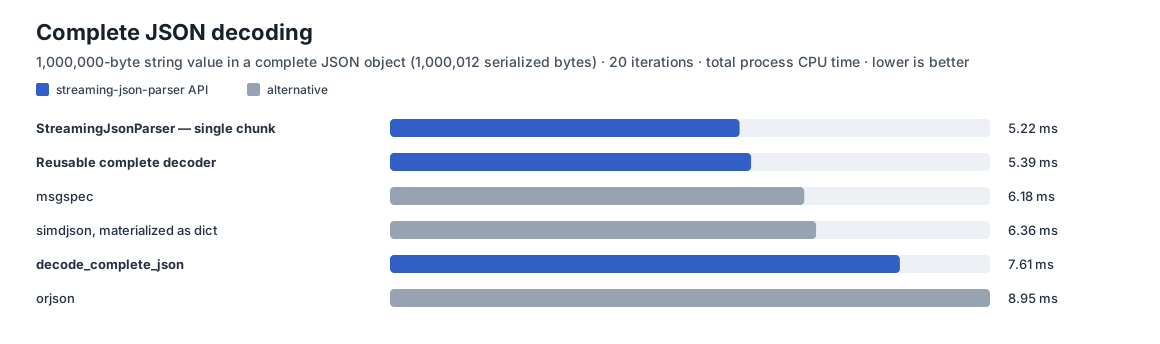
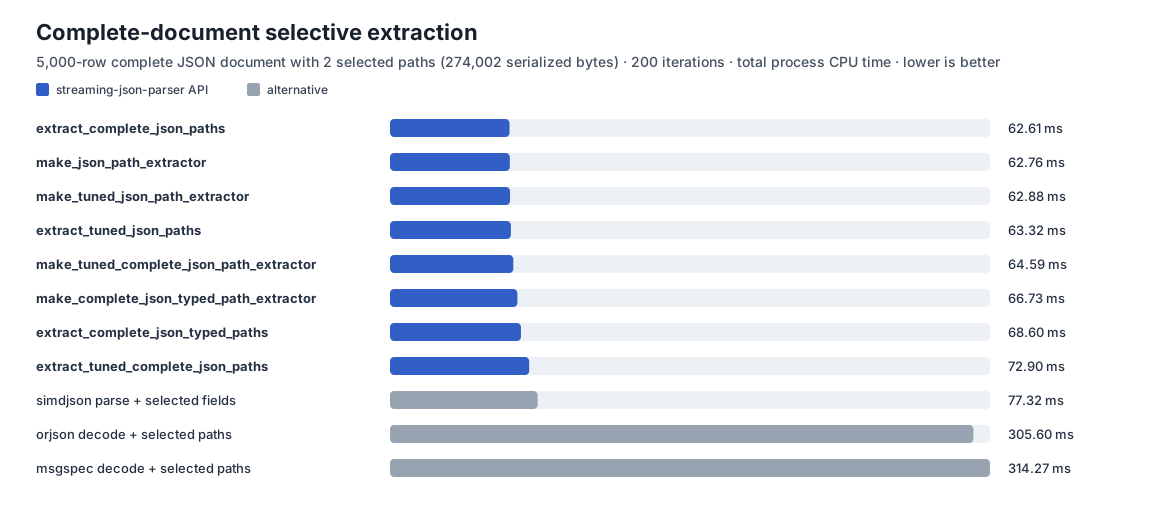
These charts show three separate workloads from the checked-in benchmark snapshot. Bars report total process CPU time for each repeated batch; lower is better. Every measured result is shown. Values are generated from docs/benchmark-snapshot.json, and the environment, versions, workload sizes, and timing method are recorded in the benchmark report.
Complete JSON decoding
Decodes the same roughly 1 MB JSON object into a complete value. The StreamingJsonParser — single chunk row feeds the entire payload in one call and is included as a complete-input reference. This chart does not measure incremental parsing across arriving chunks.
Complete-document selective extraction
Reads the same two object paths (meta.name and tail.count) from a 5,000-row JSON document. The full-decode baselines decode the document before accessing those paths.
NDJSON selective extraction
Reads row.id and row.value from each of 5,000 newline-delimited records. Full-decode baselines materialize each record before selecting its fields.
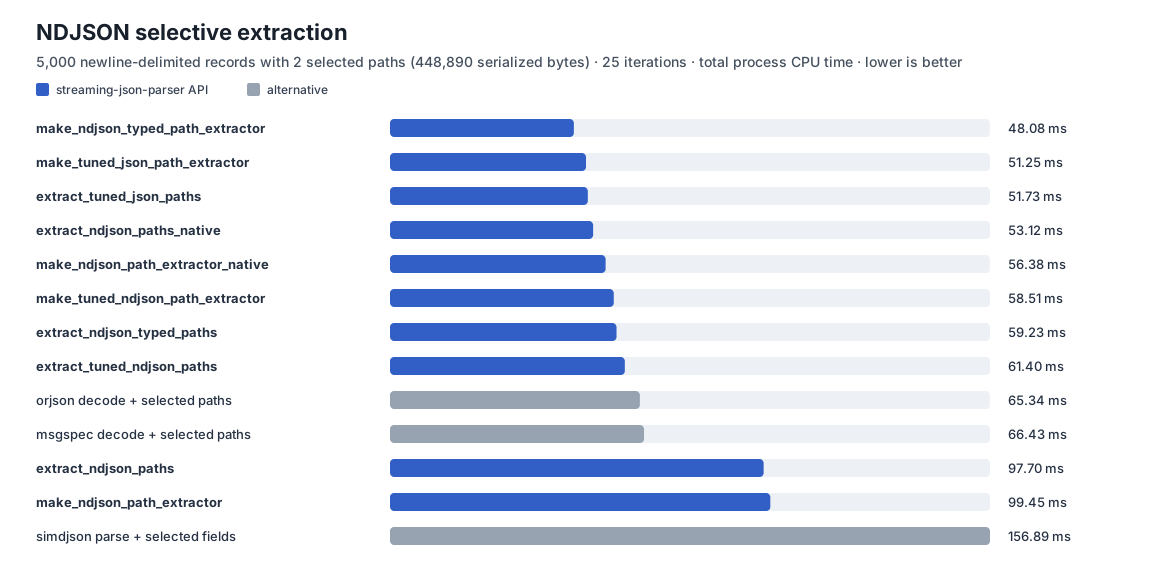
These charts compare operations with the same output paths within each workload. Strict incremental parsers, structural partial finishers, and permissive JSON-repair tools have different semantics, so they are measured separately in the API scorecard and partial-strategy benchmark harness.
Real-world Python JSON benchmark corpus
This additional chart adapts the complete-document load workload and public datasets from the community-maintained TkTech JSON benchmark. It decodes six whole documents into ordinary Python values and checks every included decoder against json.loads before timing. Each panel has its own scale and reports input throughput; higher is better. This is a Python community benchmark, not a formal industry standard. The suite's SAX/event streaming cases are omitted because they do not produce the same output as this parser.
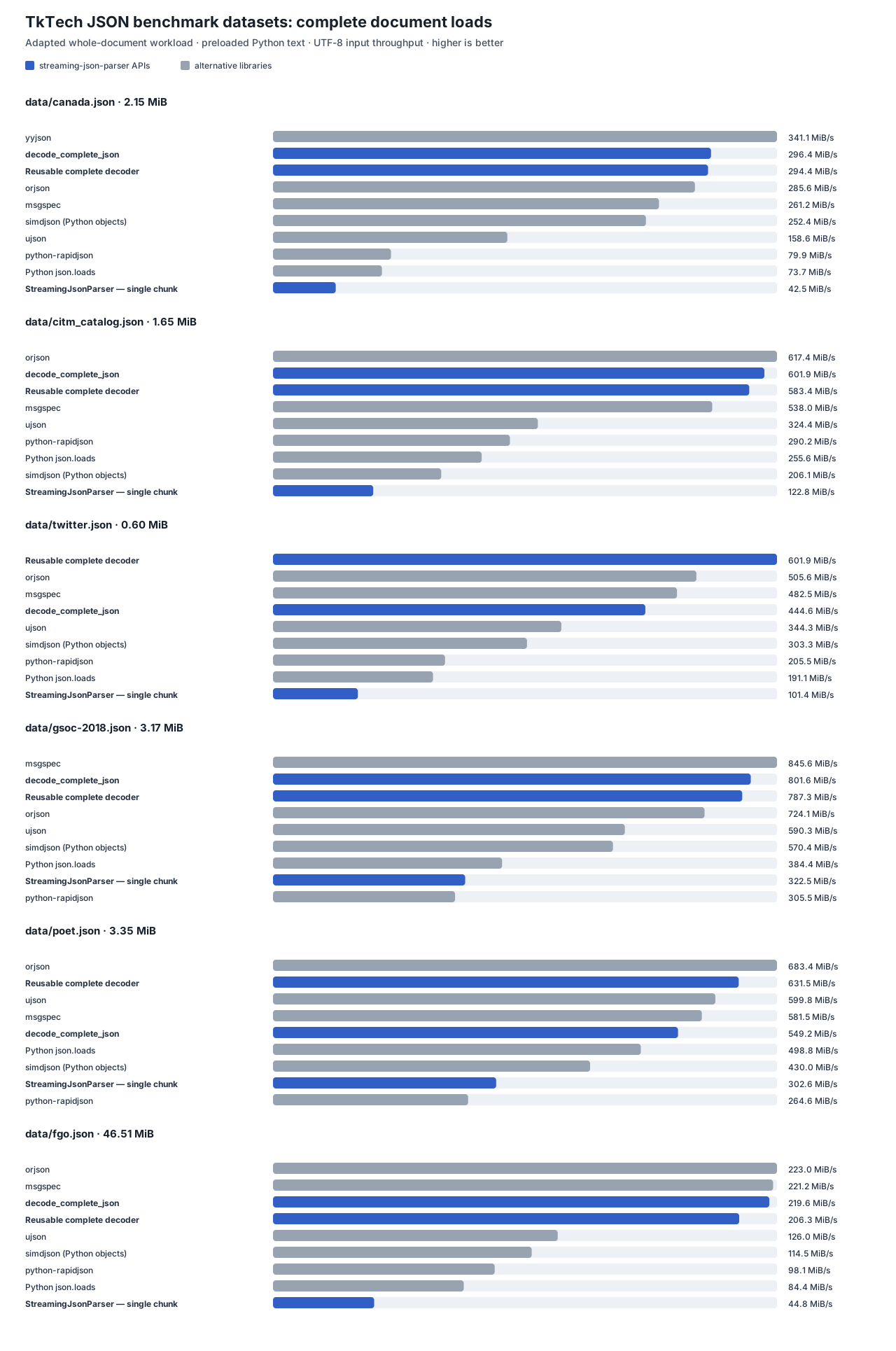
Results vary by dataset and decoder; compare the per-file values, dataset hashes, package versions, methodology, and upstream revision in the community corpus report and JSON snapshot. For an already-complete document, use a complete-document API. Sending it through StreamingJsonParser.feed() also performs incremental state handling, so it is not a substitute for decode_complete_json(). These corpus timings are separate from the generated synthetic workloads above.
Choose an API
| Workload | API | Notes |
|---|---|---|
| One complete JSON document | decode_complete_json(data) |
Returns a regular Python value. |
| Repeated complete-document decoding | make_tuned_complete_json_decoder(...) |
Calibrates against a representative sample and payload size. |
| JSON arriving in chunks | StreamingJsonParser |
Strict resumable parser; inspect ParseResult.status and .value after each feed(). |
| Newline-delimited records | decode_ndjson(data) or StreamingJsonParser(framing="ndjson") |
Call finish() to consume a final record without a newline. |
| Incomplete prefix; unfinished strings can be omitted | decode_structural_partial_json(prefix) |
Structural finisher; not equivalent to strict incremental parsing. |
| A few fields from JSON or NDJSON | make_tuned_json_path_extractor(..., framing="single" or "ndjson") |
Reuse the extractor for a stable workload. |
| Typed records | make_ndjson_decoder(record_type=...) |
Optional typed decoding through msgspec. |
There is no single best backend for every input. The tuned factories can benchmark compatible backends once during setup when given a representative sample and payload_size_hint.
Common operations
Decode a complete document
from streaming_json_parser import decode_complete_json

value = decode_complete_json(b'{"name":"example","ok":true}')
For large read-only payloads, decode_complete_json_view() can return a view backed by simdjson; use it only when proxy/view semantics are suitable for your application.
Read NDJSON records
from streaming_json_parser import decode_ndjson

records = decode_ndjson(b'{"id":1}\n{"id":2}\n')
The stateful parser also supports framing="ndjson" and poll_many() to drain complete records as they become available.
Finish a structural partial value
Structural partial mode is useful when a caller has an incomplete prefix and needs completed objects or arrays from it. By default, it omits an unfinished trailing string; use trailing_strings=True or partial_mode="structural_trailing_strings" when that text must be retained. It may complete scalar prefixes differently from the strict parser.
from streaming_json_parser import decode_structural_partial_json

value = decode_structural_partial_json('{"items":[1,2')
assert value == {"items": [1, 2]}
Optional acceleration
Install the Rust extension separately when a compatible wheel is available:
python -m pip install streaming-json-parser-native
The native package is optional. Backend-specific packages such as msgspec, orjson, and simdjson are also optional; APIs fall back to the Python implementation where applicable.
Reproduce the benchmarks
The benchmark snapshot includes the date, source revision and dirty-state flag, Python and platform details, processor and architecture, installed benchmark-package versions, native-extension availability, payload sizes, record counts, and selected paths. The methodology records its clock, warm-up, sample count, and repetitions.
To reproduce the published benchmark artifacts, install core 0.2.2 and native 0.2.1, clone the pinned community corpus, and run the guarded release target from a clean Git checkout:
python -m pip install 'streaming-json-parser[benchmark,accelerated]==0.2.2'
python -m pip install 'streaming-json-parser-native==0.2.1'
git clone https://github.com/TkTech/json_benchmark.git /tmp/tktech-json-benchmark
git -C /tmp/tktech-json-benchmark checkout 52d596b8a9bc0e00e654747298a8ec5b0d95152b
make benchmark-release-artifacts COMMUNITY_JSON_CORPUS_DIR=/tmp/tktech-json-benchmark/data
The release target refuses to run if the repository has tracked or untracked changes. It measures the installed core and native distributions, checks that their versions match the repository release metadata, collects both benchmark snapshots before writing any artifacts, and records the source commit as clean. The reports retain the module __version__ separately from installed distribution metadata.
For local iteration, you can still regenerate only the synthetic or community snapshot without the release clean-tree guard:
make benchmark-artifacts
make benchmark-community-corpus COMMUNITY_JSON_CORPUS_DIR=/tmp/tktech-json-benchmark/data
make verify-community-benchmark-artifacts
To verify generated Markdown, scorecard, charts, and the current benchmark results against the committed snapshot:
make verify-release-benchmark-artifacts COMMUNITY_JSON_CORPUS_DIR=/tmp/tktech-json-benchmark/data
Verification checks generated files against the authoritative JSON snapshot and reruns the same benchmark slices. Timing checks allow shared machine slowdowns, but detect large per-implementation regressions. For meaningful comparisons, use the same dependency versions and a similar machine; compare the provenance fields in the snapshot.
Development
python -m pip install -e '.[test]'
python -m pytest -q
See contributing guidance, the changelog, the current API scorecard, open issues, and manual GitHub settings follow-up.
License
MIT. See LICENSE.
1 maintainer

Release files for streaming-json-parser 0.2.2
For a detailed explanation of source distributions (sdists) and built distributions (wheels), please see the package formats documentation.
Source distribution (sdist)
| File | Size | Uploaded | |
|---|---|---|---|
| streaming_json_parser-0.2.2.tar.gz | 59.8 kB | Details |
Built distribution (wheel)
| File | Interpreter | ABI | Platform | Reset |
|---|---|---|---|---|
| streaming_json_parser-0.2.2-py3-none-any.whl | Python 3 | none | any | Details |
Total release size: 91.8 kB
Release files / streaming_json_parser-0.2.2.tar.gz
| Download URL | streaming_json_parser-0.2.2.tar.gz |
|---|---|
| Size | 59.8 kB |
| Tags | Source |
|
SHA-256 checksum How to use checksums |
df398b8f42daa86256a3e605e74968439d56311f271dac3055b610afc4af265b
|
|
BLAKE2b-256 checksum How to use checksums |
283552f14dd67565263f31360a3bea016e3730ae4d9dccf4739c92cc026f612c
|
| Upload date | |
|
Uploaded using Trusted Publishing? What is trusted publishing? |
Yes |
| Uploaded via |
twine/7.0.0 CPython/3.13.14
|
Provenance
Provenance describes where a file came from. On PyPI, provenance is shared via attestations, which provide a verifiable record of the build or publishing details. View details, limitations and caveats.


PyPI Publish Attestation
PyPI verified that this artifact, at this checksum, originated from the publisher listed below.
Signed by GitHub Actions, verified by PyPI on Sep 24, 2026.
Transparency logRelease files / streaming_json_parser-0.2.2-py3-none-any.whl
| Download URL | streaming_json_parser-0.2.2-py3-none-any.whl |
|---|---|
| Size | 31.9 kB |
| Tags | Python 3 |
|
SHA-256 checksum How to use checksums |
7a82869517fdbfcb64e037bbbd48e2daae4f6e78cb0b5898de52c808adfde15f
|
|
BLAKE2b-256 checksum How to use checksums |
cd28e045a472686f02105380713d7c9197bb363935c9607ed83aba14b482592d
|
| Upload date | |
|
Uploaded using Trusted Publishing? What is trusted publishing? |
Yes |
| Uploaded via |
twine/7.0.0 CPython/3.13.14
|
Provenance
Provenance describes where a file came from. On PyPI, provenance is shared via attestations, which provide a verifiable record of the build or publishing details. View details, limitations and caveats.
PyPI Publish Attestation
PyPI verified that this artifact, at this checksum, originated from the publisher listed below.
Signed by GitHub Actions, verified by PyPI on Sep 24, 2026.
Transparency log













