
Stream your DSPy application's inner-workings back to users in real-time
Verified details
These details have been verified by PyPIProject links
GitHub Statistics
Maintainers

Project description
streamll
Stream your DSPy application's inner-workings back to users in real-time. Route reasoning steps, token generation, and progress updates directly through your existing infrastructure.
Installation
# Basic (terminal output only)
uv add streamll

# With Redis for production
uv add "streamll[redis]"

# With RabbitMQ
uv add "streamll[rabbitmq]"

# Everything
uv add "streamll[all]"
Quick start
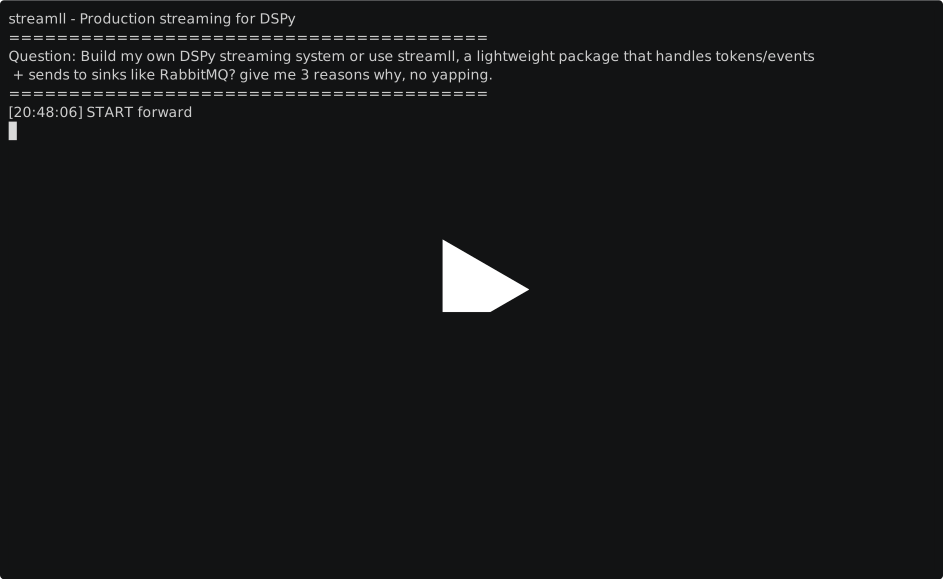
import dspy
import streamll

# Stream tokens to terminal
@streamll.instrument(stream_fields=["answer"])
class QA(dspy.Module):
    def __init__(self):
        self.generate = dspy.ChainOfThought("question -> answer")

    def forward(self, question):
        return self.generate(question=question)

# Configure DSPy
dspy.configure(lm=dspy.LM("openai/gpt-4o-mini"))

qa = QA()
result = qa("Explain quantum computing")
Production use
Send events to Redis or RabbitMQ instead of the terminal:
from streamll.sinks import RedisSink

sink = RedisSink(redis_url="redis://localhost:6379", stream_key="ml_events")

@streamll.instrument(sinks=[sink], stream_fields=["answer"])
class QA(dspy.Module):
    def __init__(self):
        self.generate = dspy.ChainOfThought("question -> answer")

    def forward(self, question):
        return self.generate(question=question)
Consume events in another service:
from streamll import EventConsumer

consumer = EventConsumer("redis://localhost:6379", target="ml_events")

@consumer.on("token")
async def handle_token(event):
    print(event.data["token"], end="", flush=True)

await consumer.run()
Custom events
Emit custom events within your processing:
@streamll.instrument
class RAGPipeline(dspy.Module):
    def forward(self, question):
        with streamll.trace("retrieval") as ctx:
            docs = self.retrieve(question)
            ctx.emit("docs_found", data={"count": len(docs)})

        answer = self.generate(docs=docs, question=question)
        return answer
Event correlation
Attach correlation IDs that persist across all events:
# In your API handler
streamll.set_context(
    conversation_id="conv_123",
    request_id="req_456"
)

# All subsequent events include this context
qa = QA()
result = qa("What is quantum computing?")

# Consumer can filter by context
@consumer.on("token")
async def handle_token(event):
    if event.data.get("conversation_id") == "conv_123":
        # Handle this specific conversation
        pass
Development
# Run tests
uv run pytest

# With coverage
uv run pytest --cov=src/streamll

# Start test services (Redis, RabbitMQ)
docker-compose -f tests/docker-compose.yml up -d
License
Apache 2.0
Project details
Verified details
These details have been verified by PyPIProject links
GitHub Statistics
Maintainers
Release history Release notifications | RSS feed


Download files
Download the file for your platform. If you're not sure which to choose, learn more about installing packages.
Source Distribution
Built Distribution
Filter files by name, interpreter, ABI, and platform.
If you're not sure about the file name format, learn more about wheel file names.
Copy a direct link to the current filters
File details
Details for the file streamll-0.1.1.tar.gz.
File metadata
- Download URL: streamll-0.1.1.tar.gz
- Upload date:
- Size: 9.3 kB
- Tags: Source
- Uploaded using Trusted Publishing? Yes
- Uploaded via: uv/0.8.17
File hashes
| Algorithm | Hash digest | |
|---|---|---|
| SHA256 |
d8ac0ba29da555de12f04bf157ec8c329a2f256e52ad82822cf683b4d7910006
|
|
| MD5 |
bc0648b7e739ce8418336cbcb58e4b55
|
|
| BLAKE2b-256 |
6a0463e5c88002e7da5839149c381a6e7c9992c15859274631e436c866449ba1
|
File details
Details for the file streamll-0.1.1-py3-none-any.whl.
File metadata
- Download URL: streamll-0.1.1-py3-none-any.whl
- Upload date:
- Size: 13.1 kB
- Tags: Python 3
- Uploaded using Trusted Publishing? Yes
- Uploaded via: uv/0.8.17
File hashes
| Algorithm | Hash digest | |
|---|---|---|
| SHA256 |
64df5cb55d82e7597421153356c8f4a3e8d8a507d31e3aea5547f1a8495cec40
|
|
| MD5 |
daf9b6b2a30fbd7b13d44510249618dd
|
|
| BLAKE2b-256 |
2bfbb4e74340c88ea99a61f1deb25ad3ace3563b7c455be4dfd97293f582991c
|






