
StripePy
| Paper |

|
| Downloads |



|
| Documentation |

|
| CI |


|
| License |

|
StripePy is a CLI application written in Python that recognizes architectural stripes found in the interaction matrix files generated by Chromosome Conformation Capture experiments, such as Hi-C and Micro-C.
StripePy is developed on Linux and macOS and is also tested on Windows. Installing StripePy is quick and easy using pip:
pip install 'stripepy-hic[all]'
For other installation options (conda, source, and Docker or Singularity/Apptainer), and details on ensuring StripePy is in your PATH, please refer to the official documentation.
Why Choose StripePy?
StripePy stands out with several key features that make it a fast and robust stripe caller:
- Broad Format Support: Compatible with major formats:
.hic,.cooland.mcool; outputs to.hdf5andBEDPE. - User-Friendly: Designed with an intuitive command-line interface, making stripe analysis accessible even to less experienced users.
- Stripe descriptors: Computes stripe width, height, and generates various statistics for post-processing, e.g., ranking and filtering.
- Optimized performance: Outperforms other tools over diverse datasets and a simulated benchmark, StripeBench.
- Exceptional speed & Low Memory: Significantly faster than existing tools (2x Chromosight, 66x Stripenn), with much lower memory usage.
Key Features
StripePy is organized into a few subcommands:
stripepy download: download a minified sample dataset suitable to quickly test StripePy - link.stripepy call: run the stripe detection algorithm and store the identified stripes in a.hdf5file - link.stripepy view: take theresult.hdf5file generated bystripepy calland extract stripes in BEDPE format - link.stripepy plot: generate various kinds of plots to inspect the stripes identified bystripepy call- link.
For a quick introduction to the tool, refer to the Quickstart section in the documentation.
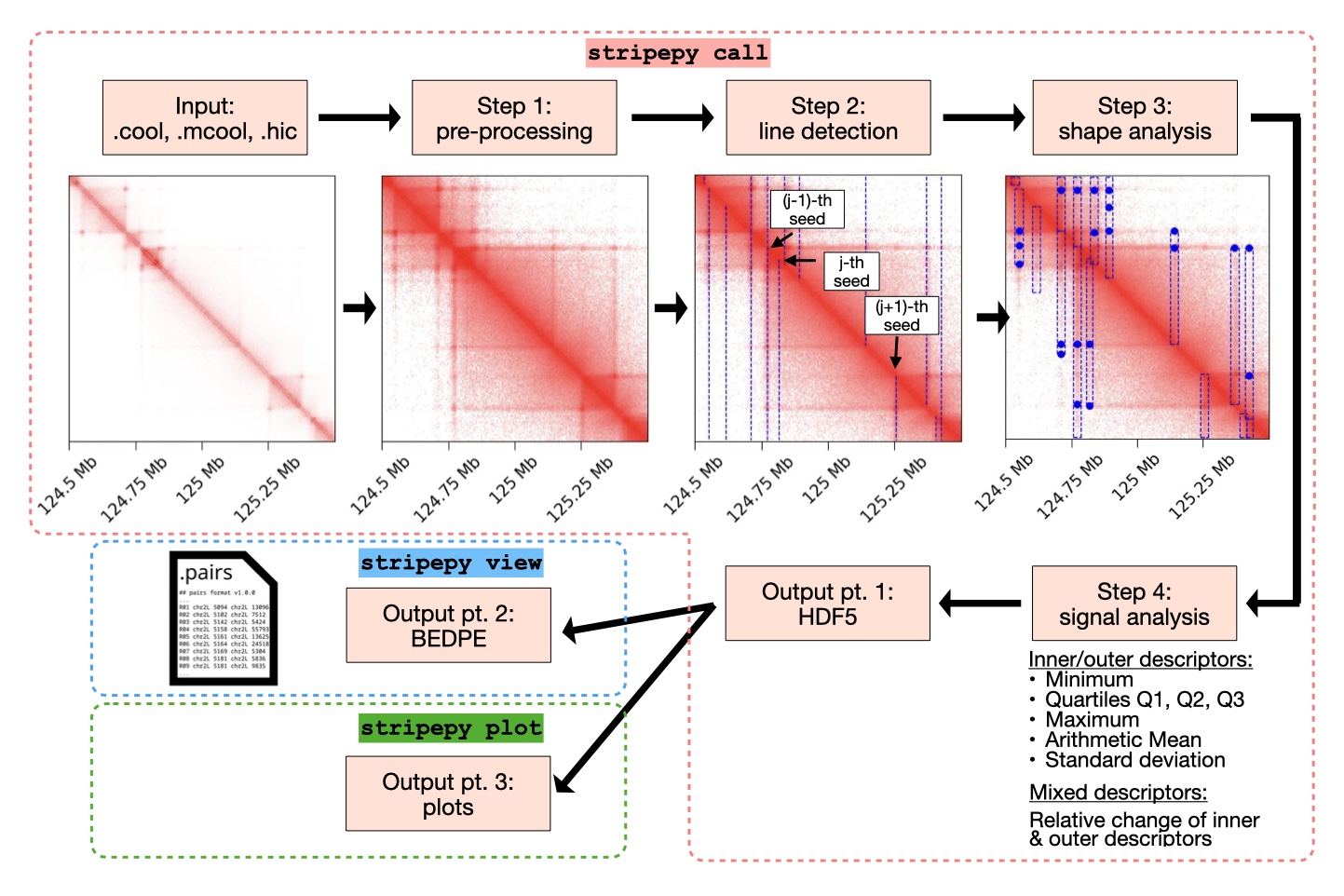
For more information on the subcommands, please run stripepy --help and refer to the documentation and the paper.
Getting help
For any issues regarding StripePy installation, walkthrough, and output interpretation please open a discussion on GitHub.
If you've found a bug or would like to suggest a new feature, please open a new issue instead.
Citing
If you use StripePy in your research, please cite the following publication:
Andrea Raffo, Roberto Rossini, Jonas Paulsen
StripePy: fast and robust characterization of architectural stripes
Bioinformatics, Volume 41, Issue 6, June 2025, btaf351
https://doi.org/10.1093/bioinformatics/btaf351
BibTex
@article{stripepy,
    author = {Raffo, Andrea and Rossini, Roberto and Paulsen, Jonas},
    title = {{StripePy: fast and robust characterization of architectural stripes}},
    journal = {Bioinformatics},
    volume = {41},
    number = {6},
    pages = {btaf351},
    year = {2025},
    month = {06},
    issn = {1367-4811},
    doi = {10.1093/bioinformatics/btaf351},
    url = {https://doi.org/10.1093/bioinformatics/btaf351},
    eprint = {https://academic.oup.com/bioinformatics/article-pdf/41/6/btaf351/63484367/btaf351.pdf},
}
3 maintainers


Metadata
3 maintainers
Release files for stripepy-hic 1.3.0
For a detailed explanation of source distributions (sdists) and built distributions (wheels), please see the package formats documentation.
Source distribution (sdist)
| File | Size | Uploaded | Provenance | |
|---|---|---|---|---|
| stripepy_hic-1.3.0.tar.gz | 3.8 MB | With provenance | Details |
Built distribution (wheel)
| File | Interpreter | ABI | Platform | Reset |
|---|---|---|---|---|
| stripepy_hic-1.3.0-py3-none-any.whl | Python 3 | none | any | Details |
Total release size: 3.9 MB
Release files / stripepy_hic-1.3.0.tar.gz
| Download URL | stripepy_hic-1.3.0.tar.gz |
|---|---|
| Size | 3.8 MB |
| Tags | Source |
|
SHA-256 checksum How to use checksums |
8d1233e9a25a94427d15306358154ba0ccbd047a398981d3da8ab81d43149d25
|
|
BLAKE2b-256 checksum How to use checksums |
b5079c9bf095804218167772a8af25607399d155b44e4f64cf5087c7a27df75b
|
| Upload date | |
|
Uploaded using Trusted Publishing? What is trusted publishing? |
Yes |
| Uploaded via |
twine/6.1.0 CPython/3.13.7
|
Provenance
Provenance describes where a file came from. On PyPI, provenance is shared via attestations, which provide a verifiable record of the build or publishing details. View details, limitations and caveats.


PyPI Publish Attestation
PyPI verified that this artifact, at this checksum, originated from the publisher listed below.
Signed by GitHub Actions, verified by PyPI on Dec 10, 2025.
Transparency logRelease files / stripepy_hic-1.3.0-py3-none-any.whl
| Download URL | stripepy_hic-1.3.0-py3-none-any.whl |
|---|---|
| Size | 96.4 kB |
| Tags | Python 3 |
|
SHA-256 checksum How to use checksums |
c7f4d693b547348e15cb3ec5edbcd40a3a15e08393d4cfb714b0e33853be7f82
|
|
BLAKE2b-256 checksum How to use checksums |
0f00e9e22ecec20d3684083abdba5d07f6fd4b0f2a335e34ae38bc360c143669
|
| Upload date | |
|
Uploaded using Trusted Publishing? What is trusted publishing? |
Yes |
| Uploaded via |
twine/6.1.0 CPython/3.13.7
|
Provenance
Provenance describes where a file came from. On PyPI, provenance is shared via attestations, which provide a verifiable record of the build or publishing details. View details, limitations and caveats.
PyPI Publish Attestation
PyPI verified that this artifact, at this checksum, originated from the publisher listed below.
Signed by GitHub Actions, verified by PyPI on Dec 10, 2025.
Transparency logSecurity for stripepy-hic 1.3.0
Provenance
Provenance describes where a file came from. On PyPI, provenance is shared via attestations, which provide a verifiable record of the build or publishing details. View details, limitations and caveats.
Full provenance
All 2 files in this release have been uploaded with provenance metadata.
Attestation for stripepy_hic-1.3.0.tar.gz
PyPI Publish Attestation
PyPI verified that this artifact, at this checksum, originated from the publisher listed below.
Signed by GitHub Actions, verified by PyPI on Dec 10, 2025.
Transparency logA note on package security
PyPI is a repository for distributing packages, not a service for auditing them. While third-party security researchers and our staff do their best to detect and remove malicious packages, PyPI cannot guarantee the quality, security or suitability of any given package.
To learn more about protecting yourself from malicious actors, visit our package security documentation.














