
Google Cloud Logging formatter for structlog
This is an opiniated package that configures structlog to output log compatible with the Google Cloud Logging log format.
The intention of this package is to be used for applications that run in Google Kubernetes Engine (GKE) or Google Cloud Function, or any other systems that know how to send logs to Google Cloud.
As such, the package is only concerned about formatting logs, where logs are expected to be written on the standard output. Sending the logs to the actual Google Logging API is supposed to be done by an external agent.
In particular, this package provides the following configuration by default:
- Logs are formatted as JSON using the Google Cloud Logging log format
- The Python standard library's
logginglog levels are available and translated to their GCP equivalents. - Exceptions and
CRITICALlog messages will be reported into Google Error Reporting dashboard - Additional logger bound arguments will be reported into the
jsonPayloadevent.
How to use?
Install the package with pip or your favorite Python package manager:
pip install structlog-gcp
Then, configure structlog as usual, using the Structlog processors the package
provides:
import structlog
import structlog_gcp

processors = structlog_gcp.build_processors()
structlog.configure(processors=processors)
Then, you can use structlog as usual:
logger = structlog.get_logger().bind(arg1="something")

logger.info("Hello world")

converted = False
try:
    int("foobar")
    converted = True
except:
    logger.exception("Something bad happens")

if not converted:
    logger.critical("This is not supposed to happen", converted=converted)

try:
    1 / 0
except ZeroDivisionError as exc:
    logger.info("This was known to happen! {exc}")
The structlog_gcp.build_processors() function constructs structlog processors to:
- Output logs as Google Cloud Logging format using the default Python JSON serializer.
- Carry context variables across loggers (see structlog: Context Variables)
For more advanced usage, see Advanced Configuration
Errors
Errors are automatically reported to the Google Error Reporting service, most of the time.
Using logger.exception
Using:
try:
    1 / 0
except:
    logger.exception("oh no")
Will give you:
- The current exception can automatically added into the log event
- The log level will be
ERROR - The exception will be reported in Error Reporting
Using logger.$LEVEL(..., exception=exc)
Using:
try:
    1 / 0
except Exception as exc
    logger.info("oh no", exception=exc)
Will give you:
- The specified exception will be part of the log event
- The log level will be
INFO, or whichever log level you used - The exception will be reported in Error Reporting
Using logger.$LEVEL(...)
Not passing any exception argument to the logger, as in:
try:
    1 / 0
except Exception as exc
    logger.warning(f"oh no: {exc}")
Will give you:
- The exception will not be part of the log event.
- The log level will be
WARNING(or whichever log level you used) - AND the exception will not be reported in Error Reporting
Configuration
You can configure the service name and the version used during the report with 2 different ways:
-
By default, the library assumes to run with Cloud Run environment variables configured, in particular the
K_SERVICEandK_REVISIONvariables. -
You can also pass the service name and revision at configuration time with:
import structlog
import structlog_gcp

processors = structlog_gcp.build_processors(
    service="my-service",
    version="v1.2.3",
)
structlog.configure(processors=processors)
Advanced Configuration
If you need to have more control over the processors configured by the library, you can use the structlog_gcp.build_gcp_processors() builder function.
This function only configures the Google Cloud Logging-specific processors and omits all the rest.
In particular, you can use this function:
- If you want to have more control over the processors to be configured in structlog. You can prepend or append other processors around the Google-specific ones.
- If you want to serialize using another JSON serializer or with specific options.
For instance:
import orjson
import structlog
from structlog.processors import JSONRenderer

import structlog_gcp


def add_open_telemetry_spans(...):
    # Cf. https://www.structlog.org/en/stable/frameworks.html#opentelemetry
    ...

gcp_processors = structlog_gcp.build_gcp_processors()

# Fine-tune processors
processors = [add_open_telemetry_spans]
processors.extend(gcp_processors)
processors.append(JSONRenderer(serializer=orjson.dumps))

structlog.configure(processors=processors)
Examples
Check out the examples folder to see how it can be used.
-
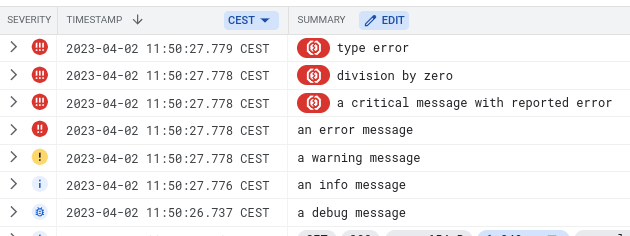
How it should appear in the Google Cloud Logging log explorer:
-
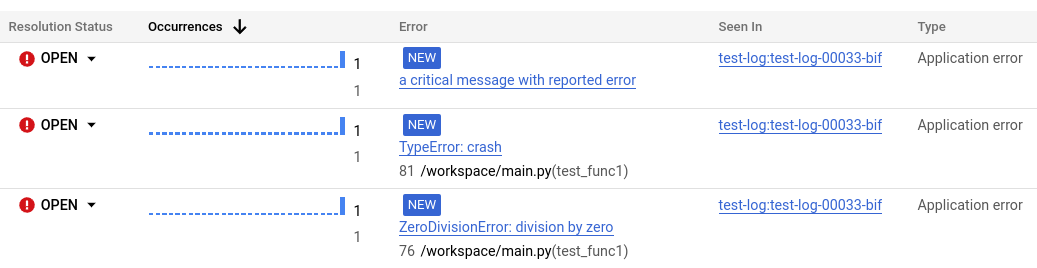
How it should appear in the Google Cloud Error Reporting dashboard:
Reference
1 maintainer

Metadata
1 maintainer
Release files for structlog-gcp 0.5.1
For a detailed explanation of source distributions (sdists) and built distributions (wheels), please see the package formats documentation.
Source distribution (sdist)
| File | Size | Uploaded | |
|---|---|---|---|
| structlog_gcp-0.5.1.tar.gz | 137.1 kB | Details |
Built distribution (wheel)
| File | Interpreter | ABI | Platform | Reset |
|---|---|---|---|---|
| structlog_gcp-0.5.1-py3-none-any.whl | Python 3 | none | any | Details |
Total release size: 146.8 kB
Release files / structlog_gcp-0.5.1.tar.gz
| Download URL | structlog_gcp-0.5.1.tar.gz |
|---|---|
| Size | 137.1 kB |
| Tags | Source |
|
SHA-256 checksum How to use checksums |
44a9b13f237a2de52df7b2fd4bd20cf0e71cf84888cbab6d07ffed9fcc22c157
|
|
BLAKE2b-256 checksum How to use checksums |
54e96e41f243d583b55213e0edf6396b75ed95ced2b9fc1d8f679501096496d5
|
| Upload date | |
|
Uploaded using Trusted Publishing? What is trusted publishing? |
Yes |
| Uploaded via |
twine/6.1.0 CPython/3.13.12
|
Provenance
Provenance describes where a file came from. On PyPI, provenance is shared via attestations, which provide a verifiable record of the build or publishing details. View details, limitations and caveats.


PyPI Publish Attestation
PyPI verified that this artifact, at this checksum, originated from the publisher listed below.
Signed by GitHub Actions, verified by PyPI on Jul 7, 2026.
Transparency logRelease files / structlog_gcp-0.5.1-py3-none-any.whl
| Download URL | structlog_gcp-0.5.1-py3-none-any.whl |
|---|---|
| Size | 9.7 kB |
| Tags | Python 3 |
|
SHA-256 checksum How to use checksums |
6c9bb790307e17eb1d00fa3643a455176699e194ecaf59b83fa07549ca80ae6b
|
|
BLAKE2b-256 checksum How to use checksums |
23c1e3fee1ee5b951c2c725966b3166fb5c0ed08de0c68eff3d259ad9f8fbe7a
|
| Upload date | |
|
Uploaded using Trusted Publishing? What is trusted publishing? |
Yes |
| Uploaded via |
twine/6.1.0 CPython/3.13.12
|
Provenance
Provenance describes where a file came from. On PyPI, provenance is shared via attestations, which provide a verifiable record of the build or publishing details. View details, limitations and caveats.
PyPI Publish Attestation
PyPI verified that this artifact, at this checksum, originated from the publisher listed below.
Signed by GitHub Actions, verified by PyPI on Jul 7, 2026.
Transparency log













