
Logprobs for OpenAI Structured Outputs

Project description





This Python library is designed to enhance OpenAI chat completion responses by adding detailed information about token log probabilities. This library works with OpenAI Structured Outputs, which is a feature that ensures the model will always generate responses that adhere to your supplied JSON Schema, so you don't need to worry about the model omitting a required key, or hallucinating an invalid enum value. It provides utilities to analyze and incorporate token-level log probabilities into structured outputs, helping developers understand the reliability of structured data extracted from OpenAI models.
Objective
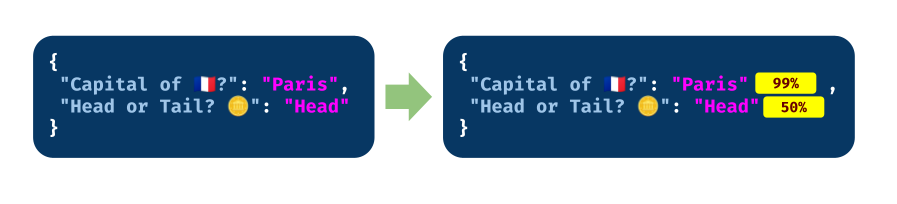
The primary goal of structured-logprobs is to provide insights into the reliability of extracted data. By analyzing token-level log probabilities, the library helps assess how likely each value generated from an LLM's structured outputs is.
Key Features
The module contains a function for mapping characters to token indices (map_characters_to_token_indices) and two methods for incorporating log probabilities:
- Adding log probabilities as a separate field in the response (
add_logprobs). - Embedding log probabilities inline within the message content (
add_logprobs_inline).
Example
To use this library, first create a chat completion response with the OpenAI Python SDK, then enhance the response with log probabilities. Here is an example of how to do that:
from openai import OpenAI
from openai.types import ResponseFormatJSONSchema
from structured_logprobs import add_logprobs, add_logprobs_inline

# Initialize the OpenAI client
client = OpenAI(api_key="your-api-key")

schema_path = "path-to-your-json-schema"
with open(schema_path) as f:
        schema_content = json.load(f)

# Validate the schema content
response_schema = ResponseFormatJSONSchema.model_validate(schema_content)

# Create a chat completion request
completion = client.chat.completions.create(
    model="gpt-4o-2024-08-06",
    messages = [
            {
                "role": "system",
                "content": (
                    "I have three questions. The first question is: What is the capital of France? "
                    "The second question is: Which are the two nicest colors? "
                    "The third question is: Can you roll a die and tell me which number comes up?"
                ),
            }
        ],
    logprobs=True,
    response_format=response_schema.model_dump(by_alias=True),
)

chat_completion = add_logprobs(completion)
chat_completion_inline = add_logprobs_inline(completion)
print(chat_completion.log_probs[0])
{'capital_of_France': -5.5122365e-07, 'the_two_nicest_colors': [-0.0033997903, -0.011364183612649998], 'die_shows': -0.48048785}
print(chat_completion_inline.choices[0].message.content)
{"capital_of_France": "Paris", "capital_of_France_logprob": -6.704273e-07, "the_two_nicest_colors": ["blue", "green"], "die_shows": 5.0, "die_shows_logprob": -2.3782086}
Example JSON Schema
The response_format in the request body is an object specifying the format that the model must output. Setting to { "type": "json_schema", "json_schema": {...} } ensures the model will match your supplied JSON schema.
Below is the example of the JSON file that defines the schema used for validating the responses.
{
    "type": "json_schema",
    "json_schema": {
        "name": "answears",
        "description": "Response to questions in JSON format",
        "schema": {
            "type": "object",
            "properties": {
                "capital_of_France": { "type": "string" },
                "the_two_nicest_colors": {
                    "type": "array",
                    "items": {
                        "type": "string",
                        "enum": ["red", "blue", "green", "yellow", "purple"]
                    }
                },
                "die_shows": { "type": "number" }
            },
            "required": ["capital_of_France", "the_two_nicest_colors", "die_shows"],
            "additionalProperties": false
        },
        "strict": true
    }
}


Download files
Download the file for your platform. If you're not sure which to choose, learn more about installing packages.
Source Distribution
Built Distribution
Filter files by name, interpreter, ABI, and platform.
If you're not sure about the file name format, learn more about wheel file names.
Copy a direct link to the current filters
File details
Details for the file structured_logprobs-0.1.3.tar.gz.
File metadata
- Download URL: structured_logprobs-0.1.3.tar.gz
- Upload date:
- Size: 13.3 kB
- Tags: Source
- Uploaded using Trusted Publishing? No
- Uploaded via: twine/6.0.1 CPython/3.12.8
File hashes
| Algorithm | Hash digest | |
|---|---|---|
| SHA256 |
d3871eaebffbee24450fcd574783a00ce17c329268f6cff2f47b752c601f4a00
|
|
| MD5 |
c4a24bc8c80fb323a450d293feb85477
|
|
| BLAKE2b-256 |
77d3be22977d6377a384ad779232694be3cdd9e2b96cdd08d3c6d949a6fc5660
|
File details
Details for the file structured_logprobs-0.1.3-py3-none-any.whl.
File metadata
- Download URL: structured_logprobs-0.1.3-py3-none-any.whl
- Upload date:
- Size: 10.9 kB
- Tags: Python 3
- Uploaded using Trusted Publishing? No
- Uploaded via: twine/6.0.1 CPython/3.12.8
File hashes
| Algorithm | Hash digest | |
|---|---|---|
| SHA256 |
9acb2d3dbbb7cab05a5a82e08f74b2d45ec43003cc3df4978e41758955c955ae
|
|
| MD5 |
cc45dd2ba7820019ede8cc72a2a19e60
|
|
| BLAKE2b-256 |
a1114422fd3642621990287c861c97755f0d1cf3ecffd71a604471aef50f8f74
|






