

/sʌb.pɛɹ/
SubPair 
"All you need is love and evolutionary matrix subset extraction." - J. Lennon
Pairwise cosine distance is great to easily compare many vectors. However, you can end up with a very sizeable distance matrix. What if you would like to find a small subset of that matrix? Let's search it by evolution.
Given N elements and their (N,N) pairwise distance matrix we would like to get the subset of S elements such that the sum of elements in the corresponding (S,S) submatrix is minimal. See example below.
  [0  1  2  3  4] indeces
      i  j     k
      │  │     │          i j k   = [1, 2, 4]
   0  1  6  4  1
i──1  0  3  1  7       i  0 3 7
j──6  3  0  2  3  -->  j  3 0 3  -->  7 + 3 + 3 = 13 👎
   4  1  2  0  1       k  7 3 0
k──1  7  3  1  0

         i  j  k
         │  │  │          i j k  = [2, 3, 4]
   0  1  6  4  1
   1  0  3  1  7       i  0 2 3
i──6  3  0  2  3  -->  j  2 0 1  -->  2 + 1 + 3 = 6 👍
j──4  1  2  0  1       k  3 1 0
k──1  7  3  1  0
All the possible subsets are ${N}\choose{S}$ and for N = 1024, S = 20 (like in the tests) we would have to check ${1024}\choose{20}$ $= 5.479 \times 10^{41}$ of them.
A few too many. Instead we are going to use an evolutionary approach to search for it.
Example usage
The usage is quite straight forward since there are only a couple of functions exported pairwise_cosine and extract.
>>> import matplotlib.pyplot as plt
>>> from subpair import pairwise_cosine
>>>
>>> X = np.random.rand(N, K).astype(np.float32)
>>> distances = pairwise_cosine(X) # (N,N)
>>> ...
>>> best, stats = extract(distances, P=200, S=S, K=50, M=3, O=2, its=3_000)
100%|█████████████████████████████████| 3000/3000 [00:03<00:00, 817.42it/s]
>>> plt.plot(stats["fits"]); plt.show()
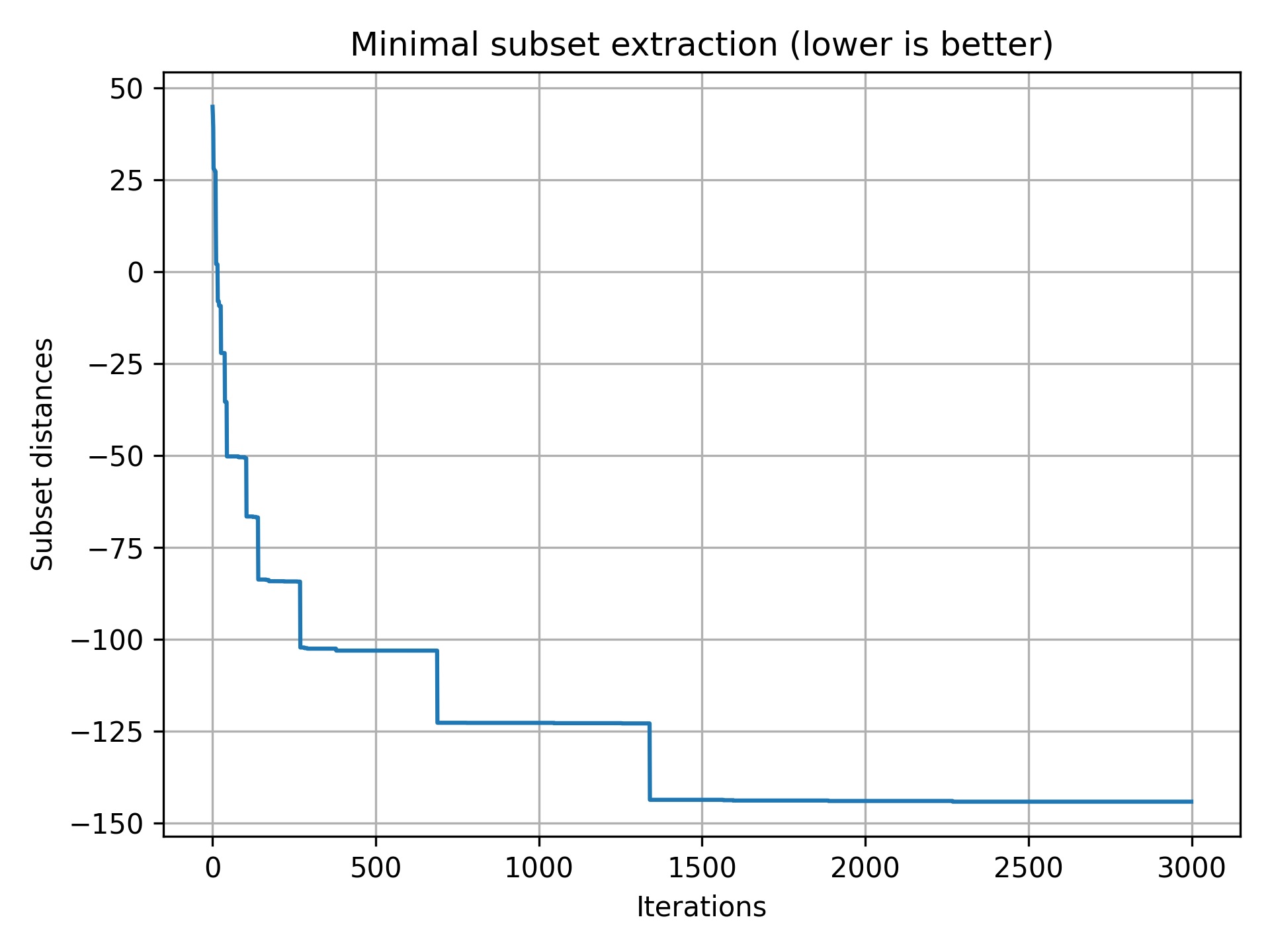
(We have sprinkled a few negative numbers to see if the algorithm can find them)
Where the options of extract are parameters for the evolutionary algorithm:distances (int, int) : N vectors of length L
P (int) : population size
S (int) : desired subset size <- determines size of output
K (int) : number of parents (P-K children)
M (int) : number of mutations
O (int) : fraction of crossovers e.g. O=2 -> 1/2, O=10 -> 1/10, (bigger=faster)
Note
This repo contains both numpy and numba/CUDA versions of the pairwise cosine distance matrix calculation. But numpy is already blazingly fast so the cuda version is provided mostly for inspiration. Our numpy version is very similar to sklearn's metrics.pairwise.cosine_distances but slightly faster. Sklearn's one has some extra nicities that our simplified version does not have.
> python flops.py # On Macbook pro M1 Max
N=513 K=2304 GOPs=1
  sklearn: 0.01s - 109.4 GFLOPS
    numpy: 0.00s - 162.4 GFLOPS

N=1027 K=2304 GOPs=2
  sklearn: 0.02s - 135.9 GFLOPS
    numpy: 0.01s - 192.4 GFLOPS

N=2055 K=2304 GOPs=10
  sklearn: 0.07s - 142.9 GFLOPS
    numpy: 0.06s - 166.0 GFLOPS

N=4111 K=2304 GOPs=39
  sklearn: 0.20s - 195.8 GFLOPS
    numpy: 0.16s - 248.6 GFLOPS

N=8223 K=2304 GOPs=156
  sklearn: 0.61s - 255.3 GFLOPS
    numpy: 0.54s - 289.5 GFLOPS

N=16447 K=2304 GOPs=623
  sklearn: 2.11s - 295.4 GFLOPS
    numpy: 1.79s - 347.9 GFLOPS
Todo
- Add type info to minimize.py to allow for AOT compilation.
1 maintainer

Metadata
1 maintainer
Release files for subpair 0.1.1
For a detailed explanation of source distributions (sdists) and built distributions (wheels), please see the package formats documentation.
Source distribution (sdist)
| File | Size | Uploaded | |
|---|---|---|---|
| subpair-0.1.1.tar.gz | 7.6 kB | Details |
Built distribution (wheel)
| File | Interpreter | ABI | Platform | Reset |
|---|---|---|---|---|
| subpair-0.1.1-py3-none-any.whl | Python 3 | none | any | Details |
Total release size: 15.3 kB
Release files / subpair-0.1.1.tar.gz
| Download URL | subpair-0.1.1.tar.gz |
|---|---|
| Size | 7.6 kB |
| Tags | Source |
|
SHA-256 checksum How to use checksums |
e3b51a8b9423358bfac561301b96e4ef167c1c74bd65cb7dfd0a69bb737a8600
|
|
BLAKE2b-256 checksum How to use checksums |
09c6fbb4394423f7cadddc9b78d5ef6804bd071f3635a7d5af0469c23f128a29
|
| Upload date | |
|
Uploaded using Trusted Publishing? What is trusted publishing? |
No |
| Uploaded via |
twine/4.0.2 CPython/3.10.8
|
Release files / subpair-0.1.1-py3-none-any.whl
| Download URL | subpair-0.1.1-py3-none-any.whl |
|---|---|
| Size | 7.6 kB |
| Tags | Python 3 |
|
SHA-256 checksum How to use checksums |
a55ccb182fa3841589d9eed3edd3a746c42f107957898e55f84bf51abdf9f8ea
|
|
BLAKE2b-256 checksum How to use checksums |
fbaedd312e3233ac0137115fe0cf0372da35b43eac8db9fd60df5f1167e66aa2
|
| Upload date | |
|
Uploaded using Trusted Publishing? What is trusted publishing? |
No |
| Uploaded via |
twine/4.0.2 CPython/3.10.8
|













