
A scalable manifold learning (SUDE) method that can cope with large-scale and high-dimensional data in an efficient manner.

Project description
Sampling-enabled scalable manifold learning unveils the discriminative cluster structure of high-dimensional data (SUDE)
We propose a scalable manifold learning (SUDE) method that can cope with large-scale and high-dimensional data in an efficient manner. It starts by seeking a set of landmarks to construct the low-dimensional skeleton of the entire data, and then incorporates the non-landmarks into this skeleton based on the constrained locally linear embedding.
This repository provides the Python version of SUDE. The MATLAB version can be found at https://github.com/ZPGuiGroupWhu/sude. The related paper has been published in Nature Machine Intelligence: https://www.nature.com/articles/s42256-025-01112-9.
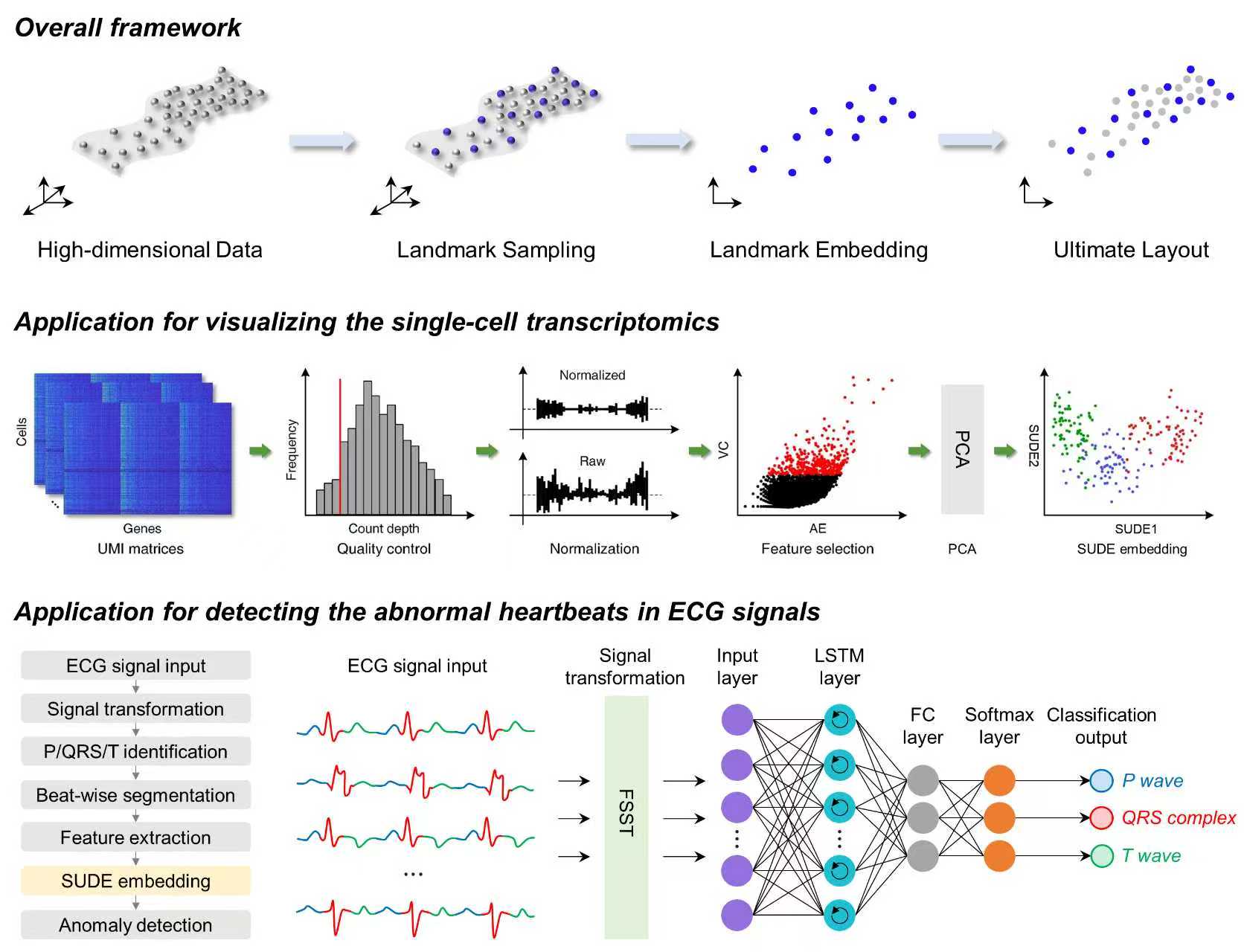
Project layout
The project now follows the structure of the
scikit-learn-contrib/project-template:
.
|-- .github/workflows/
|-- benchmarks/
|-- doc/
|-- examples/
|-- image/
|-- sude/
|   |-- __init__.py
|   |-- _sude.py
|   |-- _version.py
|   `-- tests/
|-- pyproject.toml
`-- README.md
Installation
Supported python versions are 3.8 and above.
This project has been uploaded to PyPI, supporting direct download and installation from pypi
pip install sude
Manual installation
git clone https://github.com/ZPGuiGroupWhu/SUDE-pkg.git
cd SUDE-pkg
pip install -e .
How to run
The SUDE package exposes the sude function for embedding high-dimensional
data.
The description of the hyperparameters for user configuration are presented as follows
def sude(
    X,
    no_dims = 2,
    k1 = 20,
    normalize = True,
    large = False,
    initialize = 'le',
    agg_coef = 1.2,
    T_epoch = 50,
):
"""
    This function returns representation of the N by D matrix X in the lower-dimensional space. Each row in X
    represents an observation.

    Parameters are:

    'no_dims'      - A positive integer specifying the number of dimension of the representation Y.
                   Default: 2
    'k1'           - A non-negative integer specifying the number of nearest neighbors for PPS to
                   sample landmarks. It must be smaller than N.
                   Default: adaptive
    'normalize'    - Logical scalar. If true, normalize X using min-max normalization. If features in
                   X are on different scales, 'Normalize' should be set to true because the learning
                   process is based on nearest neighbors and features with large scales can override
                   the contribution of features with small scales.
                   Default: True
    'large'        - Logical scalar. If true, the data can be split into multiple blocks to avoid the problem
                   of memory overflow, and the gradient can be computed block by block using 'learning_l' function.
                   Default: False
    'initialize'   - A string specifying the method for initializing Y before manifold learning.
        'le'       - Laplacian eigenmaps.
        'pca'      - Principal component analysis.
        'mds'      - Multidimensional scaling.
                   Default: 'le'
    'agg_coef'     - A positive scalar specifying the aggregation coefficient.
                   Default: 1.2
    'T_epoch'      - Maximum number of epochs to take.
                   Default: 50
"""
After installing the SUDE package, you can use this function as follows:
import numpy as np
from sude import sude
import time
import matplotlib.pyplot as plt

# Input data
data = np.loadtxt("benchmarks/rice.csv", delimiter=",")

# Obtain data size and true annotations
m = data.shape[1]
X = data[:, :m - 1]
ref = data[:, m - 1]

# Perform SUDE embedding
start_time = time.time()
Y = sude(X, k1=10)
end_time = time.time()
print("Elapsed time:", end_time - start_time, 's')

plt.scatter(Y[:, 0], Y[:, 1], c=ref, cmap='tab10', s=4)
plt.show()
Run the packaged example with:
uv run python examples/plot_sude_embedding.py
Run the test suite with:
uv run python -m unittest discover -s sude/tests
Citation request
Peng, D., Gui, Z., Wei, W. et al. Sampling-enabled scalable manifold learning unveils the discriminative cluster structure of high-dimensional data. Nat. Mach. Intell. (2025). https://doi.org/10.1038/s42256-025-01112-9
License
SUDE is released under the MIT License.


Download files
Download the file for your platform. If you're not sure which to choose, learn more about installing packages.
Source Distribution
Built Distribution
Filter files by name, interpreter, ABI, and platform.
If you're not sure about the file name format, learn more about wheel file names.
Copy a direct link to the current filters
File details
Details for the file sude-0.1.3.tar.gz.
File metadata
- Download URL: sude-0.1.3.tar.gz
- Upload date:
- Size: 4.0 MB
- Tags: Source
- Uploaded using Trusted Publishing? No
- Uploaded via: uv/0.6.4
File hashes
| Algorithm | Hash digest | |
|---|---|---|
| SHA256 |
99d9f8585953777ae4c594717889237bb9fd9706a46ea7291b3c359f8c777ae0
|
|
| MD5 |
1742b4154d679e19188509c26ad50f44
|
|
| BLAKE2b-256 |
1d10be19ef4e7ac0a064636197e3dfaf704081274dd20f17d5300b4c735cdcee
|
File details
Details for the file sude-0.1.3-py3-none-any.whl.
File metadata
- Download URL: sude-0.1.3-py3-none-any.whl
- Upload date:
- Size: 14.5 kB
- Tags: Python 3
- Uploaded using Trusted Publishing? No
- Uploaded via: uv/0.6.4
File hashes
| Algorithm | Hash digest | |
|---|---|---|
| SHA256 |
84bb51edbc01a3a4ed22e5aaef1b9cb5fb9b34db94163873d47238b4bbf46e6e
|
|
| MD5 |
515320f7c2488f5a64da150d00b4f6aa
|
|
| BLAKE2b-256 |
0faff5fa07aba4116bfc435cbc0d9e8c37d21f875d9fec65b1950ffd4b060b5b
|






