
DEPy
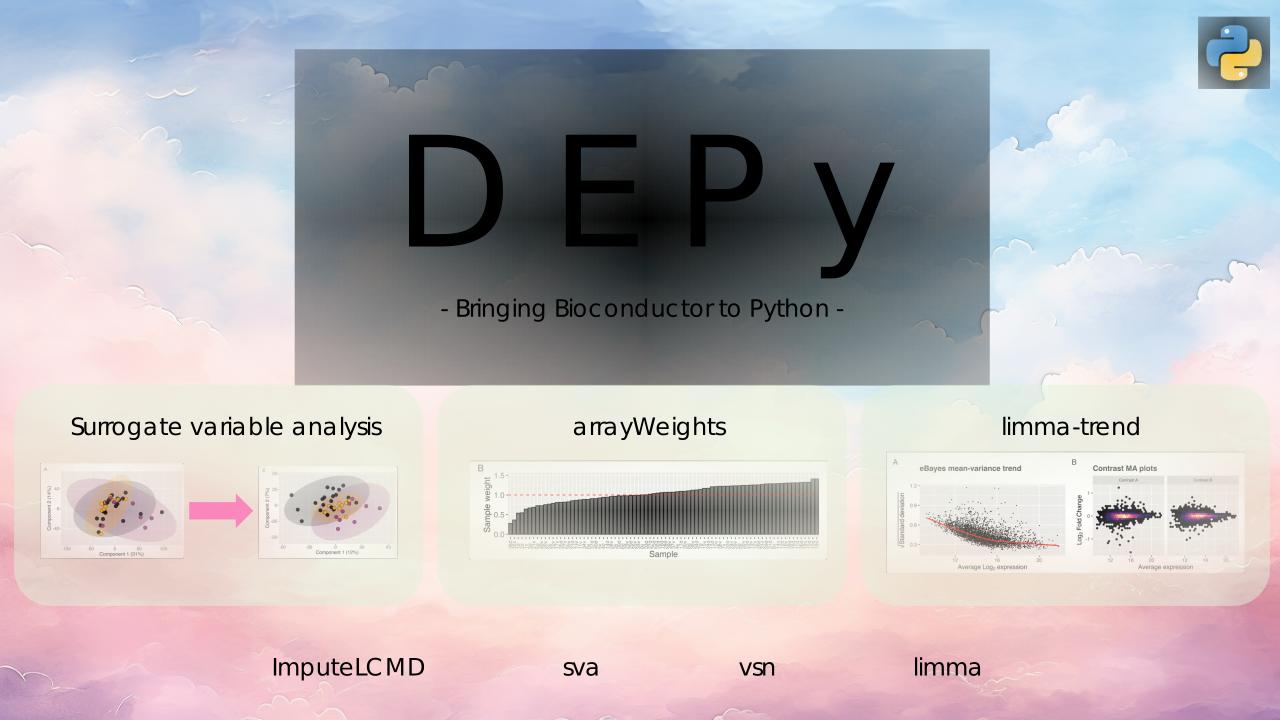
A differential expression analysis package for bulk proteomics (and metabolomics) data, which leverages transcriptomics tools. Inspired by R tools like DEP and SummarizedExperiment, it brings the power of Bioconductor to Python. All you need is a matrix of features and their intensity values.
- PyPI package: https://pypi.org/project/summarizedpy/
- GitHub: SebastianDHA/DEPy
- Free software: MIT License
Features
- SummarizedPY: A container for your -omics data, much like SummarizedExperiment or DEP in R.
- Filtering and subsetting your samples and features
- Missing value filtering
- Imputation using ImputeLCMD (many methods)
- Transforming (log, centering, standardizing, vsn)
- Leverage surrogate variable analysis (sva) to adjust for latent batch effects
- Use the flexibility and power of limma-trend to improve your DEA results and accommodate mixed effects
- Limma arrayWeights to adjust variable sample quality (often an issue in human and animal datasets)
- Visualize your DEA results with elegant volcano plots
- Highly-variable feature selection
- PCA plots
- Saving & loading SummarizedPy objects to & from disk
Installation
conda
This is the best way to install DEPy.
conda env create -f environment.yml
Note that DEPy (summarizedpy) must be run within the depy conda environment or a cloned version of it. This is because summarizedpy needs an isolated environment to run R in due to the complex loading behavior of Bioconductor packages.
Using pip
pip install summarizedpy
Quick start
import depy as dp

sp = dp.SummarizedPy()
sp = sp.import_from_delim_file(path="path/to/pgroup.tsv", delim="\t")
See the full tutorial for more.
Documentation
Credits
This package leverages amazing packages from the R and Bioconductor community, including limma, vsn, sva, ImputeLCMD, and Tidyverse. This package was created with Cookiecutter and the audreyfeldroy/cookiecutter-pypackage project template.
1 maintainer

Metadata
1 maintainer
Release files for summarizedpy 0.5.0
For a detailed explanation of source distributions (sdists) and built distributions (wheels), please see the package formats documentation.
Source distribution (sdist)
| File | Size | Uploaded | Provenance | |
|---|---|---|---|---|
| summarizedpy-0.5.0.tar.gz | 2.0 MB | Without provenance | Details |
Built distribution (wheel)
| File | Interpreter | ABI | Platform | Reset |
|---|---|---|---|---|
| summarizedpy-0.5.0-py3-none-any.whl | Python 3 | none | any | Details |
Total release size: 2.1 MB
Release files / summarizedpy-0.5.0.tar.gz
| Download URL | summarizedpy-0.5.0.tar.gz |
|---|---|
| Size | 2.0 MB |
| Tags | Source |
|
SHA-256 checksum How to use checksums |
ca6b59f36edbfe1a9470893a9100e813546e64d3c196442ad8ad27e85ab4f7d0
|
|
BLAKE2b-256 checksum How to use checksums |
e168da313a29914ea9aeb63487ab4bdbedc1d97bc8341b7c45db3f3a9d429d2e
|
| Upload date | |
|
Uploaded using Trusted Publishing? What is trusted publishing? |
No |
| Uploaded via |
twine/6.2.0 CPython/3.12.3
|
Release files / summarizedpy-0.5.0-py3-none-any.whl
| Download URL | summarizedpy-0.5.0-py3-none-any.whl |
|---|---|
| Size | 27.8 kB |
| Tags | Python 3 |
|
SHA-256 checksum How to use checksums |
8a65f67b114c4c66e1b8de606e4faaa933ecef762396596207852928840ffe4a
|
|
BLAKE2b-256 checksum How to use checksums |
61c62f695172e19021a34b54ab88646812dda21458850afc38ccce49387c7a2a
|
| Upload date | |
|
Uploaded using Trusted Publishing? What is trusted publishing? |
No |
| Uploaded via |
twine/6.2.0 CPython/3.12.3
|
Security for summarizedpy 0.5.0
Provenance
Provenance describes where a file came from. On PyPI, provenance is shared via attestations, which provide a verifiable record of the build or publishing details. View details, limitations and caveats.
No provenance found
None of the files in this release were uploaded with provenance metadata.
A note on package security
PyPI is a repository for distributing packages, not a service for auditing them. While third-party security researchers and our staff do their best to detect and remove malicious packages, PyPI cannot guarantee the quality, security or suitability of any given package.
To learn more about protecting yourself from malicious actors, visit our package security documentation.














