
SURGE — Surrogate Unified Robust Generation Engine
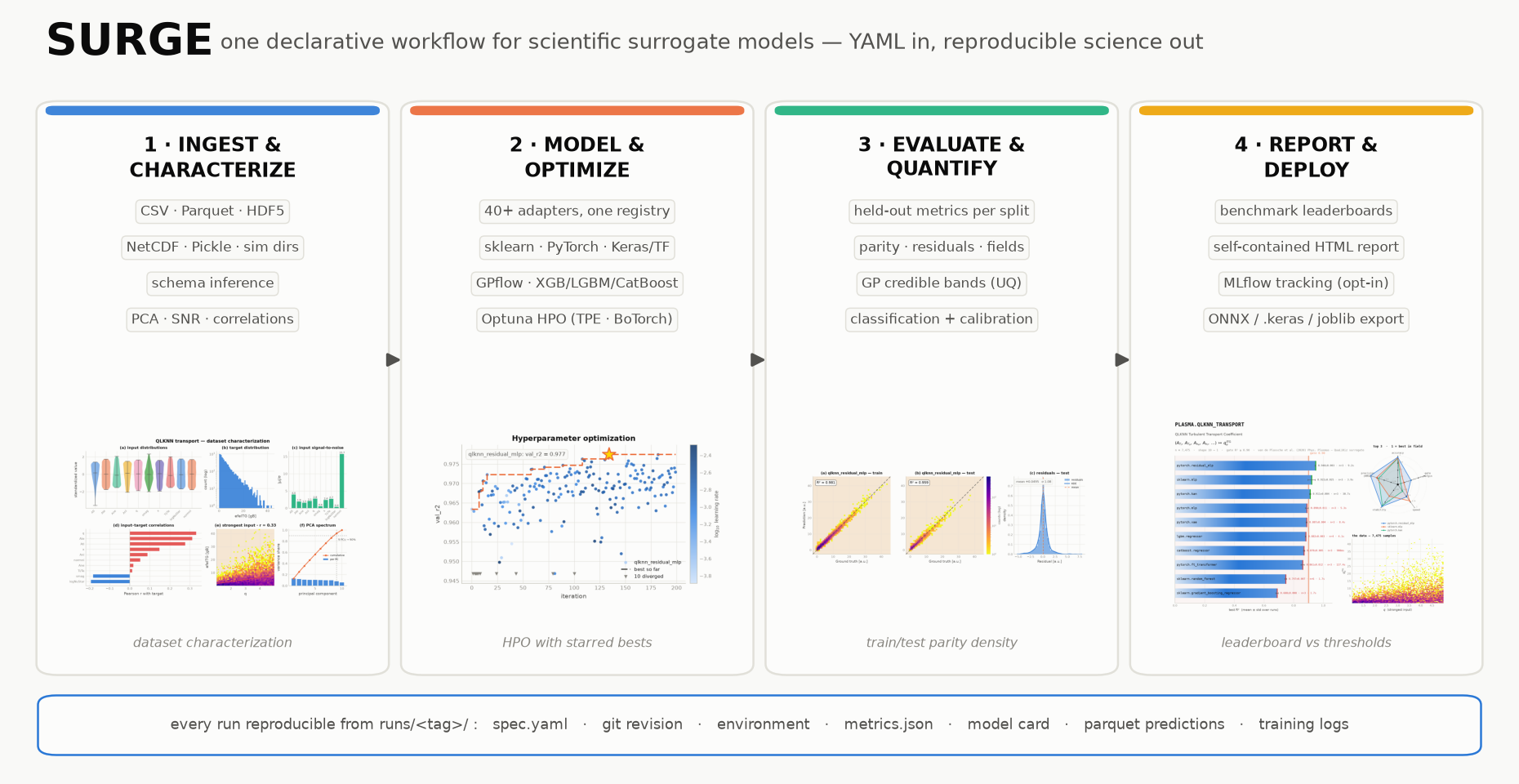
SURGE is a surrogate modeling framework for scientific workflows that
integrates Scientific Machine Learning (SciML) and AutoML features,
uncertainty quantification (UQ), and MLOps-style provenance in a single
declarative pipeline. One YAML spec (or Python API) covers
load → schema → split → train → HPO → metrics → UQ → artifacts → figures,
backed by an extensible registry of 50 model adapters across scikit-learn,
PyTorch, TensorFlow/Keras, and Gaussian-process backends — with every run
reproducible from its own runs/<tag>/ directory.
v0.1.0 · License: BSD-3-Clause · DOE CODE 179819 · DOI 10.11578/dc.20260422.5
Built on


Names and logos are trademarks of their respective projects; they appear here to state a dependency and do not imply endorsement of SURGE by those projects.
Install
pip install surge-ml
| Extra | Adds | Install |
|---|---|---|
| (base) | sklearn, pandas, Optuna, plotting | pip install surge-ml |
torch |
PyTorch model families | pip install "surge-ml[torch]" |
onnx |
ONNX export + runtime parity tests | pip install "surge-ml[onnx]" |
benchmarks |
h5py for the benchmark suite | pip install "surge-ml[benchmarks]" |
tensorflow |
TF ≥ 2.21 + tf-keras → keras.mlp adapter |
pip install "surge-ml[tensorflow]" |
gpflow |
TF stack for GPflow GPs — finish with pip install gpflow --no-deps (its published metadata pins numpy<2, unresolvable next to the TF floor above, though GPflow itself runs fine on NumPy 2.x) |
pip install "surge-ml[gpflow]" |
all |
torch + onnx + shap + mlflow + benchmarks + tensorflow (not gpflow — see the no-deps note above) | pip install "surge-ml[all]" |
Requires Python 3.10 to 3.13.
Quickstart
Your own table, three commands:
surge init --data my_data.csv --target y --yes --out spec.yaml   # inspect the data, write a commented spec
surge validate spec.yaml                                         # schema-check it
surge run spec.yaml                                               # train, tune, evaluate -> runs/<tag>/
A fusion surrogate end to end — QLKNN turbulent transport with an Optuna HPO campaign, live monitoring and the mission-control dashboard:
pip install "surge-ml[torch]" fusion_surrogates
surge data export plasma.qlknn_transport qlknn.csv          # 10 gyrokinetic inputs -> efeITG
surge init --data qlknn.csv --target efeITG --goal accuracy --budget standard --yes --out qlknn.yaml
surge run qlknn.yaml                                        # RF + residual MLP, 10-trial search
surge monitor runs/qlknn --watch 30                         # second terminal
surge viz runs/qlknn --units gB                             # mission control, HPO, training, parity
surge bench -b plasma.qlknn_transport -m all --seeds 3      # leaderboard against the published gate
surge report --out leaderboard.html                         # self-contained HTML dashboard
Every run writes metrics.json, trained models, scalers, per-split
predictions and model cards to runs/<tag>/; surge models lists the
registered adapters.
Benchmarks
SURGE is built for the fusion energy sciences community: its benchmark
suite leads with public fusion datasets (QLKNN10D turbulent transport,
ConStellaration stellarator equilibria, SOLPS-NN divertor exhaust, the
C-Mod density-limit database), followed by operator-learning fields
(PDEBench, TheWell) and a tutorial tier of general tabular and vision
datasets (California housing, superconductor critical temperature,
MNIST/CIFAR-10, …) you can pull and run in a minute. Every benchmark has a
citation, a published pass threshold and machine-readable result.json
artifacts. Headline numbers from the fusion benchmarks:
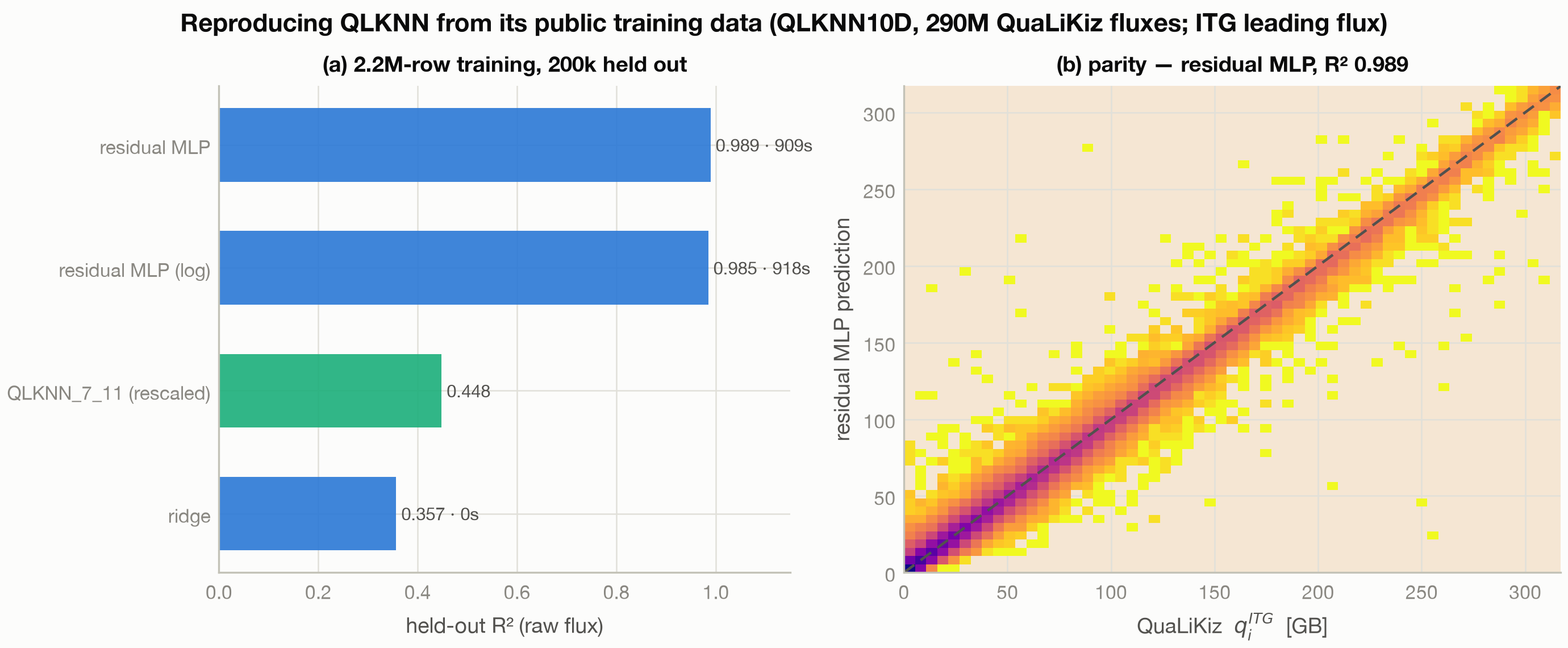
- QLKNN10D plasma transport — R² 0.989 on 200k held-out QuaLiKiz ITG fluxes, reproduced end-to-end from public data (gate R² ≥ 0.95).
- ConStellaration stellarator design — mean R² 0.916 across 8 VMEC++ equilibrium metrics (gate R² ≥ 0.85).
- C-Mod density-limit precursor detection — discharge-grouped split of the MIT-PSFC open database on the natural 1.4 % imbalance: random forest AUROC 0.9999 against 0.973 for the Greenwald-fraction scaling (gate AUROC ≥ 0.99).
- SOLPS-NN divertor exhaust (in progress) — an in-context tabular
foundation model (
kumo.tabular_regressor) reaches 8.4 % median relative error on the peak target heat flux with no training, against the published 13 % from tuned five-fold networks.
Full ledger with per-benchmark status: docs/benchmarks/README.md.
Learn more
- Full README — architecture, highlights, visualization system, all 50 model adapters
- Getting started
- Benchmark ledger — status, gates and data citations per benchmark
- References — the datasets, architectures and software behind the suite
- Changelog
- Citation — DOE CODE 179819, DOI 10.11578/dc.20260422.5
License
1 maintainer

Metadata
1 maintainer
Release files for surge-ml 0.1.0
For a detailed explanation of source distributions (sdists) and built distributions (wheels), please see the package formats documentation.
Source distribution (sdist)
| File | Size | Uploaded | Provenance | Actions |
|---|---|---|---|---|
| surge_ml-0.1.0.tar.gz | 437.2 kB | Without provenance | Details for surge_ml-0.1.0.tar.gz |
Built distribution (wheel)
| File | Interpreter | ABI | Platform | Actions Reset |
|---|---|---|---|---|
| surge_ml-0.1.0-py3-none-any.whl | Python 3 | none | any | Details for surge_ml-0.1.0-py3-none-any.whl |
Total release size: 936.7 kB
Release files / surge_ml-0.1.0.tar.gz
| Download URL | surge_ml-0.1.0.tar.gz |
|---|---|
| Size | 437.2 kB |
| Tags | Source |
|
SHA-256 checksum How to use checksums |
205ea3c7fe6a9ec9e3a3adf6bc30b5e321953680c3e568446f94a0489b41dbde
|
|
BLAKE2b-256 checksum How to use checksums |
b93a818b6a66806e718afc600b681aaad73e0ebd9faf8a040547fe5964433f57
|
| Upload date | |
|
Uploaded using Trusted Publishing? What is trusted publishing? |
No |
| Uploaded via |
uv/0.13.6 {"installer":{"name":"uv","version":"0.13.6","subcommand":["publish"]},"python":null,"implementation":{"name":null,"version":null},"distro":{"name":"macOS","version":null,"id":null,"libc":null},"system":{"name":null,"release":null},"cpu":null,"openssl_version":null,"setuptools_version":null,"rustc_version":null,"ci":null}
|
Release files / surge_ml-0.1.0-py3-none-any.whl
| Download URL | surge_ml-0.1.0-py3-none-any.whl |
|---|---|
| Size | 499.5 kB |
| Tags | Python 3 |
|
SHA-256 checksum How to use checksums |
4202c1432b2bc9847274ec63ba7968a117af65affaa4c1ec3c6c36da2ea71f6e
|
|
BLAKE2b-256 checksum How to use checksums |
a2f18ed9a813ba4ae685d9634e4320a2dc9e465c64534d5c69110acfc33ae1ef
|
| Upload date | |
|
Uploaded using Trusted Publishing? What is trusted publishing? |
No |
| Uploaded via |
uv/0.13.6 {"installer":{"name":"uv","version":"0.13.6","subcommand":["publish"]},"python":null,"implementation":{"name":null,"version":null},"distro":{"name":"macOS","version":null,"id":null,"libc":null},"system":{"name":null,"release":null},"cpu":null,"openssl_version":null,"setuptools_version":null,"rustc_version":null,"ci":null}
|
Security for surge-ml 0.1.0
Provenance
Provenance describes where a file came from. On PyPI, provenance is shared via attestations, which provide a verifiable record of the build or publishing details. View details, limitations and caveats.
No provenance found
None of the files in this release were uploaded with provenance metadata.
A note on package security
PyPI is a repository for distributing packages, not a service for auditing them. While third-party security researchers and our staff do their best to detect and remove malicious packages, PyPI cannot guarantee the quality, security or suitability of any given package.
To learn more about protecting yourself from malicious actors, visit our package security documentation.













