
SwarmControl
The control loop for AI agent swarms: enforce the rules, correct mistakes as they happen, and turn every correction into training data.
What it does
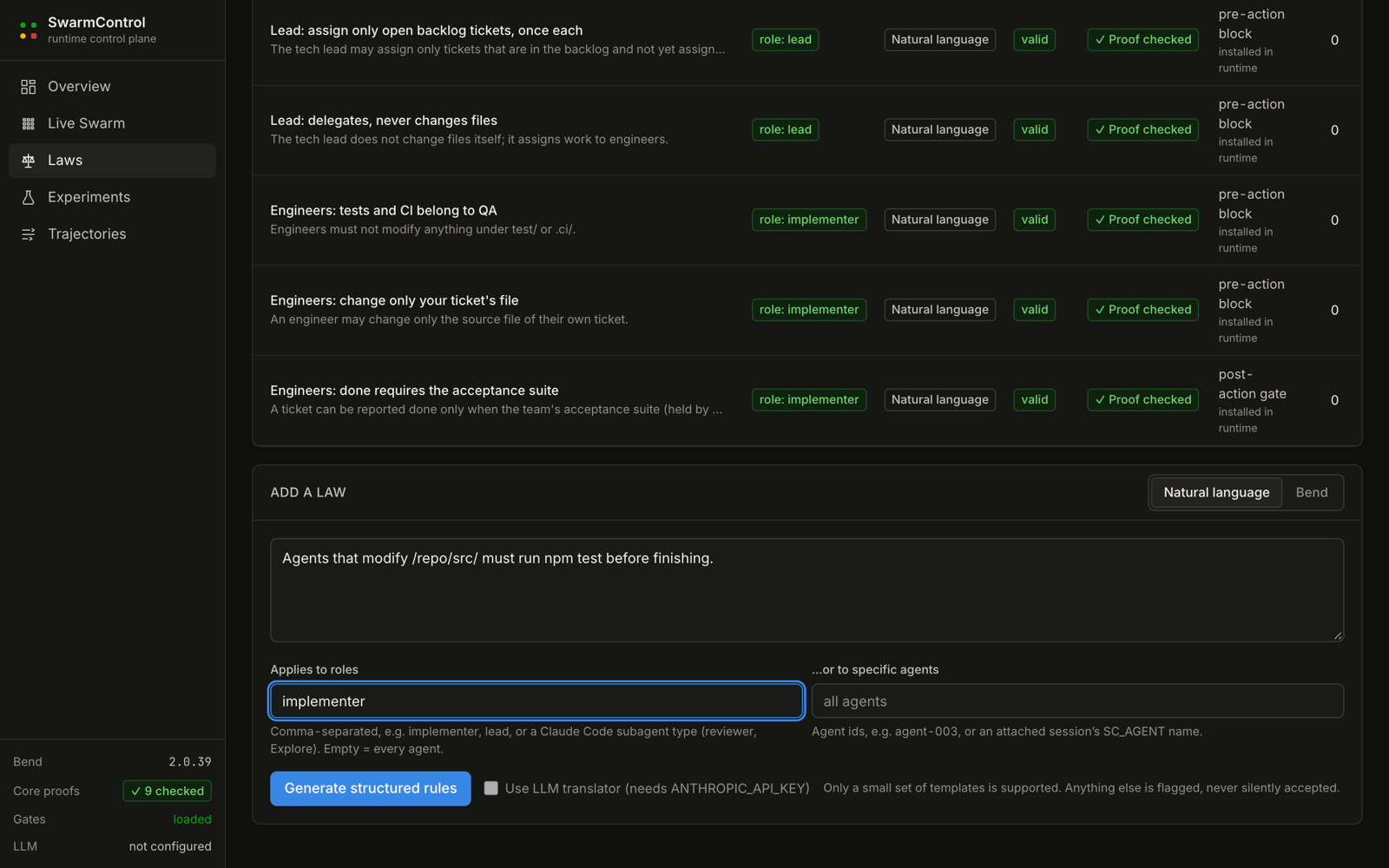
- Write laws for your agents in plain English, for everyone, a role, or one agent.
- Every action is checked before it runs. A rule-breaking action is blocked and the agent gets feedback to fix course. If it keeps failing, a human is asked.
- Every correction becomes training data, exported as fine-tuning and preference pairs.
- A live dashboard shows each agent as green, yellow (recovering) or red (needs a human).
- "Done" has to pass the laws, so green means actually done.
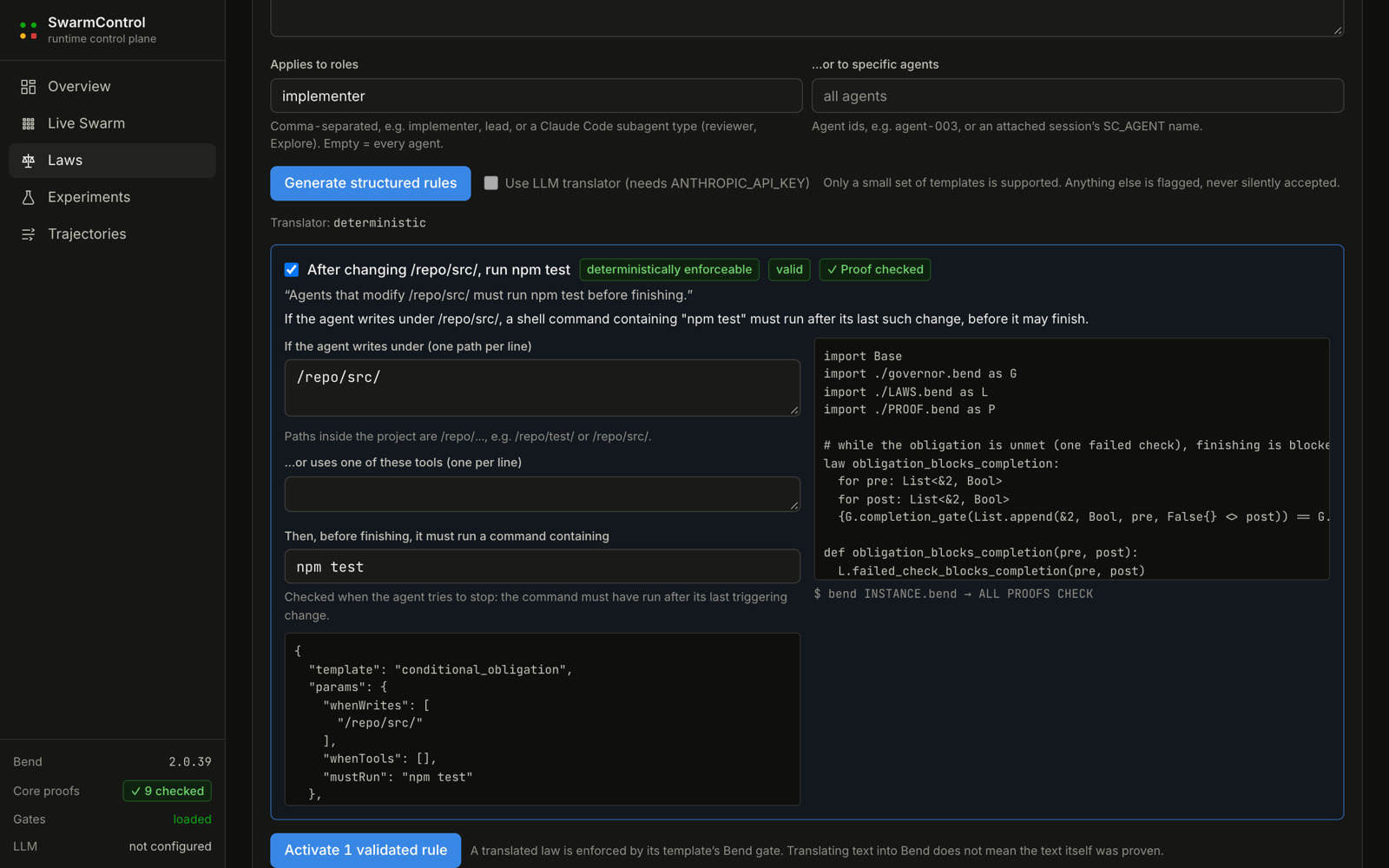
- The checks are Bend functions with machine-proven guarantees, and they fail closed.
Install
Needs Python ≥ 3.11, uv, Bend, and clang (recommended).
curl -fsSL https://bend-lang.com/install.sh | sh && export PATH="$HOME/.bend/bin:$PATH"
uv tool install swarmcontrol   # or: pip install swarmcontrol
swctl serve                    # dashboard on http://localhost:8787
Claude Code
cd my-project
swctl connect                  # installs the Claude Code hooks (and starts the server if it isn't running)
claude                         # use Claude Code as usual
Every edit and shell command is now checked against your laws, and the session shows up live on the dashboard. Optionally give the session a role and a check that must pass before it can finish: SC_ROLE=implementer SC_DONE_CHECK="npm test" claude.
Add a law. On the Laws page, type the rule and who it applies to:
Click Generate structured rules. SwarmControl shows what it understood, checks it with Bend, and you activate it:
Full walkthrough: tutorials/claude-code.md.
Benchmarks
The same tasks and model (Qwen 3 Coder 30B), with SwarmControl off and on:
| Benchmark | Off | On |
|---|---|---|
| Delegated team: false "done" claims | 32 | 0 |
| Ops shift: customers resolved | 172 / 328 | 202 / 328 |
| τ²-bench airline: tasks resolved | 86 / 200 | 111 / 200 |
| AgentDojo: prompt-injection attack success | 21% | 1% |
Claude Haiku and Sonnet rarely break the rules, so there results are unchanged at no extra cost. Details.
Coming soon
- Codex support.
Contributions are welcome: see CONTRIBUTING.md.
License
1 maintainer

Metadata
1 maintainer
Release files for swarmcontrol 0.1.3
For a detailed explanation of source distributions (sdists) and built distributions (wheels), please see the package formats documentation.
Source distribution (sdist)
| File | Size | Uploaded | Provenance | Actions |
|---|---|---|---|---|
| swarmcontrol-0.1.3.tar.gz | 987.7 kB | Without provenance | Details for swarmcontrol-0.1.3.tar.gz |
Built distribution (wheel)
| File | Interpreter | ABI | Platform | Actions Reset |
|---|---|---|---|---|
| swarmcontrol-0.1.3-py3-none-any.whl | Python 3 | none | any | Details for swarmcontrol-0.1.3-py3-none-any.whl |
Total release size: 2.1 MB
Release files / swarmcontrol-0.1.3.tar.gz
| Download URL | swarmcontrol-0.1.3.tar.gz |
|---|---|
| Size | 987.7 kB |
| Tags | Source |
|
SHA-256 checksum How to use checksums |
368a2bfa11b2fe00873f8913fd82debbf34274d15a11ec934b81b3f66be81be5
|
|
BLAKE2b-256 checksum How to use checksums |
c4256f826b20d4a7393b9ca70ee3f729c156c4550c6680e624ea0ab602cd6396
|
| Upload date | |
|
Uploaded using Trusted Publishing? What is trusted publishing? |
No |
| Uploaded via |
twine/7.0.0 CPython/3.11.6
|
Release files / swarmcontrol-0.1.3-py3-none-any.whl
| Download URL | swarmcontrol-0.1.3-py3-none-any.whl |
|---|---|
| Size | 1.1 MB |
| Tags | Python 3 |
|
SHA-256 checksum How to use checksums |
a17733f1b0e91ed47b3f3a6d45d0db56b7775cf8d430bb8f40d862b3cb81edaa
|
|
BLAKE2b-256 checksum How to use checksums |
3560aabe8eb18e3842b1ea8f4eb6fec1a3f955a8eab6920961ad08186c5f3f12
|
| Upload date | |
|
Uploaded using Trusted Publishing? What is trusted publishing? |
No |
| Uploaded via |
twine/7.0.0 CPython/3.11.6
|
Security for swarmcontrol 0.1.3
Provenance
Provenance describes where a file came from. On PyPI, provenance is shared via attestations, which provide a verifiable record of the build or publishing details. View details, limitations and caveats.
No provenance found
None of the files in this release were uploaded with provenance metadata.
A note on package security
PyPI is a repository for distributing packages, not a service for auditing them. While third-party security researchers and our staff do their best to detect and remove malicious packages, PyPI cannot guarantee the quality, security or suitability of any given package.
To learn more about protecting yourself from malicious actors, visit our package security documentation.














