


Why Sweet-RL
It exists dozens of Reinforcement Learning frameworks and algorithms implementations.
Yet, most of them suffer of poor modularity and ease of understanding. This is why, I started to implement my own: Sweet-RL.
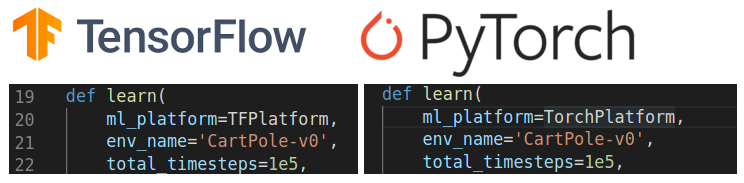
It's so sweet that you can switch from Tensorflow 2.1 to PyTorch 1.4 with a single configuration line:
Getting started
Install sweet-rl
First, create a virtualenv:
python3.x -m venv ~/.virtualenvs/sweet/
# or: virtualenv ~/.virtualenvs/sweet/ -p python3
source ~/.virtualenvs/sweet/bin/activate
And then, install project dependancies:
make install # or pip install -e .
First execution
Run a DQN training:
python -m sweet.run --env=CartPole-v0 --algo=dqn --ml=tf

# Parameters:
#   -h, --help            show this help message and exit
#   --env ENV             Environment to play with
#   --algo ALGO           RL agent
#   --ml ML               ML platform (tf or torch)
#   --model MODEL         Model (dense, pi_actor_critic)
#   --timesteps TIMESTEPS
#                         Number of training steps
#   --output OUTPUT       Output directory (eg. './target/')
Custom neural network
If you want to specify your own model instead of default ones, take a look to
sweet.agents.dqn.experiments.train_custom_model
Features, algorithms implemented
Algorithms
| Algorithm | Implementation status | ML platform |
|---|---|---|
| DQN | ✔️ | TF2, Torch |
| A2C | ✔️ | TF2, Torch |
| PPO | Soon |
IO: Logs, model, tensorboard events
Outputs are configurable in training function:
targets: dict = {
        'output_dir': Path('./target/'), # Main directory to store your outputs
        'models_dir': 'models_checkpoints', # Saving models (depending on model_checkpoint_freq)
        'logs_dir': 'logs', # Saving logs (info, debug, errors)
        'tb_dir': 'tb_events' # Saving tensorboard events
}
Models are saved depending on model_checkpoint_freq parameter set in train function.
Benchmark
To reproduce benchmark, execute:
python -m sweet.benchmark.benchmark_runner
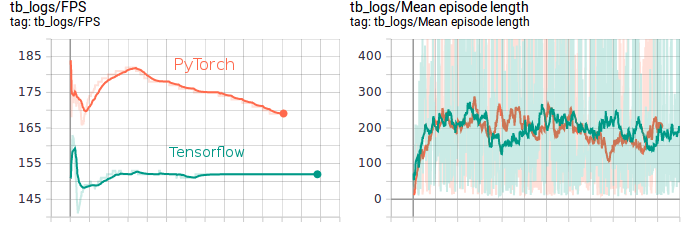
Here is an example of benchmark between TF 2.0 and Torch 1.4 with CartPole-v0 environment:
Troubleshootings
- Tensorflow 2.x doesn't work with Python 3.8 so far, so only Python versions 3.6 and 3.7 are supported
- GPU is not used. See https://www.tensorflow.org/install/gpu
History/Author
I started this open-source RL framework in january 2020, at first to take benefit of tensorflow 2.x readability without sacrifying the performance. Besides coding open-source project, i work for both Airbus and IRT Saint-Exupéry on Earth Observation satellites. Our team is focus on mission planning for satellites and Reinforcement Learning is an approach to solve it. Feel free to discuss with me: Adrien HADJ-SALAH @linkedin
You are welcome to participate to this project
RL related topics
- What is Reinforcement Learning It is supposed that you have knowledge in RL, if it is not the case, take a look to the spinningup from OpenAI
1 maintainer

Metadata
1 maintainer
Release files for sweet-rl 0.1
For a detailed explanation of source distributions (sdists) and built distributions (wheels), please see the package formats documentation.
Source distribution (sdist)
| File | Size | Uploaded | Provenance | Actions |
|---|---|---|---|---|
| sweet-rl-0.1.tar.gz | 12.3 kB | Without provenance | Details for sweet-rl-0.1.tar.gz |
Release files / sweet-rl-0.1.tar.gz
| Download URL | sweet-rl-0.1.tar.gz |
|---|---|
| Size | 12.3 kB |
| Tags | Source |
|
SHA-256 checksum How to use checksums |
2cd6885f95b1fd7169cf11f172c102a0e5dd1c86368fc2973eb4b8e15cba7519
|
|
BLAKE2b-256 checksum How to use checksums |
fe692f1d5ced0f81fc0fb2cc6196f2033420036ccd10e8b9ee1e94f3df4cfee2
|
| Upload date | |
|
Uploaded using Trusted Publishing? What is trusted publishing? |
No |
| Uploaded via |
twine/3.1.1 pkginfo/1.5.0.1 requests/2.22.0 setuptools/45.1.0 requests-toolbelt/0.9.1 tqdm/4.42.0 CPython/3.6.8
|
Security for sweet-rl 0.1
Provenance
Provenance describes where a file came from. On PyPI, provenance is shared via attestations, which provide a verifiable record of the build or publishing details. View details, limitations and caveats.
No provenance found
None of the files in this release were uploaded with provenance metadata.
A note on package security
PyPI is a repository for distributing packages, not a service for auditing them. While third-party security researchers and our staff do their best to detect and remove malicious packages, PyPI cannot guarantee the quality, security or suitability of any given package.
To learn more about protecting yourself from malicious actors, visit our package security documentation.














