
Swiftrank is now using flashrank int8 models from Huggingface repository

Streamlined, Light-Weight, Ultra-Fast State-of-the-Art Reranker, Engineered for Both Retrieval Pipelines and Terminal Applications.
Re-write version of FlashRank with additional features, more flexibility and optimizations.
Features 🌀
🌟 Light Weight:
- No Torch or Transformers: Operable solely on CPU.
- Boasts the tiniest reranking model in the world, ~4MB.
⚡ Ultra Fast:
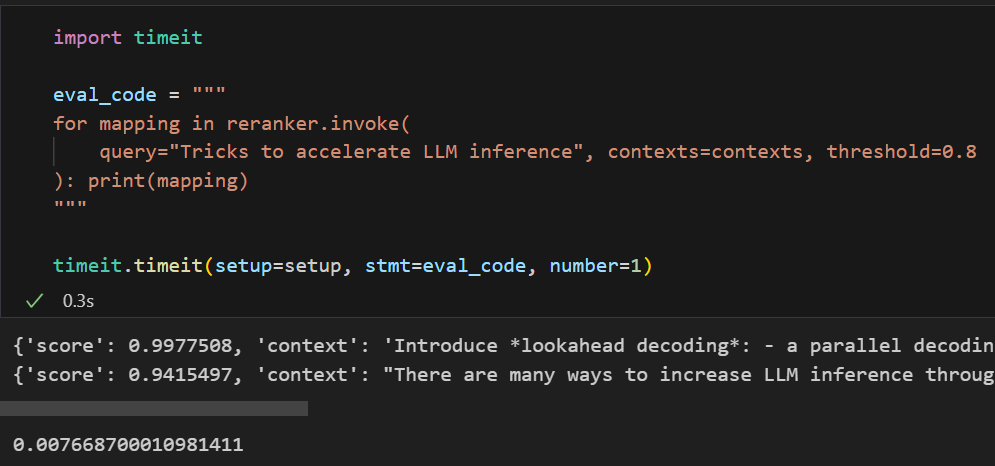
- Reranking efficiency depends on the total token count in contexts and queries, plus the depth of the model (number of layers).
- For illustration, the duration for the process using the standard model is exemplified in the following test:
🎯 Based on SoTA Cross-encoders and other models:
- How good are Zero-shot rerankers? => Reference.
- Supported Models :-
ms-marco-TinyBERT-L-2-v2(default) Model cardms-marco-MiniLM-L-12-v2Model cardrank-T5-flan(Best non cross-encoder reranker) Model cardms-marco-MultiBERT-L-12(Multi-lingual, supports 100+ languages)ce-esci-MiniLM-L12-v2FT on Amazon ESCI dataset (This is interesting because most models are FT on MSFT MARCO Bing queries) Model card
- Why only sleeker models? Reranking is the final leg of larger retrieval pipelines, idea is to avoid any extra overhead especially for user-facing scenarios. To that end models with really small footprint that doesn't need any specialised hardware and yet offer competitive performance are chosen. Feel free to raise issues to add support for a new models as you see fit.
🔧 Versatile Configuration:
- Implements a structured pipeline for the reranking process.
RankerandTokenizerinstances are passed to create the pipeline. - Supports complex dictionary/class objects handling.
- Includes a customizable threshold parameter to filter contexts, ensuring only those with a value equal to or exceeding the threshold are selected.
⌨️ Terminal Integration:
- Pipe your output into
swiftrankcli tool and get reranked output
🌐 API Integration:
- Deploy
swiftrankas an API service for seamless integration into your workflow.
🚀 Installation
pip install swiftrank
CLI Usage 🤗
Usage: swiftrank COMMAND

Rerank contexts provided on stdin.

╭─ Commands ─────────────────────────────────────────────────────╮
│ process    STDIN processor. [ json | jsonl | yaml ]            │
│ serve      Startup a swiftrank server                          │
│ --help,-h  Display this message and exit.                      │
│ --version  Display application version.                        │
╰────────────────────────────────────────────────────────────────╯
╭─ Parameters ───────────────────────────────────────────────────╮
│ *  --query      -q  query for reranking evaluation. [required] │
│    --threshold  -t  filter contexts using threshold.           │
│    --first      -f  get most relevant context.                 │
╰────────────────────────────────────────────────────────────────╯
-
Print most relevant context
cat files/contexts | swiftrank -q "Jujutsu Kaisen: Season 2" -f
Jujutsu Kaisen 2nd Season -
Filtering using threshold
piping the output to
fzfprovides with a selection menucat files/contexts | swiftrank -q "Jujutsu Kaisen: Season 2" -t 0.98 | fzf
Jujutsu Kaisen 2nd Season Jujutsu Kaisen 2nd Season Recaps -
Using different model by setting
SWIFTRANK_MODELenvironment variable- Shell
export SWIFTRANK_MODEL="ms-marco-MiniLM-L-12-v2"
- Powershell
$env:SWIFTRANK_MODEL = "ms-marco-MiniLM-L-12-v2"
cat files/contexts | swiftrank -q "Jujutsu Kaisen: Season 2"
Jujutsu Kaisen 2nd Season Jujutsu Kaisen 2nd Season Recaps Jujutsu Kaisen Jujutsu Kaisen 0 Movie Jujutsu Kaisen Official PV Shingeki no Kyojin Season 2 Shingeki no Kyojin Season 3 Part 2 Shingeki no Kyojin Season 3 Shingeki no Kyojin: The Final Season Kimi ni Todoke 2nd Season - Shell
Handling Complex Data
Note: The schema closely resembles that of JQ, but employs a custom parser to avoid the hassle of installing JQ.
Usage: swiftrank process [OPTIONS]

STDIN processor. [ json | jsonl | yaml ]

╭─ Parameters ──────────────────────────────────────────────╮
│ --pre   -r  schema for pre-processing input.              │
│ --ctx   -c  schema for extracting context.                │
│ --post  -p  schema for extracting field after reranking.  │
╰───────────────────────────────────────────────────────────╯
-
jsoncat files/contexts.json | swiftrank -q "Jujutsu Kaisen: Season 2" process -r ".categories[].items" -c '.name' -t 0.9
Jujutsu Kaisen 2nd Season
Jujutsu Kaisen 2nd Season Recaps
Jujutsu Kaisen
Jujutsu Kaisen Official PV
Jujutsu Kaisen 0 Movie
Provide one field for reranking and retrieve a different field as the output using
--post/-poptioncat files/contexts.json | swiftrank -q "Jujutsu Kaisen: Season 2" process -r ".categories[].items" -c '.name' -p '.url' -f
https://myanimelist.net/anime/51009/Jujutsu_Kaisen_2nd_Season -
yamlcat files/contexts.yaml | swiftrank -q "Monogatari Series: Season 2" process -r ".categories[].items" -c '.name' -f
Monogatari Series: Second SeasonProvide one field for reranking and receive a different field as the output using
--post/-poptioncat files/contexts.yaml | swiftrank -q "Monogatari Series: Season 2" process -r ".categories[].items" -c '.name' -p '.payload.status' -f
Finished Airing
Json and Yaml lines doesn't require
--pre/-roption, as they're by default loaded into an array object.
-
jsonlinescat files/contexts.jsonl | swiftrank -q "Monogatari Series: Season 2" process -c '.name' -p '.payload.aired' -f
Jul 7, 2013 to Dec 29, 2013 -
yamllinescat files/contextlines.yaml | swiftrank -q "Monogatari Series: Season 2" process -c '.name' -f
Monogatari Series: Second Season
Startup a FastAPI server instance
Usage: swiftrank serve [OPTIONS]

Startup a swiftrank server

╭─ Parameters ──────────────────────────────╮
│ --host  Host name [default: 0.0.0.0]      │
│ --port  Port number. [default: 12345]     │
╰───────────────────────────────────────────╯
swiftrank serve
[GET] /models - List Models
[POST] /rerank - Rerank Endpoint
Library Usage 🤗
-
Build a
ReRankPipelineinstance- From
RankerandTokenizerinstancefrom swiftrank import Ranker, Tokenizer, ReRankPipeline ranker = Ranker(model_id="ms-marco-TinyBERT-L-2-v2") tokenizer = Tokenizer(model_id="ms-marco-TinyBERT-L-2-v2") reranker = ReRankPipeline(ranker=ranker, tokenizer=tokenizer)
- Or directly from Model ID
from swiftrank import ReRankPipeline

reranker = ReRankPipeline.from_model_id("ms-marco-TinyBERT-L-2-v2")
- From
-
Evaluate the pipeline
contexts = [
    "Introduce *lookahead decoding*: - a parallel decoding algo to accelerate LLM inference - w/o the need for a draft model or a data store - linearly decreases # decoding steps relative to log(FLOPs) used per decoding step.",
    "LLM inference efficiency will be one of the most crucial topics for both industry and academia, simply because the more efficient you are, the more $$$ you will save. vllm project is a must-read for this direction, and now they have just released the paper",
    "There are many ways to increase LLM inference throughput (tokens/second) and decrease memory footprint, sometimes at the same time. Here are a few methods I’ve found effective when working with Llama 2. These methods are all well-integrated with Hugging Face. This list is far from exhaustive; some of these techniques can be used in combination with each other and there are plenty of others to try. - Bettertransformer (Optimum Library): Simply call `model.to_bettertransformer()` on your Hugging Face model for a modest improvement in tokens per second.  - Fp4 Mixed-Precision (Bitsandbytes): Requires minimal configuration and dramatically reduces the model's memory footprint.  - AutoGPTQ: Time-consuming but leads to a much smaller model and faster inference. The quantization is a one-time cost that pays off in the long run.",
    "Ever want to make your LLM inference go brrrrr but got stuck at implementing speculative decoding and finding the suitable draft model? No more pain! Thrilled to unveil Medusa, a simple framework that removes the annoying draft model while getting 2x speedup.",
    "vLLM is a fast and easy-to-use library for LLM inference and serving. vLLM is fast with: State-of-the-art serving throughput Efficient management of attention key and value memory with PagedAttention Continuous batching of incoming requests Optimized CUDA kernels"
]
for ctx in reranker.invoke(
    query="Tricks to accelerate LLM inference", contexts=contexts
):
    print(ctx)
Introduce *lookahead decoding*: - a parallel decoding algo to accelerate LLM inference - w/o the need for a draft model or a data store - linearly decreases # decoding steps relative to log(FLOPs) used per decoding step. There are many ways to increase LLM inference throughput (tokens/second) and decrease memory footprint, sometimes at the same time. Here are a few methods I’ve found effective when working with Llama 2. These methods are all well-integrated with Hugging Face. This list is far from exhaustive; some of these techniques can be used in combination with each other and there are plenty of others to try. - Bettertransformer (Optimum Library): Simply call `model.to_bettertransformer()` on your Hugging Face model for a modest improvement in tokens per second. - Fp4 Mixed-Precision (Bitsandbytes): Requires minimal configuration and dramatically reduces the model's memory footprint. - AutoGPTQ: Time-consuming but leads to a much smaller model and faster inference. The quantization is a one-time cost that pays off in the long run. vLLM is a fast and easy-to-use library for LLM inference and serving. vLLM is fast with: State-of-the-art serving throughput Efficient management of attention key and value memory with PagedAttention Continuous batching of incoming requests Optimized CUDA kernels LLM inference efficiency will be one of the most crucial topics for both industry and academia, simply because the more efficient you are, the more $$$ you will save. vllm project is a must-read for this direction, and now they have just released the paper Ever want to make your LLM inference go brrrrr but got stuck at implementing speculative decoding and finding the suitable draft model? No more pain! Thrilled to unveil Medusa, a simple framework that removes the annoying draft model while getting 2x speedup. -
Get score mapped contexts as output
for ctx_w_score in reranker.invoke_with_score(
    query="Tricks to accelerate LLM inference", contexts=contexts
):
    print(ctx_w_score)
(0.9977508, 'Introduce *lookahead decoding*: - a parallel decoding algo to accelerate LLM inference - w/o the need for a draft model or a data store - linearly decreases # decoding steps relative to log(FLOPs) used per decoding step.') (0.9415497, "There are many ways to increase LLM inference throughput (tokens/second) and decrease memory footprint, sometimes at the same time. Here are a few methods I’ve found effective when working with Llama 2. These methods are all well-integrated with Hugging Face. This list is far from exhaustive; some of these techniques can be used in combination with each other and there are plenty of others to try. - Bettertransformer (Optimum Library): Simply call `model.to_bettertransformer()` on your Hugging Face model for a modest improvement in tokens per second. - Fp4 Mixed-Precision (Bitsandbytes): Requires minimal configuration and dramatically reduces the model's memory footprint. - AutoGPTQ: Time-consuming but leads to a much smaller model and faster inference. The quantization is a one-time cost that pays off in the long run.") (0.47455463, 'vLLM is a fast and easy-to-use library for LLM inference and serving. vLLM is fast with: State-of-the-art serving throughput Efficient management of attention key and value memory with PagedAttention Continuous batching of incoming requests Optimized CUDA kernels') (0.43783104, 'LLM inference efficiency will be one of the most crucial topics for both industry and academia, simply because the more efficient you are, the more $$$ you will save. vllm project is a must-read for this direction, and now they have just released the paper') (0.043041725, 'Ever want to make your LLM inference go brrrrr but got stuck at implementing speculative decoding and finding the suitable draft model? No more pain! Thrilled to unveil Medusa, a simple framework that removes the annoying draft model while getting 2x speedup.') -
Want to filter contexts? Utilize
thresholdparameter.for ctx in reranker.invoke( query="Tricks to accelerate LLM inference", contexts=contexts, threshold=0.8 ): print(ctx)
Introduce *lookahead decoding*: - a parallel decoding algo to accelerate LLM inference - w/o the need for a draft model or a data store - linearly decreases # decoding steps relative to log(FLOPs) used per decoding step. There are many ways to increase LLM inference throughput (tokens/second) and decrease memory footprint, sometimes at the same time. Here are a few methods I’ve found effective when working with Llama 2. These methods are all well-integrated with Hugging Face. This list is far from exhaustive; some of these techniques can be used in combination with each other and there are plenty of others to try. - Bettertransformer (Optimum Library): Simply call `model.to_bettertransformer()` on your Hugging Face model for a modest improvement in tokens per second. - Fp4 Mixed-Precision (Bitsandbytes): Requires minimal configuration and dramatically reduces the model's memory footprint. - AutoGPTQ: Time-consuming but leads to a much smaller model and faster inference. The quantization is a one-time cost that pays off in the long run. -
Have dictionary or class instance as contexts? Utilize
keyparameter.-
dictionaryobjectcontexts = [ {"id": 1, "content": "Introduce *lookahead decoding*: - a parallel decoding algo to accelerate LLM inference - w/o the need for a draft model or a data store - linearly decreases # decoding steps relative to log(FLOPs) used per decoding step."}, {"id": 2, "content": "LLM inference efficiency will be one of the most crucial topics for both industry and academia, simply because the more efficient you are, the more $$$ you will save. vllm project is a must-read for this direction, and now they have just released the paper"}, {"id": 3, "content": "There are many ways to increase LLM inference throughput (tokens/second) and decrease memory footprint, sometimes at the same time. Here are a few methods I’ve found effective when working with Llama 2. These methods are all well-integrated with Hugging Face. This list is far from exhaustive; some of these techniques can be used in combination with each other and there are plenty of others to try. - Bettertransformer (Optimum Library): Simply call `model.to_bettertransformer()` on your Hugging Face model for a modest improvement in tokens per second. - Fp4 Mixed-Precision (Bitsandbytes): Requires minimal configuration and dramatically reduces the model's memory footprint. - AutoGPTQ: Time-consuming but leads to a much smaller model and faster inference. The quantization is a one-time cost that pays off in the long run."}, {"id": 4, "content": "Ever want to make your LLM inference go brrrrr but got stuck at implementing speculative decoding and finding the suitable draft model? No more pain! Thrilled to unveil Medusa, a simple framework that removes the annoying draft model while getting 2x speedup."}, {"id": 5, "content": "vLLM is a fast and easy-to-use library for LLM inference and serving. vLLM is fast with: State-of-the-art serving throughput Efficient management of attention key and value memory with PagedAttention Continuous batching of incoming requests Optimized CUDA kernels"} ] for ctx in reranker.invoke( query="Tricks to accelerate LLM inference", contexts=contexts, key=lambda x: x['content'] ): print(ctx)
{'id': 1, 'content': 'Introduce *lookahead decoding*: - a parallel decoding algo to accelerate LLM inference - w/o the need for a draft model or a data store - linearly decreases # decoding steps relative to log(FLOPs) used per decoding step.'} {'id': 3, 'content': "There are many ways to increase LLM inference throughput (tokens/second) and decrease memory footprint, sometimes at the same time. Here are a few methods I’ve found effective when working with Llama 2. These methods are all well-integrated with Hugging Face. This list is far from exhaustive; some of these techniques can be used in combination with each other and there are plenty of others to try. - Bettertransformer (Optimum Library): Simply call `model.to_bettertransformer()` on your Hugging Face model for a modest improvement in tokens per second. - Fp4 Mixed-Precision (Bitsandbytes): Requires minimal configuration and dramatically reduces the model's memory footprint. - AutoGPTQ: Time-consuming but leads to a much smaller model and faster inference. The quantization is a one-time cost that pays off in the long run."} {'id': 5, 'content': 'vLLM is a fast and easy-to-use library for LLM inference and serving. vLLM is fast with: State-of-the-art serving throughput Efficient management of attention key and value memory with PagedAttention Continuous batching of incoming requests Optimized CUDA kernels'} {'id': 2, 'content': 'LLM inference efficiency will be one of the most crucial topics for both industry and academia, simply because the more efficient you are, the more $$$ you will save. vllm project is a must-read for this direction, and now they have just released the paper'} {'id': 4, 'content': 'Ever want to make your LLM inference go brrrrr but got stuck at implementing speculative decoding and finding the suitable draft model? No more pain! Thrilled to unveil Medusa, a simple framework that removes the annoying draft model while getting 2x speedup.'} -
class instance or
pydantic.BaseModelobjectfrom langchain_core.documents import Document contexts = [ Document(page_content="Introduce *lookahead decoding*: - a parallel decoding algo to accelerate LLM inference - w/o the need for a draft model or a data store - linearly decreases # decoding steps relative to log(FLOPs) used per decoding step."), Document(page_content="LLM inference efficiency will be one of the most crucial topics for both industry and academia, simply because the more efficient you are, the more $$$ you will save. vllm project is a must-read for this direction, and now they have just released the paper"), Document(page_content="There are many ways to increase LLM inference throughput (tokens/second) and decrease memory footprint, sometimes at the same time. Here are a few methods I’ve found effective when working with Llama 2. These methods are all well-integrated with Hugging Face. This list is far from exhaustive; some of these techniques can be used in combination with each other and there are plenty of others to try. - Bettertransformer (Optimum Library): Simply call `model.to_bettertransformer()` on your Hugging Face model for a modest improvement in tokens per second. - Fp4 Mixed-Precision (Bitsandbytes): Requires minimal configuration and dramatically reduces the model's memory footprint. - AutoGPTQ: Time-consuming but leads to a much smaller model and faster inference. The quantization is a one-time cost that pays off in the long run."), Document(page_content="Ever want to make your LLM inference go brrrrr but got stuck at implementing speculative decoding and finding the suitable draft model? No more pain! Thrilled to unveil Medusa, a simple framework that removes the annoying draft model while getting 2x speedup."), Document(page_content="vLLM is a fast and easy-to-use library for LLM inference and serving. vLLM is fast with: State-of-the-art serving throughput Efficient management of attention key and value memory with PagedAttention Continuous batching of incoming requests Optimized CUDA kernels") ] for ctx in reranker.invoke( query="Tricks to accelerate LLM inference", contexts=contexts, key=lambda x: x.page_content ): print(ctx)
page_content='Introduce *lookahead decoding*: - a parallel decoding algo to accelerate LLM inference - w/o the need for a draft model or a data store - linearly decreases # decoding steps relative to log(FLOPs) used per decoding step.'
page_content="There are many ways to increase LLM inference throughput (tokens/second) and decrease memory footprint, sometimes at the same time. Here are a few methods I’ve found effective when working with Llama 2. These methods are all well-integrated with Hugging Face. This list is far from exhaustive; some of these techniques can be used in combination with each other and there are plenty of others to try. - Bettertransformer (Optimum Library): Simply call `model.to_bettertransformer()` on your Hugging Face model for a modest improvement in tokens per second.  - Fp4 Mixed-Precision (Bitsandbytes): Requires minimal configuration and dramatically reduces the model's memory footprint.  - AutoGPTQ: Time-consuming but leads to a much smaller model and faster inference. The quantization is a one-time cost that pays off in the long run."
page_content='vLLM is a fast and easy-to-use library for LLM inference and serving. vLLM is fast with: State-of-the-art serving throughput Efficient management of attention key and value memory with PagedAttention Continuous batching of incoming requests Optimized CUDA kernels'
page_content='LLM inference efficiency will be one of the most crucial topics for both industry and academia, simply because the more efficient you are, the more $$$ you will save. vllm project is a must-read for this direction, and now they have just released the paper'
page_content='Ever want to make your LLM inference go brrrrr but got stuck at implementing speculative decoding and finding the suitable draft model? No more pain! Thrilled to unveil Medusa, a simple framework that removes the annoying draft model while getting 2x speedup.'
-
Acknowledgment of Original Repository
This project is derived from FlashRank, which is licensed under the Apache License 2.0. We extend our gratitude to the original authors and contributors for their work. The original repository provided a foundational framework for the development of our project, and we have built upon it with additional features and improvements.
Citation
@software{Damodaran_FlashRank_Lightest_and_2023,
author = {Damodaran, Prithiviraj},
doi = {10.5281/zenodo.10426927},
month = dec,
title = {{FlashRank, Lightest and Fastest 2nd Stage Reranker for search pipelines.}},
url = {https://github.com/PrithivirajDamodaran/FlashRank},
version = {1.0.0},
year = {2023}
}
1 maintainer

Metadata
1 maintainer
Release files for swiftrank 1.3.0
For a detailed explanation of source distributions (sdists) and built distributions (wheels), please see the package formats documentation.
Source distribution (sdist)
| File | Size | Uploaded | |
|---|---|---|---|
| swiftrank-1.3.0.tar.gz | 20.0 kB | Details |
Built distribution (wheel)
| File | Interpreter | ABI | Platform | Reset |
|---|---|---|---|---|
| swiftrank-1.3.0-py3-none-any.whl | Python 3 | none | any | Details |
Total release size: 38.2 kB
Release files / swiftrank-1.3.0.tar.gz
| Download URL | swiftrank-1.3.0.tar.gz |
|---|---|
| Size | 20.0 kB |
| Tags | Source |
|
SHA-256 checksum How to use checksums |
afdc75ac3cc644f7c74f50433107af4e1e41e9128aedfce51ab59f616abb3d5f
|
|
BLAKE2b-256 checksum How to use checksums |
df7f2ffe3d999681ead03b4cde3d2cd5b80c6f656669fdab15712502eddb262c
|
| Upload date | |
|
Uploaded using Trusted Publishing? What is trusted publishing? |
No |
| Uploaded via |
poetry/1.7.1 CPython/3.10.11 Windows/10
|
Release files / swiftrank-1.3.0-py3-none-any.whl
| Download URL | swiftrank-1.3.0-py3-none-any.whl |
|---|---|
| Size | 18.1 kB |
| Tags | Python 3 |
|
SHA-256 checksum How to use checksums |
bcf5379321ee5e38394ba690c543a030893ac0890fa87bf741ca401eecb143c7
|
|
BLAKE2b-256 checksum How to use checksums |
215099c693c2d8e0fa5dd99cbf6e38c87ae050c03764b9ddebb57cdc32cb3b5b
|
| Upload date | |
|
Uploaded using Trusted Publishing? What is trusted publishing? |
No |
| Uploaded via |
poetry/1.7.1 CPython/3.10.11 Windows/10
|














