
swim-protocol
SWIM protocol implementation for exchanging cluster membership status and metadata.





This library is intended to fit into an asyncio event loop to help synchronize a distributed group of processes.
Introduction
API Documentation
Install and Usage
$ pip install swim-protocol
File Sync Tool
A basic tool for reporting cluster membership and synchronizing metadata as files is provided:
$ swim-protocol-sync --name 127.0.0.1:2001 --peer 127.0.0.1:2002 ~/node1
$ swim-protocol-sync --name 127.0.0.1:2002 --peer 127.0.0.1:2001 ~/node2
While running, the state of the cluster and the metadata of each member are visible on the filesystem.
$ tree -a ~/node1
node1
├── .available
│   └── 127.0.0.1:2002 -> ../127.0.0.1:2002
├── .local -> 127.0.0.1:2001
├── .offline
├── .online
│   └── 127.0.0.1:2002 -> ../127.0.0.1:2002
├── .suspect
├── .unavailable
├── 127.0.0.1:2001
│   └── file-one.txt
└── 127.0.0.1:2002
    └── file-two.txt
To change the metadata of the local cluster member, edit the files and issue a SIGHUP to the process:
$ vim ~/node1/.local/file-one.txt
$ pkill -HUP -f swim-protocol-sync
Running the Demo
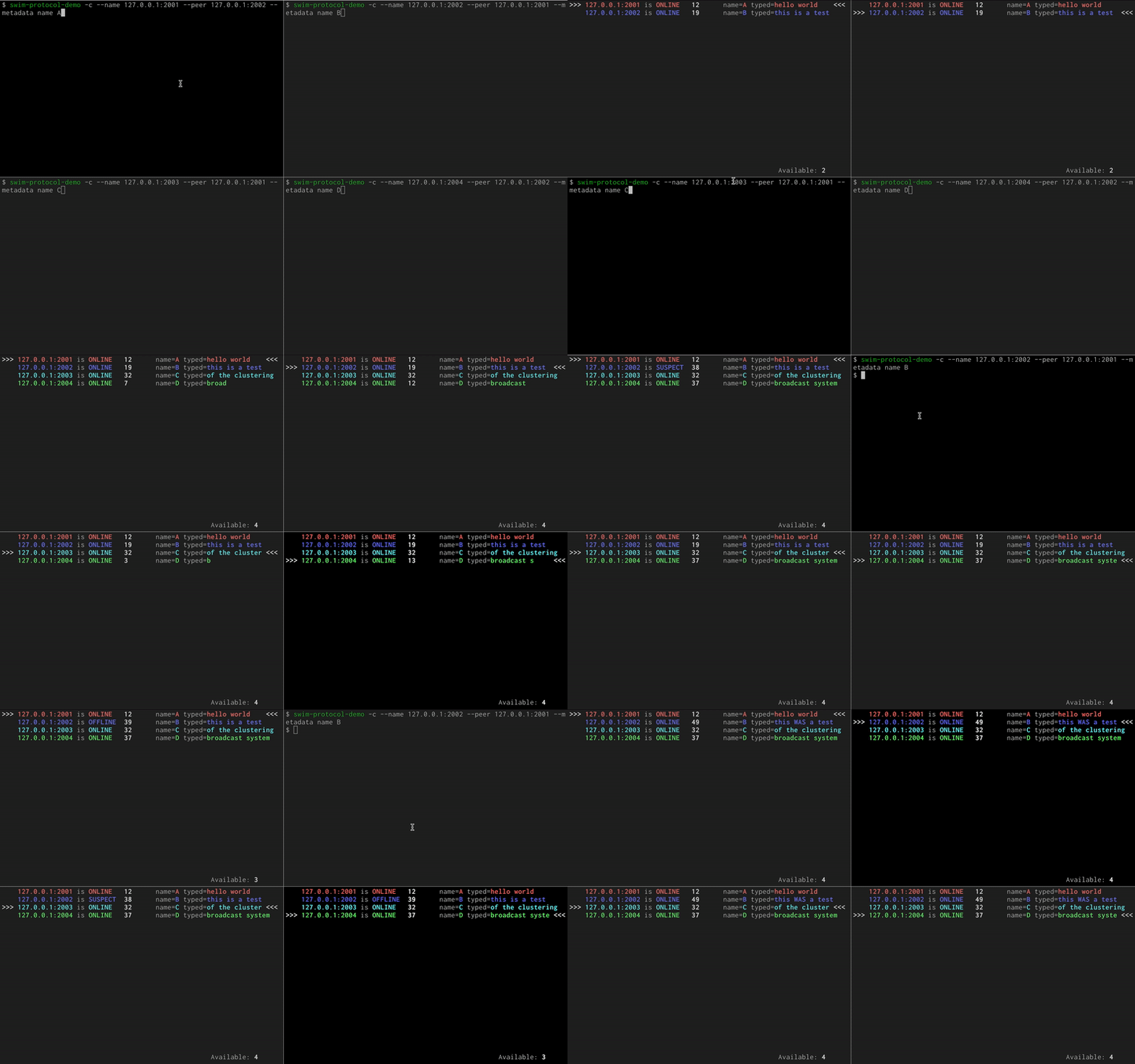
There is a demo application included as a reference implementation. Try it out by running the following, each from a new terminal window, and use Ctrl-C to exit:
$ swim-protocol-demo --name 127.0.0.1:2001 --peer 127.0.0.1:2003
$ swim-protocol-demo --name 127.0.0.1:2002 --peer 127.0.0.1:2001
$ swim-protocol-demo --name 127.0.0.1:2003 --peer 127.0.0.1:2001
$ swim-protocol-demo --name 127.0.0.1:2004 --peer 127.0.0.1:2003
Typing in any window will disseminate what has been typed across the cluster with eventual consistency.
Getting Started
First you should create a new UdpConfig object:
from swimprotocol.udp import UdpConfig

config = UdpConfig(local_name='127.0.0.1:2001',
                   local_metadata={'name': b'one'},
                   peers=['127.0.0.1:2002'],
                   secret='my secret')
All other config arguments have default values, which are tuned somewhat arbitrarily with a small cluster of 3-4 members in mind.
Now you can create the cluster members manager and transport layer, and enter the event loop:
from contextlib import AsyncExitStack
from swimprotocol.members import Member, Members
from swimprotocol.udp import UdpTransport
from swimprotocol.worker import Worker

members = Members(config)
worker = Worker(config, members)
transport = UdpTransport(config, worker)

async def run() -> None:
    async with AsyncExitStack() as stack:
        await stack.enter_async_context(transport)
        await stack.enter_async_context(worker)
        await stack.enter_async_context(
            members.listener.on_notify(on_member_change))
        await ...  # run your application

async def on_member_change(member: Member) -> None:
    ...  # handle a change in member status or metadata
These snippets demonstrate the UDP transport layer directly. For a more generic approach that uses argparse and load_transport, check out the demo or the sync tool.
If your application is deployed as a Docker Service, the UdpConfig
discovery=True keyword argument can be used to discover configuration based
on the service name. See the documentation for more comprehensive usage.
Checking Members
The Members object provides a few ways to check on the cluster and its members:
for member in members.non_local:
    # all other known cluster members
    print(member.name, member.status, member.metadata)

from swimprotocol.status import Status
for member in members.get_status(Status.AVAILABLE):
    # all cluster members except offline
    print(member.name, member.status, member.metadata)
Alternatively, listen for status or metadata changes on all members:
from swimprotocol.member import Member

async def _updated(member: Member) -> None:
    print('updated:', member.name, member.status, member.metadata)

async with AsyncExitStack() as stack:
    # ...
    stack.enter_context(members.listener.on_notify(_updated))
UDP Transport Security
The UdpTransport transport layer (the only included transport implementation) uses salted hmac digests to sign each UDP packet payload. Any UDP packets received that are malformed or have an invalid signature are silently ignored. The eventual consistency model should recover from packet loss.
The signatures rely on a shared secret between all cluster members, given
as the secret=b'...' argument to the UdpConfig constructor. If
secret=None is used, it defaults to uuid.getnode() but this is not
secure for production setups unless all sockets are bound to a local loopback
interface.
The cluster member metadata is not encrypted during transmission, so only private networks should be used if metadata includes any secret data, or that secret data should be encrypted separately by the application.
If member metadata is larger than can be transmitted in a single UDP packet (hard-coded at 1500 bytes due to MTU sizes on public networks), a TCP connection is used instead. There is no additional protocol for TCP; the connection is opened, the oversized packet is transmitted, and then the connection is closed without waiting for a response.
Development
You will need to do some additional setup to develop and test plugins. Install Hatch to use the CLI examples below.
Run all tests and linters:
$ hatch run check
Because this project supports several versions of Python, you can use the following to run the checks on all versions:
$ hatch run all:check
Type Hinting
This project makes heavy use of Python's type hinting system, with the intention of a clean run of mypy:
$ mypy
No code contribution will be accepted unless it makes every effort to use type hinting to the extent possible and common in the rest of the codebase.
1 maintainer

Metadata
1 maintainer
Release files for swim-protocol 0.6.3
For a detailed explanation of source distributions (sdists) and built distributions (wheels), please see the package formats documentation.
Source distribution (sdist)
| File | Size | Uploaded | |
|---|---|---|---|
| swim_protocol-0.6.3.tar.gz | 27.2 kB | Details |
Built distribution (wheel)
| File | Interpreter | ABI | Platform | Reset |
|---|---|---|---|---|
| swim_protocol-0.6.3-py3-none-any.whl | Python 3 | none | any | Details |
Total release size: 63.2 kB
Release files / swim_protocol-0.6.3.tar.gz
| Download URL | swim_protocol-0.6.3.tar.gz |
|---|---|
| Size | 27.2 kB |
| Tags | Source |
|
SHA-256 checksum How to use checksums |
0fa43941c8290e2cb2e896c5672b15a74870d4a240b3168eff17844789d94a9b
|
|
BLAKE2b-256 checksum How to use checksums |
f73f263e9c674d634c332e3f5768940e1b6a7cd1f312ab0360b43dd5039e65a3
|
| Upload date | |
|
Uploaded using Trusted Publishing? What is trusted publishing? |
No |
| Uploaded via |
python-httpx/0.24.1
|
Release files / swim_protocol-0.6.3-py3-none-any.whl
| Download URL | swim_protocol-0.6.3-py3-none-any.whl |
|---|---|
| Size | 35.9 kB |
| Tags | Python 3 |
|
SHA-256 checksum How to use checksums |
61f7fa79a1bbf20e2165c47acfc2786978f279df3af9744e05a71fa1d45828d0
|
|
BLAKE2b-256 checksum How to use checksums |
672cdc9c58cd47708fb532f736d0c7e0ad0bb404a339ac8550c830b7fe20136c
|
| Upload date | |
|
Uploaded using Trusted Publishing? What is trusted publishing? |
No |
| Uploaded via |
python-httpx/0.24.1
|














