
███████╗██╗    ██╗██╗████████╗ ██████╗██╗  ██╗██████╗  █████╗  ██████╗██╗  ██╗
██╔════╝██║    ██║██║╚══██╔══╝██╔════╝██║  ██║██╔══██╗██╔══██╗██╔════╝██║ ██╔╝
███████╗██║ █╗ ██║██║   ██║   ██║     ███████║██████╔╝███████║██║     █████╔╝
╚════██║██║███╗██║██║   ██║   ██║     ██╔══██║██╔══██╗██╔══██║██║     ██╔═██╗
███████║╚███╔███╔╝██║   ██║   ╚██████╗██║  ██║██████╔╝██║  ██║╚██████╗██║  ██╗
╚══════╝ ╚══╝╚══╝ ╚═╝   ╚═╝    ╚═════╝╚═╝  ╚═╝╚═════╝ ╚═╝  ╚═╝ ╚═════╝╚═╝  ╚═╝
switchback — Python web scraper: any URL → clean Markdown
One cost-ordered scrape cascade — HTTP → stealth browser → paid — shared by every tool.
Give it a URL; it tries the cheapest way to get clean Markdown first and only escalates to a heavier (slower, costlier) tier when the cheap one is walled. Stops at the first success.




⭐ If switchback saved you a paid-API bill, a star helps others find it.
Why
Most scrapers either give up on hard pages or send everything through an expensive headless browser / paid API. switchback orders the methods by cost and walks them cheapest-first, per host, learning which tier wins where so the next run starts there. The easy majority stays free; only genuinely-walled hosts pay for the heavy tiers.
- Cost-ordered cascade — free APIs → cheap HTTP → anti-bot solver → stealth browser → paid API.
- Per-host memory (botwall) — remembers the winning tier per host, skip-lists hard blockers, auto-skips hosts stuck on the paid tier.
- Cost-scoped residential egress — routes only walled hosts through a residential proxy, never the easy majority.
- One shape, three entry points — Python library, CLI (JSON on stdout), or an HTTP service.
- Observable — every attempt is an OpenTelemetry span; logs ship trace-correlated to any OTLP backend (Jaeger, Tempo, SigNoz).
- Runs with any subset installed — each tier imports its deps lazily; a missing one is just a tier miss.
Quickstart
pip install switchback # core: cheap tiers (0/1) + search
from switchback import scrape

for r in scrape(["https://arxiv.org/abs/1706.03762"]):
    print(r.source_method, len(r.markdown))
python -m switchback https://example.com/article # JSON on stdout — bridge for any language
That's the whole loop. Add tiers as you need them (see Install).
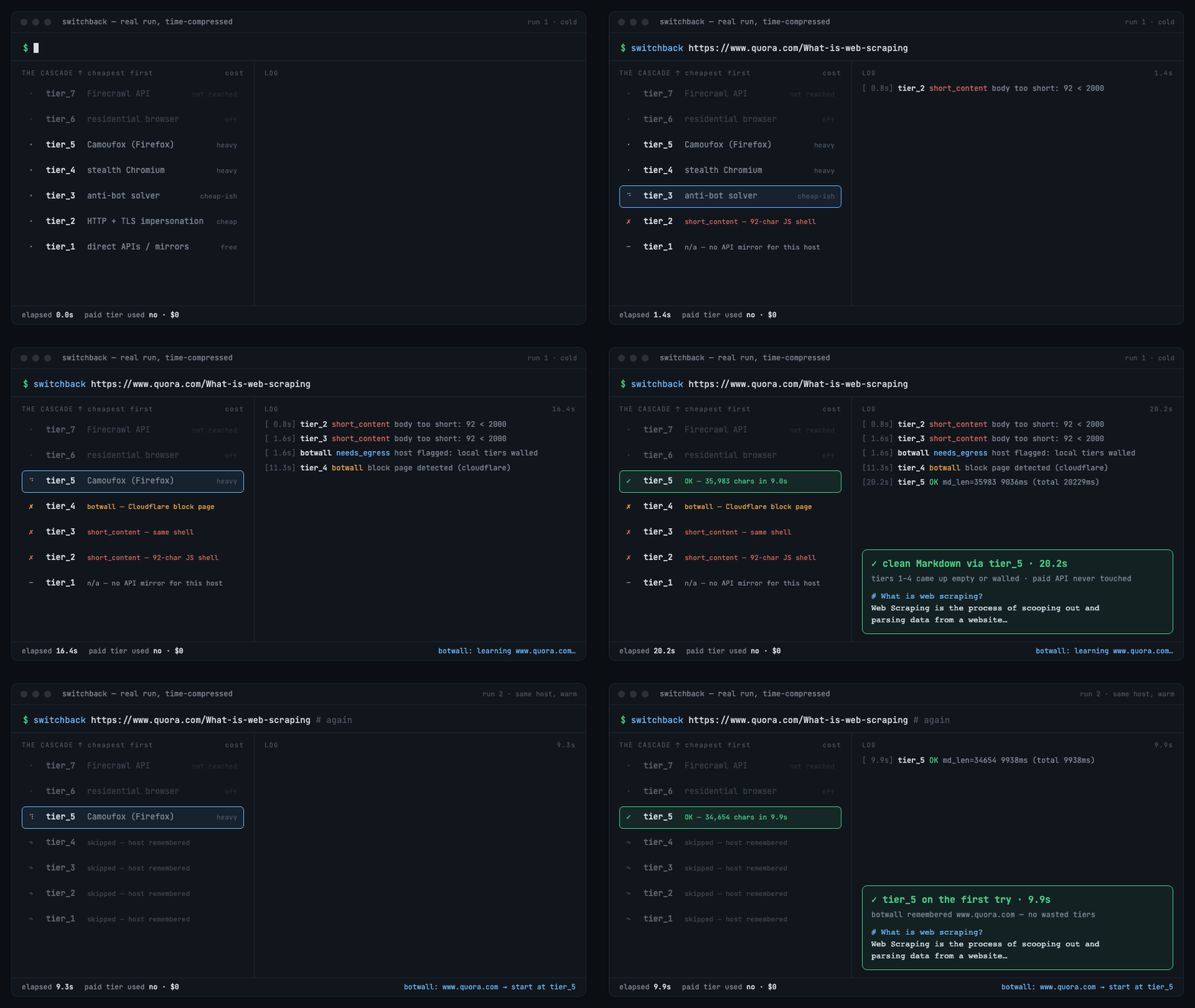
A real run, time-compressed. Run 1 climbs the cascade until a tier gets through. Run 2 hits the same host, and botwall starts at the tier that won last time. The paid tier is never touched.
The cascade (stop at first success)
| Tier | Strategy | Cost |
|---|---|---|
| tier_1 | Direct APIs / mirrors (arxiv, wikipedia, EuropePMC, YouTube transcripts; extend: job boards) | free, cleanest |
| tier_2 | Plain HTTP + TLS impersonation (curl_cffi), incl. PDFs and office/ebook files |
cheap |
| tier_3 | Cloudflare / anti-bot solver (cloudscraper, install .[cloudflare]) — on by default (opt out: SCRAPER_DISABLE_CLOUDSCRAPER) |
cheap-ish (~5s/host) |
| tier_4 | Stealth headless browser (patchright, Chromium) |
heavy |
| tier_5 | Camoufox (Firefox stealth) — on by default (opt out: SCRAPER_DISABLE_CAMOUFOX) |
heavy + slow (~40s on hard CF) |
| tier_6 | Residential-IP browser over CDP (BU_CDP_URL) — off unless configured |
heavy (remote egress) |
| tier_7 | Firecrawl (paid, env-gated, audited) | paid, last resort |
Every URL has a wall-clock budget (SCRAPER_DEADLINE_S, default 45s) checked between
tiers so one URL can't run the whole cascade of timeouts. Each tier attempt records
latency + outcome (ok / short_content / rate_limited / miss / not_applicable)
to its span and the botwall event log; the root span carries total latency and the final
outcome (incl. deadline_exceeded).
Search (query → URLs) is separate from the scrape cascade: switchback.search() /
python -m switchback.api --search <query>, backed by a local SearXNG.
Install
pip install switchback                 # core: normalization + cheap tiers (tier_1/tier_2) + search
pip install "switchback[cloudflare]"   # + tier_3 Cloudflare/anti-bot solver (cloudscraper)
pip install "switchback[server]"       # + HTTP service (fastapi, uvicorn) incl. /metrics + /traces
pip install "switchback[browser]" && patchright install chromium   # + tier_4 stealth Chromium
pip install "switchback[camoufox]" && camoufox fetch               # + tier_5 Firefox stealth
pip install "switchback[firecrawl]"    # + tier_7 paid API (needs FIRECRAWL_API_KEY)
pip install "switchback[tracing]"      # + OpenTelemetry -> any OTLP backend
pip install "switchback[all]"          # all of the above
pip install "switchback[mcp]"          # + MCP server for agents (switchback-mcp)
pip install "switchback[youtube]"      # + YouTube transcripts in tier_1 (and set SCRAPER_YOUTUBE=1)
pip install "switchback[documents]"    # + .docx/.pptx/.xlsx/.xls/.epub → markdown in tier_2 (and set SCRAPER_DOCUMENTS=1)
mcp, youtube and documents are not part of [all], so upgrading an existing
[all] install doesn't pull new dependencies (documents brings markitdown and
onnxruntime). Add them by name. YouTube transcripts and office files also need
their switch (SCRAPER_YOUTUBE=1, SCRAPER_DOCUMENTS=1), because they change what
those URLs return; without it they behave exactly as before, installed or not.
For tier_3's full v3 JS-VM + Turnstile + stealth, install the Enhanced Edition
3.x fork (PyPI's cloudscraper is the older v1/v2 — PyPI forbids pinning a
git-URL dep inside a published package, so install it alongside):
pip install "cloudscraper @ git+https://github.com/VeNoMouS/cloudscraper@3.0.0"
Or run the whole thing as a container:
docker build -t switchback . && docker run -p 8799:8799 switchback.
Production / cold-start deployment
The two heavy tiers pull dependencies that often can't be baked into a base image
and land after boot (e.g. an async install thread on Azure). Until they're
ready, those tiers report unavailable (a distinct outcome carrying the exact
fix) and the cascade falls through — they are never silently skipped. Checklist:
- tier_4 is the real workhorse for Cloudflare/JS sites — make sure its browser
is installed:
patchright install chromium(note: patchright, not vanillaplaywright). On a cold start, run this in your post-boot install step/thread; tier_4 flips to ready once it finishes. - tier_3 needs the cloudscraper 3.x fork (above) to attempt stealth. With the
frozen PyPI
cloudscraperit reportsunavailableand fails fast (no wasted solve budget) instead of erroring mid-cascade. tier_3 is a weak solver for modern Cloudflare — treat it as a cheap try before the browser, not the primary. - Install Node.js for tier_3's v3 JS-VM challenges — faster and thread-safe vs. the pure-Python js2py fallback (relevant under concurrent load).
- Bound tier_3's solve budget with
SCRAPER_TIER_3_TIMEOUT_S(default25; the oldSCRAPER_CLOUDSCRAPER_TIMEOUT_Sis still honored) so an unsolvable challenge can't eat the per-URL deadline before the browser tier runs. Lower it (e.g.12) if tier_3 rarely wins on your hosts.
Scraping URLs other people submit
If the URLs come from users you don't fully trust (a "save this link" box, a feed reader, a public API), two opt-in switches harden the engine. Both default to off, so nothing changes unless you set them:
export SCRAPER_DISABLE_CLOUDSCRAPER=1   # tier_3 runs site JavaScript outside a browser sandbox
export SCRAPER_BROWSER_BLOCK_PRIVATE=1  # browser tiers can't reach your machine's or network's private services
- Why tier_3: solving a Cloudflare JS challenge means running JavaScript the
site sent, in js2py or Node's
vmmodule, and neither is a security boundary. The browser tiers run page JavaScript inside the browser's own sandbox instead. - Install tier_4's browser first (
patchright install chromium): with tier_3 off, it is what clears Cloudflare.--doctorshows tier_3 asoffand still exits 0. - Why the browser guard: a scraped page can redirect, frame or
fetch()an address likehttp://127.0.0.1:…or a cloud metadata endpoint, and whatever answers comes back as scraped content. With the guard, those requests (and WebSockets) are refused and service workers are disabled so they can't route around it. Check the URL you pass in yourself too: the guard covers what the page asks for in the browser tiers, not the HTTP tiers' own requests.
Verify readiness on the box with the preflight check (doubles as a healthcheck — exit 0 when the capable tiers are ready):
switchback --doctor # or: python -m switchback --doctor
Use it from your app
Three interchangeable entry points — all return the same shape
([{url, source_method, markdown}], successes only):
Python library
from switchback import scrape
for r in scrape(["https://arxiv.org/abs/1706.03762"]):
    print(r.source_method, len(r.markdown))

# Need failures + reasons too? scrape_detailed returns a ScrapeOutcome per URL
# (ok, final_outcome, error_class, status_code, and the per-tier attempts):
from switchback import scrape_detailed
for o in scrape_detailed(["https://www.pcmag.com/news"]):
    if not o.ok:
        print(o.url, o.final_outcome, o.error_class, o.status_code)
CLI (JSON on stdout — bridge for any language)
python -m switchback https://example.com/article # or: switchback <url>
HTTP service (language-agnostic; one warm process keeps the browser pool hot)
switchback-server                                    # listens on :8799
curl -s localhost:8799/scrape -d '{"urls":["https://example.com"]}'
curl 'localhost:8799/search?q=web+scraping'
Non-Python callers: see clients/node_bridge.md. Python callers that want HTTP-with-CLI-fallback can drop in clients/python_client.py.
MCP server (for agents: Claude Code, Cursor, any MCP client)
pip install "switchback[mcp]"
claude mcp add switchback -- switchback-mcp           # stdio; tools: scrape, search
Agent-ready extras
Off by default: without them every result is exactly what it was before, the same
ScrapeResult / ScrapeOutcome with the same fields, and the same CLI and HTTP
JSON. Ask for any combination per call; results then come back as
ScrapeResultWithExtras / ScrapeOutcomeWithExtras (subclasses, so existing
isinstance checks still hold) with the extras you asked for filled in and the
rest None. The CLI and HTTP JSON add only the keys you asked for.
from switchback import scrape
[r] = scrape("https://example.com/product", state=True, appendix=True,
             query="what does it cost?")
r.state       # {"__NEXT_DATA__": {...}, "json_ld": [...], "__INITIAL_STATE__": {...}}
r.appendix    # [{"region": "nav", "markdown": "..."}, {"region": "footer", ...}]
r.highlights  # [{"text": "...", "score": 7.1, "grader": "bm25",
              #   "link": "https://example.com/product#:~:text=Price%20from,per%20month"}]
switchback --state --appendix --query "what does it cost?" https://example.com/product
curl -s localhost:8799/scrape -d '{"urls":["https://example.com"],"query":"pricing","state":true}'
| extra | what you get |
|---|---|
state |
The JSON the page embeds for its own frontend: Next.js __NEXT_DATA__, Nuxt, window.__X__ globals (incl. JSON.parse("…")), schema.org JSON-LD. Often cleaner than the text (prices, ids, dates). Only valid JSON is returned. {} when the winning tier had no HTML (API mirrors, PDFs, docs, Firecrawl markdown). |
appendix |
The menus, header, footer and sidebars that are stripped from the main content, as separate markdown, one entry per region. |
query → highlights |
The passages that answer the question, best first, each with a citation link: a text fragment URL that opens the page scrolled to, and highlighting, that passage (for a YouTube transcript, the video at that moment). If the text isn't visible on the page (e.g. it came from the <title> or image alt text) the browser simply opens the page at the top. |
state and appendix need the fetched HTML, so they skip the content cache
(SCRAPER_CONTENT_TTL_S) and fetch; highlights work on cached content too.
Grading highlights. The default grader is local BM25 keyword scoring: free,
offline, no data leaves the box. For better relevance, opt into
TypeSafe's Jev model, which answers "does this passage
answer the question?" for every passage and returns a calibrated probability
(passages under SCRAPER_HIGHLIGHTS_MIN_SCORE, default 0.5, are dropped, so an
off-topic page honestly returns []):
export SCRAPER_HIGHLIGHTS_GRADER=jev
export TYPESAFE_API_KEY=...        # sends the page passages + query to api.typesafe.ai
Jev is billed per input token (about $0.0004 for a 10k-token page). If the call
fails, that request falls back to BM25 ("grader": "bm25"); the scrape never fails
because of highlights.
Cost-scoped residential egress
The dominant reason hard hosts wall you is the datacenter IP, not the
fingerprint. When a host repeatedly walls the local tiers (a 403/429 or a
bot-wall page, SCRAPER_BOTWALL_EGRESS_AFTER times) it's flagged needs_egress
and the cascade reruns through a residential proxy — but only for that host:
export SCRAPER_EGRESS_PROXY="http://user:pass@p.webshare.io:80"
The easy majority that already succeeds free at the datacenter IP stays direct,
so you never spend (often metered) residential bandwidth on it. Escalation tries
the cheap HTTP tiers through the proxy first (~0.2MB/page) before the heavier
browser tiers. Webshare's free plan includes ~1GB/mo
of residential bandwidth — enough for low-volume hard-host recovery at $0. Use
SCRAPER_PROXY instead to force every request through a proxy.
Metrics & reporting
The engine derives all metrics from its own state files (no external store): the
botwall event log (one row per tier attempt, incl. the detected challenge vendor)
and the per-host DB (winning tier, per-vendor challenge_counts).
curl localhost:8799/metrics            # cost savings vs Firecrawl, coverage,
                                       # overall + per-tier latency, outcomes
curl localhost:8799/metrics/domains    # per-domain: error codes, challenges, latency
python -m switchback.flags             # periodic digest: domains stuck on Firecrawl,
                                       # escalated to egress, top challenged (cron-friendly)
Both endpoints accept ?minutes=N to window the event-derived sections. The
savings figure compares engine spend (Firecrawl invocations only) against a
Firecrawl-everything baseline, charging the hard-page credit multiplier
(BENCH_FIRECRAWL_HARD_MULT) for URLs that needed a browser/residential tier or
hit a challenge — i.e. exactly the ones Firecrawl bills more for.
Configuration
All configuration is via environment variables. The engine runs with missing pieces: each tier imports its deps lazily and a missing one just counts as a tier miss. Tracing no-ops if OTel isn't installed/configured.
Tracing (optional)
export OTEL_SERVICE_NAME=switchback
export OTEL_EXPORTER_OTLP_ENDPOINT=http://localhost:4317
Env gates — enable/disable tiers and integrations
SCRAPER_DISABLE_FIRECRAWL— skip tier_7FIRECRAWL_API_KEY— enable tier_7SCRAPER_DISABLE_CAMOUFOX— turn off tier_5 (on by default; needspip install camoufox+camoufox fetch)SCRAPER_DISABLE_CLOUDSCRAPER— turn off tier_3 (on by default). Recommended when you scrape URLs other people submit; see Scraping URLs other people submitSCRAPER_BROWSER_BLOCK_PRIVATE— opt-in, off by default: tiers 4 and 5 refuse any request a page makes to a loopback, private, link-local (incl. cloud metadata) or CGNAT addressBU_CDP_URL— enable tier_6 residential browser by pointing at a CDP endpointSCRAPER_PROXY— route all tiers/URLs through a proxySCRAPER_EGRESS_PROXY— route only walled hosts through a proxy (see Cost-scoped residential egress)SEARXNG_URL— defaults tohttp://localhost:8888SCRAPER_ARXIV_CONTACT— optional email added to the User-Agent of arXiv API calls (arXiv asks clients to identify themselves; the default names only the project URL)SCRAPER_STATE_DIR— where the botwall DB/event log + session cache liveSCRAPER_COOKIES_FILE— Netscapecookies.txtto scrape login-gated hosts (injected into the HTTP and browser tiers)SCRAPER_CAPTCHA_PROVIDER+SCRAPER_CAPTCHA_API_KEY— opt-in, off by default: wire a third-party solver (2captcha/capsolver/capmonster/anticaptcha/deathbycaptcha/9kw) into tier_3 for Turnstile/reCAPTCHA/hCaptcha on CF hosts. Paid, billed per solve by the provider.
Tunables — budgets, timeouts, caches, backoff
SCRAPER_OUTPUT_FORMAT— output shape:markdown(default) ·markdown_trimmed·html·html_selectors(see Output formats)SCRAPER_DEADLINE_S— per-URL budget (45s)SCRAPER_FIRECRAWL_FALLBACK_AFTER_S— after this many seconds on a URL, stop trying the local tiers and fall back to Firecrawl, so a hard host doesn't burn the whole deadline before the paid last resort gets a turn (25s; 0 = off)SCRAPER_TIER_<N>_TIMEOUT_S— per-tier timeout in seconds,N= 1–7 (tier_1 apis · tier_2 http · tier_3 cloudscraper · tier_4 browser · tier_5 camoufox · tier_6 residential · tier_7 firecrawl). Defaults: 15/15/25/15/45/30/15 (the three bold ones keep their prior budgets; everything else is 15s). The pre-0.5.0SCRAPER_CLOUDSCRAPER_TIMEOUT_S/SCRAPER_CAMOUFOX_TIMEOUT_MS/SCRAPER_RESIDENTIAL_TIMEOUT_MSare still honored when the new var is unset. Note:tier_7(Firecrawl) was previously unbounded — its 15s default now bounds the paid tier, so raiseSCRAPER_TIER_7_TIMEOUT_Sif slow hosts get cut offSCRAPER_BROWSER_CONCURRENCY— max simultaneous headless browsers (default 1)SCRAPER_BOTWALL_URL_SKIP_COOLDOWN_H— auto-skip re-test window (24h; 0 = never)SCRAPER_BOTWALL_EGRESS_AFTER— local-tier failures before a host escalates to the residential tier (default 2)SCRAPER_SESSION_TTL_S— cf_clearance reuse window (1800s)SCRAPER_DISABLE_SESSION_CACHE— turn off cf_clearance reuseSCRAPER_CONTENT_TTL_S— URL→result cache TTL (0 = off; set e.g. 86400 to skip re-scraping a page within a day)SCRAPER_BACKOFF_BASE_MS/SCRAPER_BACKOFF_MAX_MS— exponential backoff between tiers after a rate-limit/timeout (base 0 = off)SCRAPER_TIER_RETRIES— same-tier retries before falling through (default 0 = off;N→ up to1+Ntries per tier), with per-tier overridesSCRAPER_TIER_RETRIES_<TIER>(e.g.SCRAPER_TIER_RETRIES_TIER_4=2)SCRAPER_TIER_RETRY_ON— failure classes eligible for a same-tier retry (defaulttimeout,rate_limited,connection; widen to includebotwall,http_blockbehind a rotating residential proxy so each retry gets a fresh IP). Retries are bounded bySCRAPER_DEADLINE_S; enabling them on the paid Firecrawl tier bills per attemptSCRAPER_LOGIN_HOOK—pkg.module:funcreturning{cookie: value}for a host (see Logged-in sessions)SCRAPER_EXTRACTION_FILE— per-domain extraction prefs JSON (defaultconfig/extraction.json)SCRAPER_HIGHLIGHTS_GRADER—bm25(default) orjev(needsTYPESAFE_API_KEY; see Agent-ready extras)SCRAPER_HIGHLIGHTS_TOP_K— highlights returned per URL (5)SCRAPER_HIGHLIGHTS_MIN_SCORE— Jev probability below which a passage is dropped (0.5)SCRAPER_JEV_MODEL/SCRAPER_JEV_TIMEOUT_S— Jev model alias (jev-latest) and per-request timeout (20s)SCRAPER_YOUTUBE— opt-in:1returns YouTube transcripts from tier_1 (needsswitchback[youtube])SCRAPER_DOCUMENTS— opt-in:1converts .docx/.pptx/.xlsx/.xls/.epub to markdown in tier_2 (needsswitchback[documents])SCRAPER_YOUTUBE_LANGS— transcript languages to try, in order (en; e.g.en,hi). YouTube blocks most cloud IPs; when it does, the transcript is retried once throughSCRAPER_EGRESS_PROXYif setSCRAPER_TRACE_SESSION— opt-in: capture a Playwright trace (screenshots + DOM + network) per browser-tier attempt, written tostate/traces/BENCH_FIRECRAWL_USD/BENCH_FIRECRAWL_HARD_MULT— cost model for the savings report
Logged-in sessions
Beyond a static SCRAPER_COOKIES_FILE, wire SCRAPER_LOGIN_HOOK to a callable
func(host) -> {cookie: value}. When an authenticated host trips a login/bot
wall, the engine calls the hook once, persists the returned cookies per host, and
overlays them on every tier (and future runs), then re-runs that URL on a fresh
budget. The hook owns the site-specific login mechanics; the engine stays generic.
Session traces
With SCRAPER_TRACE_SESSION=1, each browser-tier attempt writes a Playwright
trace zip to state/traces/. Manage them over HTTP — GET /traces (list),
GET /traces/{id} (download), DELETE /traces/{id} — and open one with
playwright show-trace <zip>. Off by default (traces are MBs each).
Output formats
Markdown is the default and is unchanged. Pick a different shape globally with
SCRAPER_OUTPUT_FORMAT, or per call:
from switchback import scrape
scrape(["https://example.com/article"])                    # markdown (default)
scrape(["https://example.com/article"], fmt="html")        # raw HTML
scrape(["https://example.com/article"], fmt="markdown_trimmed")
switchback --format html_selectors https://example.com/article
curl -s localhost:8799/scrape -d '{"urls":["https://example.com"],"format":"html"}'
| format | what you get |
|---|---|
markdown |
whole-page markdown (boilerplate stripped + per-domain prefs) — default |
markdown_trimmed |
markdown with extra ad/nav/boilerplate lines removed |
html |
the raw HTML exactly as fetched, untouched |
html_selectors |
cleaned HTML (boilerplate strip + per-domain drop/selector), not converted |
The chosen content rides in the result's markdown field; in the CLI/server JSON
the key is markdown for markdown formats and html for html formats. The
API/PDF tiers (arXiv synth, PDF→text) have no HTML, so html formats fall back to
their text for those sources.
Per-domain extraction
Markdown of the whole page is the default. To scope a site to its content node or
strip site-specific noise, declare prefs per host in config/extraction.json
(see config/extraction.example.json); every
tier's normalize step picks them up automatically.
Roadmap
Not built yet:
- Layout-aware markdown — keep pricing grids and card layouts built from
<div>s (not<table>s) as tables, using the browser tiers' rendered layout. - Scanned pages and images — OCR / vision-model text for PDFs with no text layer and for images.
- Audio and caption-less video — speech-to-text transcription.
- Hosted service — managed browsers at high concurrency, stored results and shareable result links. switchback stays a library you run yourself.
- Smaller gaps: Next.js App Router flight data (
self.__next_f) instate, and YouTube chapters in transcripts.
Contributing
Issues and PRs welcome — see CONTRIBUTING.md. Start with the
cascade runner in switchback/orchestrator.py.
Responsible use
This engine is for lawful data collection. You are responsible for respecting
each target site's Terms of Service, robots.txt, and rate limits, and for
having the right to access the content you fetch. The stealth / anti-bot tiers
(cloudscraper, patchright, camoufox) exist to handle legitimate access
friction (e.g. generic bot interstitials on public pages) — not to evade access
controls, paywalls, or authentication you aren't authorized to bypass. The
software is provided "as is", without warranty (see LICENSE).
License
MIT — see LICENSE. Third-party dependencies and their licenses are listed in NOTICE; all are permissive (MIT / BSD-3-Clause / Apache-2.0) and compatible with this project's MIT license.
1 maintainer

Metadata
1 maintainer
Release files for switchback 0.6.2
For a detailed explanation of source distributions (sdists) and built distributions (wheels), please see the package formats documentation.
Source distribution (sdist)
| File | Size | Uploaded | |
|---|---|---|---|
| switchback-0.6.2.tar.gz | 101.1 kB | Details |
Built distribution (wheel)
| File | Interpreter | ABI | Platform | Reset |
|---|---|---|---|---|
| switchback-0.6.2-py3-none-any.whl | Python 3 | none | any | Details |
Total release size: 195.2 kB
Release files / switchback-0.6.2.tar.gz
| Download URL | switchback-0.6.2.tar.gz |
|---|---|
| Size | 101.1 kB |
| Tags | Source |
|
SHA-256 checksum How to use checksums |
b6cbe15b09dd445068c4f0a674fc9a34de38d18019bc726d65cf542396ae2f8f
|
|
BLAKE2b-256 checksum How to use checksums |
cd5cd2e67db8c214bfe004fcb2f572ecf481484fd29ee7c191b227266176196d
|
| Upload date | |
|
Uploaded using Trusted Publishing? What is trusted publishing? |
Yes |
| Uploaded via |
twine/7.0.0 CPython/3.13.14
|
Provenance
Provenance describes where a file came from. On PyPI, provenance is shared via attestations, which provide a verifiable record of the build or publishing details. View details, limitations and caveats.


PyPI Publish Attestation
PyPI verified that this artifact, at this checksum, originated from the publisher listed below.
Signed by GitHub Actions, verified by PyPI on Oct 14, 2026.
Transparency logRelease files / switchback-0.6.2-py3-none-any.whl
| Download URL | switchback-0.6.2-py3-none-any.whl |
|---|---|
| Size | 94.1 kB |
| Tags | Python 3 |
|
SHA-256 checksum How to use checksums |
9b4a5a134c57f754edfdb835fb05fa227375a22c94654827358faaac8fb78a96
|
|
BLAKE2b-256 checksum How to use checksums |
00186e8da1237d5e80e917aeb1e79d2c162d80c4c42aec542daf175354abd48f
|
| Upload date | |
|
Uploaded using Trusted Publishing? What is trusted publishing? |
Yes |
| Uploaded via |
twine/7.0.0 CPython/3.13.14
|
Provenance
Provenance describes where a file came from. On PyPI, provenance is shared via attestations, which provide a verifiable record of the build or publishing details. View details, limitations and caveats.
PyPI Publish Attestation
PyPI verified that this artifact, at this checksum, originated from the publisher listed below.
Signed by GitHub Actions, verified by PyPI on Oct 14, 2026.
Transparency log













