
Modern Python control systems framework with distributed multi-agent simulation
Verified details
These details have been verified by PyPIProject links
GitHub Statistics
Maintainers

Project description

Synapsys
Modern Python control systems framework with distributed multi-agent simulation






📖 Documentation · 🚀 Quickstart · 📦 PyPI · 💡 Examples · 📋 Changelog
Overview
Synapsys is an open-source Python library for modelling, simulating, and deploying control systems. It provides a MATLAB-compatible API built on SciPy, a modern multi-agent simulation framework, and a pluggable transport layer (shared memory / ZeroMQ) that scales from a single laptop to distributed lab setups.
from synapsys.api import tf, ss, feedback, step, c2d

# SISO
G    = tf([1], [1, 2, 1])    # G(s) = 1 / (s² + 2s + 1)
T    = feedback(G)            # closed-loop: T = G / (1 + G)
t, y = step(T)                # step response
Gd   = c2d(G, dt=0.02)       # ZOH discretisation at 50 Hz

# MIMO
G_mimo = tf([[[ 1], [0]],     # 2×2 transfer-function matrix
             [[ 0], [1]]],
            [[[1,1],[1]],
             [[1],[1,2]]])
T_mimo = feedback(G_mimo)     # state-space closed-loop
pip install synapsys
See it in action
Neural-LQR controller on a 2-DOF mass-spring-damper — MLP initialized with LQR optimal gains tracking setpoint x₂ = 1 m:
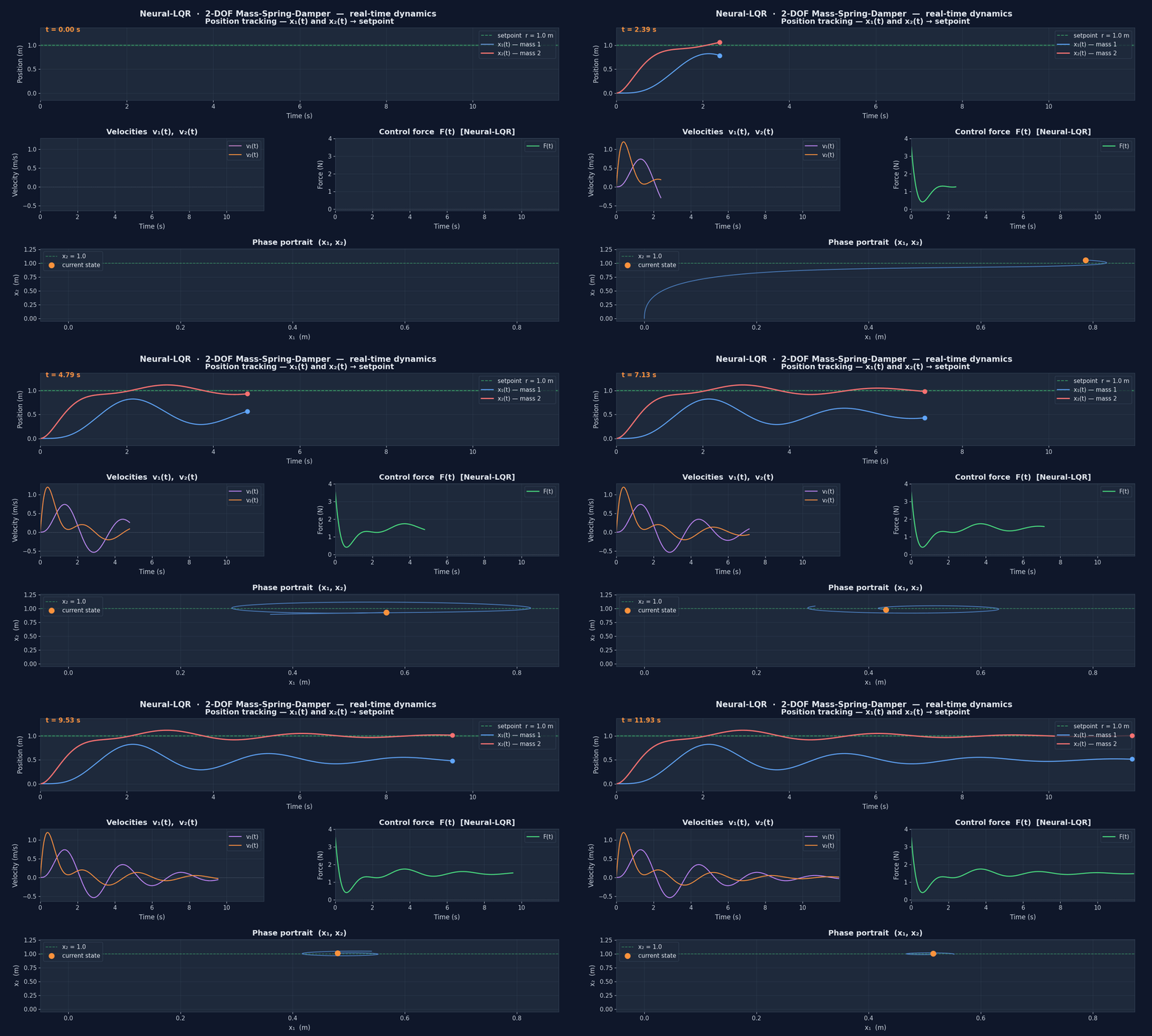
Full walkthrough: SIL + Neural-LQR example →
Features
| Feature | Description |
|---|---|
| ⚡ MATLAB-Compatible API | tf(), ss(), c2d(), step(), bode(), feedback(), lsim() — same names, pure Python |
| 📐 LTI Core | TransferFunction, StateSpace, and TransferFunctionMatrix with operator overloading, poles, zeros, stability |
| 🔀 MIMO Support | TransferFunctionMatrix for multi-input multi-output plants · MIMO feedback() · transmission zeros via Rosenbrock pencil |
| 🧮 Control Algorithms | Discrete PID with anti-windup · LQR via algebraic Riccati equation (Q/R validated) |
| 🤖 Multi-Agent Simulation | PlantAgent and ControllerAgent with lock-step and wall-clock sync |
| 🔗 Pluggable Transport | Zero-copy shared memory (single-host) · ZeroMQ PUB/SUB and REQ/REP (distributed) |
| 🔌 Hardware Abstraction | HardwareInterface contract enables seamless MIL → SIL → HIL transitions |
| 🧱 Matrix Builders | StateEquations, mat(), col(), row() — define state-space models from named equations |
Installation
pip install synapsys
Requirements: Python ≥ 3.10 · NumPy ≥ 1.24 · SciPy ≥ 1.10 · pyzmq ≥ 25.0
For development:
git clone https://github.com/synapsys-lab/synapsys.git
cd synapsys
uv sync --extra dev
Quickstart
1 · LTI systems and frequency analysis
from synapsys.api import tf, ss, bode, feedback, c2d

# SISO second-order transfer function
G = tf([1], [1, 2, 1])

# Closed-loop with unity negative feedback
T = feedback(G)

# Frequency response
w, mag, phase = bode(G)

# ZOH discretisation at 50 Hz
Gd = c2d(G, dt=0.02)

# MIMO: 2×2 transfer-function matrix
G_mimo = tf(
    [[[1], [0]], [[0], [1]]],           # numerators
    [[[1, 1], [1]], [[1], [1, 2]]],     # denominators
)
T_mimo = feedback(G_mimo)               # returns StateSpace
2 · Control algorithms
from synapsys.algorithms import PID, lqr
import numpy as np

# Discrete PID with anti-windup saturation
pid = PID(Kp=3.0, Ki=0.5, Kd=0.1, dt=0.01, u_min=-10.0, u_max=10.0)
u   = pid.compute(setpoint=5.0, measurement=y)

# LQR — solves the algebraic Riccati equation
A = np.array([[0., 1.], [-2., -3.]])
B = np.array([[0.], [1.]])
K, P = lqr(A, B, Q=np.eye(2), R=np.eye(1))
# Control law: u = −K · x
3 · State-space from named equations
from synapsys.utils import StateEquations

m, c, k = 1.0, 0.1, 2.0

eqs = (
    StateEquations(states=["x1", "x2", "v1", "v2"], inputs=["F"])
    .eq("x1", v1=1).eq("x2", v2=1)
    .eq("v1", x1=-2*k/m, x2=k/m,  v1=-c/m)
    .eq("v2", x1=k/m,  x2=-2*k/m, v2=-c/m, F=1/m)
)

print(eqs.A)   # 4×4 system matrix
print(eqs.B)   # 4×1 input matrix
4 · Multi-agent closed-loop simulation
from synapsys.api import ss, c2d
from synapsys.agents import PlantAgent, ControllerAgent, SyncEngine, SyncMode
from synapsys.algorithms import PID
from synapsys.transport import SharedMemoryTransport
import numpy as np

# Discretise G(s) = 1/(s+1) at 100 Hz
plant_d = c2d(ss([[-1]], [[1]], [[1]], [[0]]), dt=0.01)

with SharedMemoryTransport("demo", {"y": 1, "u": 1}, create=True) as bus:
    bus.write("y", np.zeros(1))
    bus.write("u", np.zeros(1))

    pid  = PID(Kp=4.0, Ki=1.0, dt=0.01)
    law  = lambda y: np.array([pid.compute(setpoint=3.0, measurement=y[0])])
    sync = SyncEngine(SyncMode.WALL_CLOCK, dt=0.01)

    PlantAgent("plant", plant_d, bus, sync).start(blocking=False)
    ControllerAgent("ctrl",  law,  bus, sync).start(blocking=True)
5 · MIL → SIL → HIL — swap transport, keep algorithm
# MIL — shared memory, single host
from synapsys.transport import SharedMemoryTransport
bus = SharedMemoryTransport("demo", {"y": 1, "u": 1}, create=True)

# SIL — ZeroMQ, cross-process / cross-machine
from synapsys.transport import ZMQTransport
bus = ZMQTransport("tcp://localhost:5555", mode="pub")

# HIL — real hardware
from synapsys.agents import HardwareAgent
from synapsys.hw import MockHardwareInterface   # replace with your driver
hw    = MockHardwareInterface(n_inputs=1, n_outputs=1, plant_fn=my_hw)
agent = HardwareAgent("hw", hw, bus, sync)

# PlantAgent / ControllerAgent stay exactly the same in all three modes
Examples
| Example | Description |
|---|---|
basic/step_response.py |
Step response of a 2nd-order system |
distributed/plant.py + controller.py |
Two-process PID loop via shared memory |
distributed/plant_zmq.py |
Same loop over ZeroMQ (cross-machine) |
advanced/01_custom_signals.py |
Custom reference signals with lsim() |
advanced/02a_sil_plant.py + 02b_sil_ai_controller.py |
SIL + Neural-LQR PyTorch controller |
advanced/03_realtime_scope.py |
Text-mode real-time oscilloscope |
advanced/04_realtime_matplotlib.py |
Live matplotlib oscilloscope |
advanced/05_digital_twin.py |
Digital twin with mechanical wear detection |
quickstart_en.ipynb |
Interactive Jupyter notebook walkthrough |
Architecture
synapsys/
├── api/            # MATLAB-compatible façade  (tf, ss, c2d, step, bode, feedback, …)
├── core/           # LTI math — TransferFunction, StateSpace, TransferFunctionMatrix, LTIModel
├── algorithms/     # PID (discrete, anti-windup), LQR (ARE solver)
├── agents/         # PlantAgent, ControllerAgent, HardwareAgent, SyncEngine
├── transport/      # SharedMemoryTransport, ZMQTransport, ZMQReqRepTransport
├── hw/             # HardwareInterface (abstract) + MockHardwareInterface
└── utils/          # StateEquations, mat(), col(), row()
The transport layer is the key abstraction: agents communicate exclusively through a TransportStrategy interface. Swapping the concrete transport (shared memory ↔ ZMQ ↔ real hardware) requires changing one line — algorithms and agents are untouched.
Testing
uv run pytest                      # run all tests
uv run pytest --cov=synapsys       # with coverage report
uv run mypy synapsys               # type checking
uv run ruff check synapsys tests   # linting
| Metric | Value |
|---|---|
| Test suite | 184 tests |
| Coverage | 90 % |
| Type checking | mypy strict — 0 errors |
| Python versions | 3.10 · 3.11 · 3.12 |
Roadmap
| Version | Status | Features |
|---|---|---|
| v0.1.0 | ✅ Released | SISO LTI, PID, LQR, multi-agent, shared memory, ZMQ, hardware abstraction, Neural-LQR example |
| v0.2.0 | ✅ Released | MIMO support — TransferFunctionMatrix, MIMO feedback(), transmission zeros (Rosenbrock pencil), LQR Q/R validation, covariant LTI type annotations |
| v0.3 | 🔜 Planned | margin(), rlocus(), pole_placement() · State estimation — Kalman filter, Luenberger observer |
| v0.5 | 🔜 Planned | Real hardware drivers (serial, CAN, FPGA via PYNQ) |
See CHANGELOG.md for the full release history.
Citing
If you use Synapsys in academic work, please cite it as:
BibTeX
@software{synapsys2026,
  author    = {Farias, Oseias D. and contributors},
  title     = {Synapsys: A Python Framework for Modelling and
               Real-Time Simulation of Linear Control Systems},
  year      = {2026},
  url       = {https://github.com/synapsys-lab/synapsys},
  license   = {MIT},
}
APA
Farias, O. D., & contributors. (2026). Synapsys: A Python framework for
modelling and real-time simulation of linear control systems.
https://github.com/synapsys-lab/synapsys
For the version number, use the version shown on PyPI.
Contributing
Contributions are welcome! Please open an issue to discuss what you'd like to change before submitting a pull request.
git clone https://github.com/synapsys-lab/synapsys.git
cd synapsys
uv sync --extra dev
uv run pytest          # make sure everything passes before you start
License
MIT © 2026 Synapsys Contributors
Project details
Verified details
These details have been verified by PyPIProject links
GitHub Statistics
Maintainers
Release history Release notifications | RSS feed


Download files
Download the file for your platform. If you're not sure which to choose, learn more about installing packages.
Source Distribution
Built Distribution
Filter files by name, interpreter, ABI, and platform.
If you're not sure about the file name format, learn more about wheel file names.
Copy a direct link to the current filters
File details
Details for the file synapsys-0.2.1.tar.gz.
File metadata
- Download URL: synapsys-0.2.1.tar.gz
- Upload date:
- Size: 11.0 MB
- Tags: Source
- Uploaded using Trusted Publishing? Yes
- Uploaded via: twine/6.1.0 CPython/3.13.12
File hashes
| Algorithm | Hash digest | |
|---|---|---|
| SHA256 |
2fe399a7de7ed0ba844b3b172aec162a8c149cd4064cf6cdbcd84953189161df
|
|
| MD5 |
95717ba69a459eef1d4679a1135c63c1
|
|
| BLAKE2b-256 |
f84772119f7306db32d7b3b8b51597235d805afca9f63fa9c8879fce0c69ab0d
|
Provenance
The following attestation bundles were made for synapsys-0.2.1.tar.gz:
Publisher:
publish.yml on synapsys-lab/synapsys
-
Statement:
-
Statement type:
https://in-toto.io/Statement/v1 -
Predicate type:
https://docs.pypi.org/attestations/publish/v1 -
Subject name:
synapsys-0.2.1.tar.gz -
Subject digest:
2fe399a7de7ed0ba844b3b172aec162a8c149cd4064cf6cdbcd84953189161df - Sigstore transparency entry: 1339887288
- Sigstore integration time:
-
Permalink:
synapsys-lab/synapsys@26e094e0eeb7c0070aec2683a8919eae2347d424 -
Branch / Tag:
refs/tags/v0.2.1 - Owner: https://github.com/synapsys-lab
-
Access:
public
-
Token Issuer:
https://token.actions.githubusercontent.com -
Runner Environment:
github-hosted -
Publication workflow:
publish.yml@26e094e0eeb7c0070aec2683a8919eae2347d424 -
Trigger Event:
release
-
Statement type:
File details
Details for the file synapsys-0.2.1-py3-none-any.whl.
File metadata
- Download URL: synapsys-0.2.1-py3-none-any.whl
- Upload date:
- Size: 37.0 kB
- Tags: Python 3
- Uploaded using Trusted Publishing? Yes
- Uploaded via: twine/6.1.0 CPython/3.13.12
File hashes
| Algorithm | Hash digest | |
|---|---|---|
| SHA256 |
73a8185c4b17d178fd6827c239a4a3e4563a865b7a5fbaf461204cc2b30e5a30
|
|
| MD5 |
17a5e8da885760e306185942389d0648
|
|
| BLAKE2b-256 |
9db2b85c6834c43f884c4b05507804c51ddacd8afc60af889932e3a7fdadba83
|
Provenance
The following attestation bundles were made for synapsys-0.2.1-py3-none-any.whl:
Publisher:
publish.yml on synapsys-lab/synapsys
-
Statement:
-
Statement type:
https://in-toto.io/Statement/v1 -
Predicate type:
https://docs.pypi.org/attestations/publish/v1 -
Subject name:
synapsys-0.2.1-py3-none-any.whl -
Subject digest:
73a8185c4b17d178fd6827c239a4a3e4563a865b7a5fbaf461204cc2b30e5a30 - Sigstore transparency entry: 1339887300
- Sigstore integration time:
-
Permalink:
synapsys-lab/synapsys@26e094e0eeb7c0070aec2683a8919eae2347d424 -
Branch / Tag:
refs/tags/v0.2.1 - Owner: https://github.com/synapsys-lab
-
Access:
public
-
Token Issuer:
https://token.actions.githubusercontent.com -
Runner Environment:
github-hosted -
Publication workflow:
publish.yml@26e094e0eeb7c0070aec2683a8919eae2347d424 -
Trigger Event:
release
-
Statement type:






