

Syndrilla
A PyTorch-based numerical simulator for decoders in quantum error correction.
Table of contents
- Syndrilla
Features
- High modularity: easily customizing your own decoding algorithms and error models
- High compatibility: cross-platform simulation on CPUs, GPUs, and even AI accelerators
- High performance: showing 10-20X speedup on GPUs over CPUs
- Community focus: support for standard BPOSD, BP4, MWPM, and Union-Find decoders
- Flexible data format: support for FP16/BF16/FP32/FP64 simulation
- Hardware awareness: support for quantization simulation
- Fine-grained measurement: support for a broad range of metrics, with degeneracy errors highlighted
- Multi-purpose: allowing researching new codes, new decoders, new error models, and beyond
- Circuit-level simulation: support Stim for circuit-level modeling, enabling fair and reproducible benchmarking across different decoders and noise models
Installation
All provided installation methods allow running syndrilla in the command line and import syndrilla as a python module.
Make sure you have Anaconda installed before the steps below.
Option 1: pip installation
git clonethis repo andcdto the repo dir.conda env create -f environment.yaml- The
name: syndrillainenvironment.yamlcan be updated to a preferred one.
- The
conda activate syndrillapip install syndrilla- Validate installation via
syndrilla -hin the command line orimport syndrillain python code- If you want to validate the simulation results against BPOSD, you need to change python to version 3.10. Then install BPOSD and run
python tests/validate_bposd.py
- If you want to validate the simulation results against BPOSD, you need to change python to version 3.10. Then install BPOSD and run
Option 2: source installation
This is the developer mode, where you can edit the source code with live changes reflected for simulation.
git clonethis repo andcdto the repo dir.conda env create -f environment.yaml- The
name: syndrillainenvironment.yamlcan be updated to a preferred one.
- The
conda activate syndrillapython3 -m pip install -e . --no-deps- Validate installation via
syndrilla -hin the command line orimport syndrillain python code
Basic usage
1. Run with command line arguments
Syndrilla simulation can be done via command-line arguments. Below is an example command that runs a simulation using the BPOSD decoder:
syndrilla -r=tests/test_outputs
          -d=examples/alist/bposd_hx.decoding.yaml
          -e=examples/alist/bsc.error.yaml
          -c=examples/alist/lx.check.yaml
          -s=examples/alist/perfect.syndrome.yaml
          -m=examples/alist/surface_10.matrix.yaml
          -bs=10000
          -te=1000
Following is a table for detailed explaination on each command line arguments:
| Argument | Description | Example |
|---|---|---|
-r |
Path to store outputs | -r=tests/test_outputs |
-d |
Path to decoding YAML file | -d=examples/alist/bposd_hx.decoding.yaml |
-e |
Path to error model YAML file | -e=examples/alist/bsc.error.yaml |
-c |
Path to check matrix YAML file | -c=examples/alist/lx.check.yaml |
-s |
Path to syndrome extraction YAML file | -s=examples/alist/perfect.syndrome.yaml |
-m |
Path to matrix YAML file | -m=examples/alist/surface_10.matrix.yaml |
-i |
Path to interface YAML file, replacing -m/-e/-s/-c |
-i=examples/stim/stim_generated.interface.yaml |
-ckpt |
Path to checkpoint YAML file to resume; with -t, the training run's *_result.yaml, given alongside its -tckpt |
-ckpt=tests/test_outputs/result_phy_err_0.1.yaml |
-bs |
Number of samples in each batch | -bs=10000 |
-te |
Total number of errors to stop decoding, default 1000; ignored with -t |
-te=1000 |
-tb |
Target number of batches to stop decoding, instead of an error target; wins over -te with a warning if both are given, ignored with -t |
-tb=500 |
-l |
Level of logger | -l=SUCCESS |
-t |
Train the decoder instead of decoding | -t |
-tr |
Path to training YAML file | -tr=examples/alist/train_saq_hx.training.yaml |
-tckpt |
Path to a run's *_last.pt, to resume training; given alongside the same run's -ckpt |
-tckpt=tests/test_outputs/saq_hx_n41_last.pt |
Training a learned decoder (-t)
Besides the fixed decoding algorithms above, Syndrilla supports AI decoder models, which learn their parameters from data (currently saq).
Adding -t trains the decoder given by -d instead of decoding with it, under the training YAML passed with -tr, and writes the trained weights into -r:
syndrilla -t
          -r=tests/test_outputs
          -d=examples/alist/train_saq_hx.decoding.yaml
          -m=examples/alist/surface_5.matrix.yaml
          -e=examples/alist/bsc_train.error.yaml
          -s=examples/alist/perfect.syndrome.yaml
          -tr=examples/alist/train_saq_hx.training.yaml
          -bs=256
The weights kept are the epoch the decoder scores best, the lowest validation logical error for saq, named in the result YAML under selection metric.
A learned decoder therefore ships as two YAMLs of one architecture: train_saq_hx.decoding.yaml names no weights and is the one -t fits, and saq_hx.decoding.yaml adds the config.checkpoint key naming trained weights, so the normal command above evaluates them.
Each mode is held to its own file: a run without -t is refused if a learned decoder names no weights, since it would decode at chance and still report a logical error rate, and -t ignores the key rather than warm-starting from it (that is what -tckpt does, optimizer and schedule included).
See Trainer module for the training loop, its configuration, its outputs, and how an interrupted run is resumed.
2. Input format and configurations
|
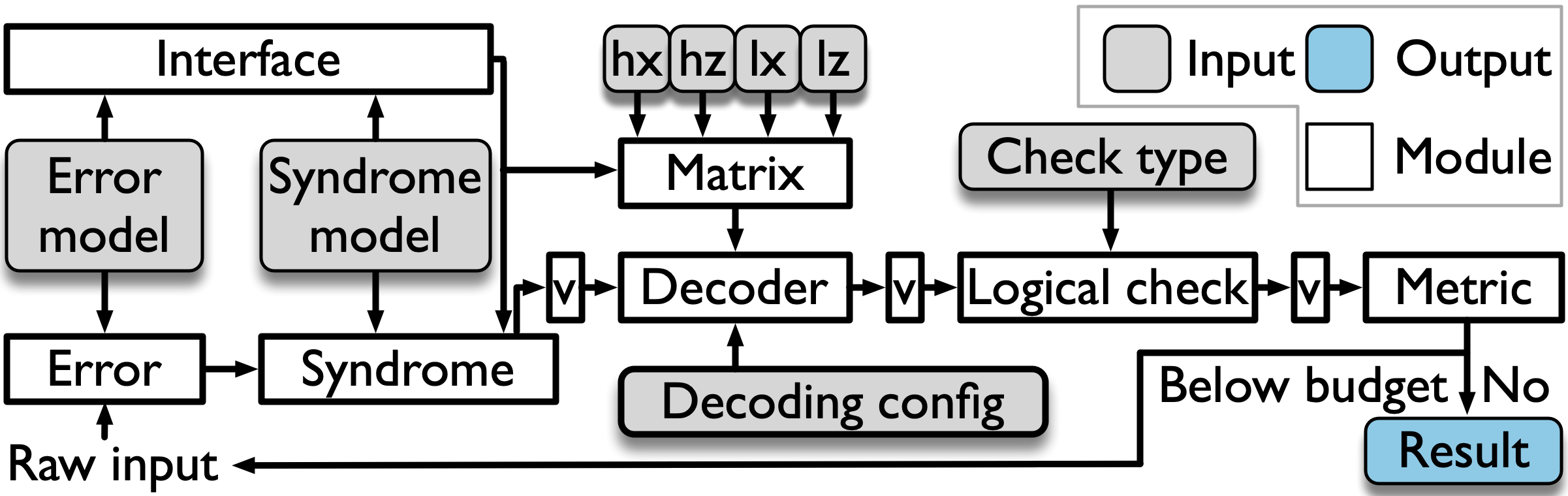
Syndrilla virtualizes the full decoder pipeline of data encoding, syndrome measurement, and error decoding into modules: error, syndrome, matrix, decoder, logical check, interface, trainer, and metric, as shown in the figure above.
All configurations are defined through YAML files.
Each module requires its own dedicated YAML configuration file, with the exception of the metric module. The trainer module supports the decoder rather than sitting in the decode pipeline: it is built only for a -t run, is selected with -tr, and carries the objective, the optimizer, and the epoch schedule.
2.1. Error module
The error YAML file defines all configuration parameters associated with the error model.
It currently supports a 1-channel Binary Symmetric Channel (BSC) error model, 2-channel error models for both depolarizing noise and BSC, a training-only swept-rate BSC, and a stim circuit-level model.
An example error configuration file using the Binary Symmetric Channel (BSC) model is provided in bsc.error.yaml:
error:
  model: bsc
  number_channel: 1
  device:
    device_type: cpu
    device_idx: 0
  rate: 0.1
The following table details the configuration parameters used in the error YAML file.
| Key | Description | Example |
|---|---|---|
error.model |
Type of quantum error model applied to data qubits | bsc, depol or stim_circuit |
error.number_channel |
The number of error channel applied to quantum circuit | 1 or 2 |
error.device.device_type |
Type of the device where the error injection will happen | cpu or cuda |
error.device.device_idx |
Index of the device where the error injection will happen. This option only works when device_type = cuda. |
0 |
error.rate |
Physical error rate applied to each data qubit. A training run may sweep it as a [lower, upper, points] range, one level drawn per shot |
0.05 or [0.01, 0.20, 9] |
The following table details all types of error model Syndrilla supports. (Using different error model may need different configuration format, which will be shown on Error module.)
| Error Model | Number of channels | Example |
|---|---|---|
| Binary Symmetric Channel (BSC) | Both 1 and 2 | bsc |
| Depolarizing Channel | 2 | depol |
| Stim circuit-level model | 1 | stim_circuit |
2.2. Syndrome module
The syndrome YAML file defines all configuration parameters associated with the syndrome measurement.
An example configuration file that assumes ideal (error-free) syndrome measurements is provided in perfect.syndrome.yaml:
syndrome:
  measure: perfect
The following table details the configuration parameters used in the syndrome module YAML file.
| Key | Description | Example |
|---|---|---|
syndrome.measure |
Model for syndrome measurement | perfect, phenomenological, or stim |
The following table details all types of syndrome measurement Syndrilla supports. (Using different syndrome measurement model may need different configuration format, which will be shown on Syndrome module.)
| Syndrome model | Description | Example |
|---|---|---|
| Perfect | Ideal (error-free) syndrome measurement: returns H * e mod 2 |
perfect |
| Phenomenological | Replicates the true syndrome over rounds and flips each bit with probability measurement_error_rate, which a training run may sweep as a range |
phenomenological |
| Stim | Circuit-level syndrome sampler driven by a stim circuit (used with the stim interface) | stim |
2.3. Matrix module
The matrix YAML file defines all configuration parameters associated with the matrix processing. Syndrilla accepts matrix from:
- .alist format introduced by David MacKay, Matthew Davey, and John Lafferty, which contains a sparse matrix.
- .npz format from NumPy, which contains a sparse matrix.
- .txt format containing a dense 2D matrix. Each row represents a check node of the H matrix, in which each 1 entry denotes a connecting variable node to that check node.
A decoder consumes a bundle of matrices (Hx, Hz, and optionally Lx and Lz). These are combined into a single matrix YAML file, where each entry can be referenced as a file path or inlined as a config dict. An example combined matrix configuration is provided in surface_10.matrix.yaml, which is the file passed via -m in the command above:
matrix:
  parity_matrix_hx:
    file_type: alist
    path: examples/alist/surface/surface_10_hx.alist
  parity_matrix_hz:
    file_type: alist
    path: examples/alist/surface/surface_10_hz.alist
  logical_check_matrix: True
  logical_check_lx:
    file_type: alist
    path: examples/alist/surface/surface_10_lx.alist
  logical_check_lz:
    file_type: alist
    path: examples/alist/surface/surface_10_lz.alist
The following table details the configuration parameters used in the combined matrix YAML file.
| Key | Description | Example |
|---|---|---|
matrix.parity_matrix_hx |
Matrix entry (path or inline dict) for the X-type parity-check matrix | examples/alist/surface/surface_10_hx.alist |
matrix.parity_matrix_hz |
Matrix entry (path or inline dict) for the Z-type parity-check matrix | examples/alist/surface/surface_10_hz.alist |
matrix.logical_check_matrix |
Flag for whether logical-check matrices are provided; if False, they are computed from Hx/Hz via compute_lz |
True or False |
matrix.logical_check_lx |
Matrix entry for the X-type logical-check matrix (used when logical_check_matrix = True) |
examples/alist/surface/surface_10_lx.alist |
matrix.logical_check_lz |
Matrix entry for the Z-type logical-check matrix (used when logical_check_matrix = True) |
examples/alist/surface/surface_10_lz.alist |
The following table details all matrix formats Syndrilla supports. (Using different matrix formats may need different configuration format, which will be shown on Matrix module.)
| Matrix format | Description | Example |
|---|---|---|
| alist | Sparse format from MacKay/Davey/Lafferty; lists nonzero neighbor indices per check node | alist |
| npz | NumPy/SciPy compressed archive containing a sparse parity-check matrix | npz |
| txt | Plain-text dense 2D matrix; each row is a check node with 1s marking connected variable nodes |
txt |
| stim | Built directly from a stim circuit's detector error model; selects either the check (H) or observable (L) matrix |
stim |
2.4. Decoder module
The decoding YAML file defines all configuration parameters associated with the decoder.
An example decoder configuration file is provided in bposd_hx.decoding.yaml:
decoding:
  algorithm: [bp_norm_min_sum, osd_0]
  check_type: hx
  dtype: float64
  device:
    device_type: cuda
    device_idx: 0
  config:
    max_iter: 181
The following table details the configuration parameters used in the decoder module YAML file.
| Key | Description | Example |
|---|---|---|
decoding.algorithm |
List of decoding algorithms used | [bp_norm_min_sum, osd_0] |
decoding.check_type |
Type of parity-check matrix used | hx or hz |
decoding.device.device_type |
Type of the device where the decoding will happen | cpu or cuda |
decoding.device.device_idx |
Index of the device where the decoding will happen. This option only works when device_type = cuda. |
0 |
decoding.dtype |
Data type for decoding computations | float32, float64 |
decoding.force_pytorch |
(optional) Run the plain PyTorch module even on a CUDA device | false |
decoding.rebatch_speedup |
(optional) Adaptive batch-shrinking cap; see Decoder module | {kl_eps: 0.001} |
decoding.config |
Algorithm-specific settings (e.g. max_iter, or a learned decoder's checkpoint). A mapping configures the first algorithm; a list gives one entry per entry of decoding.algorithm |
max_iter: 181 |
The keys above the last one are framework-wide and apply to the whole block; anything only one algorithm understands (max_iter, quantization widths, relay_bp's leg schedule) goes under decoding.config. Written as a plain mapping, as above, it configures the first algorithm, so max_iter reaches bp_norm_min_sum and osd_0, which takes no settings of its own, runs on its defaults. Written as a list it is matched to decoding.algorithm by position, which is how a chain configures a stage other than its first. A key written at the top level that belongs under decoding.config, or the reverse, is rejected with a message naming the block it belongs in. See Decoder module for the full rule.
An AI decoder trained with -t takes no run settings from this block: its optimizer and epoch budget configure the run rather than the model, so they live in the training YAML passed with -tr, under training.optimizer and training.budget; see Trainer module. The decoder block keeps the model itself, and a decode run loads decoding.config.checkpoint from it, whose key list is in Decoder module.
When decoding.device.device_type is set to cuda, every decoder automatically uses its CUDA-kernel implementation if a CUDA-capable GPU is present and the kernel is available; otherwise it falls back to the PyTorch implementation. This covers every registered decoder except saq: the BP family plus osd_0, mwpm, and union_find. For osd_0, mwpm, and union_find the CUDA output is bit-for-bit identical to the CPU implementation. Non-NVIDIA accelerators (e.g. AMD ROCm, IBM), where the CUDA kernels do not compile, automatically use the PyTorch implementation. See Decoder module for details.
The following table details the different types of decoding algorithms Syndrilla supports. (Using different decoder may need different configuration format, which will be shown on Decoder module.)
| Decoding Algorithm | #Channel | Example | Reference |
|---|---|---|---|
| Min-Sum Belief Propagation (Min-Sum BP) | 1 | bp_norm_min_sum | Factor Graphs and the Sum-Product Algorithm |
| Branch-Assisted Sign-Flipping Belief Propagation (BSFBP) | 1 | bp_branch_assisted | Branch-Assisted Sign-Flipping Belief Propagation Decoding for Topological Quantum Codes Based on Hypergraph Product Structure |
| Ordered Statistics Decoding (OSD) | 1 | osd_0 | Soft-Decision Decoding of Linear Block Codes Based on Ordered Statistics |
| Quaternary Belief Propagation (BP4) | 2 | bp4 | Quaternary Neural Belief Propagation Decoding of Quantum LDPC Codes with Overcomplete Check Matrices |
| Relay Belief Propagation (Relay BP) | 1 | relay_bp | Relay BP: normalized min-sum over multiple legs with disordered per-variable memory (relay-bp crate, trmue/relay) |
| Belief Propagation with Syndrome Flipping (BP-SF) | 1 | bp_sf | Fully Parallelized BP Decoding for Quantum LDPC Codes Can Outperform BP-OSD (Dies-Irae/BP-SF) |
| Quantized Min-Sum BP | 1 | bp_norm_min_sum_quant | Normalized min-sum BP with fixed-point quantized messages |
| Lottery BP | 1 | bp_lottery | Sobol/system-driven sign-flip perturbations on the BP messages |
| Quantized Lottery BP | 1 | bp_lottery_quant | Lottery BP with fixed-point quantized messages |
| Lottery BP with a sign-flip policy | 1 | bp_lottery_policy | Lottery BP with a selectable sign-flip policy |
| SAQ (learned decoder) | 1 | saq | SAQ: Stabilizer-Aware Quantum Error Correction Decoder (arXiv:2512.08914); trained with -t |
| Minimum-Weight Perfect Matching (MWPM) | 1 | mwpm | PyMatching v2 sparse-blossom (Higgott & Gidney); graphlike codes only |
| Union-Find (Delfosse-Nickerson) | 1 | union_find | Almost-linear-time decoding for topological codes (arXiv:1709.06218); graphlike codes only (surface and toric) |
2.5. Logical check module
The check YAML file defines all configuration parameters associated with the computation of logical check error rates.
An example configuration file for computing the logical check error rate using the lx matrix is provided in lx.check.yaml.
check:
  check_type: lx
The following table provides a detailed explanation of the configuration parameters used in the check module YAML file.
| Key | Description | Example |
|---|---|---|
check.check_type |
Method used on logical check computation | lx or lz |
2.6. Interface module
This module can be used with a quantum circuit simulator such as Stim to generate circuits that include various types of errors.
An example configuration file using Stim is provided in stim_generated.interface.yaml. (Using interface will cause other modules having different format, which will be shown on Interface module.)
interface:
  backend: stim
  code: surface_code:rotated_memory_x
  distance: 3
The following table provides a detailed explanation of the configuration parameters used in the interface module YAML file.
| Key | Description | Example |
|---|---|---|
interface.backend |
The quantum circuit simulator is used | stim |
interface.code |
Stim code family to generate, required unless interface.circuit is given |
surface_code:rotated_memory_x |
interface.distance |
Code distance of the generated circuit, required unless interface.circuit is given |
3 |
interface.circuit |
(optional) Inline stim circuit string, or a mapping of generation parameters, used instead of code/distance |
<stim circuit string> |
interface.number_channel |
(optional) Fallback channel count when error.number_channel is absent |
1 |
The device and dtype of an interface run come from the decoder YAML, not from this file. See Interface module for the full key list.
2.7. Trainer module
The trainer is a support module for the decoder: its YAML file defines everything that configures a -t run rather than the model it fits, namely the objective, the optimizer, and the epoch schedule.
It is read only when training, and is the one module a decode run never builds.
An example configuration file is provided in train_saq_hx.training.yaml:
training:
  algorithm: saq
  loss:
    lambda_lc: 1.0
    lambda_lp: 0.2
    lambda_ent: 1.0
  optimizer:
    lr: 5.0e-4
    weight_decay: 5.0e-8
    min_lr: 1.0e-6
  budget:
    epochs: 100
    test_batches: 200
    validation_batches: 20
    error_random_seed: 42
The following table provides a detailed explanation of the configuration parameters used in the trainer module YAML file.
| Key | Description | Example |
|---|---|---|
training.algorithm |
Training algorithm, naming a module under syndrilla/trainer/; it brings the objective and the optimizer |
saq |
training.loss.* |
That algorithm's objective settings; saq weights its three terms |
lambda_lp: 0.2 |
training.optimizer.* |
Settings the Trainer builds the run's optimizer from; it fits Adam with lr, weight_decay and min_lr |
lr: 5.0e-4 |
training.budget.epochs |
Number of epochs to run | 100 |
training.budget.test_batches |
Training batches per epoch | 200 |
training.budget.validation_batches |
Validation batches per epoch, drawn clear of the training set | 20 |
training.budget.error_random_seed |
Seeds the error stream, so every epoch trains on the same batches | 42 |
Each block has one reader: loss and optimizer the algorithm's own trainer module, budget the metric module. See Trainer module for the training loop and its outputs.
2.8. Metric module
This module does not take any YAML file as inputs, it will report default metrics as output, which will be described in the output.
3. Output format and metrics
The result YAML file will be saved to the path specified by the -r option.
In the example above, the result YAML file can be found in the tests/test_outputs folder.
This file includes both the metric results for each decoder and a summary of the full decoding.
Additionally, the result YAML file is updated every 100 batches, allowing Syndrilla to resume the simulation from the last checkpoint if the error budget was not reached in the previous run.
Example output of a run like the one above, abridged:
decoder_0:
  algorithm: bp_norm_min_sum
  decoder invoke rate: 1.00000000000000000e+00
  average iteration: 7.69916235294117968e+01
  iteration distribution: [1, 1, 1, 1, 1, 2, 2, 2, 2, 2, 2, 2, 2, 2, 2, 2, 2, 2, 2,
    2, 2, 2, 2, 3, 3, 3, 3, 3, 3, 3, 4, 4, 4, 4, 4, 4, 4, 5, 5, 6, 6, 8, 14, 131,
    131, 131, 131, 131, 131, 131, 131, 131, 131, 131, 131, 131, 131, 131, 131, 131,
    131, 131, 131, 131, 131, 131, 131, 131, 131, 131, 131, 131, 131, 131, 131, 131,
    131, 131, 131, 131, 131, 131, 131, 131, 131, 131, 131, 131, 131, 131, 131, 131,
    131, 131, 131, 131, 131, 131, 131, 131, 131]
  total time (s): '1.10485250949859619e+01'
  average time per batch (s): '6.49913240881527104e-02'
  average time per sample (s): '6.49913240881526920e-05'
  average time per iteration (s): '8.44576808757733200e-07'
  hx:
    data qubit accuracy: 9.75190120246994030e-01
    data qubit correction accuracy: 6.41507008117403132e-01
    data frame error rate: 6.73282352941176554e-01
    syndrome frame error rate: 5.77482352941176336e-01
    logical error rate: 5.78029411764705681e-01
    converge failure rate: 5.47058823529412205e-04
    converge success rate: 4.21970588235294097e-01
decoder_1:
  algorithm: osd_0
  decoder invoke rate: 5.77482352941176336e-01
  average iteration: 1.77477071406242374e+02
  iteration distribution: [1, 170, 172, 172, 173, 173, 174, 174, 174, 175, 175, 175,
    175, 175, 175, 176, 176, 176, 176, 176, 176, 176, 176, 176, 177, 177, 177, 177,
    177, 177, 177, 177, 177, 177, 177, 178, 178, 178, 178, 178, 178, 178, 178, 178,
    178, 178, 178, 178, 178, 178, 178, 178, 178, 178, 178, 178, 178, 178, 179, 179,
    179, 179, 179, 179, 179, 179, 179, 179, 179, 179, 179, 179, 179, 179, 179, 179,
    179, 179, 179, 179, 179, 179, 179, 179, 179, 179, 179, 179, 179, 179, 179, 179,
    179, 179, 179, 179, 179, 179, 179, 179, 179]
  total time (s): '6.03572950363159180e+01'
  average time per batch (s): '3.55042911978328934e-01'
  average time per sample (s): '3.55042911978328650e-04'
  average time per iteration (s): '2.00049854387823897e-06'
  hx:
    data qubit accuracy: 9.81503314917126946e-01
    data qubit correction accuracy: 6.86872349409486938e-01
    data frame error rate: 5.27194117647059146e-01
    syndrome frame error rate: 0.00000000000000000e+00
    logical error rate: 5.92352941176471030e-03
    converge failure rate: 5.92352941176471030e-03
    converge success rate: 9.94076470588235228e-01
decoder_full:
  batch size: 1000
  batch count: 170
  target error: 1000
  target error reached: 1007
  data type: torch.float64
  physical error rate: 5.00000000000000028e-02
  total time (s): '7.14058201313018799e+01'
  H matrix: /home/ya212494/code/syndrilla/examples/alist/surface/surface_10_hx.alist
  hx:
    logical error rate: 5.78029411764705681e-01
The block above is abridged: a real result file also carries sample count and iteration count for every decoder, and its numbers reflect whichever batch size and error rate the run actually used.
3.1. Per-decoder metrics
Since Syndrilla supports a sequence of decoding algorithms, there are two types of output metrics: (1) per-decoder metrics for each individual decoder, and (2) final metrics after all decoders.
The following table provides a detailed explanation of the metrics in the output YAML file for per-decoder metrics:
| Metric | Description |
|---|---|
algorithm |
Name of the decoding algorithm used (e.g., bp_norm_min_sum, osd_0) |
data qubit accuracy |
Ratio of correctly matched data qubits over all data qubits |
data qubit correction accuracy |
Ratio of correctly identified data qubit errors |
data frame error rate |
Ratio of samples with any data qubit mismatched |
syndrome frame error rate |
Ratio of samples with any syndrome mismatched |
logical error rate |
Ratio of samples that have a logical error |
converge failure rate |
Ratio of samples that successfully converge with a logical error |
converge success rate |
Ratio of samples that successfully converge without a logical error |
decoder invoke rate |
Ratio of samples for which the decoder is invoked |
average iteration |
Average number of iterations per sample |
sample count |
Total number of samples this decoder metered. Per-sample rates are accumulated weighted by this count (not by batch count), so they stay correct when batches differ in size — e.g. under the adaptive iteration speedup (rebatch_speedup), where a batch may meter only its converged samples. For equal-size batches it equals batch count × batch size. |
iteration distribution |
Once the error budget is reached, the per-percentile iteration counts (101 values, 0–100% at 1% intervals); before then, the raw per-iteration histogram |
iteration count |
Raw per-iteration histogram (samples stopping at each iteration index), always saved un-percentiled regardless of completion |
total time (s) |
Total time taken by the decoder in seconds |
average time per batch (s) |
Average time taken per batch in seconds |
average time per sample (s) |
Average time taken per sample in seconds |
average time per iteration (s) |
Average time per iteration per sample in seconds |
3.2. Final metrics
The following table provides a detailed explanation of the metrics in the output YAML file for final metrics:
| Metric | Description |
|---|---|
H matrix |
Path to the parity-check matrix used |
batch size |
Number of samples in each batch |
batch count |
Total number of batches |
target error |
Total number of errors to stop decoding |
target batch |
Batch budget the run was given with -tb, null under an error target |
target error reached |
Actual number of logical errors observed |
data type |
Floating point data used |
physical error rate |
Physical error rate |
logical error rate |
Logical error rate across all samples |
total time (s) |
Total simulation time across all batches in seconds |
Note that the time metric here only considers the decoding time.
To change the configuration of the simulator, user need to update the YAML files.
For example, if you want to use a different physical error rate, you need to find the input error YAML (e.g., examples/alist/bsc.error.yaml) and update the rate field.
4. Resume from checkpoint
If previous run is terminated by accident, the simulation can resume by setting -ckpt to the checkpoint YAML file, the results of a previous run (e.g., tests/test_outputs/result_phy_err_0.1.yaml). The checkpoint's physical error rate has to match the one in the error YAML, or the run is rejected.
syndrilla -r=tests/test_outputs
          -d=examples/alist/bposd_hx.decoding.yaml
          -m=examples/alist/surface_10.matrix.yaml
          -e=examples/alist/bsc.error.yaml
          -c=examples/alist/lx.check.yaml
          -s=examples/alist/perfect.syndrome.yaml
          -bs=10000
          -te=1000
          -ckpt=tests/test_outputs/result_phy_err_0.1.yaml
A training run resumes on the pair of checkpoints it wrote, -ckpt set to the run's *_result.yaml and -tckpt to its *_last.pt, with every other flag left as it was; either flag without the other is refused, as is a resume under a different selection metric. See Trainer module.
5. Sweep configurations
Syndrilla also allows sweeping configurations during simulation, which is done in the zoo folder.
To generate all the configurations in the zoo directory, user can use the generate_sweeping_configs.py script.
python zoo/script/generate_sweeping_configs.py
The configurations to sweep are specified in the sweeping_configs.yaml file.
It allows specifying decoder (decoder algorithm), code (code type), probability (physical error rate), check_type (check type), distance (code distance), and dtype (data type).
Below is an example:
decoder: [bposd_quant]
code: [surface]
probability: [0.001, 0.002, 0.005, 0.01, 0.02, 0.05, 0.1, 0.2, 0.5]
check_type: [hx]
distance: [3, 5, 7, 9, 11, 13]
dtype: ['float32']
This file lives at zoo/script/sweeping_configs.yaml; it ships with the wider alternatives commented out above each line.
Note that currently supported data format includes ['bfloat16', 'float16', 'float32', 'float64'].
Once all configurations are prepared, you can see the corresponding folders in the zoo, and you can now sweep the simulation using the run_sweeping.py script.
This command will generate a corresponding result YAML file within each configuration folder.
Moreover, if a result YAML file already exists and simulation is terminated by accident, running the script again will, by default, automatically resume from the checkpoint, where the simulated is terminated.
python zoo/script/run_sweeping.py -r=zoo/bposd_sweeping/ -d=bposd
There are command line arguments to control the script, allowing you to specify the configuration path, select the decoder, define batch sizes, and adjust logging verbosity.
| Argument | Description | Example |
|---|---|---|
-r |
Path to configuration folder | -r=zoo/bposd_sweeping/ |
-d |
Decoder algorithm to run | -d=bposd |
-bs |
Number of samples run each batch | -bs=10000 |
-st |
Syndrome type used for the sweep | -st=perfect |
-l |
Level of logger | -l=SUCCESS |
Simulation results
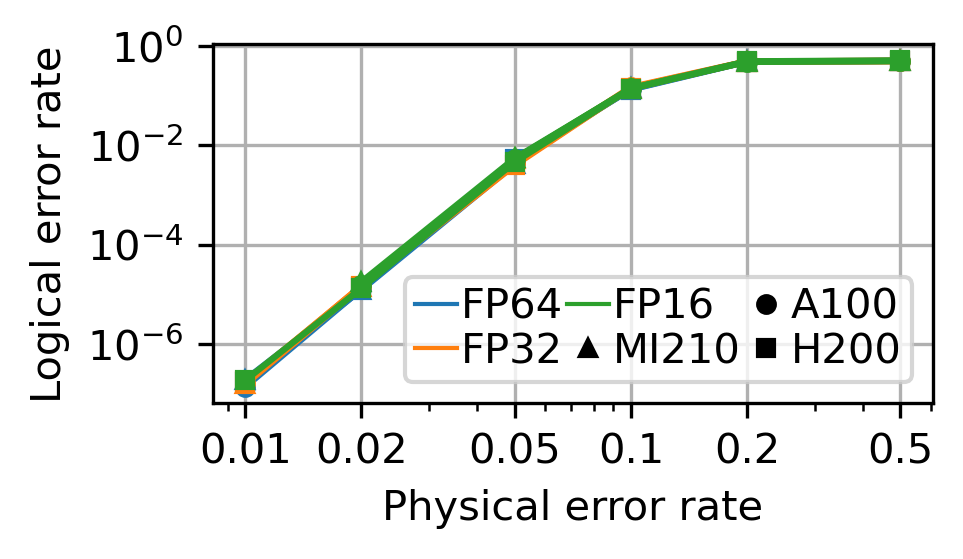
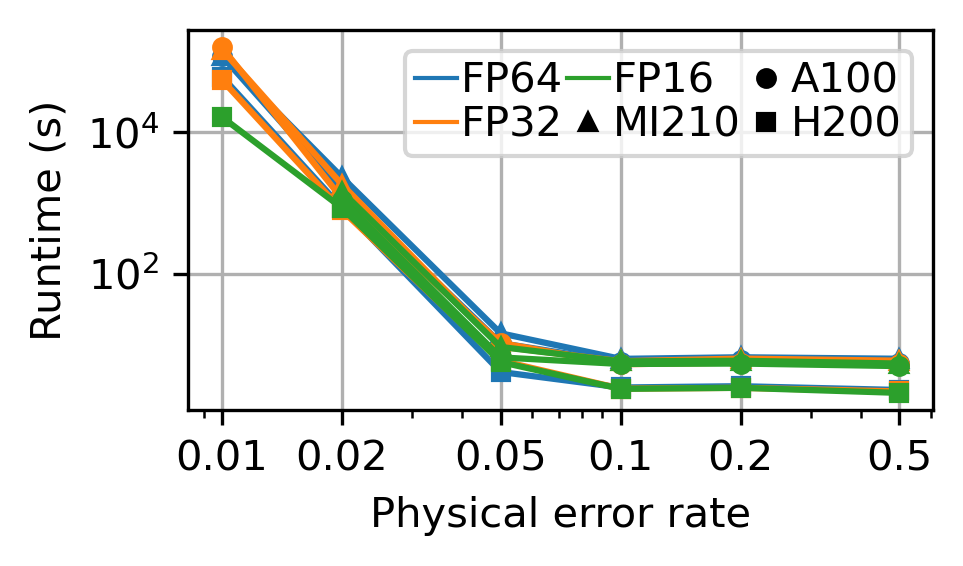
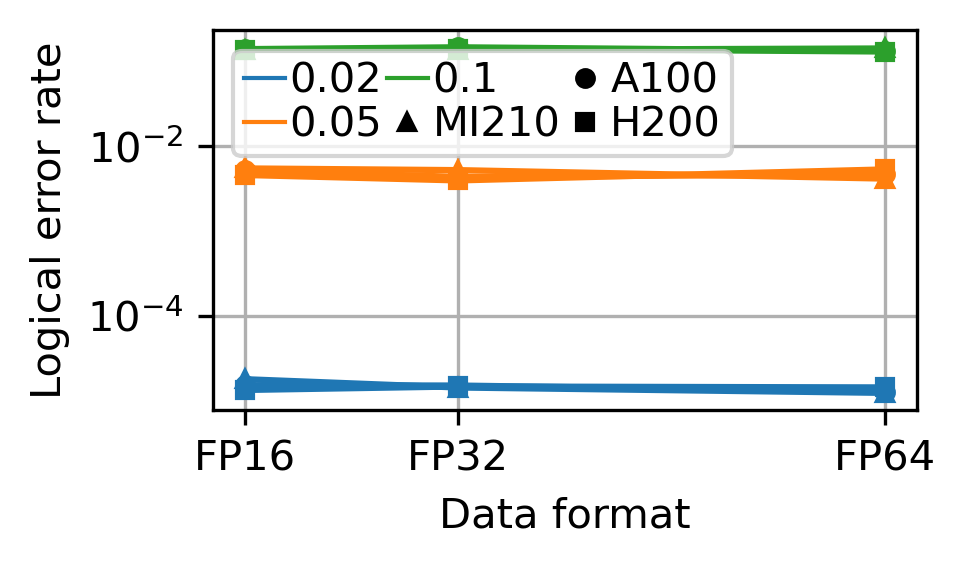
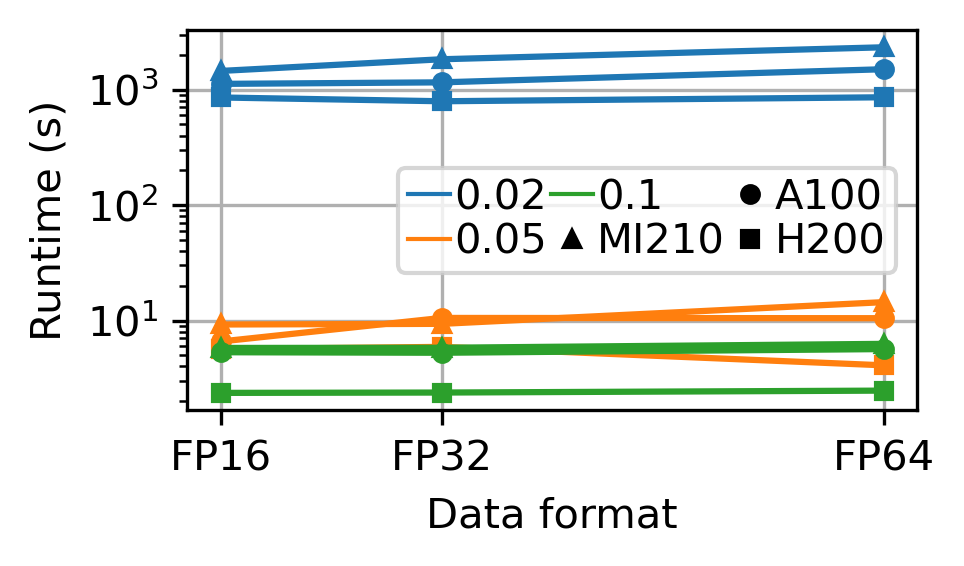
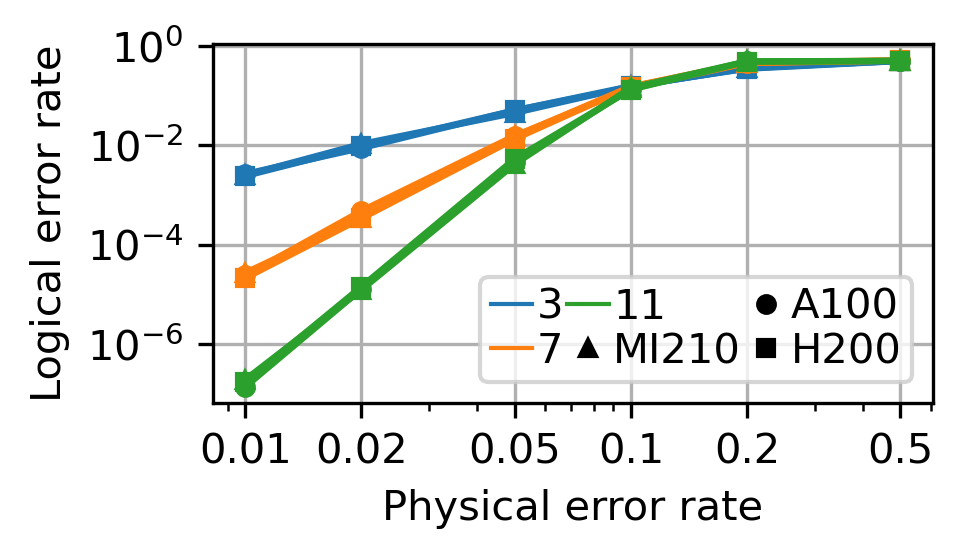
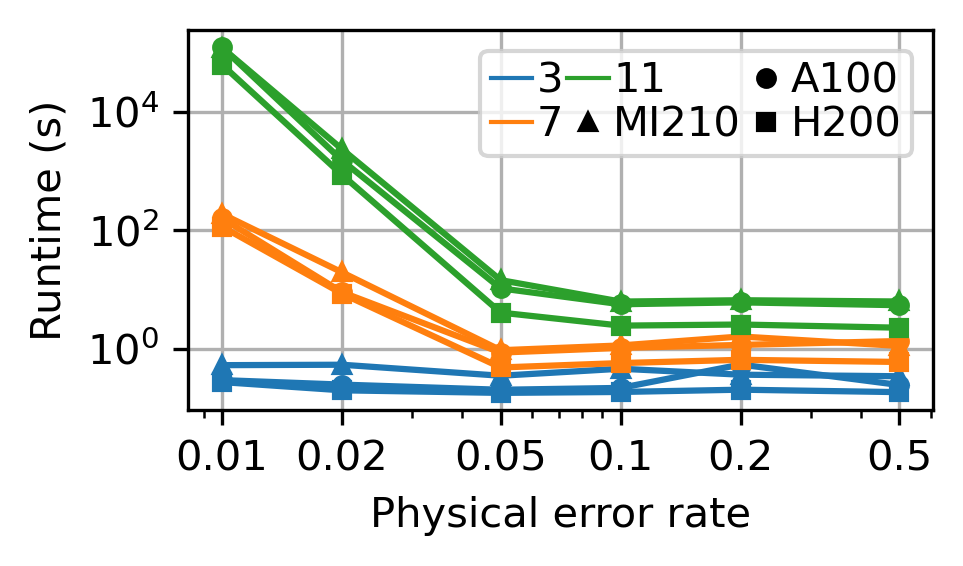
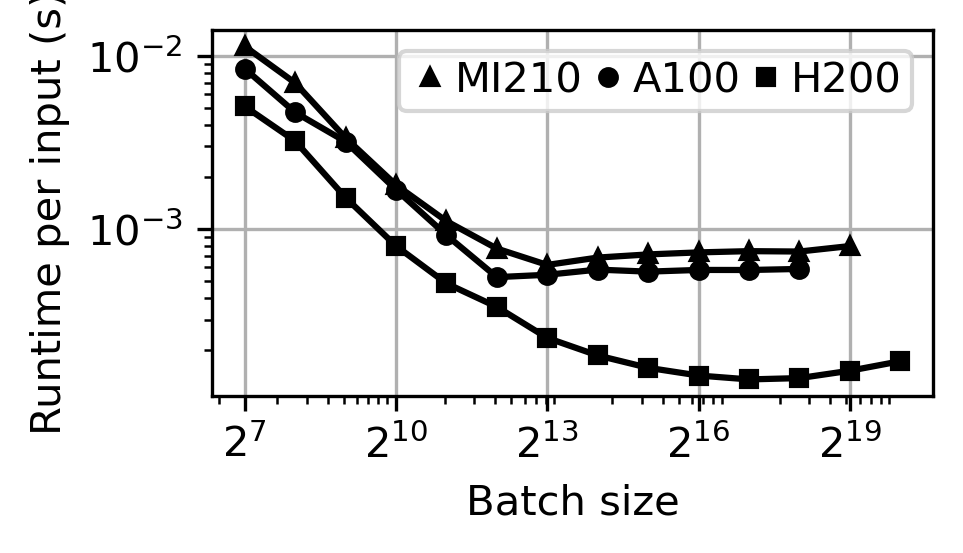
We show some of the simulation results as below. These results show the impact of data format, code distance, physical error rate, and hardware on logical error rate and runtime.
GPUs: AMD Insticnt MI210, NVIDIA A100, NVIDIA H200
CPU: Intel i9-13900K
Comparison across GPUs
 Accuracy |
 Time |
Comparison across data formats
 Accuracy |
 Time |
Comparison across distances
 Accuracy |
 Time |
Comparison across batch sizes and against CPU
 Time |
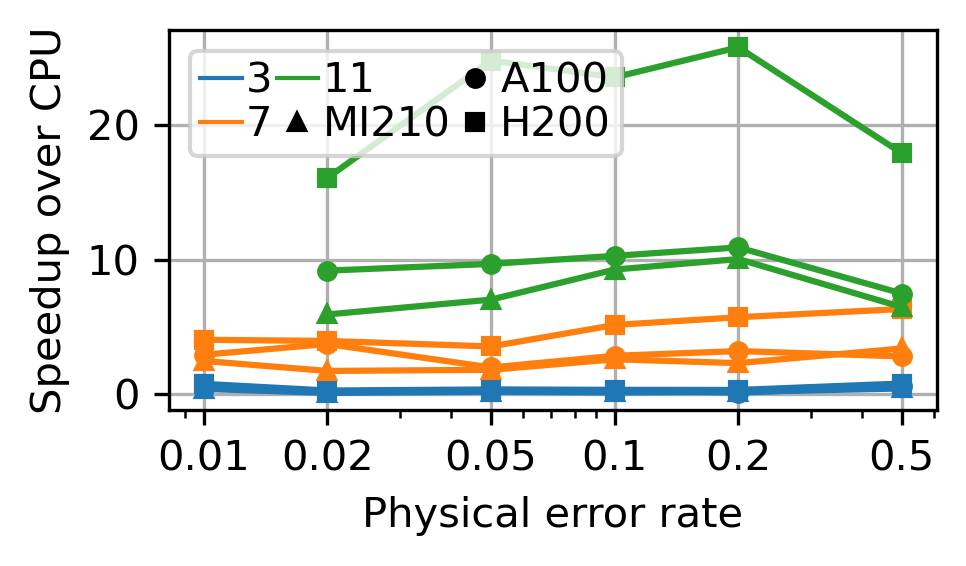 Speedup over CPU |
Citation
If you use Syndrilla in your research, please cite the following papers:
@article{2026_arxiv_lottery_bp,
	title={{Lottery BP: Unlocking Quantum Error Decoding at Scale}},
	author={Yanzhang Zhu and Chen-Yu Peng and Yun Hao Chen and Yeong-Luh Ueng and Di Wu},
	year={2026},
	eprint={2605.00038},
	archivePrefix={arXiv},
	url={https://arxiv.org/abs/2605.00038}
}
@article{2025_qce_syndrilla,
	title={{Syndrilla: Simulating Decoders for Quantum Error Correction using PyTorch}},
	author={Yanzhang Zhu and Chen-Yu Peng and Yun Hao Chen and Siyuan Niu and Yeong-Luh Ueng and Di Wu},
	booktitle={International Conference on Quantum Computing and Engineering},
	year={2025}
}
Contribution
We warmly welcome contributions to Syndrilla — just open a pull request!
License
Syndrilla is released under the MIT License. See LICENSE for the full text.


Download files
Download the file for your platform. If you're not sure which to choose, learn more about installing packages.
Source Distribution
Built Distribution
Filter files by name, interpreter, ABI, and platform.
If you're not sure about the file name format, learn more about wheel file names.
Copy a direct link to the current filters
File details
Details for the file syndrilla-2.0.0.tar.gz.
File metadata
- Download URL: syndrilla-2.0.0.tar.gz
- Upload date:
- Size: 9.1 MB
- Tags: Source
- Uploaded using Trusted Publishing? Yes
- Uploaded via:
twine/7.0.0 CPython/3.13.14
File hashes
| Algorithm | Hash digest | |
|---|---|---|
| SHA256 |
c659662a455720a3e49a2af99da6bda9419d0f27143480948db5000f6f9708de
|
|
| MD5 |
1e5592d0d316918edc87936a482fcae2
|
|
| BLAKE2b-256 |
f6c0cf81dfeeed5eb097ef11e541a6475f1269e50b7ba7575c97f6e25df688fb
|
Provenance
The following attestation bundles were made for syndrilla-2.0.0.tar.gz:
Publisher:
publish.yml on UnaryLab/syndrilla
-
Statement:
-
Statement type:
https://in-toto.io/Statement/v1 -
Predicate type:
https://docs.pypi.org/attestations/publish/v1 -
Subject name:
syndrilla-2.0.0.tar.gz -
Subject digest:
c659662a455720a3e49a2af99da6bda9419d0f27143480948db5000f6f9708de - Sigstore transparency entry: 2694468584
- Sigstore integration time:
-
Permalink:
UnaryLab/syndrilla@841a925919a6afe7983fe2469a38a1e025eae0f1 -
Branch / Tag:
refs/tags/v2.0.0 - Owner: https://github.com/UnaryLab
-
Access:
public
-
Token Issuer:
https://token.actions.githubusercontent.com -
Runner Environment:
github-hosted -
Publication workflow:
publish.yml@841a925919a6afe7983fe2469a38a1e025eae0f1 -
Trigger Event:
push
-
Statement type:
File details
Details for the file syndrilla-2.0.0-py3-none-any.whl.
File metadata
- Download URL: syndrilla-2.0.0-py3-none-any.whl
- Upload date:
- Size: 231.2 kB
- Tags: Python 3
- Uploaded using Trusted Publishing? Yes
- Uploaded via:
twine/7.0.0 CPython/3.13.14
File hashes
| Algorithm | Hash digest | |
|---|---|---|
| SHA256 |
cbef8e584c7ae9267ec21a9332daa902d588bd5a8576eef2430f6c1d9ca477e7
|
|
| MD5 |
c4bf6b4c7c8297b9765a0d73f0798521
|
|
| BLAKE2b-256 |
9ecc063b10610a0279e002338d39c2f48e2d78aa3e5ed566bf7a5ae191bf063a
|
Provenance
The following attestation bundles were made for syndrilla-2.0.0-py3-none-any.whl:
Publisher:
publish.yml on UnaryLab/syndrilla
-
Statement:
-
Statement type:
https://in-toto.io/Statement/v1 -
Predicate type:
https://docs.pypi.org/attestations/publish/v1 -
Subject name:
syndrilla-2.0.0-py3-none-any.whl -
Subject digest:
cbef8e584c7ae9267ec21a9332daa902d588bd5a8576eef2430f6c1d9ca477e7 - Sigstore transparency entry: 2694468642
- Sigstore integration time:
-
Permalink:
UnaryLab/syndrilla@841a925919a6afe7983fe2469a38a1e025eae0f1 -
Branch / Tag:
refs/tags/v2.0.0 - Owner: https://github.com/UnaryLab
-
Access:
public
-
Token Issuer:
https://token.actions.githubusercontent.com -
Runner Environment:
github-hosted -
Publication workflow:
publish.yml@841a925919a6afe7983fe2469a38a1e025eae0f1 -
Trigger Event:
push
-
Statement type:














