
synfit
Dose–response curve fitting and drug-combination synergy scoring for pharmacology: Hill models (4- and 5-parameter), explicit noise models, and Bliss, HSA, Loewe and ZIP references for inhibition and activation assays.
Install
pip install synfit
Python 3.11 or newer. Pure Python — nothing to compile — on top of NumPy, SciPy, pandas and Matplotlib.
Quick start
A single-drug inhibition fit. Data goes in as a tidy DataFrame of
concentration, y and replicate:
import pandas as pd
from synfit import SingleDrugFit

data = pd.DataFrame({
    "concentration": [0, 0.1, 1, 10, 100, 100],
    "y": [1.0, 0.95, 0.75, 0.35, 0.08, 0.05],
    "replicate": [0, 0, 0, 0, 0, 0],
})
result = SingleDrugFit(data).fit()
print(f"c50 (κ): {result.c50:.3g}")
print(f"IC50:    {result.half_max:.3g}")
print(f"Hill:    {result.hill:.3g}")
cis = result.param_ci()
if cis and "c50" in cis:
    lo, hi = cis["c50"]
    print(f"c50 95% CI: [{lo:.3g}, {hi:.3g}]")
The half-max concentration is result.half_max, reported as IC₅₀ for an
inhibition fit and EC₅₀ for an activation one. result.to_dict() gives the
full parameter set, confidence intervals and goodness-of-fit statistics in a
JSON-serialisable form.
What it does
- Hill fitting for single-drug dose–response data, 4-parameter or 5-parameter (asymmetric), for inhibition and activation assays
- Drug-drug interaction matrices —
JointMarginalFitis the recommended marginal path: it fits the two single-agent curves together with shared plate-level asymptotes.MatrixFitis a diagnostic Bliss-null surface model. - Synergy references: Bliss, HSA, Loewe and ZIP — the last implementing the published Zero Interaction Potency model, unit- and direction-neutral
- Explicit noise models: constant and heteroscedastic Gaussian, and Lognormal, fitted by maximum likelihood rather than assumed
- Confidence intervals for each fitted parameter, from the covariance estimate at the optimum, where the optimiser produced one
- Ready-made datasets with known ground truth, shipped with the package
- Plots: dose–response curves and synergy heatmaps via Matplotlib
Modules
Everything in the table is importable from an installed package. The names in
the first row are also re-exported from the top-level synfit namespace.
| Module | Holds |
|---|---|
synfit |
SingleDrugFit, MatrixFit, FitConfig, FitResult, hill_curve, loewe_ci, zip_delta, … |
synfit.hill |
the Hill equation, concentration series, the log_wall prior |
synfit.single |
single-drug fitters and their default bounds and config |
synfit.matrix |
drug-drug matrix fitting |
synfit.joint_marginal |
two drugs' curves fitted together, sharing plate-level asymptotes |
synfit.noise |
the NoiseSpec union, its serialisation and likelihoods |
synfit.bliss |
Bliss independence and HSA references |
synfit.loewe |
Loewe additivity reference and combination index |
synfit.zip |
ZIP reference surface and δ-scores |
synfit.synthetic |
data generation, and the scenarios shipped with the package |
synfit.plotting |
Matplotlib dose–response curves and heatmaps |
For API details and worked examples, see the API reference and tutorials.
Datasets included
Twenty scenarios install with the package, so there is data to fit
immediately: clean and noisy single-drug curves, an activation curve, additive
and synergistic matrices, and a Loewe sham — a drug combined with itself, whose
noise-free combination index is 1 wherever it is defined. Each keeps the config.json that
generated it, so the true parameters behind every fit are known:
from synfit.synthetic import list_scenarios, scenario_config, scenario_dir

print(list_scenarios())
#  ['matrix_antagonism', 'matrix_asymmetric_potency', 'matrix_independent', ...]

path = scenario_dir("single_drug_clean")
csv = path / "single_drug_clean.csv"           # concentration, y, replicate
truth = scenario_config("single_drug_clean")   # the generating parameters
print(truth["hill_params"]["c50"])
Matrix scenarios hold one rep*.csv per replicate; single-drug scenarios hold
one tidy CSV. The installed CSVs are fixed within a release, so you can use them
as reproducible fixtures and record synfit.__version__ with your analysis.
Fit a bundled synthetic dataset
The bundled scenarios make a compact, reproducible starting point. This one loads a noisy three-replicate curve and fits it. Its ground truth is available because the dataset is synthetic; real experimental data does not have one.
# Generates synthetic-fit.png
import pandas as pd
from synfit import FitConfig, SingleDrugFit
from synfit.plotting import dose_response_plot
from synfit.synthetic import scenario_config, scenario_dir

# load dataset (here, one of the synthetic ones)
name = "single_drug_noisy"
directory = scenario_dir(name)
data = pd.read_csv(directory / f"{name}.csv")
truth = scenario_config(name)["hill_params"]

# fit
result = SingleDrugFit(data, FitConfig(noise="lognormal")).fit()

# plot
dose_response_plot(
    data, result, reference=truth, x_label="Concentration [µM]",
)
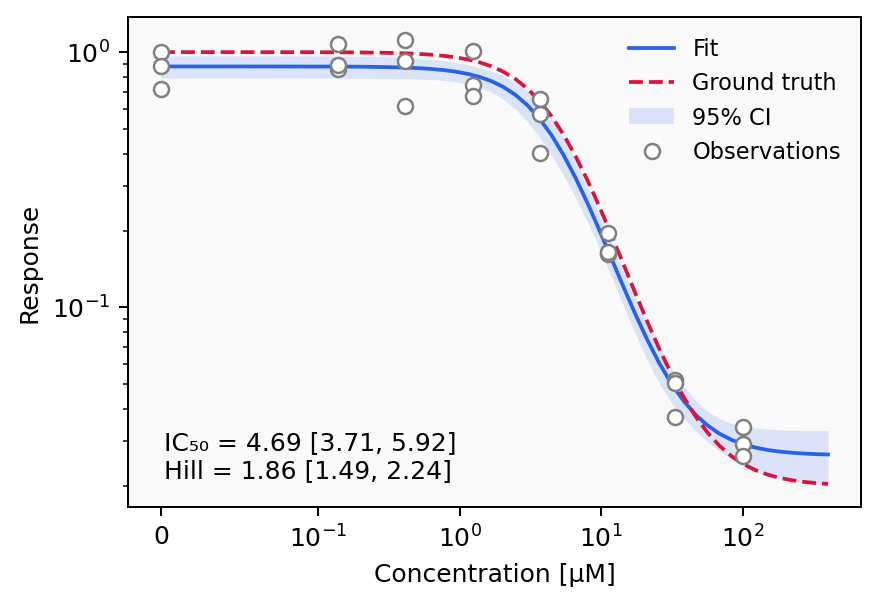
The shaded band is an approximate confidence interval for the fitted curve, derived from the parameter covariance. It is not a prediction interval for individual observations, and it need not contain the whole true curve in every experiment. The plotting helper uses a symmetric logarithmic axis when the data contains a zero-dose control.
For an observed matrix, reference surfaces, and synergy score heatmaps generated by their accompanying code, see the matrix synergy tutorial.
How the fitting works
Fits run scipy.optimize.minimize (L-BFGS-B) in scale-relative coordinates, so
they are stable across response magnitudes. Parameters are bounded through
FitBounds: L-BFGS-B enforces box bounds, and the objective also includes a
log_wall penalty that is zero inside the bounds and rises linearly outside
them. Variance is profiled out of the likelihood
analytically where the noise model allows it. When a heteroscedastic Gaussian
fit stalls on its first iteration, it is retried once with variance initials
refreshed from the data.
Noise models
The noise model is part of the fit, configured through FitConfig.noise as a
tagged NoiseSpec union that serialises to JSON — for example
{"kind": "gaussian_linear", "a_init": 0.001, "b_init": 0.0}. The fittable
variants are GaussianConstant, GaussianLinear, GaussianQuadratic and
Lognormal.
Constant Gaussian and Lognormal profile their single variance term
analytically. The linear and quadratic Gaussians instead fit coefficients of a
response-dependent variance, σ²(μ) = a + b·d + c·d², where
d = μ − min(effect_0, effect_inf). This anchors the variance at the lower
asymptote when scatter grows with signal. Per-point y_err weights remain
available for constant Gaussian and Lognormal fits.
Synergy references
Each score follows its published definition:
-
ZIP (Zero Interaction Potency) — Yadav B, Wennerberg K, Aittokallio T, Tang J. Searching for drug synergy in complex dose–response landscapes using an interaction potency model. Computational and Structural Biotechnology Journal 13:504–513 (2015). doi:10.1016/j.csbj.2015.09.001 — the best-known implementation of this method is SynergyFinder.
synfitimplements the published formulation for symmetric (4-parameter) curves; for 5-parameter drugs it keeps the moving drug's asymmetry in the slice fits, which is an extension of the published method and reduces to it when the asymmetry equals 1.Tested scope: the δ-scores are checked against fixtures generated by the independent
synergypackage for two dose–response landscapes (one synergistic, one potentiated), agreeing to better than1e-3in δ units. That is evidence for these cases, not a general proof of equivalence to any other implementation. -
Bliss independence — Bliss CI. The toxicity of poisons applied jointly. Annals of Applied Biology 26:585–615 (1939).
-
HSA (Highest Single Agent) — the combination is compared against whichever single agent acts more strongly; see Berenbaum MC. What is synergy? Pharmacological Reviews 41:93–141 (1989) for the reference frames and how they differ. HSA is undefined for an inhibitor combined with an activator.
-
Loewe additivity — Loewe S, Muischnek H. Über Kombinationswirkungen. Naunyn-Schmiedeberg's Archiv für experimentelle Pathologie und Pharmakologie 114:313–326 (1926).
What each function returns
The synergy helpers do not share one sign convention — they return three different kinds of quantity, so read the units before reading the sign:
| Function | Returns | Synergy is |
|---|---|---|
bliss_independence, bliss_reference, hsa_reference, loewe_reference, zip_reference |
the expected response under that null model, in response units | not a sign — compare against the observed response |
zip_fitted_surface |
the fitted ZIP combination surface, in response units | not a null model |
zip_delta |
a signed δ-score, -(f_c - f_zip) in fraction-affected units |
negative |
zip_scores |
ZipResult: reference, fitted surface, δ-score, and slice-failure metadata |
δ is negative for synergy |
loewe_ci |
a combination index, a dimensionless ratio | below 1 (1 is additive, above 1 antagonistic) |
The top-level synfit namespace exports the reference helpers above.
synfit.bliss also exposes bliss_deviation and hsa_deviation, which return
normalised deviations (negative for synergy); see the
API reference.
Contributing
See CONTRIBUTING.md for the development setup and the test and release commands.
License
MIT — see LICENSE.
1 maintainer

Metadata
1 maintainer
Release files for synfit 0.9.0
For a detailed explanation of source distributions (sdists) and built distributions (wheels), please see the package formats documentation.
Source distribution (sdist)
| File | Size | Uploaded | |
|---|---|---|---|
| synfit-0.9.0.tar.gz | 366.8 kB | Details |
Built distribution (wheel)
| File | Interpreter | ABI | Platform | Reset |
|---|---|---|---|---|
| synfit-0.9.0-py3-none-any.whl | Python 3 | none | any | Details |
Total release size: 483.3 kB
Release files / synfit-0.9.0.tar.gz
| Download URL | synfit-0.9.0.tar.gz |
|---|---|
| Size | 366.8 kB |
| Tags | Source |
|
SHA-256 checksum How to use checksums |
b7bda9acf82fe03f12a76d5405e4a5337e6a49d6e9972862343b48bc15d27a7d
|
|
BLAKE2b-256 checksum How to use checksums |
44d9f1a929c565082840e895565f459363d26204e7d73f0f151d555bcb2f1139
|
| Upload date | |
|
Uploaded using Trusted Publishing? What is trusted publishing? |
Yes |
| Uploaded via |
twine/7.0.0 CPython/3.13.14
|
Provenance
Provenance describes where a file came from. On PyPI, provenance is shared via attestations, which provide a verifiable record of the build or publishing details. View details, limitations and caveats.


PyPI Publish Attestation
PyPI verified that this artifact, at this checksum, originated from the publisher listed below.
Signed by GitHub Actions, verified by PyPI on Oct 8, 2026.
Transparency logRelease files / synfit-0.9.0-py3-none-any.whl
| Download URL | synfit-0.9.0-py3-none-any.whl |
|---|---|
| Size | 116.5 kB |
| Tags | Python 3 |
|
SHA-256 checksum How to use checksums |
7d8cf9737b1f61739fb46fa71107018254e24acc8421c1f65c7563899590e247
|
|
BLAKE2b-256 checksum How to use checksums |
fa0b5e73ad6c3455f7f3643e88836bfa0107a844751e5019d1ef23286159e07a
|
| Upload date | |
|
Uploaded using Trusted Publishing? What is trusted publishing? |
Yes |
| Uploaded via |
twine/7.0.0 CPython/3.13.14
|
Provenance
Provenance describes where a file came from. On PyPI, provenance is shared via attestations, which provide a verifiable record of the build or publishing details. View details, limitations and caveats.
PyPI Publish Attestation
PyPI verified that this artifact, at this checksum, originated from the publisher listed below.
Signed by GitHub Actions, verified by PyPI on Oct 8, 2026.
Transparency log













