
syntillate




Name
The name is a portmanteau of scintillate and Synthesizer — the parent package ecosystem. To scintillate is to scatter and reflect light; here, the package scatters photometry with physically motivated noise.
Overview
syntillate is a standalone Python package that provides a score-based diffusion noise model for photometric surveys. It learns the conditional distribution p(σ | m) — the joint flux-uncertainty distribution as a function of observed magnitude — from real survey data, and then draws physically realistic uncertainty samples when generating mock catalogues.
The model is a variance-preserving (VP) score-based diffusion model trained on pairs of observed photometry and flux uncertainties. After training, the reverse-time ODE or SDE is integrated to sample uncertainties conditioned on any input magnitude vector, making it suitable for injecting realistic noise into simulated galaxy catalogues.
syntillate was originally developed as part of Synference, a simulation-based inference (SBI) package for SED fitting. This package extracts the noise-modelling component for standalone use.
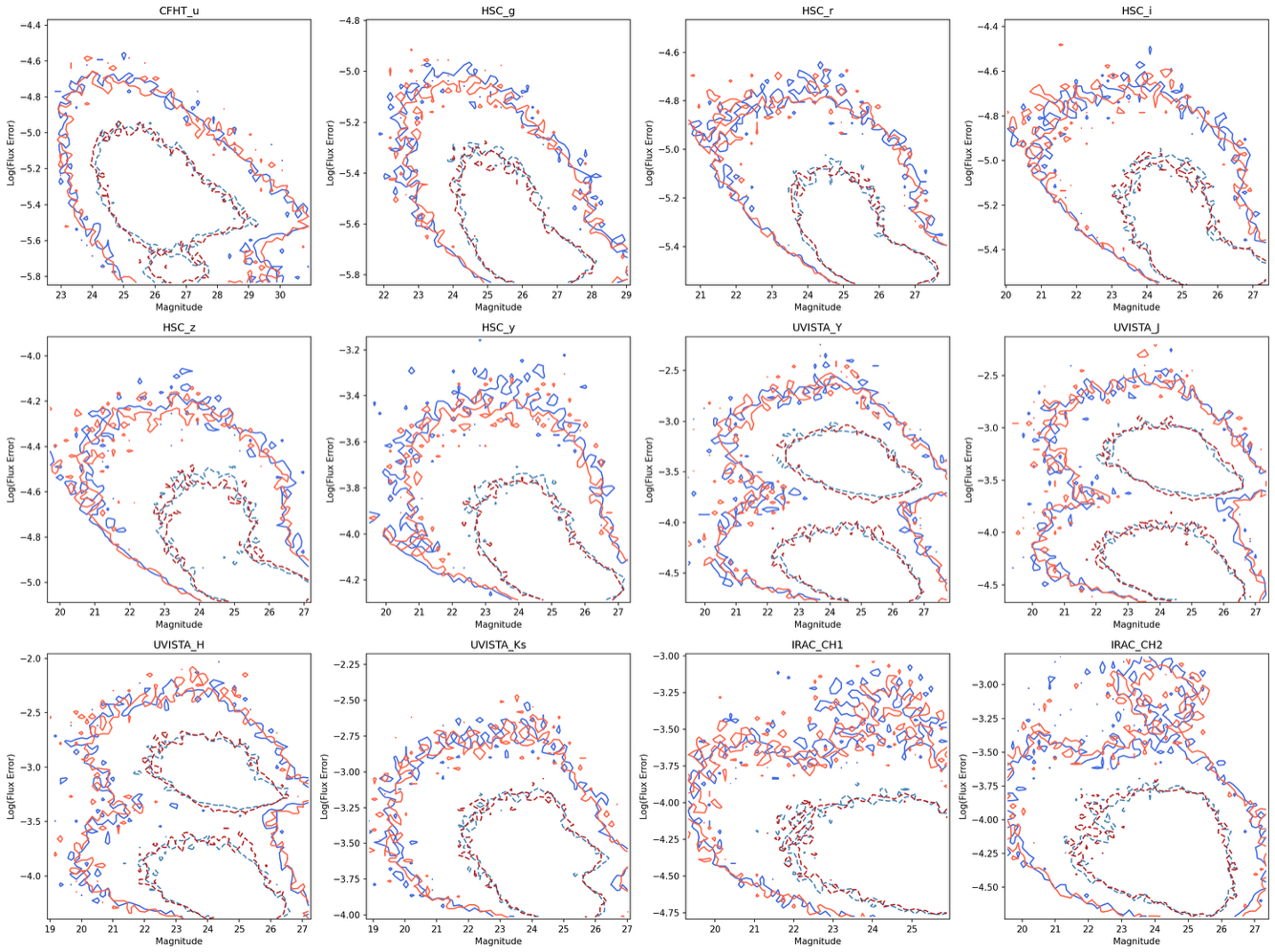
Here's an example of a trained model which has learned p(σ | m) for the COSMOS2020 catalog (blue, Weaver et al. 2023) and accurately reproduces the density distribution for the uncertainity distribution of each filter (in red).
Key Features
- Score-based diffusion model: Learns p(σ|m) via a VP-SDE with a linear β schedule, using a residual MLP conditioned on Gaussian Fourier time embeddings.
- Asinh magnitude support: Optional training in asinh magnitude space to handle faint or negative-flux sources.
- HDF5 serialization: Save and restore trained models with full weight and normalisation-statistic preservation.
- Minimal dependencies: Requires only PyTorch, h5py, NumPy, unyt, and matplotlib.
Requirements
syntillate requires Python 3.10 or higher. Core dependencies:
- torch for the neural score network
- numpy for numerical operations
- h5py for HDF5 serialization
- unyt for unit handling
Installation
pip install syntillate
Or from source:
git clone https://github.com/synthesizer-project/syntillate.git
cd syntillate
pip install -e .
Quick Start
import numpy as np
from unyt import Jy, uJy, unyt_array
from syntillate import ScoreBasedUncertaintyModel, save_model_to_hdf5, load_model_from_hdf5

# --- Training ---
# observed_phot: (N, n_filters) array of AB magnitudes
# observed_sigma: (N, n_filters) array of flux uncertainties in uJy
filter_names = ["F115W", "F150W", "F200W", "F277W", "F356W", "F444W"]

model = ScoreBasedUncertaintyModel(filter_names=filter_names)
history = model.fit(
    photometry=observed_phot,           # (N, 6) AB magnitudes, or a unyt_array of fluxes
    flux_uncertainties=observed_sigma,  # (N, 6) uncertainties
    flux_uncertainty_units="uJy",       # or pass observed_sigma as a unyt_array
    n_epochs=500,
    verbose=True,
)

# --- Sampling uncertainties for new photometry ---
new_mags = np.array([[25.0, 24.8, 24.5, 24.2, 24.0, 23.8]])  # (1, 6)
sigma = model.sample_uncertainty(new_mags)  # (1, 6) in model.sigma_units ("uJy" here)

# --- Apply noise to a mock flux array ---
mock_flux = unyt_array(np.array([1e-6, 1.2e-6, 1.5e-6, 2e-6, 2.5e-6, 3e-6]), units=Jy)
noisy_flux = model.apply_noise(mock_flux)

# --- Serialization ---
save_model_to_hdf5(model, "noise_model.hdf5", "my_survey", overwrite=True)
loaded_model = load_model_from_hdf5("noise_model.hdf5", "my_survey")
Asinh Magnitude Training
For surveys with significant numbers of faint or non-detected sources, you can train in asinh magnitude space instead of AB magnitudes. This avoids log(0) failures and handles negative flux entries naturally:
from unyt import uJy

model = ScoreBasedUncertaintyModel(filter_names=filter_names)
history = model.fit(
    photometry=observed_phot_flux,  # unyt_array of fluxes required
    flux_uncertainties=observed_sigma,
    asinh_scaling=True,
    asinh_b_factor=0.01 * uJy,  # softening parameter; a list gives one per filter
)

# Asinh models take fluxes (not magnitudes) at sampling time, and convert
# internally using the stored b factor — negative fluxes are fine:
sigma = model.sample_uncertainty(unyt_array([[-1e-3, 5e-3, ...]], units=uJy))
License
This project is licensed under the GNU General Public License v3.0 (GPLv3). See the LICENSE file for details. syntillate is under active development and is provided "as is" without warranty of any kind.
1 maintainer

Metadata
1 maintainer
Release files for syntillate 0.1.0
For a detailed explanation of source distributions (sdists) and built distributions (wheels), please see the package formats documentation.
Source distribution (sdist)
| File | Size | Uploaded | |
|---|---|---|---|
| syntillate-0.1.0.tar.gz | 816.3 kB | Details |
Built distribution (wheel)
| File | Interpreter | ABI | Platform | Reset |
|---|---|---|---|---|
| syntillate-0.1.0-py3-none-any.whl | Python 3 | none | any | Details |
Total release size: 861.4 kB
Release files / syntillate-0.1.0.tar.gz
| Download URL | syntillate-0.1.0.tar.gz |
|---|---|
| Size | 816.3 kB |
| Tags | Source |
|
SHA-256 checksum How to use checksums |
44f3ccba2bc890021b9689ecbfddcb6fcab5f6b8e6484d11ac1f0396ee6b6ceb
|
|
BLAKE2b-256 checksum How to use checksums |
81299a295c1456d962c63da4fdec4b66fbd76a990df841c61c66868bbbcac260
|
| Upload date | |
|
Uploaded using Trusted Publishing? What is trusted publishing? |
Yes |
| Uploaded via |
twine/6.1.0 CPython/3.13.14
|
Provenance
Provenance describes where a file came from. On PyPI, provenance is shared via attestations, which provide a verifiable record of the build or publishing details. View details, limitations and caveats.


PyPI Publish Attestation
PyPI verified that this artifact, at this checksum, originated from the publisher listed below.
Signed by GitHub Actions, verified by PyPI on Jul 25, 2026.
Transparency logRelease files / syntillate-0.1.0-py3-none-any.whl
| Download URL | syntillate-0.1.0-py3-none-any.whl |
|---|---|
| Size | 45.1 kB |
| Tags | Python 3 |
|
SHA-256 checksum How to use checksums |
c90538b2a0acaae72a895efe2ea358a873a803ad8f4bc1578893d5cba8dc0de5
|
|
BLAKE2b-256 checksum How to use checksums |
3909bdb28cf71aa327612e7b408d311c5324c83fc9be311a078a87154e872b53
|
| Upload date | |
|
Uploaded using Trusted Publishing? What is trusted publishing? |
Yes |
| Uploaded via |
twine/6.1.0 CPython/3.13.14
|
Provenance
Provenance describes where a file came from. On PyPI, provenance is shared via attestations, which provide a verifiable record of the build or publishing details. View details, limitations and caveats.
PyPI Publish Attestation
PyPI verified that this artifact, at this checksum, originated from the publisher listed below.
Signed by GitHub Actions, verified by PyPI on Jul 25, 2026.
Transparency log












