

Replace an LLM agent's closed-set decisions with a cheap classifier trained from its own logs.
TabAgent: Distilling LLM Agent Components into Cheap Classifiers
Ido Levy1,2 · Segev Shlomov1 · Avi Yaeli1 · Nir Mashkif1 · Asaf Adi1 · Yinon Goldstein1 · Eilam Shapira1 · Leshem Choshen1,2
1IBM · 2Weizmann Institute of Science









Quick start · How it works · Results · Use it in your agent · Docs · Cite
Why
- Agents pay a frontier LLM for the same kind of decision again and again. Which tools to shortlist, which skill or application to use, which model or sub-agent to route to: closed-set decisions whose repeated calls dominate per-task latency and cost.
- A classifier trained on the agent's own successful runs can make them instead. On AppWorld tool shortlisting it recovers essentially all of the tools the GPT-5.4 shortlister used on its successful runs (Recall@9 of 92–100), in 2.682 ms for $2.0×10⁻⁷ per decision against 7.50 s and $0.052: more than 10³× lower latency and 10⁵× lower cost.
- The representation does the work, not the model. A head over raw text or embeddings alone collapses; trace-derived features make it accurate, so one lightweight CatBoost head serves every decision family.
How it works
 |
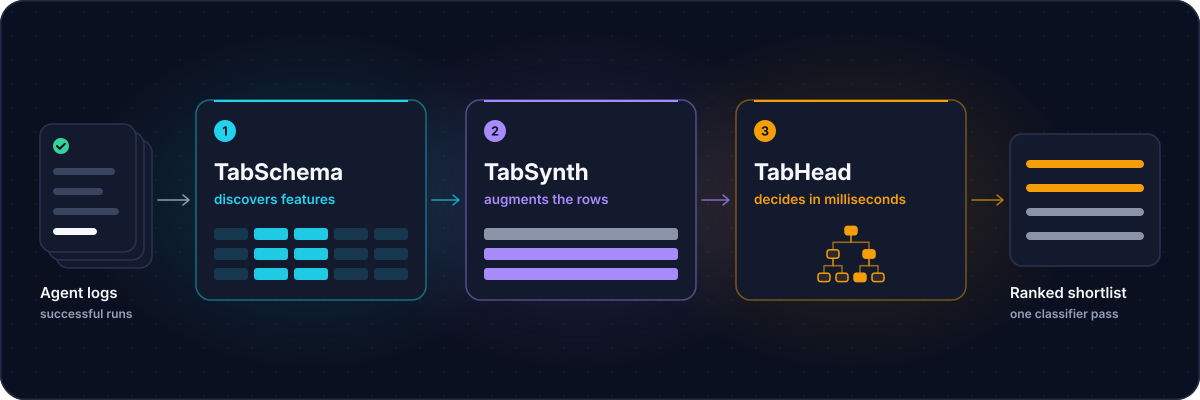
Discovers features. LLM agents analyze the successful trajectories, write and sandbox-test the extraction code, and a judge ensemble keeps the features that matter. |
 |
Augments the rows. Deterministic, label-preserving paraphrases of the free-text state, where trajectories are scarce. |
 |
Decides in milliseconds. A CatBoost classifier scores every candidate in one pass; a confidence gate can defer unsure decisions back to the LLM. |
The three phases run once per agent and catalog. At inference the head replaces the LLM call, and the rest of the agent is unchanged. Components covers each phase in detail.
Quick start
pip install tabagent
See it work on a public benchmark, in a few minutes on a laptop CPU (it downloads 3.5 MB of data and a 128 MB encoder once):
git clone https://github.com/dolev31/TabAgent && cd TabAgent
pip install -e ".[embed]"
python examples/01_quickstart_skillsbench.py   # P@R ≈ 0.80, Recall@9 ≈ 0.90 on SkillsBench skill selection
The paper reports P@R 80 and Recall@9 91 there; Reproducing the paper compares every public result with the paper's.
Extras and the other examples
pip install "tabagent[tabschema]"   # onboarding from agent logs (OpenAI and OpenAI-compatible LLMs)
pip install "tabagent[llm]"         # Anthropic, Gemini and other providers through LiteLLM
pip install "tabagent[embed]"       # e5 context-candidate similarity features
pip install "tabagent[serve]"       # the HTTP decision service
| Example | What it shows | Needs |
|---|---|---|
| 01_quickstart_skillsbench.py | the paper's components on a public benchmark, cross-validated | CPU; network on first run |
| 02_bring_your_own_table.py | scikit-learn estimators on your own decision table | CPU, offline |
| 03_onboard_agent_logs.py | onboarding a decision from your own agent logs | an LLM API key |
| 04_deploy.py | live decisions in-process, the HTTP service, a tool filter in front of your LLM | a saved head |
| 05_tau2_cross_agent_transfer.py | training on one agent's traces and deploying on another's | CPU; network on first run |
For the exact dependency versions pinned in uv.lock, clone the repository and run uv sync --extra embed.
Results
| Decision | Benchmark | Metric | Best baseline | TabAgent |
|---|---|---|---|---|
| Tool shortlisting | AppWorld, five apps | P@R | 56–92 | 66–96 |
| Tool shortlisting | τ²-bench, three domains, 38 tools | P@R | 42 | 78 |
| Skill shortlisting | SkillsBench, 195 skills | P@R | 74 | 80 |
| Application selection | AppWorld, multi-label | macro-F1 | 92 | 97 |
| Operation selection | Mind2Web, three-way | macro-F1 | 84 | 92 |
| GUI element selection | Mind2Web, three domains | R@3 | 15–23 | 68–74 |
| Model routing | LLMRouterBench, 12 models | route@1 | 70 | 71 (on par) |
How to read this table, and what is reproducible here
Percentages from the paper's Table 1 and, for AppWorld, its full per-method table. TabAgent is the better of its real-only and +synth variants. Best baseline is the strongest of BM25, DSR (zero-shot and fine-tuned; on AppWorld also fine-tuned on the same TabSynth rows, where TabAgent's lead is significant only on Gmail) and the few-shot LLM in each row; on model routing it is the best single model applied to every task. A fine-tuned 8B small LLM, a reference at about 10²–10⁴× TabAgent's cost, is excluded as in the paper; it scores higher on four of the five AppWorld apps. The paper's table also covers the OAK and BPO enterprise benchmarks, where the small trajectory pools leave TabAgent behind or level with the best baseline, and sub-agent routing and skill gating, where it is on par with the best fixed default.
The AppWorld rows use the CUGA agent's own trajectories, which are not released. Every other row is recomputed by Reproducing the paper from public data, on the feature cards bundled with each dataset, so it calls no LLM. The released TabSchema implementation has not yet been validated against a paper number.
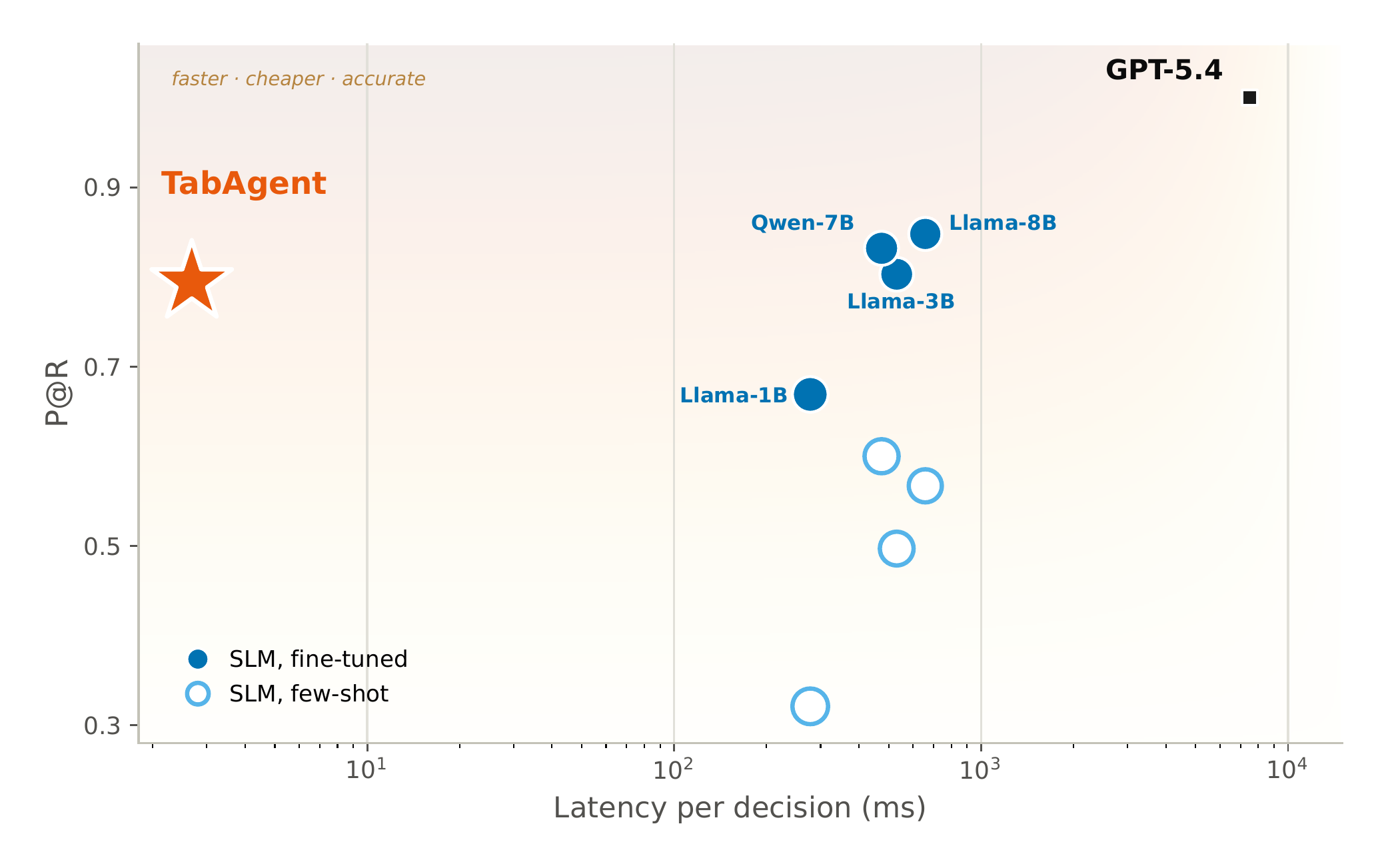
AppWorld tool shortlisting: TabAgent (star) is the fastest, cheapest point, near the top on quality.
More findings
- In the loop. Hot-swapped into a live agent on 24 held-out AppWorld tasks, TabAgent reaches 27.1% task success against 29.2% for the GPT-5.4 shortlister; the paired 95% CI of the difference, [−18.8, +16.7], includes zero.
- Few traces. The head reaches 90% of its full-pool P@R from 118 successful trajectories on AppWorld and from 37 to 51 on the four τ²-bench agents.
- Across agents. Trained on one ReAct agent's traces and tested on another's, it loses about 3.1 points of P@R on τ²-bench (transfer within one architecture).
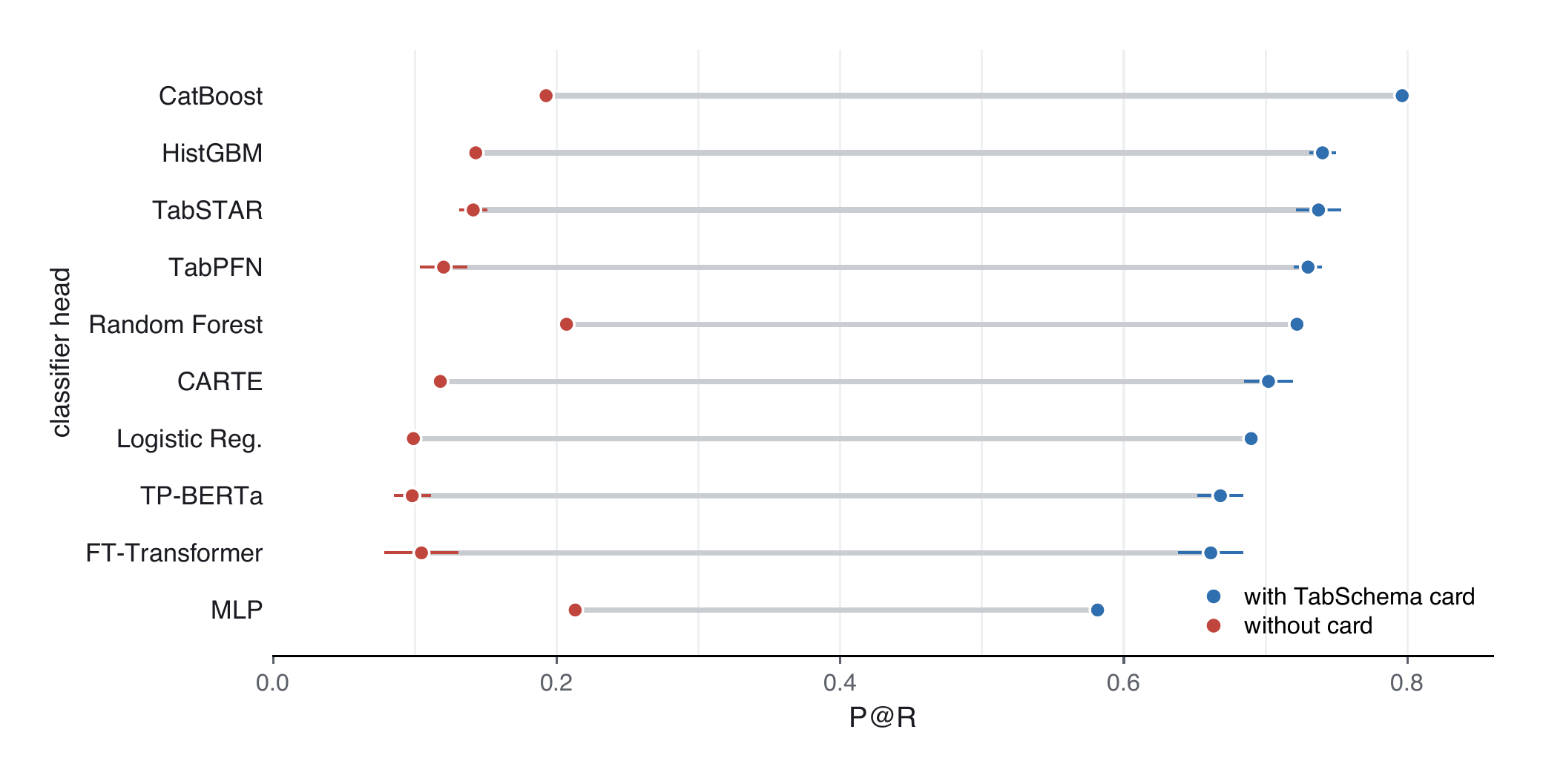
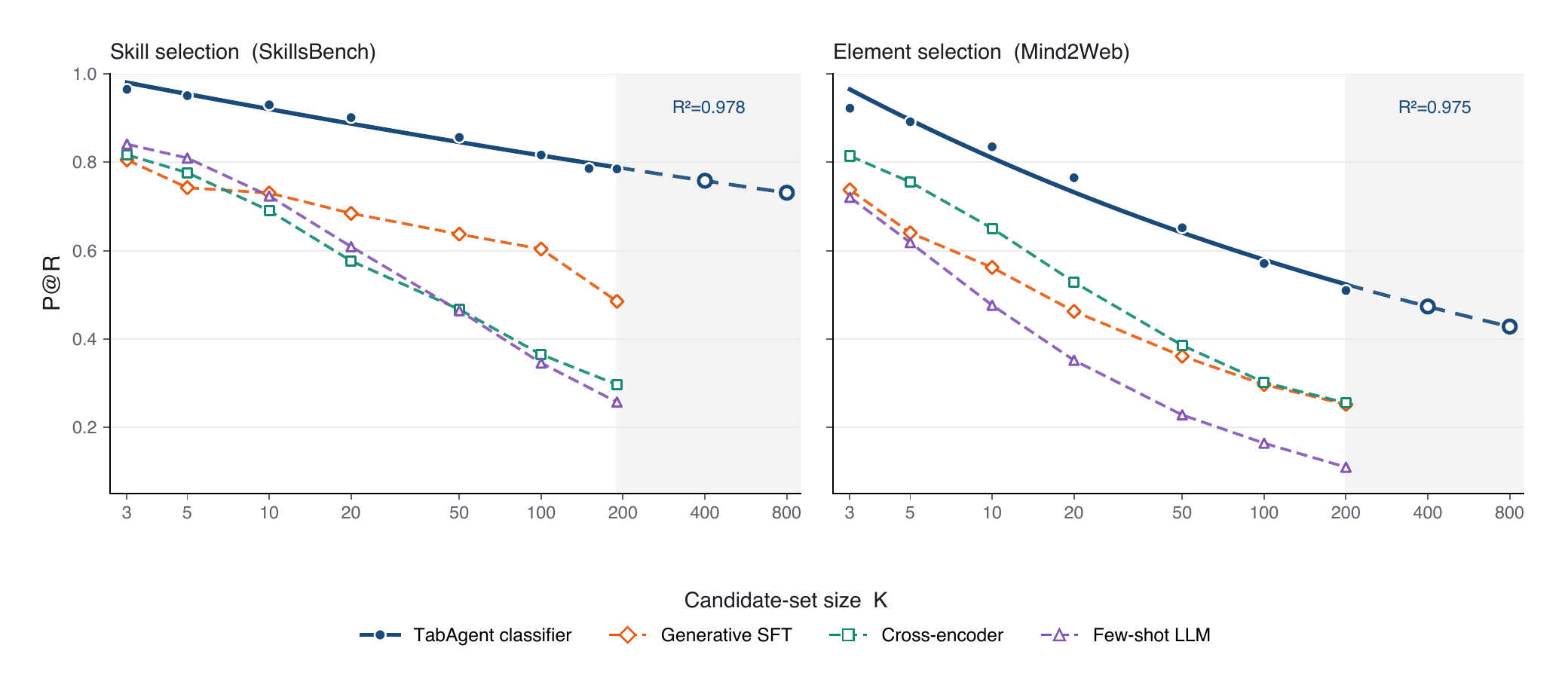
- The head barely matters. Every classifier head reaches useful P@R with the feature card and collapses to 0.10–0.21 without it; as the candidate set grows, LLM regimes degrade sharply while TabAgent stays highest.
Reproduce the paper
Every public result has one command; make reproduce runs every public Table 1 and Table 2 cell on a CPU.
| Paper result | Command | Runs on |
|---|---|---|
| Table 1, τ²-bench rows | python -m experiments.reproduce --cells tau2-airline tau2-retail tau2-telecom tau2-combined |
CPU, 25 min |
| Table 1, skill selection | python -m experiments.reproduce --cells skill-selection |
CPU, 2 min |
| Table 1, Mind2Web operation and element selection | python -m experiments.reproduce --cells operation-selection element-selection |
CPU, 5.9 GB of data |
| Table 2, transfer across agents | python -m experiments.reproduce --cells transfer |
CPU, 5 min |
| Fig. 3, classifier heads | python -m experiments.figures.head_ablation |
CPU, 1 hour |
| Table 15 and Fig. 4, cost and the Pareto plot | python -m experiments.efficiency.cost and python -m experiments.efficiency.pareto --paper |
CPU, seconds |
Reproducing the paper lists every table and figure with its command, time and data, puts the released numbers next to the paper's, and names what public data cannot reproduce (the results on the CUGA agent's AppWorld trajectories).
Use it in your agent
1. Onboard a decision from the agent's own logs (OpenAI, Anthropic, LangChain, τ²-bench, CUGA or generic JSON):
export OPENAI_API_KEY=...                                          # the LLM TabSchema calls
tabagent scan ./agent_logs                                         # which LLM calls are worth replacing?
tabagent onboard ./agent_logs --decision ToolShortlist --dry-run   # what it will process and cost
tabagent onboard ./agent_logs --decision ToolShortlist --out ./my_head
2. Serve it: tabagent serve ./my_head --port 8077 answers POST /decide from warm, sandboxed workers, with
readiness, Prometheus metrics and drift monitoring (production runbook).
3. Hot-swap the LLM call: ToolFilter sends your tool-calling LLM only the tools the head shortlists, and the full
list whenever the head defers.
from tabagent.integrations.openai_tools import ToolFilter

tool_filter = ToolFilter("my_head", k=7)  # or the URL of a `tabagent serve` service
session = tool_filter.session(task={"instruction": goal})  # one per conversation
client.chat.completions.create(model=..., messages=messages, tools=session(messages, tools))
Python API and scikit-learn estimators
import tabagent

head = tabagent.onboard("./agent_logs", decision="ToolShortlist")
print(head.report)  # grouped cross-validation vs BM25 and chance, latency, cost per decision
head.save("my_head")
head.decide(prefix, candidates, k=5)  # {"candidates", "scores", "confidence", "deferred", "error"}
from tabagent import TabAgentRanker

# one row per (decision, candidate); y = 1 if the agent chose the candidate
ranker = TabAgentRanker(group_col="task_id", candidate_col="tool")
ranker.fit(X, y)  # infers the card, picks TabSynth and the prior by nested validation
ranker.rank(X_new, k=5)  # top-5 candidates per decision
Onboarding sends trajectories to your LLM provider; redact= (CLI: --redact module:function) scrubs them first.
Documentation
Concepts · Components · Onboard an agent · Bring your own table · Deploy · Datasets · Reproducing the paper
The guides are also a searchable site at dolev31.github.io/TabAgent. Pretrained
heads for SkillsBench skill selection and
τ²-bench tool shortlisting load with
tabagent.load("hf://..."), and the Colab quickstart runs one in the browser.
Citation
@misc{levy2026tabagent,
  title  = {TabAgent: Distilling LLM Agent Components into Cheap Classifiers},
  author = {Levy, Ido and Shlomov, Segev and Yaeli, Avi and Mashkif, Nir and Adi, Asaf and
            Goldstein, Yinon and Shapira, Eilam and Choshen, Leshem},
  year   = {2026},
  eprint = {2602.16429},
  archivePrefix = {arXiv},
  primaryClass  = {cs.CL},
  doi    = {10.48550/arXiv.2602.16429},
  url    = {https://arxiv.org/abs/2602.16429}
}
License
Apache-2.0 (see LICENSE). TabAgent ships no benchmark data and no agent trajectories; the benchmarks keep their own licenses, listed in NOTICE. Contributions are welcome: see CONTRIBUTING.md and the Code of Conduct; SECURITY.md covers how generated extraction code is sandboxed and how to report a vulnerability privately.
Acknowledgements
The public results are recomputed from the benchmarks' own releases, downloaded at pinned revisions and verified by SHA-256: τ²-bench and the tau2-sft-final trajectories, SkillsBench, Mind2Web (CC-BY-4.0), LLMRouterBench and AppWorld. The paper also evaluates on AppWorld with the CUGA agent and on the OAK and BPO benchmarks. TabHead is built on CatBoost, the similarity features on e5-small-v2, and the brand type is Inter and JetBrains Mono (SIL OFL 1.1).
1 maintainer

Metadata
1 maintainer
Release files for tabagent 0.1.0
For a detailed explanation of source distributions (sdists) and built distributions (wheels), please see the package formats documentation.
Source distribution (sdist)
| File | Size | Uploaded | Provenance | |
|---|---|---|---|---|
| tabagent-0.1.0.tar.gz | 845.5 kB | With provenance | Details |
Built distribution (wheel)
| File | Interpreter | ABI | Platform | Reset |
|---|---|---|---|---|
| tabagent-0.1.0-py3-none-any.whl | Python 3 | none | any | Details |
Total release size: 1.4 MB
Release files / tabagent-0.1.0.tar.gz
| Download URL | tabagent-0.1.0.tar.gz |
|---|---|
| Size | 845.5 kB |
| Tags | Source |
|
SHA-256 checksum How to use checksums |
93a44893adfa2c2c041aec1ff5e4b3453e47c644e5cf841c0d9fb70fcbb03122
|
|
BLAKE2b-256 checksum How to use checksums |
88782429bc0a7477abb30a46596f3c2eee79d54392c7504d546a75f6c58095f4
|
| Upload date | |
|
Uploaded using Trusted Publishing? What is trusted publishing? |
Yes |
| Uploaded via |
twine/7.0.0 CPython/3.13.16
|
Provenance
Provenance describes where a file came from. On PyPI, provenance is shared via attestations, which provide a verifiable record of the build or publishing details. View details, limitations and caveats.


PyPI Publish Attestation
PyPI verified that this artifact, at this checksum, originated from the publisher listed below.
Signed by GitHub Actions, verified by PyPI on Oct 21, 2026.
Transparency logRelease files / tabagent-0.1.0-py3-none-any.whl
| Download URL | tabagent-0.1.0-py3-none-any.whl |
|---|---|
| Size | 522.9 kB |
| Tags | Python 3 |
|
SHA-256 checksum How to use checksums |
6d97b60cf6348dce9fd3365c352e1e64016545664d21865a21213331e81f9c0d
|
|
BLAKE2b-256 checksum How to use checksums |
8f46a22b706170321139eac3b311556ea9dd7bb60d09927c7a1752b71670a241
|
| Upload date | |
|
Uploaded using Trusted Publishing? What is trusted publishing? |
Yes |
| Uploaded via |
twine/7.0.0 CPython/3.13.16
|
Provenance
Provenance describes where a file came from. On PyPI, provenance is shared via attestations, which provide a verifiable record of the build or publishing details. View details, limitations and caveats.
PyPI Publish Attestation
PyPI verified that this artifact, at this checksum, originated from the publisher listed below.
Signed by GitHub Actions, verified by PyPI on Oct 21, 2026.
Transparency logSecurity for tabagent 0.1.0
Provenance
Provenance describes where a file came from. On PyPI, provenance is shared via attestations, which provide a verifiable record of the build or publishing details. View details, limitations and caveats.
Full provenance
All 2 files in this release have been uploaded with provenance metadata.
Attestation for tabagent-0.1.0.tar.gz
PyPI Publish Attestation
PyPI verified that this artifact, at this checksum, originated from the publisher listed below.
Signed by GitHub Actions, verified by PyPI on Oct 21, 2026.
Transparency logA note on package security
PyPI is a repository for distributing packages, not a service for auditing them. While third-party security researchers and our staff do their best to detect and remove malicious packages, PyPI cannot guarantee the quality, security or suitability of any given package.













