
TabEBM: A Tabular Data Augmentation Method with Distinct Class-Specific Energy-Based Models
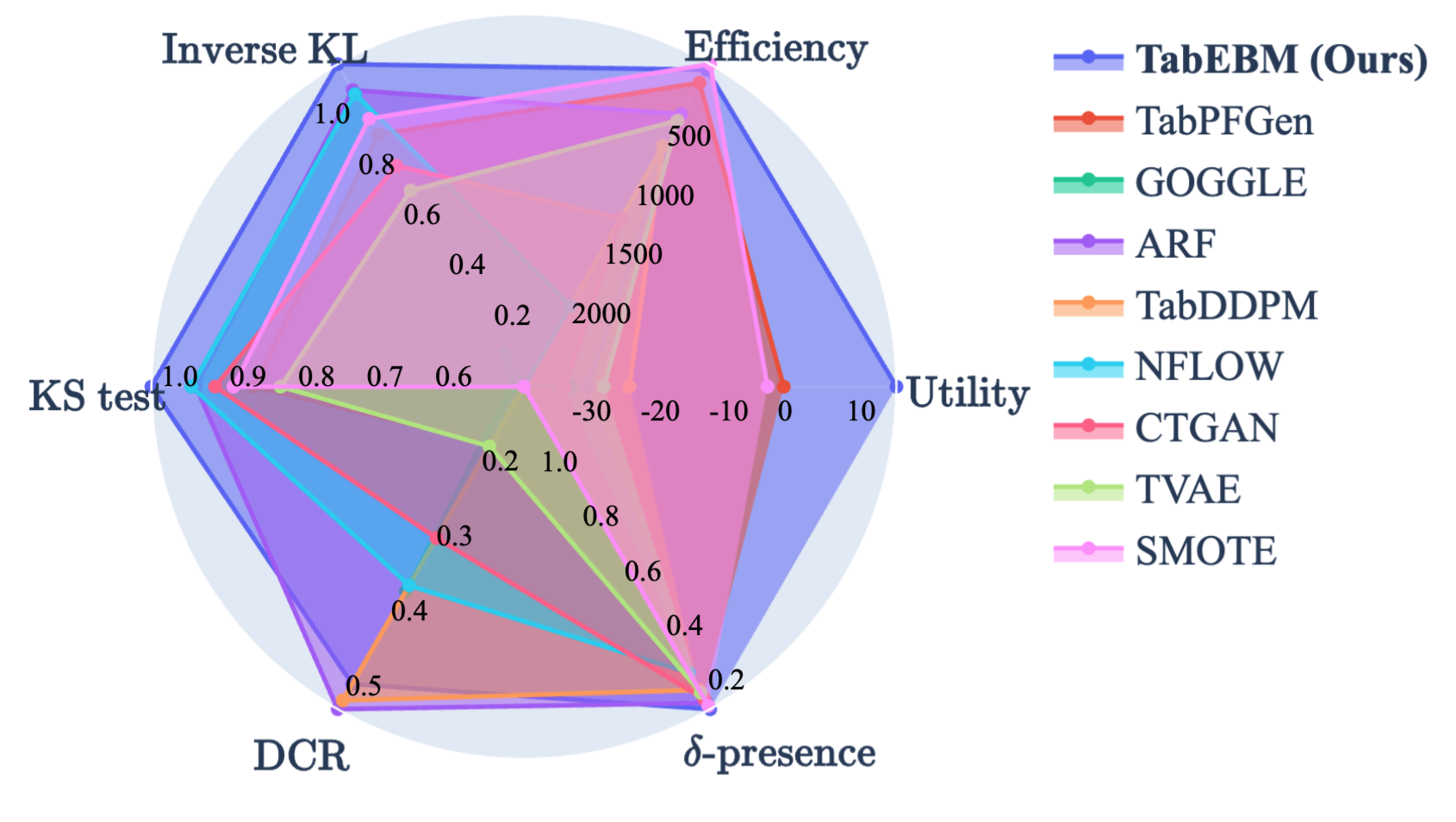





Official code for the paper "TabEBM: A Tabular Data Augmentation Method with Distinct Class-Specific Energy-Based Models", published in the Thirty-Eighth Annual Conference on Neural Information Processing Systems (NeurIPS 2024).
Authored by Andrei Margeloiu*, Xiangjian Jiang*, Nikola Simidjievski, Mateja Jamnik, University of Cambridge, UK
📌 Overview
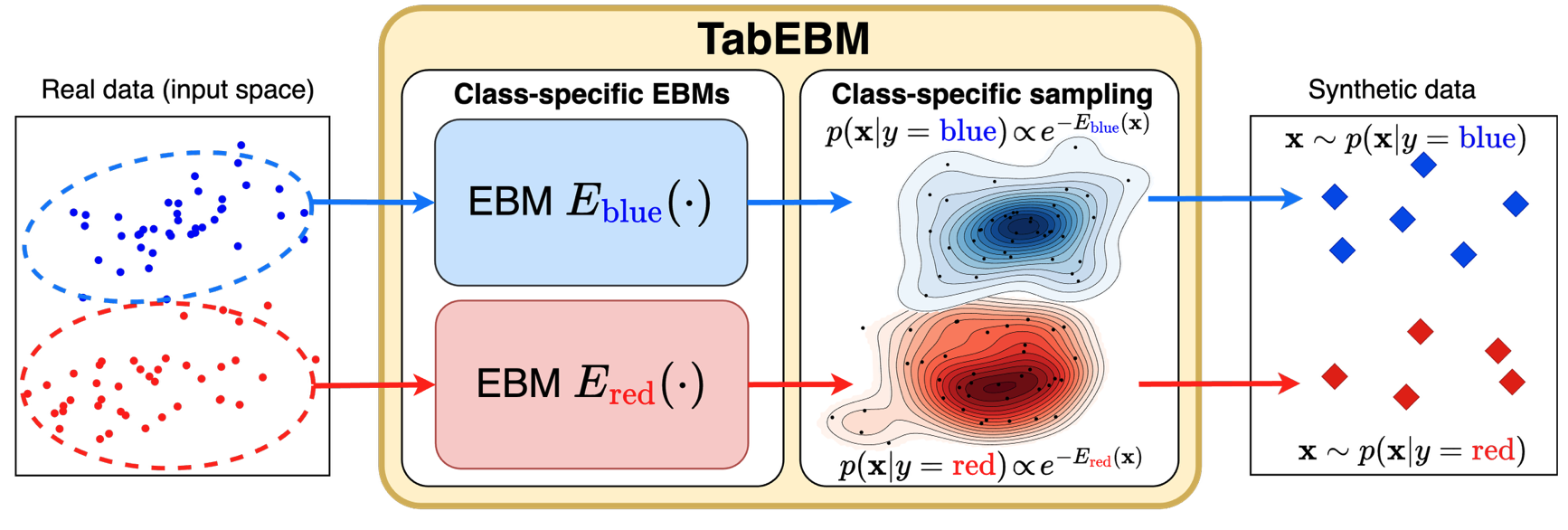
TL;DR: We introduce a high-performance tabular data augmentation method that is fast, requires no additional training, and can be applied to any downstream predictive model. The optimized implementation features advanced caching, GPU acceleration, and memory-efficient SGLD sampling.
Abstract: Data collection is often difficult in critical fields such as medicine, physics, and chemistry. As a result, classification methods usually perform poorly with these small datasets, leading to weak predictive performance. Increasing the training set with additional synthetic data, similar to data augmentation in images, is commonly believed to improve downstream classification performance. However, current tabular generative methods that learn either the joint distribution p(x,y) p(\mathbf{x}, y) or the class-conditional distribution p(x∣y) p(\mathbf{x} \mid y) often overfit on small datasets, resulting in poor-quality synthetic data, usually worsening classification performance compared to using real data alone. To solve these challenges, we introduce TabEBM, a novel class-conditional generative method using Energy-Based Models (EBMs). Unlike existing methods that use a shared model to approximate all class-conditional densities, our key innovation is to create distinct EBM generative models for each class, each modelling its class-specific data distribution individually. This approach creates robust energy landscapes, even in ambiguous class distributions. Our experiments show that TabEBM generates synthetic data with higher quality and better statistical fidelity than existing methods. When used for data augmentation, our synthetic data consistently improves the classification performance across diverse datasets of various sizes, especially small ones.
📖 Citation
For attribution in academic contexts, please cite this work as:
@article{margeloiu2024tabebm,
	title={TabEBM: A Tabular Data Augmentation Method with Distinct Class-Specific Energy-Based Models},
	author={Andrei Margeloiu and Xiangjian Jiang and Nikola Simidjievski and Mateja Jamnik},
	journal={The Thirty-eighth Annual Conference on Neural Information Processing Systems},
	year={2024},
}
🔑 Features
- Optimized TabEBM Implementation: High-performance TabEBM with advanced caching, memory optimizations, and GPU acceleration
- Fast Synthetic Data Generation: Generate synthetic tabular data with minimal configuration and improved speed
- TabPFN-v2 Integration: Seamless integration with the latest TabPFN-v2 for enhanced gradient-based sampling
- Memory-Efficient SGLD: Optimized Stochastic Gradient Langevin Dynamics with pre-computed noise tensors
- Comprehensive Tutorials: Three interactive notebooks covering data generation, real-world augmentation, and density analysis
🔥 Performance Optimizations
- Model Caching: Intelligent caching system to avoid redundant model training across classes
- Vectorized Operations: Optimized tensor operations and reduced device transfers for faster computation
- Stratified Sampling: Smart subsampling for large datasets while maintaining class balance
- Gradient Computation: Enhanced gradient-based sampling with TabPFN-v2's energy landscapes
- Memory Management: Pre-allocated tensors and efficient memory usage patterns
🚀 Installation
Quick Installation (Optimized Version)
pip install tabebm
This installs the latest optimized version with TabPFN-v2 integration, GPU acceleration, and performance enhancements.
To reproduce the results reported in the paper
- Create
condaenvironment
conda create -n tabebm python=3.10.12
conda activate tabebm
- Install tabebm and dependencies
git clone https://github.com/andreimargeloiu/TabEBM
cd TabEBM/
pip install --no-cache-dir -r requirements_paper.txt
pip install .
💥 Running Experiments with TabEBM
⚡ Quick Start
The optimized TabEBM implementation provides a streamlined API for high-performance synthetic data generation:
from tabebm.TabEBM import TabEBM

# Initialize with optimized configuration
tabebm = TabEBM(max_data_size=10000)  # Automatic GPU detection and caching

# Generate synthetic data with enhanced performance
augmented_data = tabebm.generate(
    X_train, y_train,
    num_samples=100,
    sgld_steps=200,    # Optimized SGLD with pre-computed noise
    debug=True         # Monitor optimization progress
)

# Output format: {class_id: numpy.ndarray} for each class
# augmented_data['class_0'] = Generated samples for class 0
# augmented_data['class_1'] = Generated samples for class 1
📚 Interactive Tutorials
-
-
The library can generate synthetic data with three lines of code.
from tabebm.TabEBM import TabEBM

tabebm = TabEBM()
augmented_data = tabebm.generate(X_train, y_train, num_samples=100)

# Output:
# augmented_data[class_id] = numpy.ndarray of generated data for a specific ’’class_id‘‘
-
-
- We provide a click-to-run example of using TabEBM to augment a real-world datasets for improved downstream performance.
-
-
The library allows computation of TabEBM’s energy function and the unnormalised data density.
from tabebm.TabEBM import plot_TabEBM_energy_contour

X, y = circles_dataset(n_samples=300, noise=2)
plot_tabebm_probabilities(X, y, title_prefix='(noise=2)', h=0.2)
plt.show()
-
1 maintainer

Metadata
1 maintainer
Release files for tabebm 2025.8.19
For a detailed explanation of source distributions (sdists) and built distributions (wheels), please see the package formats documentation.
Source distribution (sdist)
| File | Size | Uploaded | |
|---|---|---|---|
| tabebm-2025.8.19.tar.gz | 19.2 kB | Details |
Release files / tabebm-2025.8.19.tar.gz
| Download URL | tabebm-2025.8.19.tar.gz |
|---|---|
| Size | 19.2 kB |
| Tags | Source |
|
SHA-256 checksum How to use checksums |
6111611326747a680f93dfadcbac1d602ce20cb722b9b6cbff1f556b9f48d503
|
|
BLAKE2b-256 checksum How to use checksums |
5d95a6f327ed88907ca68a7e49e65c9bebe3d9f35b3a623e1c8b89b15597c094
|
| Upload date | |
|
Uploaded using Trusted Publishing? What is trusted publishing? |
No |
| Uploaded via |
twine/6.1.0 CPython/3.10.18
|














